Skip to content

Posts from the ‘Rock music’ Category

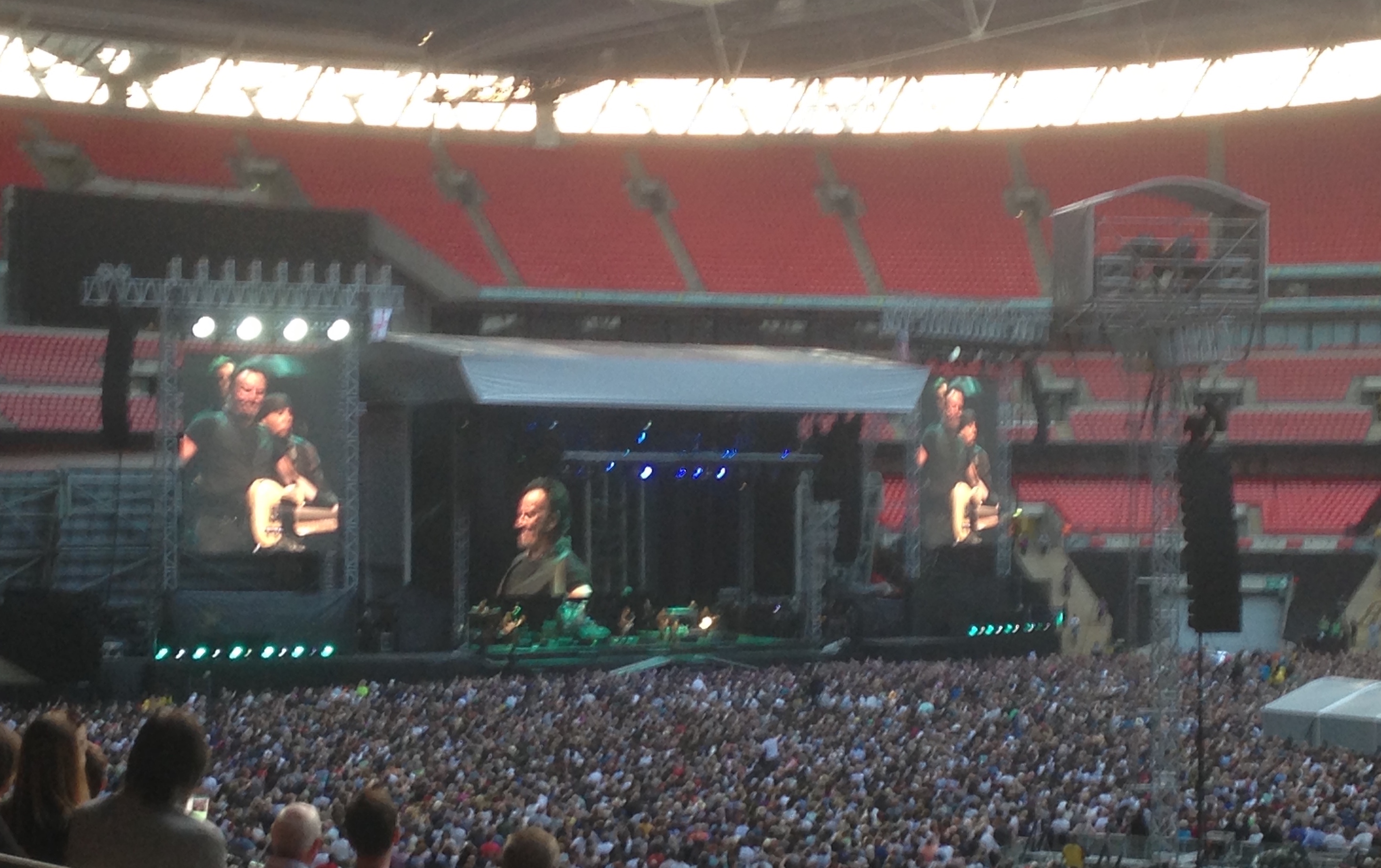
Bruce Springsteen at Wembley

Bruce River Wembley

Is it a fan’s wishful imagination, or does Bruce Springsteen reserve something special for the start of his London shows? I think back, in particular, to the spellbound harmonica and piano introduction to “Thunder Road” in a pin spot at Hammersmith Odeon in 1975 and the cathartic, eyes-closed rush through “Born to Run” at Wembley Arena six years later. Last night at Wembley Stadium it was a wholly unexpected solo-at-the-piano version of “Does This Bus Stop at 82nd Street” from Greetings from Asbury Park, N.J., slowed down, like he did with “For You” in ’75, but still a little trip back to the unshadowed wordspinning joy of youth: “Mary Lou, she found out how to cope / She rides to heaven on a gyroscope / The Daily News asks her for the dope / She says, ‘Man, the dope’s that there’s still hope.'”

If that was one for the fans, so was the next: “Seeds”, which I don’t believe he plays all that often. First the harsh voice against the stripped rockabilly guitar, and then an eruption of full-tilt rock and roll thunder — a thousand guitars, a hundred horns, the shout of a Hammond organ, the implacable backbeat, the measured walk of the bass, all churning on and on and on towards some invisible horizon — that reminds you of exactly what this music can do, in the right hands. And the realism of the lyrics: a man drags his family across the country, searching for work, seeing the homeless men by the railroad track, listening to the children’s “graveyard cough”. And watching the world of other men go by: “Big limousine, shiny and black / You don’t look forward, you don’t look back.”

“Sorry, son, it’s gone, gone, gone,” the job-seeker is told. What hasn’t gone is Springsteen’s magical ability to make an audience both dance and think, sometimes in the same song. Over the next three and a half hours of a wonderfully warm evening there were many more moments of contrast between exhilaration and reflection, from the dedication of “Tougher Than the Rest” (a gorgeous duet with Patti Scialfa) to Muhammad Ali to the fury of “Death to My Hometown”, from “Sherry Darling” to “Candy’s Room”, from “You Can Look (But You Better Not Touch)” to “American Skin (41 Shots)”. That last one resonates even more powerfully than it did when he wrote it in 1999, prompted by the shooting of the unarmed Amadou Diallo, a 23-year-old street peddler from Guinea, by four plain-clothes officers of the New York Police Department who were later acquitted of second-degree murder. Last night he gave it full justice in a sombre, intense reading that was, for me, the centrepiece of the concert.

Billed as a tour revisiting The River, it has become something much less specific and more inclusive, although half a dozen songs from that great 1980 double album studded the set (I was sorry he didn’t include “Wreck on the Highway”, but you can’t have everything). This being an arena, the sound was never going to be more than an approximation, albeit a powerful one, of how he and the E Street Band can sound. The salient bits — the lead vocals, Nils Lofgren’s howling guitar solo on “Because the Night”, Jake Clemons’ invocation of his late uncle on “Jungleland”, Charles Giordano’s keyboard salute to Danny Federici on “Hungry Heart” — were fully audible, of course, but you’d wish that everyone hearing them on this tour could also know their impact in halls of more modest size and human scale — like Hammersmith Odeon, to which he returned with the Seeger Sessions show a few years ago — where giant screens are not required and the musical nuances of which they’re capable might be fully explored.

Still, one thing a Springsteen show never lacks is a sense of intimacy. And as it had begun, so it ended: Bruce alone with the audience, strapping on an acoustic guitar to summon our collective history with “Thunder Road”, just as he did on his last visit three years ago but somehow different and still the perfect closure to yet another night invested with so much emotion that every song had the weight of an encore.

Brian Eno: The Ship

Brian Eno The ShipSomewhere in West London, there is said to be a dealer in second-hand hi-fi equipment whose face lights up every time Brian Eno walks in. Eno’s interest in speakers of all types and sizes was on show this morning in his Notting Hill studio, where a small audience gathered to listen to a 15-channel 3D mix of his new album, The Ship. After the playback, I took the photograph above in order to give a partial sense of the configuration.

Originally commissioned by a gallery in Stockholm, The Ship has also been seen in Barcelona and Geneva in a larger audio-visual form which enables Eno to describe the installation as “songs you can walk around in”. When plans to install it at Somerset House fell apart, Eno decided to present this stripped-down version privately on his own premises, but there are still hopes of a full public treatment in London in the near future. I hope that happens, because to sit in the middle of it — with the sounds coming from all angles and heights, distributed by Eno and his collaborator, Peter Chilvers, according to the individual speakers’ inherent characteristics — was a very worthwhile experience.

This, Eno says, is his First World War album, treating the sinking of the Titanic in 1912 as a prelude to the slaughter that began on the Western Front two years later. To paraphrase him, its subjects are the relationship between hubris and paranoia, and the way the oceans and the land persist while “we pass in a cloud of chatter”. I had no idea of the theme before I sat down to listen, but I couldn’t miss the sense of a threnody running through the two pieces making up the album: “The Ship” itself, 21 minutes long, and a 26-minute suite in three parts called “Fickle Sun”, in which voices and lyrics are allowed to drift in a sea of sounds largely familiar from Eno’s adventures in ambient music.

At first, listening to the slow electronic washes and bleeps and the dislocated recitative of “The Ship”, and noting a tolling bell, I wondered if this was his elegant way of saying goodbye to his friend David Bowie. Wrong there, apparently. But a lovely piece nonetheless, its overlapping layers of synthetic sounds and occasional choirs of distant shadow-voices gradually building a mood of subdued disquiet.

“Fickle Sun” begins with tintinnabulation and flutter, soon thickened by a muffled bass-drum and a wandering rubberised bass line. Eno’s sombre, careful delivery of his stately melody reminds me of Nico singing “Frozen Warnings” or “The End” — at least until organ and staccato synth-brass chords intrude with a faint echo of Holst’s “Mars”, raising the tension before the textures thin out again to support a conversation between the double-tracked natural voice and its synthesised sibling. The short second movement features the actor Peter Serafinowicz reading Eno’s poem “The Hour is Thin” against simple acoustic piano figures: “The hour is thin / Trafalgar Square is calm / Birds and cold black dark / The final famine of a wicked sun…” The suite concludes with a gently paced cover of Lou Reed’s “I’m Set Free”, that famous declaration from the Velvets’ third album, with Eno’s lead vocal, sometimes double-tracked or harmonised, floating on the bell-like keyboards of Jon Hopkins, the guitar of Leo Abrahams and the violin and viola of Neil Catchpole.

Placed at the end of the album instead of being located in the middle of side two, as it was in its original incarnation on The Velvet Underground, this deceptively reassuring song seems even more unsettling. Which, at the end of a cycle of pieces dedicated to investigating the eternal interplay of hubris and paranoia, was presumably the intention.

* The Ship is released on April 29 on the Opal label in various CD and vinyl formats. The full audio-visual installation is travelling to Belgrade, Istanbul, Copenhagen, Mantua and Lodz.

Keith Emerson 1944-2016

The NiceKeith Emerson died the other day, aged 71, apparently by his own hand. According to Mari Kawaguchi, his partner of more than 20 years, he had been thrown into a depression by the effect of nerve damage on his ability to play his keyboard instruments, with a series of concerts in prospect. Whatever one’s opinion of Emerson’s work, it is extraordinarily sad that his career should seemingly have ended in that particular form of defeat. Of one thing there was no doubt: his love of music.

I saw him first with the Nice at the Nottingham Boat Club in 1967, when they were a four-piece, with David O’List on guitar, Lee Jackson on bass and Brian Davison on drums. This was before they had made their first record. In a small room, in front of perhaps 100 people, they were exciting and stimulating; there was already a degree of showmanship emanating from Emerson, but not so much as to get in the way of the notes.

Two years later, in October 1969, I went on the road with them, on assignment for the Melody Maker: a three-day trip taking in Newcastle City Hall, the Essen Blues Festival in Germany and the Concertgebouw in Amsterdam. O’List had gone by then, and the remaining three were good company. In Newcastle, greeted by an ecstatic audience, they premiered sections of Emerson’s Five Bridges Suite, written in honour of Jackson’s home town. In Essen they followed Deep Purple and Amon Duul on stage, and were met by a muted reception. In Amsterdam’s beautiful 19th century concert hall the audience was respectfully enthusiastic; I recorded in my notebook that the applause for their version of Tim Hardin’s “Hang on to a Dream” seemed to go on for about five minutes.

This was a time when young British rock musicians, some of them with a grounding in classical music, were starting to stretch themselves in bands such as King Crimson, Soft Machine, Egg, Yes, Caravan and East of Eden. Emerson’s decision to leave the band and form a new trio with Greg Lake and Carl Palmer in 1970 represented a defining moment at which all that bright-eyed enthusiasm and musical adventurousness tipped over into excess. I saw ELP at close quarters during that year’s Isle of Wight Festival, their first large-scale gig, and I thought the whole experience was dreadful. Lake’s insistence on having a Persian rug to stand on while playing was just one of the factors that put them on their way to becoming a primary template for Spinal Tap.

But wind back a little, to a couple of months after I spent that long weekend in the company of the Nice. In December 1969 they played Fillmore West in San Francisco: here’s an audio recording of how they sounded back then. Surprisingly good, I think. When Emerson takes a long Hammond solo on “For Example”, they really hit a groove. The elements of the music are kept in reasonable proportions, with ambition and execution still in balance.

But you can sense where Emerson wanted his music to go, and why he felt he needed a different set of accomplices. To be brutal, Jackson and Davison weren’t cool enough. He needed a couple of guys who could play even faster and on whom long hair and twenty-guinea Anello & Davide stack-heeled snakeskin boots looked as natural as they did on him. For better or worse, he found them.

* The photograph of the Nice shows (clockwise from top): David O’List, Lee Jackson, Binky Davison, Keith Emerson.

John Cale in the round

John Cale RoundhouseThrough his contribution to the first two Velvet Underground albums, John Cale was one of the people who shifted the tectonic plates of popular music in the 20th century. Maybe it was unreasonable to expect more. But I always believed, based on his work with La Monte Young’s Dream Syndicate, the three albums of archive material from 1965-69 released by Table of the Elements a few years ago, his arrangements on Nico’s The Marble Index, his collaboration with Terry Riley on The Church of Anthrax, his instrumental music for the Warhol films Eat and Kiss, and various other pieces of evidence, that he had the potential to go a long way beyond the rock and roll template into which he settled with Vintage ViolenceParis 1919 and their various successors, whatever his occasional flirtations with punkish sedition (such as the line “We could all feel safe/Like Sharon Tate” which so upset the Island Records hierarchy in 1976).

The weird thing about Cale was that so much of his post-Velvets music sounded like the Velvets had never existed, which was why it was so pleasing to hear the way he treated “(I Keep a) Close Watch” at the Roundhouse last night, during his spot in a week-long series called In the Round which has also been featuring Marianne Faithfull, Edwyn Collins, Mulatu Astatke, Scritti Politti and others.

Even if, like many of his songs from the mid-’70s, it sounds as though he never quite got round to completing it, “Close Watch” remains Cale’s most poignantly affecting ballad. It’s perfectly fine when sung straight and solo, as he did with the version included in the excellent Fragments of a Rainy Season, recorded during a 1992 tour and released by Hannibal that same year. But last night he and his three-piece band subjected it to a complete overhaul, stretching its sturdy sinews and ligaments almost to snapping point with an arrangement based on waves and surges of growling, shrieking electronic sound. It was a mighty noise, and it gave the song a devastating impact.

Wearing a conductor’s black tail coat, black T-shirt and jeggings and brown lace-up ankle boots, with his hair dyed silvery blonde in a sort of Small-Faces-circa-Itchycoo Park style, Cale was in relatively genial mood, although he didn’t say much. There was a “Hello, London — good to see you” and an unsatisfactory introduction to his keyboards-player (doubling bass guitar), guitarist and drummer, both of whom doubled on electronic bits and pieces: “This is Nick, this is Dusty, and this is (indecipherable).” Given the attitude with which the three musicians approached arrangements that required not just precision but commitment, and in the absence of any other way for the audience to identify them, he might have done better.

The repertoire in his 100-minute set included “Coral Moon”, “Changes Made”, “Hemingway” and a densely propulsive final pass at Jonathan Richman’s “Pablo Picasso”, a reminder of what a creative rearranger of other people’s classics he can be. But, with the exception of “Close Watch”, it was still mostly generic rock and roll. At 73, and seemingly in good nick, there’s time for him to stretch his capacious intellect and wide range of technical skills in other directions once more. I do wish he would.

Lisa says

Lisa Robinson

Lisa Robinson’s There Goes Gravity — subtitled “A life in rock and roll” — contains photographs of the author with Mick Jagger and Keith Richard, Jimmy Page and Robert Plant, John and Yoko, David Bowie, Lou Reed, Andy Warhol, Ahmet Ertegun, Iggy Pop, Elton John, Michael Jackson, Patti Smith, all of the Ramones, Johnny Rotten, David Johansen and Johnny Thunders, Joe Strummer and Mick Jones, Bono, Eminem, Dr Dre, Jay Z, Smokey Robinson and Berry Gordy Jr, Kanye West, and Lady Gaga. Oh, and John McEnroe. What it doesn’t have is a photograph of Lisa with me. So I thought I’d fix that.

Here we are, caught by the flashbulb of her friend Leee Black Childers, who became the Weegee of the Max’s Kansas City/CBGB set. This picture was taken on July 6, 1972, according to the caption on the back, written in Lisa’s sloping hand. Apparently we’re at a restaurant in New York City called Butler’s, attending — and I can hardly believe I’m writing these words — a press reception for Black Sabbath.

We were, of course, on our way to somewhere else. I was in New York for the relocated Newport Jazz Festival, so we might have been bound for a concert by Ornette Coleman at Lincoln Centre’s Philharmonic Hall (where I think I embarrassed her by leaning over to invite Jerry Wexler and the New York Post writer Al Aronowitz to shut up) or Cecil Taylor at Carnegie Hall. Or we could have been heading off-piste to the St Regis Hotel to hear Mabel Mercer.

When she came to Europe in those days she stayed the Ritz in London and L’Hotel in Paris, and always insisted on changing her allotted room shortly after arrival, as a matter of principle. But New York was the capital of the world, and she was an excellent companion and sometimes guide. Mabel Mercer would have been her idea. Thanks to her, I saw the New York Dolls at the Mercer Arts Centre, Television (with Richard Hell) and Blondie, Talking Heads (then still a three-piece) and the Ramones, all before they had their first recording contracts — and it was she who pointed out Seymour and Linda Stein of Sire Records at a front table at Max’s, moving their lips with word-perfect accuracy to the songs of Talking Heads, whom they were extremely keen to sign.

Like most musicians, she never went to bed before the small hours and got up when civilians were having lunch. She was out every night. She spent hours on the phone and could be a kindred spirit. She loved to gossip but know how to keep a secret, or at least how to share one with care. She was an early adopter and a good interviewer, adept at establishing a lasting rapport, which means the book contains unusually valuable stuff from many of the people with whom she was photographed. And she had a sharp New York wit, often employed to deflate pomposity (her best friend, and the book’s dedicatee, is the social satirist Fran Lebowitz). When the Stones hired her to be their press adviser on their 1975 US tour, she had no scruples about spending a little time on the dark side because she knew that — like her closeness to Page or Reed — it would give her marvellous material.

We lost touch some time before she became a contributing editor to Vanity Fair, where she has written about stars and edited the music issues for the last 15 years. Her very entertaining book came out last year and has just been published in paperback (by Riverhead). It’s good value if you enjoy stories about hanging out with Rick Rubin or Walter Yetnikoff, or anecdotes like the one about lending Jagger a pair of her lace knickers to wear on stage when his own underwear went missing. It’s a form of higher gossip but the less frivolous stuff is always worthwhile, too, because she engages with her subjects and approaches them from shrewdly chosen angles. She doesn’t write much about the music itself: she was an early friend of most of the great American rock critics, but she never wanted to be one. Good for her.

Taking on the British Invasion

Bobby Comstock

Fifty years ago this month, Bobby Comstock’s version of Bo Diddley’s “I’m a Man” was trying and failing to make it into the US and UK charts. It’s interesting to me not just as a favourite record from an almost freakishly fruitful year but as an example of one response to the British Invasion: an American artist copying a British approach to an American idiom.

Born in 1941 in Ithaca, New York, Bobby Comstock is a singer and guitarist who nibbled at the fringe of the Top 50 in 1958 with a lightly rocked-up treatment of “Tennessee Waltz”. It was released on the Triumph label, started by Herb Abramson after his departure from Atlantic Records, and since the 17-year-old Comstock’s early patrons also included Alan Freed and Dick Clark, it’s a little surprising that he didn’t do better. Five years later, having fallen in with the successful publisher Wes Farrell and the songwriting/production team of Bob Feldman, Jerry Goldstein and Richie Gottehrer, he released “Let’s Stomp” on the Lawn label. Despite climbing no higher than No 57, it became a party favourite and was widely covered over the years. Thanks to his association with Feldman, Goldstein and Gottehrer, he also played guitar on the Angels’ wonderful “My Boyfriend’s Back”, a girl-group classic.

“I’m a Man” is something very different and vastly superior: a raw blue-eyed R&B record with a crunching guitar/bass/drum riff, sinister organ, and lashings of echo on Comstock’s very impressive vocal. I don’t know who plays the eight bars of jagged guitar solo — probably Bobby himself — but it’s as impressive as anything Jimmy Page produced in his days as a teenaged session man over on the other side of the Atlantic.

Comstock grew up in the middle of the doo-wop era, and his earliest heroes included Chuck Berry, but I’d guess that “I’m a Man” sounds the way it does because in the summer of 1964 he and his band, the Counts, had supported the Rolling Stones on a handful of East Coast dates, finishing at Carnegie Hall. As he watched the chart-storming English longhairs delivering their interpretations of hard-core R&B songs to audiences in Pittsburgh, Pennsylania and Harrisburg, West Virginia as well as on Seventh Avenue in New York City, he must have felt he’d been given a licence to try it himself.

The single came out on Ascot Records in the US and United Artists in the UK; the copy I bought back then is pictured above. I had a Saturday job in a record shop at the time, and I guess that’s how I first heard it, while checking out the new releases. It certainly didn’t get much, if any, radio play.

Comstock had no more hits but made a good living for the rest of his career as a performer and backing musician — to artists including Chuck Berry and Bo Diddley — on the rock and roll revival shows promoted by Dick Clark and Richard Nader. He’s now living in retirement in Southern California, leaving the rest of us to carry on listening to “I’m a Man”, a highlight of his 24th year.

The first rock critic

author pic by DannyBrightBefore there was Lester Bangs, before there was Robert Christgau, before there was Dave Marsh, before there was even Greil Marcus, there was Richard Goldstein, a man with some claim to having invented the job of rock critic. I began reading Goldstein’s pieces in the Village Voice in 1966, at about the time he started his weekly column, which was titled “Pop Eye”. He was aged 22 and had actually witnessed the Exploding Plastic Inevitable; he wrote about the Velvet Underground in terms that made them sound like the most exciting thing happening that year. Which they turned out to be.

It would be more accurate to use Goldstein’s own scrupulous self-definition: “The first critic to write regularly about rock music in a major publication.” And the Voice was indeed then a major publication, a beatnik broadsheet ready-made for the incoming counterculture.

In Another Little Piece of My Heart, his new memoir of his life in the ’60s, he mentions that there is some dispute about whether he was actually the first. “A small magazine called Crawdaddy, which featured serious essays on rock, appeared a few months before my column began,” he writes. “If any of its writers want to claim that they got there first, I say, Go for it, dude! (And I’m sure you’re a dude.)”

I didn’t agree with everything he wrote. (In particular, he seemed rather too keen on the early work of the Bee Gees.) But I found myself in agreement with his provocative review of Sgt Pepper, in which he attracted scorn by claiming that the album represented a fall from the pinnacle represented by Rubber Soul and Revolver. Now he says that he has recanted. I haven’t.

His book is an entertaining account of growing up in a time of discovery. An unprepossessing (by his own account) kid from the Bronx, a seemingly unexceptional student at Columbia University’s graduate school of journalism, he found his way into the Voice, into Clay Felker’s trend-setting New York magazine, into the New York Times (whose editors censored his mention of Diana Ross farting during their encounter), and into many other publications.

It is a very ’60s story. He has extremely interesting things to say about Mailer, McLuhan, Marcuse and the Maharishi, about Janis and Jim, about Sontag and Spector (he attended the “River Deep — Mountain High” sessions), about William Burroughs and Brian Wilson. Jimi Hendrix’s flaming guitar narrowly missed his head at the Monterey pop festival (it was caught, he says, by Robert Christgau, his eventual successor at the Voice). The Velvets played at his wedding, MC’d by Murray the K at the Cheetah discotheque (a week later there was a proper Jewish ceremony, for his parents’ benefit).

He went to San Francisco to cover the Summer of Love with high hopes of witnessing the emergence of a new society, and has vivid memories of the disillusionment: “…the love-in lasted until it became apparent that the kids wandering around stoned and senseless were so many sitting ducks. Dope dealers and bruisers looking for sex descended on them, resulting in rapes and an influx of heroin. It was presented by the media as proof that the land of commodification was the only safe place; beyond lay dragons. It took less than a year for the festival to turn ugly.”

Those who chronicled the scene at the time will recognise his description of the business world’s swift adaptation to the new reality: “By 1967 the music industry had mastered the art of appealing to writers like me. Record executives wore their own version of the hippie look: a requisite Nehru jacket with a discreet string of beads. Publicists would flash a peace sign at the end of a pitch. At the major labels, there were rooms set aside for previews of albums not yet released. I remember being invited to one of those special private concerts. The president of the company, which specialised in rock with vaguely folkie credentials, greeted me personally. He ushered me into a sound-baffled chamber with huge speakers and plush chairs. He pointed to a butterfly-shaped box on the table, and then he left the room. Inside the box was a small pipe and a block of hashish. The music started. I sank into a chair and lit up. It was much harder than payola to resist.”

I haven’t read many first-person accounts of the era that make more responsible and convincing use of hindsight. Goldstein’s revolutionary politics — which extended to his own sexual identity — made him an uneasy observer quite early on. “Try as I might to be faithful to the spirit of the music,” he says, zooming in on the Who’s famous performance at Monterey from a vantage point among the hippie royalty in the VIP enclosure, “there was always something to remind me of the gap between authenticity and artifice that was such a central issue for me during the sixties. Rock, for all its power to stir and subvert, to shake and rattle the establishment, was also show business.”

Attracted to the world of Sontag, who encouraged but also patronised him, he writes: “I watched uneasily as intellectuals descended on radical culture and politics like tourists from the developed world. They were enchanted by what should have made them sceptical, and since they generally lived safe lives they were quite susceptible to the thrill of chaos.” The best thing about the ’60s, he says, was “the willingness to try nearly anything that hadn’t been tried before. It was a truly stimulating strategy, because it allowed young people to imagine the future in practically limitless terms. But it placed all our impulses on an equal footing, suppressing our ability to think and behave strategically.”

Goldstein was a believer in the revolutionary potential of art, and rock music turned out not to be quite the agent of revolution that he wanted it to be. His internal struggle reached the point at which “there was no way to justify remaining outside the battle.” The turning-point came when he went to Chicago in August 1968 to cover the protests at the Democratic Party convention and finally gave up the pretence of journalistic objectivity. In the face-off between the protesters and the police in Lincoln Park, he experienced his epiphany: “The moment when I removed my press pass was the instant when I crossed over from the regretful life of the protected to the thrilling zone of risk. Everyone here had seen, if not shed, blood. They were the hardcore, and I was finally among them.”

If his ultimate commitment to the music was not as deep, or his desire to turn it into a career as single-minded, as some of those who followed him, that makes his account, with its cherishable vignettes and constant self-questioning, all the more readable and thought-provoking.

Richard Goldstein’s Another Little Piece of My Heart: My Life of Rock and Revolution in the ’60s is published by Bloomsbury Circus. The photograph of the author is by Danny Bright.
Bryan Ferry’s dance to the music of time

Bryan Ferry 2Bryan Ferry is doing a rather brave thing with his current tour, which reached the Albert Hall last night and continues around the country for the next three weeks. Unlike most performers of his age, he is trying to give us more than we bargained for.

The show begins with the nine members of the Bryan Ferry Orchestra, the band that created instrumental versions of Roxy Music songs in the style of Jelly Roll Morton, Bix Beiderbecke and Duke Ellington on The Jazz Age and went on to contribute to the soundtrack of Baz Luhrmann’s The Great Gatsby. So we’re presented with a banjo, a bass saxophone, a variety of clarinets, a string bass and a drum kit from a 1920s photograph: but Colin Good, Ferry’s musical director, has such a profound understanding of this form — as do his musicians, notably the trumpeter Enrico Tomasso — that the results go well beyond mere pastiche or novelty.

For some members of the audience, however, it is undoubtedly something of a shock to hear “Avalon”, “Slave to Love”, “The Bogus Man” and “Do the Strand” so radically transformed, and they have to wait until half a dozen pieces have been delivered in this fashion before Ferry himself arrives on stage to sing “The Way You Look Tonight”, joined by his two backing singers. “Reason or Rhyme” also begins in the same idiom, but is transformed by the mid-song arrival of Cherisse Ofosu-Osei, who settles behind a second drum kit, and Oliver Thompson, who plugs in his Gibson Les Paul, heralding a sudden time-shift to the present day.

From that instant the momentum builds, thanks in large part to Ofosu-Osei, who bludgeons her equipment with an unwavering ferocity that would make Paul Thompson, Roxy’s hard-hitting old drummer, sound as though he were playing for tea-drinkers at the Ritz. But Ferry hasn’t stopped taking chances. He’s going to sing what he wants to sing, and what he wants us to hear, and much of the pleasure of the concert is derived from seeing how he and Good marshal their resources to refresh the material, with Martin Wheatley switching from banjo and guitar to mandolin for a delicate “Carrickfergus”, John Sutton adding percussive decoration to Ofuso-Osei’s rolling thunder, and Tomasso and Iain Dixon providing a blast of Dizzy Gillespie and Charlie Parker on “Au Privave” as a prelude to “N.Y.C.” (a song from Ferry’s album Mamouna). And if you have a bass saxophone standing there, why not use it on “Editions of You”?

The set is liberally sprinkled with Dylan songs, including a lovely voice-and-piano treatment of “Don’t Think Twice, It’s All Right”, and there’s a version of “Shame, Shame, Shame” in which the backing singers interpolate a chorus of “Can I Get a Witness”: a witty and appropriate touch that you can’t imagine coming from anyone who didn’t have a real love and first-hand experience of that kind of R&B.

And that’s what I liked most about the concert. It was about the music, not the image. Ferry seems to have adopted Dylan’s view of time, which is that there is no division between the past and the present. On this evidence he seems to be making it work, for us as well as for him.

“Thanks for the song, Mr Knight…”

Frederick KnightThose are the words spoken by Leonard Cohen over the final notes of one of the tracks on his 1992 album, The Future, and they came to mind when I read something Sharon Robinson, Cohen’s songwriting and singing partner for the past three and a half decades, said during the course of an interview in last Saturday’s FT magazine.

The interviewer, Philippe Sands, reminded Robinson that she had joined Cohen’s band in 1979 “as a classically trained pianist (having studied at the California Institute of the Arts) with a serious interest in R&B and soul, the likes of Sam Cooke and Otis Redding”.

Her response was interesting. “He likes to bring that flavour into some of his music,” she said.

It reminded me of a track from The Future, one that has always been among my  favourite Cohen recordings: a cover version of Frederick Knight’s “Be For Real”, a glorious, gospel-drenched deep soul ballad delivered with a very proper sense of how to treat such material: i.e. with the utmost respect.

Cohen doesn’t do many cover versions, and he knew that you don’t mess with a song like “Be For Real”. He used a great Los Angeles rhythm section — Greg Phillinganes on keys, Paul Jackson Jr on guitar, Freddie Washington on bass guitar, James Gadson on drums and Lennie Castro on percussion — and a warm but never overbearing arrangement for backing voices and strings by David Campbell. Everything about it, including the dead-slow tempo, serves the quality of the song.

It had been recorded once before, by Marlena Shaw in 1976 on a Blue Note album called Just a Matter of Time. Produced by Bert DeCoteaux and Tony Silvester, Shaw’s version is pretty good, although she twists the melody more than necessary in her efforts to be expressive. In 1996, unaccountably, it was absolutely murdered by the Afghan Whigs as part of the soundtrack to Ted Demme’s Beautiful Girls, otherwise one of my favourite films. (It’s here, but I wouldn’t listen to it if I were you.) This is a song that is best left to sing itself, as I discovered when I heard Knight’s original demo a few years ago.

The composer’s version is hidden away on a four-CD compilation, not for sale to the general public, called East Memphis Music: The Hits, compiled and circulated inside the business in 1988 by the Stax publishing company’s then licensees, Irving Music and Rondor Music. Almost all of the 80 tracks are the well known versions of the songs from which the publishers were trying to extract additional life: Carla Thomas’s “B-A-B-Y”, Otis’s “Dock of the Day”, Sam and Dave’s “Hold On, I’m Coming”, the Staple Singers “Respect Yourself”, and so on.  Frederick Knight’s “Be For Real” is the exception that, from my point of view, makes the whole exercise worthwhile.

You might remember Knight from his days as a Stax artist, a period which yielded his big hit with “I’ve Been Lonely For So Long” in 1972 and the not quite as successful “I Betcha Didn’t Know That” three years later. He was born in Birmingham, Alabama in 1944, and after Stax fell apart his only real claim to fame came when he wrote “Ring My Bell” for Anita Ward in 1979, at the height of the disco boom.

His version of “Be For Real” is clearly a demo, and that’s part of its charm. A piano that hasn’t been tuned lately, a Hammond B3 dialled into a deep church setting, a bass guitar, a drummer who seems to have left everything except his basic snare and kick drum combo at home, and falsetto backing vocals that could well be Knight himself overdubbed a handful of times, every voice and instrument performing — and recorded — with the maximum of restraint and no tricks: that’s all it takes to render the classic version of this glorious, timeless song.

I’m sorry I can’t give a link to it. As far as I know (and I hope someone will pop up to prove me wrong), it has never been commercially available. It’s not on either of the two Knight albums that go for exotic prices on Amazon. But there’s a copy of East Memphis Music: The Hits for sale here at http://www.discogs.com at what seems to me to be a reasonable price; if I were you, I wouldn’t hesitate, even if the package as a whole contains dozens of tracks you already possess. And if anyone reading this is in a position to put forward material for Aretha Franklin’s next album, then her version, appropriately produced, is the only one I can think of that might live on equal terms with the original.