Skip to content

Posts from the ‘Jazz’ Category

‘Rhapsody in Blue’ at 100

The first public performance of George Gershwin’s “Rhapsody in Blue” was given 100 years ago this week, on 12 February 1924, at the Aeolian Hall on West 43rd Street in New York City, by Paul Whiteman and his Concert Orchestra, with Gershwin himself at the piano. Whiteman had commissioned the piece from its composer specially for the evening, which was billed as ‘An Experiment in Modern Music’.

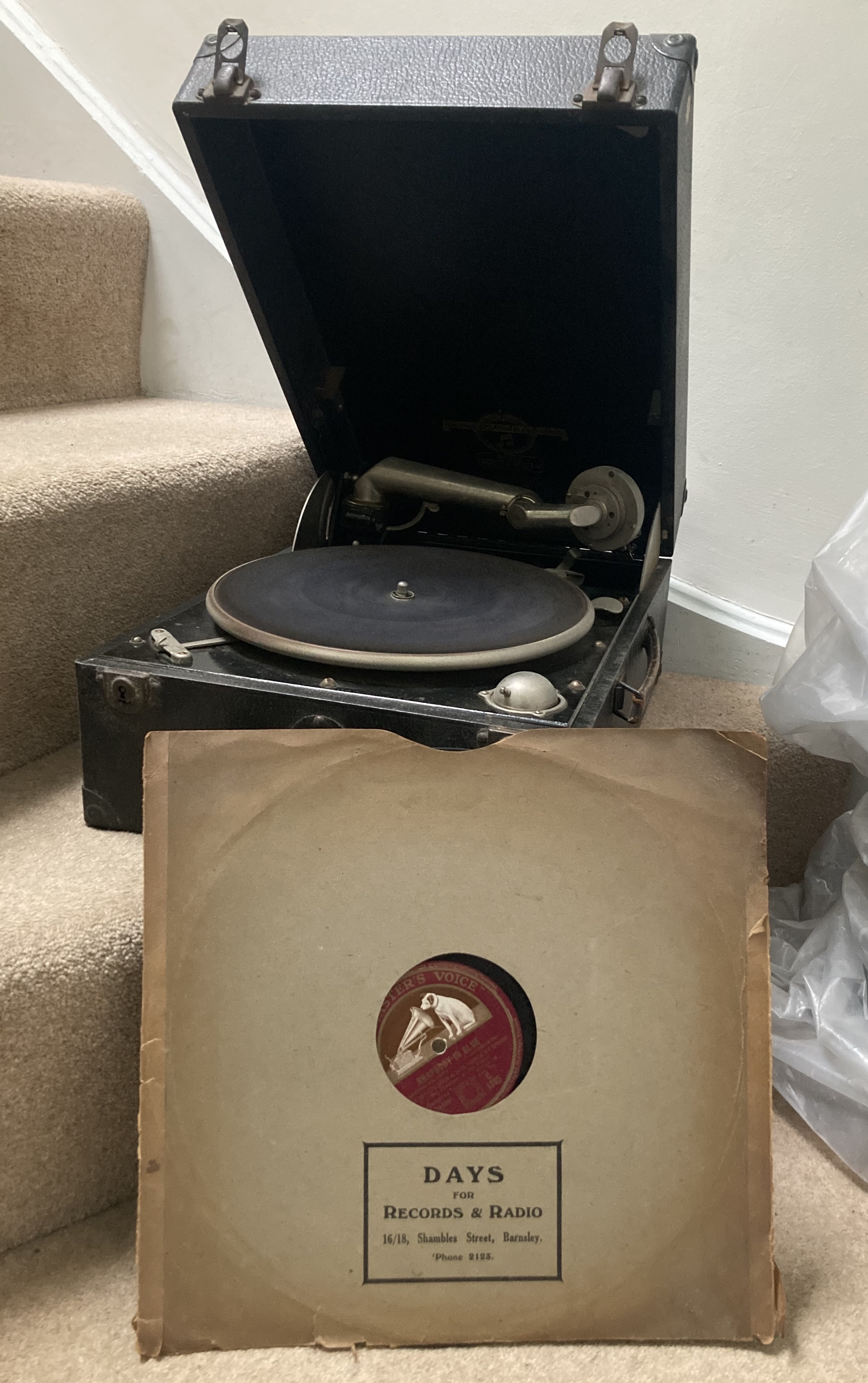
I first heard “Rhapsody in Blue” in childhood, played by the same Whiteman/Gershwin combination, on the 12-inch 78rpm record you see above, which my mother would have bought from a record shop in Barnsley, South Yorkshire, in the 1930s. Nine minutes long, it’s split over both sides of the disc. The gramophone — a Columbia Viva-Tonal Grafonola — is the one on which she played it, along with her other 78s.

To mark the centenary, the pianist Ethan Iverson started a lively debate the other day with a piece for the New York Times in which he examined the artistic impact, then and now, of what he called “a naive and corny” attempt to blend the superficial characteristics of jazz with European classical music. If “Rhapsody in Blue” is a masterpiece, he wrote, it’s surely “the worst masterpiece”: an uncomfortable compromise that blocked off the progress of what would later be called the Third Stream, and with which we are both “blessed and stuck”.

Thanks to my mother’s influence, I view it from a slightly different angle. For me, in childhood, it became a gateway drug. I loved the spectacular clarinet introduction, and the shifting melodies and the hints of syncopation, but more than anything I responded to the tonality that reflected its title, expressed in the exotic flattened thirds and sevenths of the blues scale.

It didn’t take very long before I was following a path that led to Louis Armstrong, Duke Ellington, Charlie Parker, Thelonious Monk, Miles Davis, Charles Mingus, John Coltrane, Ornette Coleman and Cecil Taylor, right up to the Vijay Iyers, Matana Robertses and Tyshawn Soreys of today’s jazz. Pretty soon I’d worked out that an ounce of Ellington was worth a ton of Gershwin’s instrumental music*, but I retain a respectful gratitude to “Rhapsody in Blue” and its role as a gateway, just as I do to The Glenn Miller Story and “Take Five”.

A few weeks after the world première Gershwin’s piece, F. Scott Fitzgerald and his young family would set off for France, where he spent the summer knocking the early draft of his third novel into shape. When The Great Gatsby was published the following April, it contained a vivid scene in which the society guests at one of Jay Gatsby’s Long Island parties were entertained by a band described by the author as “no thin five-piece affair, but a whole pitful of oboes and trombones and saxophones and viols and cornets and piccolos, and high and low drums.”

The bandleader — who is unnamed, but it’s easy to imagine him as Paul Whiteman, with his tuxedo, bow-tie and little moustache — makes an announcement. “At the request of Mr Gatsby,” he says, “we are going to play for you Mr Vladimir Tostoff’s latest work, which attracted so much attention at Carnegie Hall last May.” The piece is known, he adds, as “Vladimir Tostoff’s Jazz History of the World”. I’ve always idly wondered what it would sound like, but I imagine Mr George Gershwin’s “Rhapsody in Blue”, with its bustling bass saxophone eruptions and flamboyantly choked cymbal splashes, is as close as we’ll get.

* A few people have picked me up on this statement, and I tend to agree with them. I was trying to make a specific point, rather clumsily. George Gershwin was a genius songwriter, as any fule kno.

At Peggy’s Skylight

Some jazz clubs are intimidating to the first-time visitor, and maybe that’s how they’re supposed to be. Not all of them, though. I’d been meaning to visit Peggy’s Skylight in Nottingham for ages, and on Saturday afternoon I walked in there for the first time and felt right at home.

A Saturday afternoon might seem an odd time to visit a jazz club. But I’d just got off the train from London, with a couple of hours to spare in my old home town before the start of the football match I’d come up to see, so I walked from the station to George Street, just off Hockley, a narrow but always busy street on the edge of the historic Lace Market.

Peggy’s Skylight occupies the double-frontage of a nice old building. The club was opened in 2018 by Rachel Foster and Paul Deats, and it’s named after Charles Mingus’s “Peggy’s Blue Skylight”; you can see a visual reference above the bandstand in the photo. The Mingus track was recorded in 1961 and featured Roland Kirk, who in 1964 played a concert one street away from where Peggy’s now stands, at the Co-operative Arts Centre on Broad Street (I wrote about it here and here).

On Saturday afternoons Peggy’s has an Unplugged session, with free admission. Deats was playing piano when I walked in. He was sharing the stage with a seriously good local tenor saxophonist, Ben Martin, and they were playing “My One and Only Love”, one of my favourite ballads. The room was full, and I was lucky that they could find me a seat. People of several generations were eating, drinking, chatting and occasionally checking their phones while Martin and Deats produced accomplished, unflashy, nicely proportioned duets that were soon putting me in mind of how Hank Mobley and Tommy Flanagan might have sounded together.

At this session, the music had a different vibe. It was part of a social setting, absorbed in a way that didn’t devalue it at all. If you wanted to listen to as good version of “Alone Together” as you’re likely to find this side of Jo Stafford, or a lively “On the Sunny Side of the Street”, you could do happily do so, joining the warm applause at the end of each tune. But the voices from the tables around you were part of the environment. It wasn’t like that oaf guffawing for posterity over Scott LaFaro’s final notes on the Bill Evans Trio’s sublime version of “Milestones” at the Village Vanguard in 1961. Here, the ambient sounds were perfectly natural and unobtrusive.

Normally I don’t like eating while I listen to music, and I’m not much interested in food anyway. But I was hungry and it seemed fine to enjoy an excellent pan of eggs with harissa while keeping my ears open. (Deats is also a chef, and Peggy’s menu has a North African and Middle Eastern tilt.)

Last year the club’s partners were required to resist plans to sell the building by the local council, which owns the freehold and has recently become one of several around England to announce its own bankruptcy. The day before I walked in had brought news the reduction of the city’s entire culture budget to zero. Nottingham Playhouse, opened with great pride 60 years ago almost to the month and whose artistic directors included John Neville and Richard Eyre, will see its council subsidy, which stood at an annual £430,000 a decade ago, reduced from last year’s £60,000 to £0.

This is mostly due, of course, to the severe reduction, during 14 years of Tory misrule, in the government funding on which local authorities depend. The present generation of Conservative Party politicians seems to regard the arts as something that might open minds and encourage independent thought, and therefore to be stamped on.

On the train from London I’d been reading a depressing piece in the FT about the boom in giant high-tech music arenas — the sort of place where you might go to see Taylor Swift or U2 — being built around the country, paralleled by a crisis affecting small-scale venues, almost one in six of which closed or stopped scheduling music during 2023. That made a first visit to Peggy’s Skylight seem even more precious.

* The very nice new album by the guitarist John Etheridge and his organ trio was recorded live at Peggy’s Skylight. It’s called Blue Spirits, it’s on the DYAD label and appropriately enough it concludes with Etheridge’s solo treatment of a favourite Mingus tune, “Goodbye Pork Pie Hat”. Forthcoming attractions at the club include the saxophonist Tony Kofi and the trombonist Dennis Rollins. Full programme: peggysskylight.co.uk

Son of a drum

Vinnie Sperrazza grew up in Utica, New York as the son and great-grandson of drummers. He’s played the drums all his life, while thinking about drums and drumming and drummers. We’ll get to his own playing in a minute, but what first alerted me to his existence were his Substack posts, which appear under the heading of “Chronicles”. They’re not always about drumming, but they’re always interesting. And the ones that are about drumming contain the most perceptive and eloquent writing about drummers that I’ve ever read.

Sperrazza doesn’t describe the art of a drummer with the kind of literary eloquence with which the New Yorker‘s Whitney Balliett could bring, say, a solo piece by Papa Jo Jones to life on the page. (But then Balliett once claimed that Max Roach didn’t swing.) Sperrazza finds different but equally compelling ways to tell you what a Roach, a Gerald Cleaver, a Billy Hart or an Ed Blackwell is doing, and perhaps why, and certainly how it affects the surrounding music.

When I had a cup of coffee with Sperrazza during in London before Christmas, he was keen to hear my memories of seeing Tony Williams, who is his special subject, and about whom he writes with great insight. I was able to tell him about things he’s too young to have seen for himself, like Lifetime’s gigs at Ungano’s and the Marquee, a later edition of the band in Berlin, VSOP at the Grosvenor House and the Albert Hall, the quartet with Herbie Hancock, Ron Carter and Wynton Marsalis in Nice, and Tony’s own great quintet — the one with Wallace Roney, Bill Pierce and Mulgrew Miller — in Camden.

Most of all, I think he liked me describing the unforgettable experience of listening to Tony tuning his drums during the soundcheck for the gig in the Grosvenor House ballroom, for a gig that, believe it or not, was part of the 1977 Columbia Records international sales convention. That music is still in my ears.

Before we parted, he gave me a copy of Sunday, the third album in 10 years by his quartet, which is called Vinnie Sperrazza Apocryphal and also includes Loren Stillman on soprano and tenor saxophones, Brandon Seabrook on guitar, mandolin and banjo, and Eivind Opsvik on double bass — all great players from the contemporary New York scene. Frankly, I didn’t much mind whether I was going to like it or not, because I admire his writing so much and enjoyed his company. But when I put it on, it had me entranced.

The eight pieces making up the album are intended, he says, to depict “the moods and actions of one man in NYC on a random Sunday.” It’s probably typical of Sperrazza that the opening track doesn’t feature him at all: just Stillman’s affectingly human tenor tone, Seabrook’s pinched harmonics and distortions and Opsvik’s rich arco playing in an enticing prologue full of hints of what’s to come. But then the drums have the second track more or less to themselves, creating a subtly shaded, carefully developed, bombast-free soliloquy that Max or Papa Jo would surely applaud.

All four musicians then come together on a low-down, behind-the-beat groove with a blues feeling given its spice by Seabrook’s spacey and increasingly asymmetrical guitar chords, which fade away to the ticking of Sperrazza’s rimshots. Banjo colours the next piece, a solemn chink above shivering bass and sombre drums, shadowing Stillman’s lyrical ruminations, before Seabrook cuts loose with a jittering, jabbing solo.

And those four pieces are just the half of it. Like them, each of the remaining four creates its own microclimate, exploiting the available resources with a sense of variety and wit. When Stillman switches to soprano, something about the open rhythm reminds me of John Coltrane with Steve Davis and Elvin Jones on Coltrane Plays the Blues. There’s a joyful guitar feature with an 8/8 backbeat, not entirely unlike the early Lifetime. The banjo reappears for a quiet piece that could reasonably be described as giving Americana a good name.

It made me think of The President, Wayne Horvitz’s old band, as does a lot of this album, in its ability to to make sure that every track has its own little story to tell, while presenting music that, without compromising its spirit of inquiry, is extremely easy to like.

* Sunday by Vinnie Sperrazza Apocryphal is on the Loyal Label: https://vinniesperrazzaapocryphal.bandcamp.com/album/sunday His Substack archive is here: https://substack.com/@vinniesperrazza

Semper Max

Max Roach, a vital link in the chain of jazz drummers that stretches from Baby Dodds to Tyshawn Sorey, was born in North Carolina a hundred years ago today, on January 10, 1924. After moving with his family to New York at the age of four, he played the bugle and the drums in gospel ensembles in Brooklyn. He was still a teenager when he depped for Sonny Greer in the Duke Ellington Orchestra. At 21 he played on the Charlie Parker session that produced the eternally breathtaking “Ko Ko”. After that he was on many of Parker’s celebrated recordings, including “Parker’s Mood” in 1948 and the Massey Hall concert in 1953.

Roach was the one who took Kenny Clarke’s proto-bebop drumming to the next stage, freeing the left hand and the right foot from the obligation of symmetry, enabling them to respond to what a soloist was doing in the moment: enhancing, encouraging, propelling, providing a spontaneous commentary. Just what Parker needed.

All that was in my head — along with his presence in Miles Davis’s historic nonet at the Royal Roost in 1948, his subsequent quintets with the trumpeters Clifford Brown and Booker Little in the ’50s, and the sequence of albums including We Insist: Freedom Now Suite and Percussion Bitter Sweet that he recorded during the civil rights era in the ’60s — when I went to interview him in his hotel during the 1971 Montreux Jazz Festival.

By then he was an elder, and that was how he seemed to me: a man of wisdom, elegance and sophistication, with something reserved and almost austere about him, someone who had been through the fires of the creative life and come out having cast aside all non-essentials, with his humanity intact. He talked freely and eloquently, and said many interesting things. But I what I remember chiefly is just the feeling of being in his presence, in a room with the embodiment of so much history.

At Montreux he was playing with a student orchestra, so I asked him about his history with big bands. “The first big band I played with was Dizzy Gillespie’s,” he said, “which had Charlie Parker, Fats Navarro and Miles Davis, who were very young, Freddie Webster, Kenny Dorham — fantastic trumpet section — Dexter Gordon, Gene Ammons, Leo Parker, Bud Powell…”

Then he corrected himself. “No, the first big band I played with was Duke’s. I remember now. That was at the Paramount Theatre in New York. I was still in school and I played with them for four or five days because Sonny Greer got sick. It was during the war and the reason I played with them was Billie Holiday’s brother-in-law, Jimmy Monroe’s brother Clark, whose protégé I was — he made sure I got in the union and he knew all these people, so when he found that Duke Ellington needed a drummer, he called me for it.”

Clark Monroe’s Uptown House, on West 134th Street in Harlem, was one of the cradles of the bop revolution. By 1942, Roach was the house drummer. Parker played there that year, so perhaps it was where they first met. I wish I’d asked him. I wish I’d asked him a whole lot of things.

I did get him to talk about Clifford Brown. “In my music I’m inspired by human values,” he said, “because I believe that human beings are supposed to live together. As artists, we feed on the past. All the things that we hear today are really extensions of things that were laid down by people who came before — and of course I’ve been fortunate enough to have been associated with many, many great musicians. One that was a turning point in my own career was Clifford.

“The association was one that was full not only of friendship and love for each other as human beings but as musicians we both spent as much time as we could involved in music as a craft. I noticed particularly that Clifford was a human being, number one, which I guess was the reason he could get so much beauty out of playing the way he did at such an early age. To sound so mature before he was 25…

“I can say this: during our whole relationship he was a very dedicated musician and an extremely responsible person as a leader, as young as he was. He was almost 24 hours immersed in music, every aspect of it, from the piano to the drums to his trumpet, and the thing we can all learn from that is that the more time you put in sincerely, the more that you will get out of it in a shorter space of time.”

Luckily, Max was granted a longer span. I was fortunate enough to see him play on a handful occasions, notably in New York in 1972 with M’Boom, his percussion ensemble, and at the Bracknell Jazz Festival about 10 years later with his regular quartet. What was striking was how he played with his back straight and shoulders still, most of the work done by his wrists. He was as crisp and precise as any jazz drummer I’ve ever seen, but without forfeiting a sense of surprise or the inner relaxation vital to swing. Carrying the joy and the responsibility of the music’s history, he was everything you’d imagined him to be.

* The image above is grabbed from a BBC recording of the Max Roach quartet with Abbey Lincoln in London in 1964, performing “Triptych: Prayer/Protest/Peace” from We Insist! The Freedom Now Suite. It’s on YouTube.

Dalston rhapsodies

There seemed to be an unusually high percentage of people in a sold-out Vortex last night wearing the sort of minimalist beanie hat long associated with Django Bates, who was there to give a rare solo piano recital. Bates talked about his brothers being present, and a son, so maybe it’s clan thing and they were all family. Anyhow, the rest of us could share a joyful evening in which the seriousness of the music was counterpointed by the impish humour of the 63-year-old pianist and composer.

He began with some new pieces. “A Flurry in the Desert” was a rhapsody in blues in E-flat, followed by “Sophie in Detail”, a rhapsodic ballad, both demonstrating a facility and an imagination in exalted balance. The multi-sectioned “Dancy Dancy” contained a Brazilian-tinged part with a la-la vocal and some lovely right-hand lines near the end that reminded me of Wynton Kelly. “Ballo”, dedicated to the saxophonist Iain Ballamy, his old friend from Loose Tubes days, had the quality common to many of Bates’s compositions, at least when performed solo: even when perfectly formed, they give the illusion of being created from scratch in real time, by spontaneous magic.

“Yard Games” was like that, although pivoting around a three-note figure constantly shifting shape and register. So was the older “For the Nurses”, written before the arrival of Covid, which had its melody doubled by whistling. (“It’s not a sentimental piece,” he said. “It’s not a sentimental profession. I imagine it’s bloody hard work.”) Something called, I think, “The Teachings of Dewey Redman” featured a high-velocity single-note boppish line played by both hands, a couple of octaves apart. The encore was another older piece, “Horses in the Rain”, a meditation on stoicism with a lyric by its original interpreter, the Norwegian singer Sidsel Endresen.

Before that, he’d produced the biggest surprise of the set: a couple of choruses of “Bridge Over Troubled Water” dedicated to “anyone with a weirdly unhealthy obsession with Rwanda”. Taking Larry Knechtel’s piano part from the original S&G recording and adding his own depth, weight, shaded voicings and exquisite timing, it was about as perfect as anything could be.

Sounds from silence

Gerald Clayton, Charles Lloyd and Marvin Sewell at the Barbican 17/11/23

Charles Lloyd’s set with his Ocean Trio at the Barbican on Friday felt like a voyage into the core of jazz. Together they created music full of warmth, humanity, experience and spontaneity, ranging from the gently probing lyricism of Lloyd’s tenor saxophone, flute and tarogato through Marvin Sewell’s stunning essay in Delta blues bottleneck guitar to the brilliant pianist Gerald Clayton’s ability to reinvigorate familiar gospel and Broadway material, enriching it with his own personality.

Lloyd is 85 now, and he wears those years with a hard-won but lightly born combination of wisdom and innocence. This is a man born in Memphis, Tennessee, of African, Cherokee, Mongolian and Irish ancestry, whose employers, friends, collaborators and sidemen have included B. B. King, Howlin’ Wolf, Booker Little, Eric Dolphy, Chico Hamilton, Cannonball Adderley, Keith Jarrett, the Beach Boys, Brad Mehldau, Billy Higgins, Jason Moran, Bill Frisell and Lucinda Williams. Even now, his sense of creative adventure remains undimmed. And what you still feel at one of his concerts, even after he has delivered the benediction concluding with “Om shanti shanti shanti”, is that he can’t bear to stop now.

In one way or another, all music emerges from silence. As part of the 2023 EFG London Jazz Festival, Lloyd’s group was preceded on to the Barbican stage by another trio, that of the tenor saxophonist and composer Mette Henriette Martedatter Rølvåg, whose first album appeared on the ECM label in 2015. On Friday she, the pianist Johan Lindvall and the cellist Judith Hamann played pieces from its follow-up, Drifting, released last year. Maybe none of the company’s releases comes closer than Mette Henriette’s music to the ideal expressed in ECM’s famous early slogan: “The most beautiful sound next to silence.”

This was quiet, patient music constructed from slow lines and careful tonal combinations, but none the less intense for an absence of overt drama. Early in her career, Mette Henriette was being told that she sounded like various prominent free-jazz saxophonists before she had even heard of them, although really she sounds like no one but herself. This was the second time I’ve seen her in concert, and on both occasions she demonstrated through her music as well as her poised presence a marked ability to cast a spell over an audience who may not have known much, if anything, about her in advance.

There was no shortage of drama in the short duo set played by the pianist Pat Thomas and the drummer Tyshawn Sorey at Café Oto on Saturday night: half an hour of relentless dynamic and textural contrasts followed by a spirited encore of “A Night in Tunisia” that lasted barely a minute, so short that it didn’t even reach the middle eight. The intensity with which ideas were investigated and compressed made it seem quite enough to satisfy any listener.

Thomas belongs to the school of jazz pianism that proceeds from Ellington through Monk, Elmo Hope, Herbie Nichols and Andrew Hill, splintering off via Cecil Taylor to Alex von Schlippenbach, Misha Mengelberg and Alexander Hawkins. He’s a player of great intellectual weight but also of emotional power, and his partnership with the extraordinary Sorey produced great dividends.

I once heard Sorey hit a very large gong with unimaginable force and precision, producing a sound of such volume that I feared it was going to bring down the walls of the Haus der Berliner Festspiele. Although some of the climaxes he devised with Thomas were quite ferocious, there was no such threat to the fabric of Café Oto. His command of the dynamic spectrum is such that at one moment, when the dialogue was at its most refined, almost transparent, he spent several seconds waving his wire brushes above his drums and cymbals, striking nothing at all. In the silence, I’ll swear you could hear him playing the air.

Val Wilmer: ‘Blue Moments, Black Sounds’

Val Wilmer is one of the most remarkable people I know, and you’ll know that too if you’ve seen her photographs. Whether it’s Muddy Waters playing cards with Brownie McGhee backstage at the Fairfield Halls in 1964, Archie Shepp sitting beneath a Jimi Hendrix poster in his New York apartment, or a joyful couple whose names we’ll never know at a blues dance in Bentonia, Mississippi half a century ago, she finds the essence of the human spirit.

Those three images are among the several dozen included in Blue Moments, Black Sounds, an exhibition of her photographs which opened this week. It’s on until the end of November at a very nice little gallery in Queen’s Park, North London, which specialises in music photography and where you can also go to get your own pictures framed.

I was particularly moved by the only photograph in the show that has an extended caption, written by Wilmer, in which she tells of going to see Louis Armstrong at Earl’s Court in 1956, when she was a 14-year-old schoolgirl. When Armstrong and the All Stars left the country, catching a plane to Ghana, she and her brother went to see them off at the airport. She took her mother’s Box Brownie camera, asked Louis if she could take his photograph, and got a lovely shot that put her, as she says, “on my way to a lifetime of learning.”

Then she adds something interesting and important: “Through getting to know the musicians, I learnt the importance of positive representation.” That doesn’t mean she learnt how to take PR photographs. It means she learnt to appreciate the importance of immersing herself in the world of her subjects, in order to portray them with greater sensitivity to their lives and to the art that came from it, and to realise that pictures of Ornette Coleman playing pool with Anthony Braxton or members of the Count Basie orchestra snoozing on the band bus can actually tell us more than photos of them on stage.

Those photographs, like most of the ones in the new show, could only have been taken by someone possessing not just painstakingly acquired technical skills but a deep sympathy with the music and the lives of those who make it, and with the courage and humility to take her own place in their world, and to find her unique vantage point.

* Val Wilmer’s Blue Moments, Black Sounds is at the WWW (Worldly, Wicked & Wise) Gallery, 81 Salusbury Road, London NW6 6NH until 30 November: wwwgallery@yahoo.com. Deep Blues 1960-1988, a pamphlet of Wilmer’s photographs from the world of the blues, edited by Craig Atkinson, has just been published by Café Royal Books: caferoyalbooks.com. Wilmer’s As Serious As Your Life: Black Music and the Free Jazz Revolution 1957-1977 is published by Serpent’s Tail.

Sylvie Courvoisier x 2

Sylvie Courvoisier and Mary Halvorson at Café Oto 30 October 2023

One way and another, Sylvie Courvoiser’s new album, Chimaera, contains the most sheerly beautiful music I’ve heard this year. Inspired by the paintings and drawings of Odilon Redon (1840-1916), these pieces recall the words of the French artist about his own work: “They place us, as does music, in the ambiguous realm of the undetermined.” Without getting remotely literal about it, Courvoisier finds ways of creating a music parallel to such works as “Partout des prunelles flamboient (Everywhere eyeballs are ablaze)” and “Le pavout rouge (The red poppy)”, summoning dream-like textures that swirl and mingle, float and evaporate, creating pictures of their own.

Courvoisier, the Swiss-born pianist and composer, has lived in Brooklyn for the past 25 years, becoming an important figure in the New York downtown scene. Her band for the new album unites her partners in her regular trio, the bassist Drew Gress and the drummer and vibraphone-player Kenny Wollesen, with the trumpeters Wadada Leo Smith and Nate Wooley and the Austrian guitarist Christian Fennesz, who brings along his array of electronic tools. The broad palette of instrumental colours is used with immense care and subtlety, and with a sense of spatial resolution that invites the listener’s engagement.

She was at Café Oto in London last night with another regular partner, the guitarist Mary Halvorson, to present music based on their most recent album together, Searching for the Disappeared Hour. As piano-guitar duos go, this was neither Bill Evans with Jim Hall nor Cecil Taylor with Derek Bailey, although it contained elements of both those rare partnerships: the elegance of detail of the first and the fearless extended vocabularies of the second. This was music characterised by exactitude and generosity, making its own unique world, in which dizzyingly rapid written passages, never gratuitous, opened out into spellbinding improvised solo passages.

* Sylvie Courvoisier’s Chimaera is on the Intakt label. Couvoisier and Mary Halvorson’s Searching for the Disappeared Hour is on Pyroclastic Records.

Our Island Story

To those who found Chris Blackwell’s 2022 autobiography, The Islander, long on charm but, shall we say, short on detail, The Island Book of Records Vol 1 1959-68 will be the answer to their prayers. Here is the story of the UK’s most charismatic independent label during its formative years, in which the foundations were laid for the company that would later become the home of King Crimson and ELP, the Wailers and Bob Marley, Roxy Music, Bryan Ferry and Brian Eno, Sandy Denny, Sparks, John Martyn, U2 and Grace Jones before Blackwell sold it to Polygram in 1989.

Comprehensively compiled and meticulously edited by Neil Storey, who worked in the label’s press office (and was more recently responsible for the Hidden Masters archive box sets devoted to Chris Wood and Jess Roden), the book’s large square format — handsomely designed by Jayne Gould — enables LP covers to be reproduced at their original size. The scale also allows the enormous amount of information to breathe amid the mass of photographs, press cuttings, record labels and other paraphernalia and ephemera, plus masses of oral history from figures both famous and unknown to the general public but significant to the way the label was run, all deployed to inform and entertain.

After Storey’s discursive and amusing introduction, it begins by describing Blackwell’s origins in Jamaica and the UK, including a Daily Mirror clipping from 1933 showing a picture of his mother on her way to Buckingham Palace be presented as a debutante to King George V and Queen Mary, and his own Harrow School house photo from 1954. Island’s first release, the cocktail pianist Lance Haywood’s At the Half Moon Hotel, Montego Bay, from 1959, is accompanied by quotes from Blackwell, the guitarist Ernest Ranglin, the drummer Clarence “Tootsie” Bear, and the daughter of the hotel’s director, who invited Blackwell — then a water-ski instructor — to listen to the trio performing in the lounge, an encounter on which history hinged.

That’s the degree of depth the reader can expect, whether the subject is Jackie Edwards, Millie Small, Traffic, Jimmy Cliff, Spooky Tooth and the nascent Fairport Convention or the American artists — Ike & Tina Turner, James Brown, Inez & Charlie Foxx, J. B. Lenoir, Billy Preston, Jimmy McGriff, the pre-Spector Righteous Brothers and Huey “Piano” Smith — released on the Sue label by Guy Stevens, the DJ at the Scene club in Ham Yard whose vision was recognised and given free rein by Blackwell, to the lasting benefit of me and many other ’60s teenagers.

The more obscure bands — Wynder K. Frog, Art, Nirvana, the Spontaneous Music Ensemble — are covered in full, as are the projects undertaken to pay the bills while providing a laugh along the way: That Affair (about the Christine Keeler scandal), Music to Strip By (with a lace G-string stuck on to the cover), For Adults Only (comedy) and Big Theo (Johnson)’s Bawdy British Ballads. The company’s first gold disc was apparently secured by Why Was He Born So Beautiful by the Jock Strapp Ensemble, the first of several volumes of rugby songs, at least one of which was recorded at Sound Techniques by the engineer John Wood, who would later record Nick Drake and the other Witchseason artists at the same Chelsea studio.

The making of all these is illuminated by the people who were there, not just the artists but those who were playing important roles in the background, whether by working in the Basing Street office — where everyone sat at round tables, erasing a sense of explicit hierarchy — or by going around the country selling the records, or simply by being Blackwell’s friends. How they all made it up as they went along, and how the founder encouraged and allowed it to happen, is an object lesson in human and cultural dynamics.

“I’m not a collector,” Blackwell says. “I was always looking forward.” Island maintained no real-time archive during his era (which, of course, made Storey’s task of research more demanding and almost certainly more entertaining). When I worked in A&R there, in the mid-’70s, someone told me one morning that the Richmond branch of the Blackwell-owned One Stop Records was closing that evening and that the basement contained a cache of the company’s old 45s. They were going to be chucked out and did I want to do something about them? Collectors had better close their eyes at the next bit: I drove straight down there, found boxes and boxes of mint Sue and white-label Island singles from the ’60s, sorted out two of each — one for the company, one for my office — and sent the rest to be melted down. I have no idea what happened to the ones I saved after I left in 1976. Everyone was looking forward, which is the right way to run a record company.

* The Island Book of Records Vol 1 1959-68, edited by Neil Storey, is published by Manchester University Press (£85).

Nina & Monk, etc

If you happen to be in Paris this week, you might wander along to the little bookshop and gallery of Robert Delpire, tucked away on a street beside the church of Saint-Germain-des-Prés, to see a small show of photographs taken by the Baroness Pannonica de Koenigswater.

Nica, as she was known, took snapshots of many great jazz musicians during her encounters with them in the 1950s and ’60s. To them — the pianists Thelonious Monk and Barry Harris in particular, but many others, too — she was a friend, patron and benefactor, which means that her photographs, taken in dressing rooms and hotel rooms and kitchens, have a rare intimacy and candour.

The photo above, of Thelonious Monk and Nina Simone, is one of about a dozen of the original Polaroids framed and mounted on the walls of the gallery. Many more — of Hank Mobley, Sonny Clark, Coleman Hawkins, Oscar Pettiford, Billy Higgins, Paul Chambers and others — are included in a new book called Dans l’oeil de Nica (Through Nica’s Eye).

Her photos have the tonal richness and warmth characteristic of Polaroids. They were also badly stored for decades and are presented as found, many of them in a semi-distressed condition that inevitably enhances their romantic allure.

The new book is a follow-up to Three Wishes, published in English by Abrams Image in 2006, in which Nica’s photos were accompanied by the answers given to her by dozens of musicians when she asked them the question implied in the title. Many of them are very personal, others poignant, viz. Eric Dolphy: “1: To continue playing music all my life. 2: A home and a car in New York. That’s all!”

* The exhibition is at Delpire & Co, 13 Rue de l’Abbaye, Paris 6, until Saturday 28 October (Wed-Sat 12-6pm). Dans l’oeil de Nica is published by Buchet/Chastel (€44). Nica’s remarkable story is well told in The Baroness, a biography by her niece Hannah Rothschild, published by Virago in 2013.