Skip to content

Posts from the ‘Jazz’ Category

Data mining with Maria Schneider

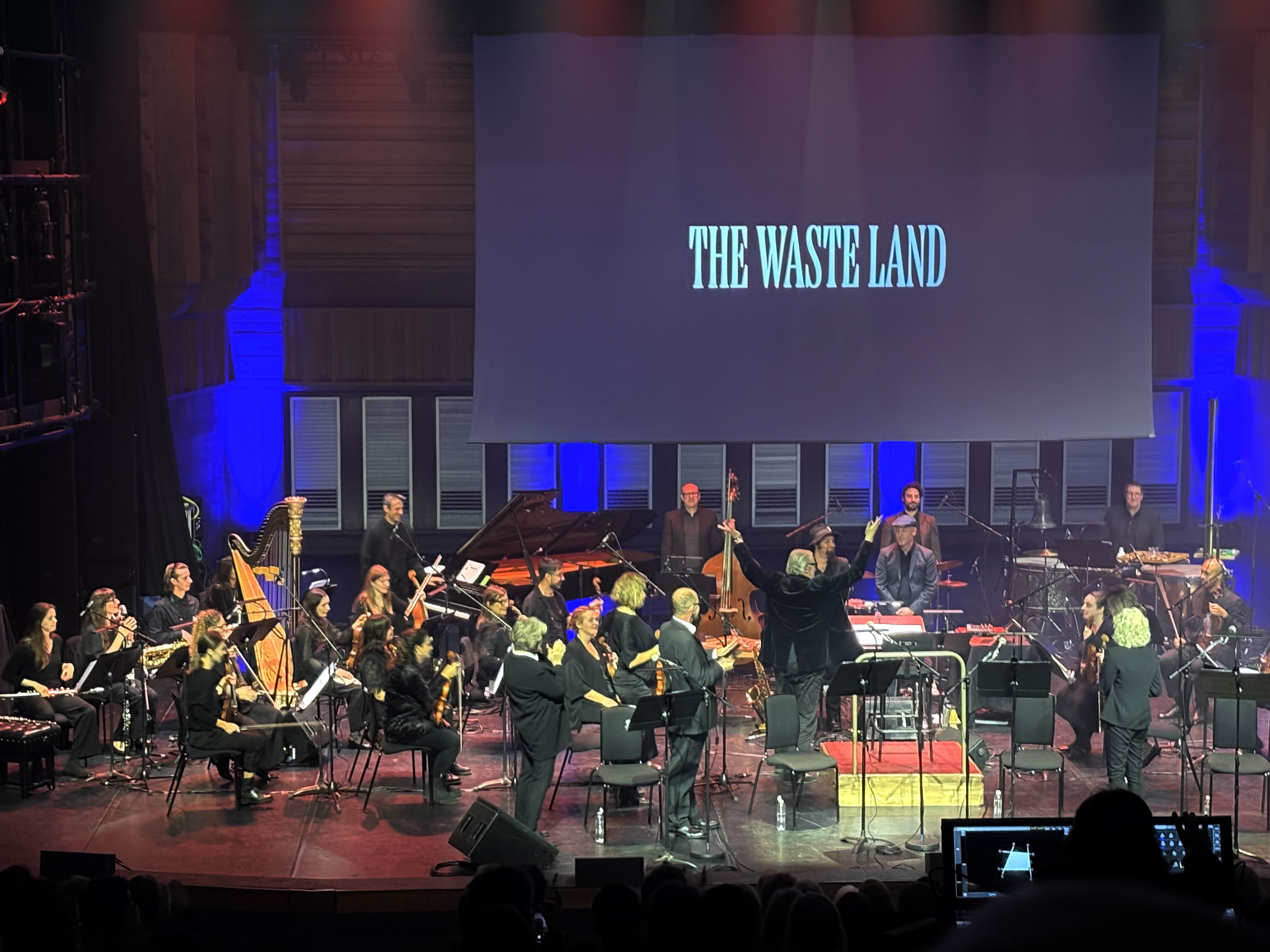
“It’s kind of nightmarish, what’s happening,” Maria Schneider said during her performance with the Oslo Jazz Ensemble at the Barbican last night. She was introducing the title piece from her most recent Grammy-winning double-album. And since 2019, when she wrote and recorded Data Lords, the nightmares have got a whole lot darker.

Half of the album is about the threat to humanity from the people who are scraping and exploiting our data, whether relating to consumer patterns or creative imaginations. In the past six years we’ve all grown more aware of the activities of people like Elon Musk, Peter Thiel, Mark Zuckerberg, Sundar Pichai and Jeff Bezos. More aware, yes, but seemingly powerless (or unwilling) to halt the tightening of their grip.

The contrasting theme of the other half is the importance of the natural world and its phenomena, from birdsong to handmade objects to poetry. Again, it’s necessary only to read the news to appreciate the individually varying but generally increasing levels of threat.

She mixed up the pieces last night, starting with the powerful lyricism of “Bluebird”, its tone set by the accordion of Kalle Moberg. More sardonic and disquieting was “Don’t Be Evil”, which takes its title from Google’s extraordinary instruction to staff. As waves of brass were finessed down to a chamber trio, this was a demonstration of Schneider’s love of dynamic contrast.

Although she spent several early years as Gil Evans’s protégée, Schneider truly belongs to the genre of composer-arrangers who worked for Stan Kenton in the 1950s: people such as Pete Rugolo, Gene Roland and Bob Graettinger, creators of dramatic charts with plenty of space for fine, characterful soloists. In Schneider’s hands, such music doesn’t have the built-in flexibility associated with Fletcher Henderson, Ellington, Basie, Carla Bley, Mike Gibbs or, for that matter, Gil Evans, but its musicality and integrity are impeccable. Maybe Kenny Wheeler’s big-band writing is the closest comparison, but Schneider’s music is imbued with her own personality.

Last night’s selection of pieces was well served not just by the ensemble but by all the soloists, given outstanding support throughout from the supple double bass of Trygve Waldemar Fiske. It was amusing to note that the two women members of the 18-piece ensemble were playing bass trombone and baritone saxophone: between them, Ingrid Utne and Tina Lægrid Olsen were holding up the earth.

Olsen was memorably featured on “Sputnik”, her softly ruminating baritone charged with evoking the innocent wonder once felt by those old enough to remember going outside to see the first satellites (the forerunners of the Starlink system with which Musk can now, should he so wish, control world wars). As she brought her spellbinding solo gently back down from its low orbit, the tone poem closed with one of those tapered endings — a sort of whispered catharsis — in which the composer specialises.

“I don’t want to leave you with the annihilation of humanity,” Schneider said, introducing the encore, the sweet waltz of “Braided Together”, which she prefaced by reading Ted Kooser’s short poem “december 29”: a flicker of candlelight offering hope amid the gathering gloom.

* Maria Schneider’s Data Lords is on the crowdfunded ArtistShare label. I took the photograph above after the performance had ended.

Roberta Flack in London

Roberta Flack, who has died aged 88, made her London debut on July 27, 1972, at an early-evening showcase presented by Atlantic Records before an invited audience of industry and media types at Ronnie Scott’s Club. She’d already released three albums but it was when Clint Eastwood chose to feature a track from the first of them, “The First Time Ever I Saw Your Face”, in his 1971 movie Play Misty For Me that she became a hot property.

I sat with my friend Charlie Gillett and we were both overjoyed to discover that her band included Richard Tee on keyboards, the guitarist Eric Gale and the drummer Bernard “Pretty” Purdie. A real New York studio ‘A’ team, the kind you couldn’t quite believe you were seeing in a London club. They provided the perfect platform for the poise and exquisitely chosen material of a singer who was already, at 35, a mature woman.

Of a beautiful little show, in which she also presented two talented young male singers who were her protégés (and whose names I’m afraid I don’t recall), the highlight for me was “Reverend Lee”, a slice of lubricious lowdown funk written by Eugene McDaniels, to whom she had been introduced by her original patron and mentor, Les McCann. She’d already recorded McDaniels’ “Compared to What” on her debut album, First Take, released the day before before McCann and Eddie Harris cut their hit live version at the Montreux Festival.

I prefer her reading, in which the incendiary lyric of a great protest song is rendered all the more powerful for her restrained delivery. Produced with exemplary sensitivity by Joel Dorn, it features the great Ron Carter on double bass, shortly after he had ended his six-year stint with Miles Davis’s quintet.

“I have chills remembering his virtuosity that first day in the studio in New York,” she told me when I asked her about working with Carter during an interview for Uncut magazine in 2020. “He understood that less is more and the importance of the silence between the notes. He was also humble and open to my musical thoughts and suggestions. Our synergy is what you hear on ‘Compared to What’ and ‘First Time’.”

Like Nina Simone, Flack had begun her musical career in the hope of becoming a classical pianist, but fate took them both in a different direction. Simone carried the sense of having been unjustly thwarted with her throughout her life. I asked Flack if she’d ever felt that way, too.

“Life can be so unpredictable,” she said. “One thing I know is that everything changes. I’ve tried to embrace the twists and turns that life’s changes have brought. I took my classical training and used it as the foundation on which I based my arrangements, my dynamics and ultimately my musical expression. I think if you’re rigid about how you see yourself and if you aren’t open to the changes that life brings you, the resentment will show in your music and can interfere with honest expression.”

I’m listening to First Take while writing this. Whether it’s in the quietly spine-tingling gospel of “I Told Jesus”, the laconic protest soul of “Tryin’ Times” or the sublime sophistication of “Ballad of the Sad Young Men”, honest expression from a great artist is what you get.

* The photograph of Roberta Flack at Ronnie Scott’s in 1972, with Eric Gale (right), was taken by Brian O’Connor. If you want to read more about Ms Flack, you won’t find anything better than this piece by Ann Powers: https://www.npr.org/2020/02/10/804370981/roberta-flack-the-virtuoso

Dave Tomlin 1934-2024

I never met Dave Tomlin, or heard him play live, but the news of his death at the age of 90 rang a bell that echoed back to London in the late 1960s. A Tibetan prayer bell, probably: among other distinctions, Tomlin was the founder of the wonderfully named Giant Sun Trolley, a group who were one of the early attractions, along with Pink Floyd and the Soft Machine, at UFO, the legendary psychedelic club which opened in December 1966 in a Tottenham Court Road basement, where it ran weekly until July 1967.

Originally an army bugler, then a clarinetist with Bob Wallis’s Storyville Jazzmen during the Trad boom, Tomlin switched in the mid-’60s to soprano saxophone, the instrument on which he was featured in the Mike Taylor Quartet, a Coltrane-influenced group led by a strikingly adventurous but troubled British pianist. A recording of a January 1965 gig, with Tony Reeves on bass and Jon Hiseman on drums, emerged under the title Mandala four years ago, supplementing their official release, Pendulum, recorded in October of that year by Denis Preston in his Notting Hill studio.

Taylor’s mental problems, seemingly exacerbated by the prolonged use of LSD, would soon destroy his musical career. According to Ron Rubin, who took over from Reeves as the group’s bassist and played on Pendulum, he was so disturbed that at one point he threatened to kill Tomlin. In January 1969, after a period during which he had been seen busking on the streets with an Arabian clay drum, Taylor’s drowned body was found washed up on an Essex shore, the cause of his death, whether accident or suicide, unexplained.

Tomlin, by contrast, survived the mind-expanding journeys of the time. Glen Sweeney, a jazz drummer when he joined Giant Sun Trolley, met him at the London Free School in 1966 and said in an interview with the archivist Luca Ferrari that he “was known as an ace guy — he’d taken a lot of drugs and dropped out.” Sweeney became Tomlin’s first recruit to Giant Sun Trolley; they were sometimes joined by bassist Roger Bunn (later to become the original Roxy Music guitarist) and a trombonist named Dick Dadem. They split up when Tomlin decided to spend some time in Morocco in 1967, leaving behind no aural evidence of the band’s time together.

Sweeney switched to tablas and formed the Third Ear Band, who became a fixture at underground events. One track of their 1969 debut album for EMI’s Harvest label featured a guest appearance by Tomlin, playing violin on his own composition “Lark Rise”.

Thereafter music seemed to play a smaller role in Tomlin’s life. He was a poet, novelist and memoirist, and between 1976 and 1991 devoted much of his time to the Guild of Transcultural Studies, a community of artists from many disciplines who took informal occupation of London’s unoccupied Cambodian Embassy.

He died three months ago, but I didn’t know about it until one of his sons wrote a short obituary for the Guardian. His death removes another link with the particular Notting Hill microclimate of artistic and social optimism embodied by UFO, the Free School, Blackhill Enterprises, Joe Boyd’s Witchseason and IT. He never became a big name, and probably never wanted to be, but the sound of his soprano saxophone survives on those challenging, sometimes exhilarating Taylor quartet recordings as evidence of a man in his element.

* The Mike Taylor Quartet’s Mandala is a CD on the Jazz in Britain label. Pendulum, originally issued on Columbia, was reissued in 2007 on Sunbeam Records. The Third Ear Band’s three albums were reissued in 2021 in a box set of CDs titled Mosaics by Esoteric/Cherry Red. The photo of Tomlin is taken from Luca Ferrari’s archive: http://www.ghettoraga.blogspot.com

Keyboard studies

Perhaps it was last month’s 50th anniversary of Keith Jarrett’s Köln Concert that got me thinking about solo jazz piano. As it happens, I’d been listening recently to the incomparable Art Tatum, particularly to the unaccompanied pieces from Jewels in the Treasure Box, recorded in 1953 at the Blue Note in Chicago and released last year, and to Paul Bley’s 1972 very different solo classic Open, to Love, now being given a vinyl reissue.

Then Mike Westbrook got in touch to tell me that his four volumes of solo recordings, made in various locations between 2022 and 2024 for private circulation under the title The Piano and Me, were now — thanks to entreaties from several quarters, including this one — available to everyone via download. And, kicking off a three-night season at Cafe Oto, I heard Alexander Hawkins play a half-hour solo set that achieved marvels of modernistic sonic architecture on material that will form part of a forthcoming solo release.

All this solo piano made me wish there was a place in London today similar to Bradley’s, the piano bar that existed in Greenwich Village between 1969 and 1996. A few months after it opened, I saw two significant pianists playing solo there. The first was the bebop veteran Al Haig, whose touch and lucidity made an understated but indelible impression. The second was Dave McKenna, in whose large frame were gathered all the virtues of mainstream jazz pianism. Like Jimmy Rowles and Alan Clare, McKenna seemed to know every standard ever written, and then some. He died in 2008, aged 78. A priceless film of him was made at a private party in 1991.

I love it when a pianist, whether on a concert platform or a railway station concourse, has the time to follow a train of thought wherever it may lead. That’s what I cherish about the Westbrook recitals, which follow on from his previous solo albums: Paris (2017) and Starcross Bridge (2018). He takes the opportunity to wander, but never without purpose. In the fourth volume of the new set, recorded at Ashburton Arts Centre in Devon, he moves seamlessly from his own “View from the Drawbridge” to Monk’s “Jackie-ing” and then John Ireland’s hymn tune “Love Unknown”. In the second volume, recorded at the Pizza Express, “My Way” runs into “Falling in Love Again”, then into “Lover Man”, and then into Billy Strayhorn’s “Blood Count”.

It’s a look inside the mind of a musician who, now in his eighties, finds nourishment in Mingus, Bacharach, Rossini and the Beatles. The pace is steady, the mood reflective. There’s time to explore the melodic byways, the harmonic implications. No Tatum-style technical fireworks, yet the result is mesmerising. And, as with all the music and musicians I’ve mentioned in this piece, it’s a reminder that the piano really is one of humanity’s noblest inventions.

* You’ll find Mike Westbrook’s The Piano and Me here: https://mikewestbrook.bandcamp.com/. Art Tatum’s Jewels in the Treasure Box is on the Resonance label. Paul Bley’s Open, to Love is reissued in ECM’s Luminessence vinyl series. Alexander Hawkins’s new solo album, Song Unconditional, will be out in the spring on Intakt. The photo is a screen-grab from a fine TV documentary on Art Tatum: https://www.youtube.com/watch?v=VXJb14qufe4

Tour de force

As we queued in the Dalston drizzle outside Cafe Oto for last night’s sold-out show by the Tyshawn Sorey Trio, I don’t suppose many of us realised quite the extent to which we were about to enter a better world.

Outside: the return of territorial conquest as a mode of historical change, the revived persecution of minorities, the increasing contrast between private affluence and public squalor, the plight of bankrupt councils trying not to close libraries and other basic services, the destruction of humanities courses in universities, the malign manipulation of such digital-era innovations as AI and cryptocurrency, the exaltation of spite, revenge and mistrust in public life, and the general deprecation of the public good. Inside: playing non-stop, without a break, for two and a quarter hours, Sorey and his colleagues, the bassist Harish Raghavan and the pianist Aaron Diehl, reminding us of what human beings can do, at their very best.

There was too much to describe. This is a group that thinks in long durations, in slow development, in whispers as well as roars. Its three albums (the first two of which had Matt Brewer on bass) fully demonstrated those priorities. In person, however, the effect is more than redoubled, thanks to the brilliance with which they manage the flow and its sometimes radical transitions through nothing more than eye-contact cues, twice managing gradual and beautifully calibrated accelerations that transported the crowd as well as the musicians.

Each player is a virtuoso, a product of intense learning and dedication as well as innate talent. But the machine they build, as with any great group, is superior to the sum of its constituent parts. There were elements of blues and gospel in some of the vast, surging climaxes that drew shouts from the audience, and of ballads and different shades of blues in the passages that flirted with silence. Sorey’s rattling Latin rhythms bounced off the walls; his gossamer shuffle barely disturbed the air. Diehl’s dizzyingly fast upper-register filigree phrases spun with a centripetal force. Raghavan’s assertive agility was balanced by deep thoughtfulness.

Their repertoire avoids original material in favour of extended explorations and dissections of generally lesser known pieces by significant jazz composers: Ahmad Jamal, Duke Ellington, Muhal Richard Abrams, Wayne Shorter, Horace Silver, Brad Mehldau, McCoy Tyner, Harold Mabern. Since the chosen themes are not the obvious ones, and are not identified in performance, the audience listens with fresh ears, unaffected by the comfort of familiarity, open to everything they do.

“See you on the other side,” Sorey had said before the start of the journey. After an hour or so, during a quiet passage, he asked: “Y’all still with us?” Not only were we still with them, both then and at the reluctant end of the performance, but many of us were probably still with them on the journey home and on the morning after, and will be with them for some time to come. An unforgettable night.

* The Tyshawn Sorey Trio’s three albums — Mesmerism, Continuing and The Susceptible Now — are on Pi Recordings, available at tyshawn-sorey@bandcamp.com

** In the original version of this I had a moment of brain fade and wrote “public affluence and private squalor”. Now corrected.

Monday at the Cockpit

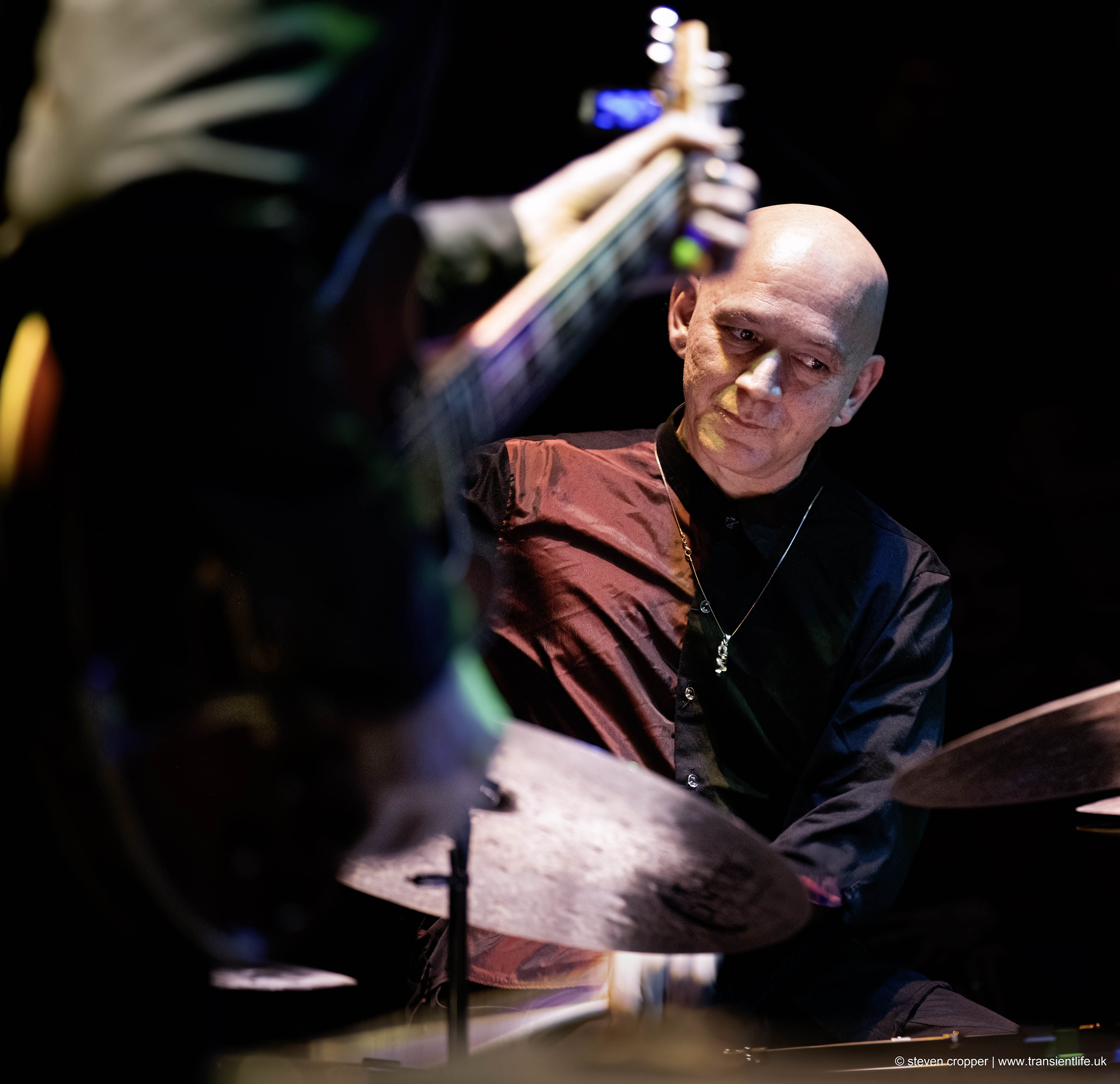
Empirical’s Shaney Forbes at the Cockpit (photo: Steven Cropper)

I was pretty horrified over the new year to see, in the guides to the arts in Britain in 2025 produced by the Guardian and The Times, no mention at all of anything that might be happening in the world of jazz. Both papers have a long tradition of covering the music in an informed way, but that seems to have been set aside by the current generation of arts editors.

It’s more than a pity, particularly at a time when jazz, although its household names have gone, is showing such vitality at all levels, and particularly among a younger generation. That was an unmissable feature of Monday’s Jazz in the Round gig at the Cockpit Theatre, not just among the musicians taking part but in the audience.

Sure, the usual jazz listeners with decades of experience were well represented. But there were also lots of people of student age, a few with instrument cases, settling on the tiered benches surrounding the players on all sides. Some of them were obviously friends of the pianist Emily Tran’s very spirited quintet, featured in the opening slot nowadays reserved for JITR’s Emergence new-talent programme, but they and the other younger listeners in the room effectively reinvigorated the whole ambiance.

After Tran’s group, its front line of alto saxophone and trombone recalling Jackie McLean’s Blue Note albums with Grachan Moncur III, came the Portuguese guitarist Pedro Valasco, 20 years a London resident, building loops and effects with his elaborate pedal board, exploring the sort of territory John Martyn might have entered, given a couple of extra booster rockets. And finally came Empirical, a long-established but perennially creative quartet, with Jonny Mansfield replacing Lewis Wright at the vibraphone.

I’ve said before that Jazz in the Round is my favourite live listening environment, and during Empirical’s set there was a good example of why that might be. It happened while Shaney Forbes was carefully unfolding a drum solo on “Like Lambs”, his own composition, against overlapping rhythm patterns played by Mansfield, altoist Nathaniel Facey and bassist Tom Farmer in what sounded like three different time signatures.

Suddenly Forbes’s concentration was abruptly broken when the bass-drum beater flew off its pedal, landing at the feet of the front row. In many decades of watching drummers, I don’t think I’ve ever seen that happen before. Anyway, the nearest member of the audience was able to lean across and hand it back to the drummer, who quickly refitted it and screwed it up tight while the other three maintained their patterns without disruption, before resuming his train of thought and taking it to a conclusion.

There was, of course, a special roar of applause when the piece ended, but that in itself is not unusual for Empirical. Their music is complex, and sometimes knotty, but they consistently engage their listeners’ emotions in a straightforward way which demands a response. That in itself is quite unusual in this kind of jazz. You could analyse what they do in terms of pacing and projection but there never seems to be anything calculating about it.

They have the spontaneity that is the propellant of jazz and the warmth that is its lubricant, qualities for which Jazz in the Round, programmed and presented by Jez Nelson and Chris Phillips, provides a consistently rewarding environment.

Three in one

It felt like a great privilege to be at Cafe Oto last night to hear the Schlippenbach Trio — Alexander von Schlippenbach (piano), Evan Parker (tenor saxophone) and Paul Lytton (drums) — make a rare appearance in London in front of a capacity crowd. This is a group that has existed since 1972, with one personnel change: Lytton’s arrival some years ago to replace his great friend Paul Lovens, who stopped touring.

At 77, Lytton is the youngster of the group. Parker is 80, Schlippenbach 86. Although their group is one of the enduring monuments of European free jazz, they continue play as though the music is being invented every night — which it is, albeit with its foundations in their vast experience, both individual and collective. Last night’s 50-minute set was a further exploration of the spaces between them: a true conversation of equal voices, merging and separating and merging again with a perfect sense of spontaneous form and balance.

Bird lives, dies, flies

Coming up to the 70th anniversary of his death (on March 12, 1955), Charlie Parker can still stop you in your tracks. His sound may be as familiar as the head on a postage stamp, his style imitated with greater or lesser success by thousands of saxophone players, but that unquenchable inventiveness retains all its singular potency, particularly when caught on the wing.

By that I mean not in a recording studio. I revere the studio classics — the hurtling audacity of “Ko Ko”, the sombre perfection of “Parker’s Mood” — as much as anyone, but Bird really flew highest in more informal or spontaneous environments, when the natural assumption of its evanescence drove his improvising into an extra dimension. That’s what impelled the devoted fan Dean Benedetti to record him in jazz clubs night after night on concealed equipment, and what made the posthumous release of such quasi-bootlegs as Bird at St Nick’s and One Night at Birdland (with Fats Navarro and Bud Powell) so vital to a true appreciation of Parker’s genius.

And now there’s more evidence of the brilliance of the uncaged Parker: an album called Bird in Kansas City, an official release on the Verve label. It’s worthy of a place alongside any of Bird’s output thanks mostly to the seven tracks with which it begins, captured during informal sessions in July 1951 at the house of a friend.

Prevented by the loss of his cabaret card from working in New York after being busted for heroin earlier in the year, Parker was staying with his mother, Addie, in Kansas City, where he had grown up. He played a few gigs at a local nightspot, Tootie’s Mayfair Club, and earned $200 for a stunning guest appearance with the Woody Herman Orchestra at the Municipal Auditorium.

But at the invitation of his friend Phil Baxter, a barber who had a pleasant habit of hosting regular soirées at his house on Kensington Avenue in the city’s Eastside district, Bird could play without pressure of any kind. Accompanied by an unidentified but more than competent bassist and drummer, he displays on these seven pieces the genius that flowed through him even in the most relaxed circumstances.

The first three pieces, each without a formal title, draw on various familiar bebop themes and motifs. The fourth, “Cherokee”, is jet-propelled. “Body and Soul” is taken at its usual ballad pace, slipping gracefully in and out of a double-time section as it proceeds to an ending in which a coruscating single phrase is followed by a particularly arch version of his favourite whimsical coda: a quote from “In an English Country Garden”. “Honeysuckle Rose” and “Perdido” swing at a mellow tempo, just on the bright side of medium, with eye-watering semi-quaver runs in the former leavened by some amusing quotes (“Fascinating Rhythm”, “Cheek to Cheek”).

For 24 minutes on these seven tracks we’re allowed to hear Parker as we became used to hearing Ornette Coleman and sometimes Sonny Rollins: an improvising saxophonist without the support of a chording instrument. It’s not a revelation — nothing conceptually different is happening — but it does allow an unusually clear sight of what he could do.

There are another four tracks recorded seven years earlier at a transcription studio in Kansas City, with two friends: the guitarist Efferge Ware, a useful witness in the first volume of the late Stanley Crouch’s sadly never-to-be-completed Parker biography, and the drummer “Little Phil” Phillips. The songs are standards — “Cherokee”, “My Heart Tells Me”, “I Found a New Baby” and “Body and Soul” — and the difference is remarkable: this is pre-bop music, belonging to the swing era, with bags of composure and fluency, completely charming in its own right while conveying barely a hint of what is to come.

The album’s compilers, Chuck Haddix and Ken Druker, go back even further for the pair of tracks that complete the set. These are two pieces recorded by the Jay McShann Orchestra informally in Kansas City in January 1941, apparently in preparation for a Decca session in Dallas a week or two later. Parker has a rather diffident eight-bar solo to close a loose-limbed “Margie” (see comment below) and a much more expressive full chorus on a smoochy “I’m Getting Sentimental Over You”, in which his tart sound and triple-time flurries must have pinned back the ears of the unwary. As they still do.

Barre Phillips 1934-2024

Barre Phillips, who died in Las Cruces, New Mexico on December 28, aged 90, was a poet of the double bass, a member of a generation of players who, building on the achievements of Jimmy Blanton, Oscar Pettiford, Charles Mingus and Paul Chambers, lifted the instrument to new levels of flexibility and expression.

One of jazz’s great contributions to music has been to extend instrumental vocabularies, a process accelerated by the idiom’s rapid stylistic evolution through the last century. No instrument developed more spectacularly than the bass, and Barre — who was born in San Francisco but lived in Europe between 1968 and 2023 — played a significant role in that process.

His first album of unaccompanied solo improvisations was recorded in London in November 1968 in the church of St James Norlands in Notting Hill. Originally released as Journal Violone in an edition of 500 on the Opus One label, it came my way the following year when it was reissued, again in an edition of 500, as Unaccompanied Barre on the Music Man imprint. I think my copy may have come from the producer Peter Eden.

It was a pioneering effort, and a very striking one. I seem to remember making it the Melody Maker‘s jazz album of the month, which raised a few eyebrows. Entirely solo albums by improvising instrumentalists (other than piano players) weren’t yet a thing. Now look how many there are. Among bassists alone, Barre’s album paved the way for unaccompanied recordings by Gary Peacock, Dave Holland, Barry Guy, William Parker, Henry Grimes, John Edwards and others, including, most recently, Arild Andersen.

Barre made several more albums in the same format, including Call Me When You Get There (1984) and End to End (2018) for the ECM label. That’s where Peacock, Holland and Andersen’s solo efforts also appeared, which is hardly surprising, since the label’s founder, Manfred Eicher, started out as a bassist.

I first heard Barre’s playing on Bob James’s ESP album, Explosions, and Archie Shepp’s On This Night. He came to Europe for the first time in 1964 with George Russell’s sextet and returned later in the decade, staying first in London before eventually making France his home. Evidence of his early collaborations with British or British-based musicians can be found on John Surman’s How Many Clouds Can You See?, Mike Westbrook’s Marching Song, and his two sessions with Chris McGregor’s sextet (Up to Earth) and trio (Our Prayer), all recorded in 1969.

In 1970 he joined Surman and the drummer Stu Martin in The Trio, recording a self-titled debut with the basic combo and Conflagration! with an augmented line-up. Thereafter he played with all kinds of partners, from Derek Bailey to Robin Williamson, and was a regular member of his friend Barry Guy’s London Jazz Composers Orchestra. Two ECM albums with Paul Bley and Evan Parker, Time Will Tell (1995) and Sankt Gerold (2000), are favourites. His last release was ECM’s Face à Face, a duo recording with the electronics of György Kurtág Jr, released in 2022.

He was intense about music and what it meant to create it, as became obvious when I interviewed him in London in 1970.

“I’m interested in the process of making music,” he said. “I’m not really interested in the product at all, because I’ve got enough confidence to know that if I’m into it the product is really going to be OK anyway. That’s my personal reason — to have something to communicate to an audience besides the product. If I can show my process to people, perhaps they can understand themselves a lot better.””

The conventional role of the bass, he said, was of little interest to him.

“That’s product-producing. I’m coming from somewhere were the product was important, and I worked and worked until I could get on stage and produce it. But what’s really important is: how did I get from birth to the product? If I go on to a deeper level where the responses are reflecting off my central nervous system, then I’m living my whole life with every instant. Because you’re living in the process of making the music, and to me the biggest thing I’m playing is my birth.”

* The photograph, by an unknown photographer, is taken from Traces: Fifty Years of Measured Memories, a career summary in the form of an illustrated discography, a DVD, and the only CD reissue of Journal Violone. It was published by Kadima Collective in 2012.

Remaining Intakt

Independent record labels are one of jazz’s indispensible support systems, fuelled by the brave willingness of the enthusiasts who run them to buck the odds. My own early tastes were largely shaped in the 1960s by the work of Alfred Lion and Francis Wolff at Blue Note, Bob Weinstock at Prestige, Dick Bock at Pacific Jazz, Lester Koenig at Contemporary and Orrin Keepnews at Riverside. It’s now more than 50 years since Manfred Eicher reimagined what an independent jazz label could be in terms of focus, identity and appeal, and today we have International Anthem, Pi, Rune Grammofon, Hubro, ACT and others swimming lustily against the current.

And there’s the outstanding Intakt Records, founded in 1984 by Patrik Landolt, who stepped back in 2021 after 37 years of producing records and, in retirement, has just received the honorary award of the Deutsche Schallplattenkritik — the organisation of German record critics. His story of those years is contained in a new book, (A)tonal Adventures, containing short extracts from his journals, vividly describing the pleasures and problems of running such a label, travelling between Europe and America.

Intakt’s catalogue of about 400 releases captures a hefty slice of the creative music of our time, from the first release by the great Swiss pianist Irene Schweizer through many recordings by Barry Guy’s London Jazz Composers Orchestra, Cecil Taylor’s epic Willisau concert, the Globe Unity Orchestra and the great solo sessions of its leader, Alexander von Schlippenbach, plus Anthony Braxton, Oliver Lake and Elliott Sharp and a galaxy of drummers including Pierre Favre, Gunter Baby Sommer, Andrew Cyrille, Louis Moholo, Han Bennink and Lucas Niggli, to newer generations of artists including Ingrid Laubrock, Chris Speed, Sylvie Courvoisier, Alexander Hawkins, James Brandon Lewis, Angelika Niescier, Tomeka Reid and the mindbending trio Punkt.Vrt.Plastik (Kaja Draksler, Petter Eldh and Christian Lillinger).

In presentational terms, Intakt’s releases conform to no house style (à la Blue Note or ECM), but the sense of strong graphic design is very evident. Despite the absence of visual uniformity, somehow they speak with the same voice. And equal care is taken with the sound. Again, there’s no equivalent here of the signature (and very effective) reverb penumbra of Blue Note or ECM. Just clarity.

Among the newer artists there’s Ohad Talmor, the American/Swiss tenor saxophonist whose new album, Back to the Land, is one of the highlights of the year. Over two CDs, Talmor reimagines compositions and motifs from the work of Ornette Coleman in a variety of settings: trios for tenor, bass (Chris Tordini) and drums (Eric McPherson), quartets (one with tenor, two trumpets and drums), the duo of Joel Ross on vibes and David Virelles on piano, and a couple of tracks for a septet including sparing use of electronics.

The music is full of air and light, evoking without mimicry some of the south-western feeling Ornette brought to the music. Joy and pain are both present, always delineated with subtlety. The playing is sensationally good by all concerned (particularly Tordini), and the programming retains the listener’s attention without resorting to tricks. In his short preface to the sleeve notes, Talmor mentions the influence on his own playing of Lee Konitz, Dewey Redman and Wayne Shorter; his solos are extruded without apparent effort but with a notable richness of melodic and rhythmic ideas. This is his third album for the label, and it would be a surprise if he were not to become one of the artists to whom Intakt’s commitment is for the long term.

Since Landolt’s retirement, the label’s reins have passed to a team including Florian Keller, whose postscript to (A)tonal Adventures takes us out on a note of optimism. “Intakt Records has never been an ivory tower,” he writes. “It is about setting topicality to music, where the political and social issues framing the music are also considered.” With albums as thoughtful and eloquent as Back to the Land, it’s fair to assume that the mission is in safe hands.

* Ohad Talmor’s Back to the Land was released in October: https://www.intaktrec.ch/408.htm. (A)tonal Achievements is published in English and German editions by Versus Verlag: bit.ly/49rIjla