Skip to content

Posts from the ‘Jazz’ Category

Monday at the Cockpit

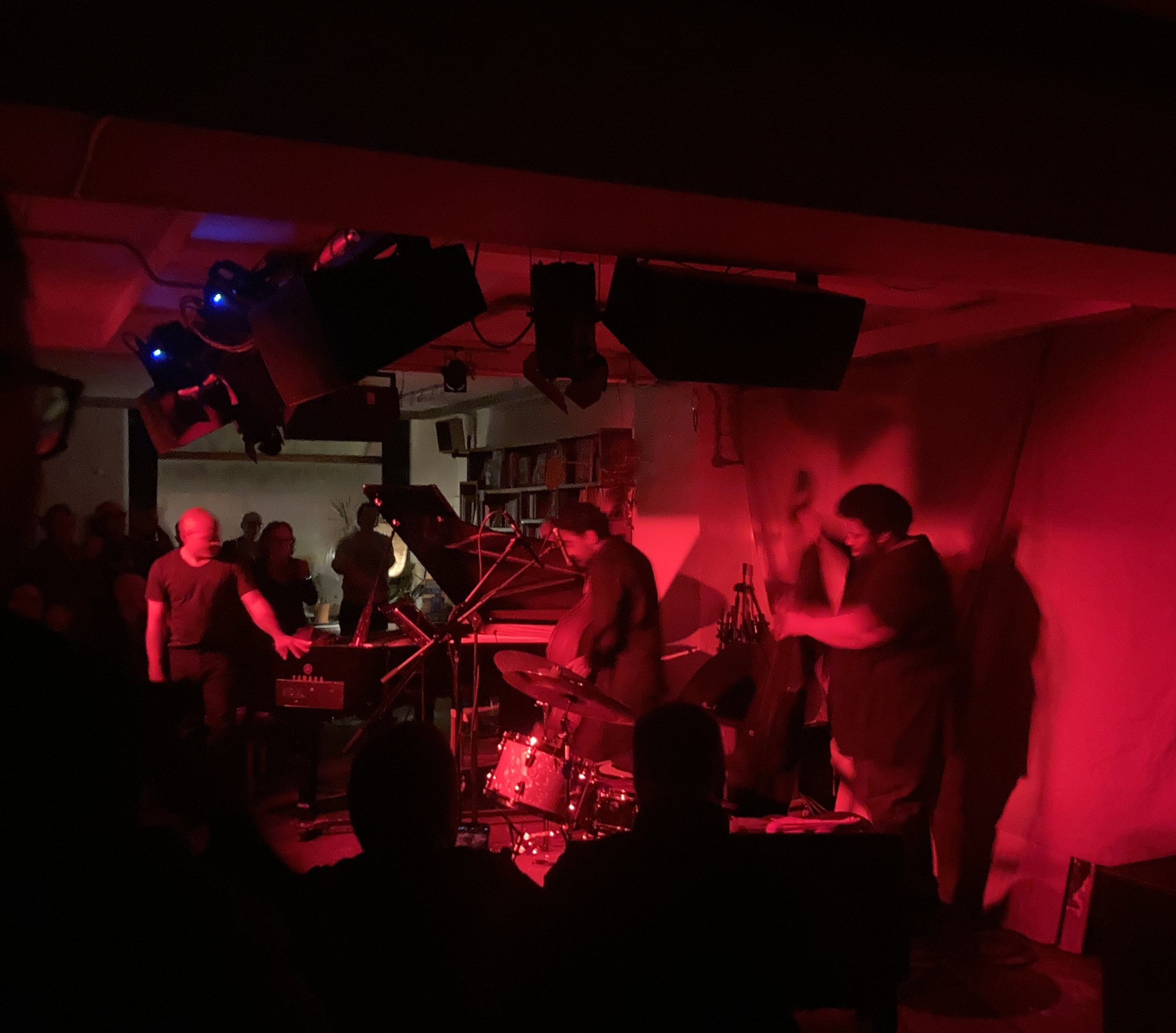
Empirical’s Shaney Forbes at the Cockpit (photo: Steven Cropper)

I was pretty horrified over the new year to see, in the guides to the arts in Britain in 2025 produced by the Guardian and The Times, no mention at all of anything that might be happening in the world of jazz. Both papers have a long tradition of covering the music in an informed way, but that seems to have been set aside by the current generation of arts editors.

It’s more than a pity, particularly at a time when jazz, although its household names have gone, is showing such vitality at all levels, and particularly among a younger generation. That was an unmissable feature of Monday’s Jazz in the Round gig at the Cockpit Theatre, not just among the musicians taking part but in the audience.

Sure, the usual jazz listeners with decades of experience were well represented. But there were also lots of people of student age, a few with instrument cases, settling on the tiered benches surrounding the players on all sides. Some of them were obviously friends of the pianist Emily Tran’s very spirited quintet, featured in the opening slot nowadays reserved for JITR’s Emergence new-talent programme, but they and the other younger listeners in the room effectively reinvigorated the whole ambiance.

After Tran’s group, its front line of alto saxophone and trombone recalling Jackie McLean’s Blue Note albums with Grachan Moncur III, came the Portuguese guitarist Pedro Valasco, 20 years a London resident, building loops and effects with his elaborate pedal board, exploring the sort of territory John Martyn might have entered, given a couple of extra booster rockets. And finally came Empirical, a long-established but perennially creative quartet, with Jonny Mansfield replacing Lewis Wright at the vibraphone.

I’ve said before that Jazz in the Round is my favourite live listening environment, and during Empirical’s set there was a good example of why that might be. It happened while Shaney Forbes was carefully unfolding a drum solo on “Like Lambs”, his own composition, against overlapping rhythm patterns played by Mansfield, altoist Nathaniel Facey and bassist Tom Farmer in what sounded like three different time signatures.

Suddenly Forbes’s concentration was abruptly broken when the bass-drum beater flew off its pedal, landing at the feet of the front row. In many decades of watching drummers, I don’t think I’ve ever seen that happen before. Anyway, the nearest member of the audience was able to lean across and hand it back to the drummer, who quickly refitted it and screwed it up tight while the other three maintained their patterns without disruption, before resuming his train of thought and taking it to a conclusion.

There was, of course, a special roar of applause when the piece ended, but that in itself is not unusual for Empirical. Their music is complex, and sometimes knotty, but they consistently engage their listeners’ emotions in a straightforward way which demands a response. That in itself is quite unusual in this kind of jazz. You could analyse what they do in terms of pacing and projection but there never seems to be anything calculating about it.

They have the spontaneity that is the propellant of jazz and the warmth that is its lubricant, qualities for which Jazz in the Round, programmed and presented by Jez Nelson and Chris Phillips, provides a consistently rewarding environment.

Three in one

It felt like a great privilege to be at Cafe Oto last night to hear the Schlippenbach Trio — Alexander von Schlippenbach (piano), Evan Parker (tenor saxophone) and Paul Lytton (drums) — make a rare appearance in London in front of a capacity crowd. This is a group that has existed since 1972, with one personnel change: Lytton’s arrival some years ago to replace his great friend Paul Lovens, who stopped touring.

At 77, Lytton is the youngster of the group. Parker is 80, Schlippenbach 86. Although their group is one of the enduring monuments of European free jazz, they continue play as though the music is being invented every night — which it is, albeit with its foundations in their vast experience, both individual and collective. Last night’s 50-minute set was a further exploration of the spaces between them: a true conversation of equal voices, merging and separating and merging again with a perfect sense of spontaneous form and balance.

Bird lives, dies, flies

Coming up to the 70th anniversary of his death (on March 12, 1955), Charlie Parker can still stop you in your tracks. His sound may be as familiar as the head on a postage stamp, his style imitated with greater or lesser success by thousands of saxophone players, but that unquenchable inventiveness retains all its singular potency, particularly when caught on the wing.

By that I mean not in a recording studio. I revere the studio classics — the hurtling audacity of “Ko Ko”, the sombre perfection of “Parker’s Mood” — as much as anyone, but Bird really flew highest in more informal or spontaneous environments, when the natural assumption of its evanescence drove his improvising into an extra dimension. That’s what impelled the devoted fan Dean Benedetti to record him in jazz clubs night after night on concealed equipment, and what made the posthumous release of such quasi-bootlegs as Bird at St Nick’s and One Night at Birdland (with Fats Navarro and Bud Powell) so vital to a true appreciation of Parker’s genius.

And now there’s more evidence of the brilliance of the uncaged Parker: an album called Bird in Kansas City, an official release on the Verve label. It’s worthy of a place alongside any of Bird’s output thanks mostly to the seven tracks with which it begins, captured during informal sessions in July 1951 at the house of a friend.

Prevented by the loss of his cabaret card from working in New York after being busted for heroin earlier in the year, Parker was staying with his mother, Addie, in Kansas City, where he had grown up. He played a few gigs at a local nightspot, Tootie’s Mayfair Club, and earned $200 for a stunning guest appearance with the Woody Herman Orchestra at the Municipal Auditorium.

But at the invitation of his friend Phil Baxter, a barber who had a pleasant habit of hosting regular soirées at his house on Kensington Avenue in the city’s Eastside district, Bird could play without pressure of any kind. Accompanied by an unidentified but more than competent bassist and drummer, he displays on these seven pieces the genius that flowed through him even in the most relaxed circumstances.

The first three pieces, each without a formal title, draw on various familiar bebop themes and motifs. The fourth, “Cherokee”, is jet-propelled. “Body and Soul” is taken at its usual ballad pace, slipping gracefully in and out of a double-time section as it proceeds to an ending in which a coruscating single phrase is followed by a particularly arch version of his favourite whimsical coda: a quote from “In an English Country Garden”. “Honeysuckle Rose” and “Perdido” swing at a mellow tempo, just on the bright side of medium, with eye-watering semi-quaver runs in the former leavened by some amusing quotes (“Fascinating Rhythm”, “Cheek to Cheek”).

For 24 minutes on these seven tracks we’re allowed to hear Parker as we became used to hearing Ornette Coleman and sometimes Sonny Rollins: an improvising saxophonist without the support of a chording instrument. It’s not a revelation — nothing conceptually different is happening — but it does allow an unusually clear sight of what he could do.

There are another four tracks recorded seven years earlier at a transcription studio in Kansas City, with two friends: the guitarist Efferge Ware, a useful witness in the first volume of the late Stanley Crouch’s sadly never-to-be-completed Parker biography, and the drummer “Little Phil” Phillips. The songs are standards — “Cherokee”, “My Heart Tells Me”, “I Found a New Baby” and “Body and Soul” — and the difference is remarkable: this is pre-bop music, belonging to the swing era, with bags of composure and fluency, completely charming in its own right while conveying barely a hint of what is to come.

The album’s compilers, Chuck Haddix and Ken Druker, go back even further for the pair of tracks that complete the set. These are two pieces recorded by the Jay McShann Orchestra informally in Kansas City in January 1941, apparently in preparation for a Decca session in Dallas a week or two later. Parker has a rather diffident eight-bar solo to close a loose-limbed “Margie” (see comment below) and a much more expressive full chorus on a smoochy “I’m Getting Sentimental Over You”, in which his tart sound and triple-time flurries must have pinned back the ears of the unwary. As they still do.

Barre Phillips 1934-2024

Barre Phillips, who died in Las Cruces, New Mexico on December 28, aged 90, was a poet of the double bass, a member of a generation of players who, building on the achievements of Jimmy Blanton, Oscar Pettiford, Charles Mingus and Paul Chambers, lifted the instrument to new levels of flexibility and expression.

One of jazz’s great contributions to music has been to extend instrumental vocabularies, a process accelerated by the idiom’s rapid stylistic evolution through the last century. No instrument developed more spectacularly than the bass, and Barre — who was born in San Francisco but lived in Europe between 1968 and 2023 — played a significant role in that process.

His first album of unaccompanied solo improvisations was recorded in London in November 1968 in the church of St James Norlands in Notting Hill. Originally released as Journal Violone in an edition of 500 on the Opus One label, it came my way the following year when it was reissued, again in an edition of 500, as Unaccompanied Barre on the Music Man imprint. I think my copy may have come from the producer Peter Eden.

It was a pioneering effort, and a very striking one. I seem to remember making it the Melody Maker‘s jazz album of the month, which raised a few eyebrows. Entirely solo albums by improvising instrumentalists (other than piano players) weren’t yet a thing. Now look how many there are. Among bassists alone, Barre’s album paved the way for unaccompanied recordings by Gary Peacock, Dave Holland, Barry Guy, William Parker, Henry Grimes, John Edwards and others, including, most recently, Arild Andersen.

Barre made several more albums in the same format, including Call Me When You Get There (1984) and End to End (2018) for the ECM label. That’s where Peacock, Holland and Andersen’s solo efforts also appeared, which is hardly surprising, since the label’s founder, Manfred Eicher, started out as a bassist.

I first heard Barre’s playing on Bob James’s ESP album, Explosions, and Archie Shepp’s On This Night. He came to Europe for the first time in 1964 with George Russell’s sextet and returned later in the decade, staying first in London before eventually making France his home. Evidence of his early collaborations with British or British-based musicians can be found on John Surman’s How Many Clouds Can You See?, Mike Westbrook’s Marching Song, and his two sessions with Chris McGregor’s sextet (Up to Earth) and trio (Our Prayer), all recorded in 1969.

In 1970 he joined Surman and the drummer Stu Martin in The Trio, recording a self-titled debut with the basic combo and Conflagration! with an augmented line-up. Thereafter he played with all kinds of partners, from Derek Bailey to Robin Williamson, and was a regular member of his friend Barry Guy’s London Jazz Composers Orchestra. Two ECM albums with Paul Bley and Evan Parker, Time Will Tell (1995) and Sankt Gerold (2000), are favourites. His last release was ECM’s Face à Face, a duo recording with the electronics of György Kurtág Jr, released in 2022.

He was intense about music and what it meant to create it, as became obvious when I interviewed him in London in 1970.

“I’m interested in the process of making music,” he said. “I’m not really interested in the product at all, because I’ve got enough confidence to know that if I’m into it the product is really going to be OK anyway. That’s my personal reason — to have something to communicate to an audience besides the product. If I can show my process to people, perhaps they can understand themselves a lot better.””

The conventional role of the bass, he said, was of little interest to him.

“That’s product-producing. I’m coming from somewhere were the product was important, and I worked and worked until I could get on stage and produce it. But what’s really important is: how did I get from birth to the product? If I go on to a deeper level where the responses are reflecting off my central nervous system, then I’m living my whole life with every instant. Because you’re living in the process of making the music, and to me the biggest thing I’m playing is my birth.”

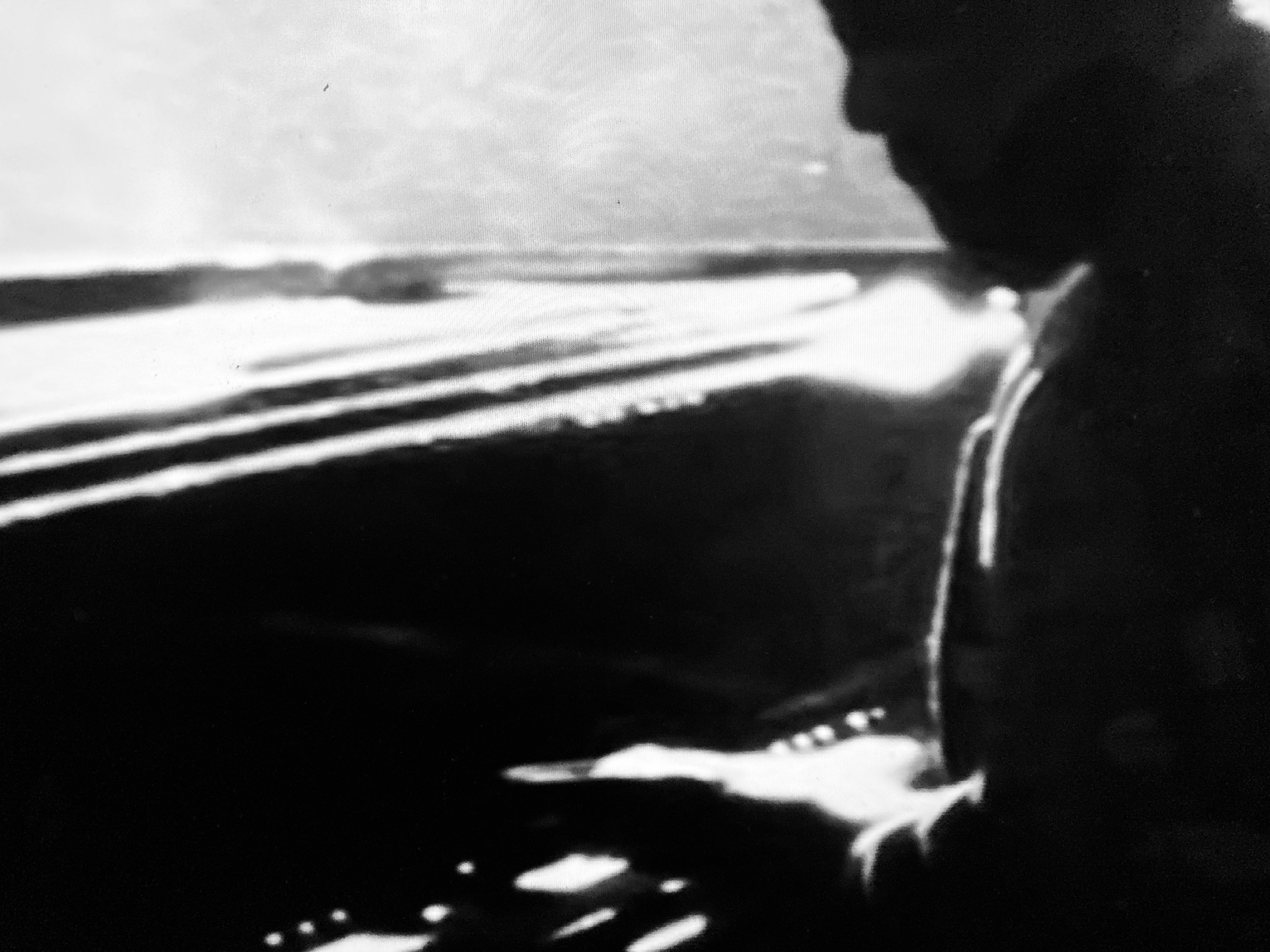
* The photograph, by an unknown photographer, is taken from Traces: Fifty Years of Measured Memories, a career summary in the form of an illustrated discography, a DVD, and the only CD reissue of Journal Violone. It was published by Kadima Collective in 2012.

Remaining Intakt

Independent record labels are one of jazz’s indispensible support systems, fuelled by the brave willingness of the enthusiasts who run them to buck the odds. My own early tastes were largely shaped in the 1960s by the work of Alfred Lion and Francis Wolff at Blue Note, Bob Weinstock at Prestige, Dick Bock at Pacific Jazz, Lester Koenig at Contemporary and Orrin Keepnews at Riverside. It’s now more than 50 years since Manfred Eicher reimagined what an independent jazz label could be in terms of focus, identity and appeal, and today we have International Anthem, Pi, Rune Grammofon, Hubro, ACT and others swimming lustily against the current.

And there’s the outstanding Intakt Records, founded in 1984 by Patrik Landolt, who stepped back in 2021 after 37 years of producing records and, in retirement, has just received the honorary award of the Deutsche Schallplattenkritik — the organisation of German record critics. His story of those years is contained in a new book, (A)tonal Adventures, containing short extracts from his journals, vividly describing the pleasures and problems of running such a label, travelling between Europe and America.

Intakt’s catalogue of about 400 releases captures a hefty slice of the creative music of our time, from the first release by the great Swiss pianist Irene Schweizer through many recordings by Barry Guy’s London Jazz Composers Orchestra, Cecil Taylor’s epic Willisau concert, the Globe Unity Orchestra and the great solo sessions of its leader, Alexander von Schlippenbach, plus Anthony Braxton, Oliver Lake and Elliott Sharp and a galaxy of drummers including Pierre Favre, Gunter Baby Sommer, Andrew Cyrille, Louis Moholo, Han Bennink and Lucas Niggli, to newer generations of artists including Ingrid Laubrock, Chris Speed, Sylvie Courvoisier, Alexander Hawkins, James Brandon Lewis, Angelika Niescier, Tomeka Reid and the mindbending trio Punkt.Vrt.Plastik (Kaja Draksler, Petter Eldh and Christian Lillinger).

In presentational terms, Intakt’s releases conform to no house style (à la Blue Note or ECM), but the sense of strong graphic design is very evident. Despite the absence of visual uniformity, somehow they speak with the same voice. And equal care is taken with the sound. Again, there’s no equivalent here of the signature (and very effective) reverb penumbra of Blue Note or ECM. Just clarity.

Among the newer artists there’s Ohad Talmor, the American/Swiss tenor saxophonist whose new album, Back to the Land, is one of the highlights of the year. Over two CDs, Talmor reimagines compositions and motifs from the work of Ornette Coleman in a variety of settings: trios for tenor, bass (Chris Tordini) and drums (Eric McPherson), quartets (one with tenor, two trumpets and drums), the duo of Joel Ross on vibes and David Virelles on piano, and a couple of tracks for a septet including sparing use of electronics.

The music is full of air and light, evoking without mimicry some of the south-western feeling Ornette brought to the music. Joy and pain are both present, always delineated with subtlety. The playing is sensationally good by all concerned (particularly Tordini), and the programming retains the listener’s attention without resorting to tricks. In his short preface to the sleeve notes, Talmor mentions the influence on his own playing of Lee Konitz, Dewey Redman and Wayne Shorter; his solos are extruded without apparent effort but with a notable richness of melodic and rhythmic ideas. This is his third album for the label, and it would be a surprise if he were not to become one of the artists to whom Intakt’s commitment is for the long term.

Since Landolt’s retirement, the label’s reins have passed to a team including Florian Keller, whose postscript to (A)tonal Adventures takes us out on a note of optimism. “Intakt Records has never been an ivory tower,” he writes. “It is about setting topicality to music, where the political and social issues framing the music are also considered.” With albums as thoughtful and eloquent as Back to the Land, it’s fair to assume that the mission is in safe hands.

* Ohad Talmor’s Back to the Land was released in October: https://www.intaktrec.ch/408.htm. (A)tonal Achievements is published in English and German editions by Versus Verlag: bit.ly/49rIjla

Outer and inner space

On the 243 bus ride to yesterday’s matinee show at Cafe Oto, I finished Samantha Harvey’s short novel Orbital, the winner of this year’s Booker Prize. Starting as a description of the lives of six astronauts aboard a space station, it finishes as a meditation on the world — the planet, the universe — and our place in it.

With that in my head, listening to Evan Parker, Matthew Wright and their four colleagues in this edition of Transatlantic Trance Map create their intricate musical conversations was like zooming in on the smallest level of earthly detail: an example of our human potential, in the face of cosmic irrelevance.

For two shortish sets of unbroken free improvisation, Parker (soprano saxophone) and Wright (turntables and live sampling devices) were joined by Hannah Marshall (cello), Pat Thomas (electronics), Robert Jarvis (trombone) and Alex Ward (clarinet). The music was calm, collective, and often very beautiful in its constant warp and weft. Maybe it was the occasional (very subtle and always appropriate) pings and hums from the electronics that reinforced the connection in my mind with Orbital: the whoosh of a closing airlock, the light clang of a piece of space junk against a titanium hull. But that was obviously just me.

Many years ago I went to interview Evan at his home in Twickenham. One thing I noticed was that his shelves of LPs had a particularly long stretch of orange and black spines: John Coltrane on the Impulse label, of course. Evan has never sounded like Coltrane, but his study of the great man was foundational to his own development and his interest remains deep. Yesterday, for example, he was keen to tell me about the extraordinary sound quality of the reissue of the 1962 Graz concert by Coltrane’s classic quartet on Werner Uehlinger’s ezz-thetics label. “You can hear the ping of Elvin’s ride cymbal,” he said.

So it was by an interesting coincidence that I went on from Dalston to another event on the last day of the EFG London Jazz Festival, a concert at the Queen Elizabeth Hall called Coltrane: Legacy for Orchestra. For this performance of arrangements by various hands of some of Coltrane’s compositions (“Impressions”, “Central Park West”, “Giant Steps”, “Naima” etc), and a few other pieces that he recorded (including “So What”, “Crepuscule with Nellie” and “Blue in Green” and a handful of standards, including “My Favourite Things”), the full BBC Concert Orchestra, conducted by Edwin Outwater, was joined by two horn soloists, the young American trumpeter Giveton Gelin and the experienced British saxophonist Denys Baptiste, and the trio of the pianist Nikki Yeoh, with Shane Forbes on drums and Ewan Hastie on bass.

Inevitably, I suppose, there were times when it felt as though Coltrane was being reduced to something close to light music; there was certainly no attempt to get to grips with the turbulence of the music he made in the last three years of his life in albums such as Interstellar Space. But there were moments of distinction, too. Baptiste tore into “Impressions”, while Gelin — a New York-based Bahamian in his mid-twenties — earned ovations for his poised reading of “My One and Only Love” and for a lovely coda to “In a Sentimental Mood”, mining the elegant post-bop tradition of Clifford Brown, Lee Morgan and Freddie Hubbard.

In terms of the response from a full house, it was a great success. But there was one moment when the music went deeper, closer to what Coltrane was really about, and it came in the arrangement of “Alabama” by Carlos Simon, a composer in residence at the John F. Kennedy Centre for the Performing Arts in Washington DC, and the principal begetter of this project.

“Alabama” is Coltrane’s most sacred song, a slow, heavy hymn to the memory of the four African American schoolgirls murdered by racists in the bombing of a church in Birmingham, Alabama on September 15, 1963. Simon chose to orchestrate it in the way Eric Dolphy and McCoy Tyner might have done, had it been written in time for inclusion in 1961 in Coltrane’s first Impulse album, Africa/Brass, on which Dolphy and Tyner made dramatic use of low brass.

Here, Simon added trombones and French horns, using tympani and a gran cassa to augment Shane Forbes’s mallets on his tom-toms, thus amplifying the effect of Elvin Jones’s original rolling thunder behind Baptiste’s emotionally weighted statements of the rubato theme. Like the tenorist’s extended but carefully shaped solo on the in-tempo passage, it honoured not only Coltrane’s memory but his intentions, and will be worthy of special attention when Radio 3 broadcasts the concert later this week.

* Transatlantic Trance Map’s album Marconi’s Drift is out now on the False Walls label (www.falsewalls.com), which is also about to release a four-CD box set of Evan Parker’s solo improvisations, titled The Heraclitean Two-Step, Etc. The live recording of Coltrane: Legacy for Orchestra will be broadcast on BBC Radio 3 between 19:30 and 21:45 on Thursday 28 November, thereafter available on BBC Sounds.

Almost like a scientist

“Almost like a scientist.” That’s what someone says near the beginning of Ingredients for Disaster, Julian Phillips’s new 67-minute documentary about the music of the Swiss composer, pianist and bandleader Nik Bärtsch. Almost like a scientist. Well, yes. When Bärtsch talked after a screening in London this week, words like “architectonics” and “topography” entered the conversation. And Phillips chooses to illustrate the polymetric structures of the music through cunningly devised computer graphics that actually illuminate the interior design of pieces which tend have the four players working in different time signatures simultaneously.

On the other hand, not like a scientist at all. Not in effect, anyway. Listening to Bärtsch’s bands, either the “Zen funk” of Ronin or the “ritual groove music” of Mobile, can be a profoundly emotional experience, particular when he gives one of his shouted cues and the whole band changes gear like a sudden shot of adrenalin.

But it’s certainly complex music, particularly in its layered polyrhythms. He made me laugh yesterday when he briefly turned the conversation to good old 4/4. If you work all the time in less conventional metres, he said, then you decide to play something that superimposes 4/4 on, say, 5/4, it’s 4/4 that ends up sounding odd, implying that it gives you something new to work with.

In the film, he talks about some of his influences: the pianists Lennie Tristano (whose polymetric “Turkish Mambo” he recorded on one of his early albums), Ran Blake and Monk, and Stravinsky. In the discussion after the film there was also mention of James Brown’s band and of Zigaboo Modeliste, the drummer with the Meters (drummers are important to Bärtsch; that’s how he started out). But his great success is to have metabolised his influences so thoroughly that they became invisible as, over the years, he developed a music of true and complete originality.

This month marks 20 years since he began his Monday night sessions at the Exil club in Zurich, where the music has taken gradually shape. Ronin currently consists of Sha (Stefan Haselbacher) on bass clarinet and alto saxophone, Jeremias Keller on bass guitar, and the drummer Kaspar Rast, with whom Bärtsch has been working since they were nine or 10 years old. Each of them has something illuminating to say in the film, none more so than Sha, master of the bass clarinet, who demonstrates how one of the parts written for his instrument can lead, as the piece unfolds in its long narrative, to variations such as “ghost notes” and percussive tapping.

Like the Quintet of the Hot Club of France, the MJQ, the MGs, Astor Piazzolla Quintet and the Chieftains, Ronin is a band with a highly evolved, distinctive and patented character. There’s a new album by the basic quartet, called Spin. With the addition of three horns and a guitar, it becomes the Ronin Rhythm Clan, which performed at Kings Place in London a few years ago. I liked that line-up very much, and Bärtsch guided me to a couple of tracks released on Bandcamp earlier this year.

I wrote about Nik when he performed with the London-based visual artist Sophie Clements at the Barbican in 2019, and when Ronin played a night at Ronnie Scott’s last year. Tonight I’m going to see him playing piano duets with Tania Giannouli at the Wigmore Hall, as part of the EFG London Jazz Festival. He’s one of the most interesting musicians around, and it’s a pleasure to keep up with him.

* Ronin’s Spin is released on November 24 on the Ronin Rhythm Records label. The film Ingredients for Disaster will be available to stream on Amazon Prime and Apple+ from November 29. Bärtsch’s book Listening: Music Movement Mind is published by Lars Müller Publishers.

‘Soundtrack to a Coup d’état’

Sixty years ago Archie Shepp wrote a provocative column for Down Beat magazine in which, if memory serves, he compared his tenor saxophone to a machine gun in the hands of a Vietcong guerrilla. In the early ’60s it seemed that jazz’s New Thing, or whatever you wanted to call it, possessed a powerful political dimension, exemplified by Max Roach and Abbey Lincoln’s Freedom Now Suite, John Coltrane’s “Alabama”, and Shepp’s own “Malcolm, Malcolm — Semper Malcolm”. Even the music that had no explicit political content, such as Ornette Coleman’s “Free Jazz”, somehow seemed to express revolutionary feelings.

It’s with great brilliance that the Belgian film director Johan Grimonprez makes that music (and indeed those very pieces, plus others) into an integral component of his award-winning documentary Soundtrack to a Coup d’état. The two-and-a-half-hour film’s subject is the murder in 1961 of the activist and politician Patrice Lumumba, whose tenure as the first prime minister of the newly independent Republic of Congo — formerly the Belgian Congo — was ended after only three months by a military coup fomented by those with interests in the country’s rich deposits of rare minerals, notably Belgium, the withdrawing colonial power, the United States government of President Eisenhower, and the British government of Harold Macmillan.

Lumumba was a symbol not just of the independence of former colonies but of pan-Africanism. Given the activities of the CIA and the British and Belgian intelligence services, it was no surprise that he welcomed support from Castro’s Cuba and Khrushchev’s Soviet Union, or that he should pay the ultimate price for it, his body hacked to pieces and dissolved in acid by the mercenaries who killed him. Names familiar to those of my generation — Moïse Tshombe, Joseph-Désiré Mobutu, Joseph Kasa-Vubu, Dag Hammarskjöld — stud the narrative, while Grimonprez deploys archive interviews of varying degrees of blatant or sly self-incrimination with participants including Larry Devlin, the CIA station chief, and the MI6 officer Daphne Park.

What makes this film different is the use of music. Grimonprez has spotted the US government’s soft-power deployment of jazz during the Cold War through State Department-sponsored international tours. In 1956 Dizzy Gillespie and an 18-piece band spent 10 weeks touring Europe, Asia and South America. A year earlier Louis Armstrong had pulled out of what would have been the inaugural tour in protest against racial segregation in schools in the Southern states, but in 1960 he travelled to Congo, where he played to an audience of 100,000 people in Léopoldville (as Kinshasa was then known) in the middle of the political disturbances, before returning to Africa in 1961 to perform in Senegal, Mali, Sierra Leone, Liberia, Sudan and the United Arab Republic.

We see Armstrong in Africa in the film, but more novel and powerful is the juxtaposition of the avant-garde jazz of the time with footage of the political events: not so much a soundtrack as an active commentary. So we hear Abbey Lincoln’s anguished screaming, Max Roach firing off snare-drum fusillades, the contorted sounds of Eric Dolphy’s bass clarinet (with Charles Mingus’s group, shortly before his death), Nina Simone simmering through Bob Dylan’s “Ballad of Hollis Brown”, and Coltrane, on fire in “My Favourite Things” and intoning the sorrow of “Alabama”. Fast cutting is usually the enemy of understanding, but Rik Chaubet’s shrewdly paced editing creates a non-stop tapestry of emotions, making the rhythms and the cry of the music mirror the events being depicted.

Direct action also played a part, and if you see this extraordinarily compelling film, you won’t forget the spectacle of Lincoln, Roach and dozens of others courageously disrupting a session of the UN Security Council in New York to protest against the assassination of the figure Malcolm X called “the greatest black man who ever walked the African continent.”

Lumumba’s death was a crime and a tragedy of enormous significance. Grimonprez alludes to its enduring importance through reminding us that the Democratic Republic of Congo, whose mines produced the uranium for the atom bombs that fell on Hiroshima and Nagasaki, remains the world’s major source of coltan, the rare and precious commodity that powers our iPhones. In other words, a country of 100 million people, whose mineral deposits are said to be worth $24 trillion, but where two million children are at risk of starvation, and which currently ranks 179th out of 191 countries in the UN’s Human Development Index, is safe for civilisation.

* Soundtrack to a Coup d’etat is being screened at various independent cinemas.

Back to Berlin

“A lot of people have died recently,” Otomo Yoshihide remarked to his Berlin audience on Sunday night, halfway through a set by his 16-piece Special Big Band. “This is for them.” The band’s marimba player, Aikawa Hitomi, began to trace out some quiet, limpid phrases, with a sound like pebbles dropping in a pond. One by one, her colleagues joined in. I don’t really know how to explain what was happening, whether or not it was a written composition or completely improvised, but each player added a layer of sadness to the piece until it gradually, and completely without ostentation, reached a critical mass of emotion.

It was amazing. The non-specific nature of Yoshihide’s introduction allowed the listeners — and the musicians, I guess — to direct their mourning wherever they wished. And having created something so sombre and profound, Yoshihide didn’t take the bandleader’s easy option by then lifting the mood with one of the absurdly entertaining rave-ups in which his band specialises, and with which they would eventually send the audience home smiling fit to burst. Instead his accordionist, Okuchi Shunsuke, squeezed out the gentle melody of “Années de Solitude”, a graceful composition by the great Astor Piazzolla. Soon the lonely accordion was joined the baritone saxophone of Yoshida Nonoko, before the other horns entered in a rich arrangement ending with hymn-like cadences.

After that, it was time to change the mood in a set that contained an unusually large proportion of the gamut of human emotions, from cheesy film and TV themes and a perky “I Say a Little Prayer” through a pretty version of Eric Dolphy’s “Something Sweet, Something Tender” and a suitably stirring reading of Charlie Haden’s “Song for Che”. The encore was a completely bonkers piece of Japanese pop music featuring the all-action singing and dancing of three of the group’s women — Hitomi, the electronics player Sachiko M and the saxophonist Inoue Nashie — with a kind of rap from Yoshihide.

For the closing performance of the 2024 JazzFest Berlin, Yoshihide’s ensemble was the perfect choice. Twenty four hours after the Sun Ra Arkestra had occupied the same stage in their tinsel and cooking-foil Afrofuturist costumes, recessing from the stage one by one with a chanted recommendation for Outer Spaceways Incorporated, the men and women of the Japanese band came dressed like refugees from a Comme des Garçons sample sale. Were they from the West, Felliniesque would be one obvious way of describing their presentation. With two drummers, a tuba and a very emphatic bass guitarist, and with the leader’s guitar sometimes throwing in some of the noise elements for which he is well known, they made me think of what might happen if you merged the Willem Breuker Kollektiev with the Glitter Band, with Carla Bley providing the arrangements.

One amusing thing they did in the up-tempo pieces was to have each member leap up to give cues and perhaps conduct a few bars before resuming their places: a kind of daisy-chain of instructions and cheer-leading. It made me think of something I’d seen that morning on stage at the Jazz Institut, where the festival’s Community Sunday, centred on the multicultural Moabit district of Berlin, began with a concert featuring children. While a young piano trio played, a group of kids, perhaps six to 10 years old, stood in front of them, giving the sort of signals — faster! slower! stop! start! — familiar from the techniques of conduction.

It was a good game, everyone enjoyed it, and it made me wonder whether, a few decades ago, someone had tried something similar in Japan, laying the foundations for Otomo Yoshihide’s Special Big Band. Almost certainly not, but there was the same sense of play at work, as it were. And if you give that opportunity to a bunch of kids, there must be a chance that it will open up a world for some of them.

The Moabit adventure continued with a mass walk through the streets, audience and musicians stopping off at various points for pop-up musical events. It ended in a church, where Alexander Hawkins played the organ and members of the Yoshihide band and the Swedish bassist Vilhelm Bromander’s Unfolding Orchestra took part, along with a young people’s choir and local musicians with various cultural backgrounds. The special project of Nadin Deventer, now seven years into her tenure as the festival’s artistic director, it proved to be a brilliant way to involve a community and its children, and deserves to become a permanent feature of an institution celebrating its 60th birthday.

For me, other highlights of the four days included Joe McPhee reading his poetry with Decoy; the French pianist Sylvie Courvoisier’s new quartet, Poppy Seeds, featuring the vibraphonist Patricia Brennan, the bassist Thomas Morgan and the drummer Dan Weiss, playing compositions of great intricacy with superb deftness; and the trio of two British musicians, the pianist Kit Downes and the drummer Andrew Lisle, and the Berlin-based Argentinian tenor saxophonist Camila Nebbia, entrancing a packed A-Trane with warm gusts of collective improvisation. In the main hall on Saturday night there was also a moving ovation for the pianist Joachim Kühn, who made a speech announcing that, at 80, this appearance with his current trio would be his last at the festival, having made his first in 1966, aged 22.

A festival with an ending, then, in more than one sense, but also full of beginnings and new possibilities, just as the visionary jazz critic and impresario Joachim-Ernst Berendt envisaged 60 years ago when he persuaded the West German government that its slice of Berlin, marooned in the GDR, needed something with which to demonstrate a sense of vibrant modernity to the world, and that thing was jazz. In very different circumstances, it still is.

Other sounds 5: Feat. Arve Henriksen

A fugitive sound, soft, glancing, indirect: the Norwegian trumpeter Arve Henriksen has a signature I love, in pretty much whatever context it appears. It could be in his group Supersilent, or with Jan Bang, Christian Wallumrød, Dhafer Youssef, Terje Rypdal, Iain Ballamy or Trygve Seim, or on his own albums, particularly Places of Worship (Rune Grammofon, 2013), which I think of as this century’s Sketches of Spain.

He’s developed the European equivalent of Jon Hassell’s trumpet sound, using electronics and a natural tendency towards understatement to take the instrument out of its normal brassy universe and into somewhere more mysterious. And he finds two soulmates in the Danish drummer Daniel Sommer and the Swedish bassist Johannes Lundberg on Sounds & Sequences, a trio recording made in a Gothenburg studio.

A series of 11 pieces evolving from free improvisations subjected to post-production processes of editing and shaping, this is a very beautiful thing indeed. Sommer’s playing draws the ear throughout, pulling gentle grooves out of the air and adding the finest of detail. Lundberg and Henriksen both contribute electronic beds and textures (Henriksen also uses his counter-tenor voice from time to time), nudging the music towards something that touches the celestial sublime.

The trumpeter pops up in Triage, the new album from Erik Honoré, one of the founders of Kristiansand’s remix-based Punkt festival, which celebrated its 20th edition last month. Deploying colleagues including Sidsel Endresen, Eivind Aarset, Ingar Zach, Nils Petter Molvaer and Jan Bang, Honoré creates little tone poems, some of them used as settings for found texts.

These include Emily Dickinson’s poems “Hope Is a Thing With Feathers” and “Pain Has an Element of Blank”, portions of Ezra Pound’s Cantos — read by Bang — and a section from the US Surgeon General’s undated instructions on early care of combat wounds: “A not uncommon occurrence in the present war are those distressing wounds of the face and jawbones which have attracted particular attention not only on account of the disfigurement which they cause but even more so from the difficulty that was first encountered on dealing with them…”

The use of different readers adds variety and surprise, as if there were not already enough in the music itself, which also makes use of radio samples and field recordings. An instrumental piece called “Prague”, featuring Molvaer’s trumpet over Bjørn Charles Dreyer’s guitar and Mats Eilertsen’s treated double bass, is particularly striking, as is “In the Station of the Metro”, in which Henriksen’s breathy trumpet emerges between Pound’s lines and Honoré’s manipulated samples with typical probing grace.

Finally, Henriksen’s recent album of duets with the Dutch pianist Harmen Fraanje, Touch of Time, is more conventional in terms of exploitation of the available sonic materials, allowing a clearer view of the trumpeter’s playing, with only the occasional effective touch of electronics. Compositions by both men create music that is delicate, pensive, carefully weighted, devoid of affectation or allusion to outside worlds. The closer you listen, the stronger it gets.

* Sounds & Sequences is on the April Records label (www.aprilrecords.com). Triage is on Punkt Editions/Jazzland. Touch of Time is on ECM. All are out now.