Skip to content

Posts from the ‘Jazz’ Category

Sandburg/Wilson

Carl Sandburg 2

Carl Sandburg

It’s National Poetry Day, and since I have a weakness for the much abused hybrid known as jazz and poetry that goes back to schooldays, this is a good excuse — if one were needed — to write about Matt Wilson’s new album, Honey and Salt, in which he sets the words of the poet Carl Sandburg to music.

Some people don’t like the star system of reviewing, but it was while reading the August edition of Down Beat in Ray’s Jazz Shop the other day that a five-star lead review sent me across the floor to search out a copy of Honey and Salt. It turned out to be a good tip.

Wilson, a fine drummer familiar in many contexts, whom I last heard with Liberation Music Orchestra, recruited an excellent band for this project: Ron Miles (cornet), Jeff Lederer (reeds and harmonium), Martin Wind (acoustic bass guitar), and Dawn Thompson, who plays guitar and sings on a handful of the 18 selections, plus an interesting group of readers better known as instrumentalists: Christian McBride, John Scofield, Bill Frisell, Rufus Reid, Joe Lovano and Carla Bley. Oh, and the actor Jack Black.

Sandburg (1878-1967) won two Pulitzer Prizes for his poetry, and a third for a biography of Abraham Lincoln. He was from Knox County, Illinois, as is Wilson. Sandburg’s first cousin was married to Wilson’s great-great-aunt. While researching an essay on the poet during his college days, Wilson discovered Sandburg’s interest in jazz.

The poems are dry, pithy, witty and humane, some of them with a powerful resonance in the new century. Here’s one called “Choose”: “The single clenched fist lifted and ready, / Or the open asking hand held out and waiting. / Choose: / For we meet by one or the other.” And here’s one of his best known, called “Fog”: “The fog comes / on little cat feet. / It sits looking / over city and harbor / on silent haunches / and then moves on.” Wilson includes Sandburg’s own recording of “Fog”, accompanying the poet’s gentle voice with mallets on tom-toms.

The arrangements are unfailingly inventive, and the playing of the individuals — particularly the always brilliant Miles — is outstanding. The readers are all terrific, and to Bley falls the privilege of delivering, without accompaniment, the marvellous “To Know Silence Perfectly”: “There is a music for lonely hearts nearly always. / If the music dies down there is a silence / Almost the same as the movement of music. / To know silence perfectly is to know music.” On this evidence, their acute awareness of tone and cadence and expression makes jazz musicians great readers of poetry.

‘The Nightfly’ at Milton Court

The Nightfly at Milton CourtEven though it meant missing the first set of Michael Gibbs’ 80th birthday concert at the Vortex, the idea of hearing Donald Fagen’s first solo album played by the new intake of students on the jazz course at the Guildhall School on Monday night was impossible to resist. The Nightfly is a wonderful album, made by a man in early middle aged in the era of Reagan looking back at how things felt as the era of Eisenhower shaded into that of Kennedy, in that brief period of illusory optimism when prosperity and progress seemed to be the prevailing forces, before the Cuban missile crisis, the civil rights marches and the Vietnam protests took over. I thought it might be interesting to see how it sounded in the era of a president whose name I don’t even want to type out on this blog.

Also I wanted to hear a bunch of young players. And first, as an hors d’oeuvre, came a succession of seven small groups under the supervision of their tutors — Tom Challenger, Yazz Ahmed, Gareth Williams, Gareth Lockrane, Robbie Robson, Barak Schmool and Stuart Hall — playing short pieces based on ideas suggested by the album, each group having the benefit of a mere three hours’ preparation. All were interesting, but my ear was caught most readily by a lovely Mingusian variation on a phrase from “New Frontier” played by Challenger’s septet and by Williams’s sextet arrangement of “Ruby Baby”, which soured the harmonies in a George Russell-ish way and provided space for cracking solos by the altoist saxophonist Albert Hills Wright and the trumpeter James Beardmore.

Introducing the evening, Scott Stroman, a professor in the jazz department since 1983, had reminded us: “These guys didn’t even know each other last week” — the start of the academic year. It hardly seemed possible. There were also fine individual contributions from the fiery tenor saxophonist Asha Parkinson, the astonishingly eloquent pianist Jay Verma, and the assured drummer Zoot Warren.

After the interval came the main course. Malcolm Edmonstone, the head of the Guildhall’s jazz programme, had transcribed and arranged the entire album for a group of 57 students, including 13 singers who shared the lead around and fleshed out the close harmonies, and a load of pianists, guitarists, bassists and drummers who alternated the rhythm section roles.

Under the precise, assertive and invigorating baton of Giles Thornton, the band soared through “I.G.Y.” on Mark Fincham’s confident bass lines, articulated the strut of “Green Flower Street” with crisp power, absolutely nailed the sublime hip-swinging arrangement of “Ruby Baby” (with Parkinson’s tenor again making its mark), glided through the yearning “Maxine”, hustled through “New Frontier” (although there doesn’t seem to be a chromatic harmonica player in the class of ’17), locked into the fingerpopping groove of “The Nightfly”, and sauntered and shuffled through “The Goodbye Look” and “Walk Between Raindrops”.

When you think about it, these young musicians were pitting themselves against the achievements of Marcus Miller, Jeff Porcaro, Larry Carlton, Dean Parks, the Brecker brothers, Greg Phillinganes, James Gadson and the rest of the crew of first-call virtuosi assembled by Fagen back in 1982. The result was joy and exhilaration all the way, delighting the large audience of friends and family assembled in the concert hall at Milton Court.

(And I made it to the Vortex for the second half of Mike Gibbs’ birthday celebration with his 14-piece band, a glorious series of glowing set-ups for soloists like the trumpeter Percy Pursglove, the altoist John O’Gallagher and the guitarist Mike Walker. It was nice to think that some of this year’s Guildhall students will be carving out similar reputations before too long.)

Doubling Downes

Vyamanikal 2

Vyamanikal + 2: Tom Challenger, Alex Bonney, Lucy Railton, Kit Downes

The profound sense of peace that descended over Hall 2 of Kings Place last night as the set by an expanded version of Vyamanikal glided towards its close was unlike anything I’ve encountered all year. The pianist Kit Downes and the tenor saxophonist Tom Challenger, normally a duo in this guise, were joined on the stage by the cellist Lucy Railton and by Alex Bonney, who sat at a laptop. Bonney was processing the music and sounds recorded by Downes and Challenger in 2015 in the small churches of five Suffolk villages, collecting the sounds of organs in various states of repair for an album released last year, and feeding it into the live performance.

In the absence of a church organ, Downes alternated between a piano and a small hand-pumped harmonium. For the better part of an hour the musicians wove tapestries of sound in which individual elements blended seamlessly. There were certainly gorgeous details, but they fade in the memory next to the overall impression of a glowing organic whole.

If there was a kind of English pastoral vibe in the air, it was implicit rather than declarative, and never suffocating. I suppose the most obvious precedent might be some of John Surman’s recordings, from Westering Home onwards, but really this music seemed to stand alone, without need for comparison. As they neared the end, the three instrumentalists stopped playing but the music continued, thanks to Bonney, in a many-layered drone which seemed to distill everything that had been played in the previous 50 minutes. And then came a few moments of silence in which we could find our own way out of the trance.

The first half of the evening had featured Tricko, the duo in which Railton and Downes perform a kind of sui generis cello-and-piano chamber music that manages to be intricate without inducing strain and immediately attractive without becoming winsome. “I’m aware that this music is cripplingly quiet,” Downes said at one point. “If I were listening, I’d probably be asleep by now.” That might indeed be the initial impression. But the longer you listen to them, the more awake you feel.

* Vyamanikal’s album is on the Slip Imprint label. Downes’s solo organ album, Obsidian, will be released by ECM early next year.

Extraordinaire: Cécile McLorin Salvant

Cécile McLorin SalvantTwo years ago I presented Cécile McLorin Salvant and her trio at the Berlin jazz festival. At that point, most of the audience hadn’t heard of the young Franco-Haitian singer who was brought up in Miami before studying classical and baroque music at the conservatory in Aix-en-Provence. To say they were impressed by her performance would be an understatement.

For me, however, the greater privilege was to be present at her soundcheck, when she ran through two or three songs to get the feel of the hall. Among the pieces she ran down was Cole Porter’s “So in Love”, which happens to be one of my favourite songs, thanks largely to Mabel Mercer’s 1956 version. Still in her overcoat (it can be chilly in Berlin in November, and singers need to be careful), she had me transfixed by the way she drew out the song’s elegance with simple, unaffected directness.

A few hours later, during the concert itself, she gave it a very different delivery: much more highly wrought, full of decoration and elaboration and dynamic contrast, making full use of her phenomenal vocal technique and fine imagination. And it didn’t move me nearly as much.

This, I thought to myself, is a brilliant young artist still discovering and celebrating her own extraordinary abilities. At this stage, it’s natural for her to push everything as far as she can. Come back in 20 years’ time, I concluded, and she’ll be singing “So in Love” the way she did at the soundcheck, with an understanding that sometimes less is more.

Her new album, Dreams and Daggers, has a lot of that exuberance, and you can hear its effect on an audience in the tracks recorded live with the trio at the Village Vanguard in September of last year. There’s an almost audible attentiveness and a lot of whooping when, having executed a breathtaking series of vocal aerobatics, she finally brings a song back to earth.

She’s not a show-off, and she doesn’t scat (thank goodness). She has some of the girlish flexibility of the young Ella Fitzgerald, some of Sarah Vaughan’s ability to manipulate her tone in quietly jaw-dropping ways, and some of Betty Carter’s combination of daring and sheer musicianship. That’s a fair old combination. Occasionally she can overdo it, as in a highly dramatised version of “My Man’s Gone Now”, but most of the time her twists and turns are at one with the material.

Her originality will take time to emerge, but it is certainly there. At the moment it reveals itself most clearly in her choice of material, which is built on a foundation of standards — “You’re My Thrill”, “Let’s Face the Music and Dance”, “Mad About the Boy” and so on — but also includes items intended to prod her listeners in interesting ways, through “Si je serais blanche”, from the repertoire of Josephine Baker, “Somehow I Never Could Believe”, Kurt Weill’s setting of Langston Hughes’s lyric, and the feminist irony that bubbles away in her readings of “Never Will I Marry” and “If a Girl Ain’t Pretty”.

She and her brilliant trio — Aaron Diehl (piano), Paul Sikivie (bass) and Lawrence Leathers (drums) — make a formidable unit, particularly on something like a tightly arranged version of “I Didn’t Know What Time It Was”. There are delightfully insouciant treatments of the two ultra-hip Bob Dorough tunes, “Nothing Like You” and “Devil May Care”, recorded by Miles Davis in 1962.

Half a dozen studio-recorded tracks on this 2-CD set feature a string quartet, arranged by Sikivie to add a welcome astringency. By contrast there’s the singer’s penchant for covering the work of the early classic blues singers: here we get lusty versions of Ida Cox’s “Wild Women Don’t Have the Blues” and Bessie Smith’s haughtily dismissive “Sam Jones’ Blues”. “Don’t need your clothes, don’t need your rent,” she sings, “don’t need your ones and twos. Though I ain’t rich, I know my stitch. I earned my strutting shoes.”

By a distance, she is the most interesting jazz singer to come forward in the past couple of decades. The new album reaffirms the impression that her virtuosity, such a double-edged gift, could take her anywhere.

* Dreams and Daggers is released by Mack Avenue Records on September 29.

Terje Rypdal at 70

Terje Rypdal 1If you were to draw a straight line connecting Hank B. Marvin to Jimi Hendrix and then extend it a bit further, the next point on the line would be Terje Rypdal, the Norwegian guitarist and composer who celebrated his 70th birthday this weekend with a couple of concerts at Oslo’s Victoria Nasjonal Jazzscene, an old cinema converted into a 300-capacity theatre for improvised music. I went to the first of the concerts, in which Rypdal was joined by the trumpeter Palle Mikkelborg, the keyboardist Ståle Storløkken and the drummer Pål Thowsen. It was an unforgettable evening, and a reminder of his singular importance.

When I first heard Rypdal, in Berlin in 1970, I had no idea that he would become one of the most interesting and influential musicians of my lifetime. Not long after that, however, I wrote a piece in which I ventured the opinion that if Miles Davis were looking for a really interesting new accomplice, he need look no further than a young guitarist who seemed to have a wholly original approach to things — and to tone and texture in particular. Perhaps attempting to give Miles Davis advice was not the smartest idea, but I still think it would have led him in a rewarding direction. After John McLaughlin, Rypdal would have brought something different to Miles’s world.

The son of a classical composer, Rypdal spent his teenage years with a successful Norwegian beat group called the Vanguards. In 1968 he became a member of George Russell’s European band, and in 1971 he released his first album on ECM, the label with which he has spent his entire career as a leader. (Mikkelborg, who is five years his elder, was featured on several of those recordings.) Some of those albums featured a variety of small groups, while others included compositions for orchestras and choirs. In 1995 a couple of Rypdal’s more noir-ish pieces were borrowed by Michael Mann for the soundtrack to his great thriller, Heat. Some years ago Rypdal endured a period of poor health, but he came through it and, although he does not move around so easily, his playing is unimpaired.

The Victoria was built as a cinema in 1915 and, apart from the swap of a stage for a screen, appears little changed. On Friday night it was packed to hear Storløkken begin the set with one of Rypdal’s ethereal tone-poems, manipulating his Hammond B3 to produce piercing textures. With the exception of a delightful duet by Rypdal and Mikkelborg (on flugelhorn) on “Stranger in Paradise”, a melody by Borodin borrowed for the 1953 musical Kismet, the programme explored Rypdal’s themes, which alternated between ecstatic skycaps and outbreaks of wonderfully thunderous hooliganism. The guitarist, manipulating the sound of his Fender Stratocaster via effects units and his volume pedal, and sometimes using a bottleneck, found the perfect ally in the organist, whose bass lines, played on a small keyboard, made the building shudder.

If you were to extend the line that starts with Hank B. Marvin beyond Rypdal, you would find people like David Torn, Bill Frisell, Nels Cline, Henry Kaiser, Jim O’Rourke, Hedvig Mollestad, Reine Fiske, Even Helte Hermansen, Raoul Björkenheim and Hans Magnus Ryan. All of those are involved in a new album called Sky Music: A Tribute to Terje Rypdal, released on the Oslo-based Rune Grammofon label. Again, Rypdal’s themes provide the basis. Frisell opens with a lovely meditation on “Ørnen”, Cline creates a lyrical meditation on “What Comes After” with the cellist Erik Friedlander, and Torn displays his extended techniques to fine effect on “Avskjed”.

These are all wonderful. But it is the group performances that steal the show. Supported by Storløkken, the bassist Ingebrigt Håker Flaten and the drummer Gard Nilsen, the guitar squadron of Mollestad, Fiske, Kaiser, Hermansen, Bjorkenheim and Ryan — in various combinations, but mostly all at once — attack such pieces as “Silver Bird Heads for the Sun”, “Chaser” and a dramatic medley of “Tough Enough” and “Rolling Stone” with verve and devotion. My favourite track also carries the most appropriate title: “Warning: Electric Guitars”. The result is heavier, in every sense, than the heaviest metal, while being enormously creative and totally exhilarating.

The album was conceived by Kaiser in collaboration with Rune Kristoffersen, the founder of Rune Grammofon. I can’t recommend it too highly, particularly to anyone who has previously been touched by Rypdal’s work — or, more generally, to anyone with an interest in guitar music.

‘When You Read This Letter’

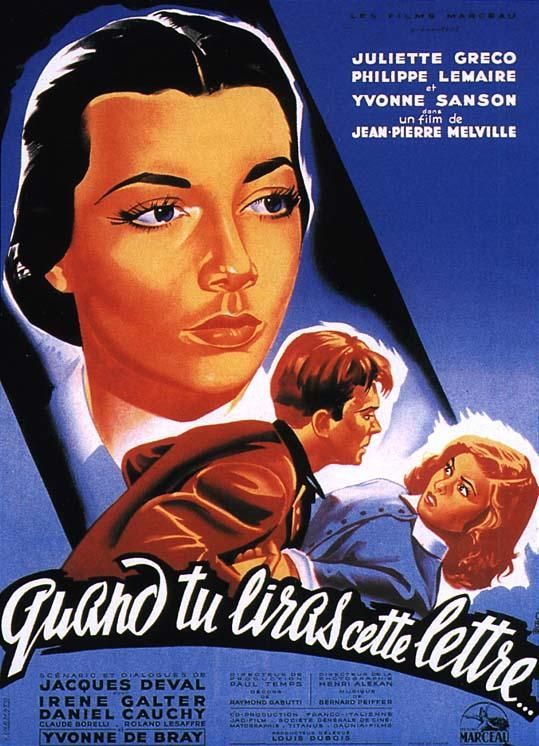
Quand tu liras cette lettre 1To be frank, I went to see Jean-Pierre Melville’s Quand tu liras cette lettre (When You Read This Letter) at the BFI last night simply out of curiosity to see what sort of a leading actress Juliette Gréco was in 1953. Screened in a beautifully restored 35mm print, the film is an old-fashioned melodrama in which Gréco plays a novice nun who leaves the convent in order to look after her younger sister, the naive victim of a handsome, libidinous rotter. There’s a rape, a murder, an accidental death under the wheels of an express train, a very nice Cadillac Series 62 convertible, and some lovely scenes of the Cannes waterfront before it all got spoiled.

There’s also a soundtrack, featuring harpsichord doodling and sepulchral church organ. It was composed by Bernard Peiffer, a French pianist who worked with Django Reinhardt and many big American names in Paris in the early ’50s before emigrating to the US in 1954, where he settled in Philadelphia and earned the praise of critical heavyweights such as Barry Ulanov and Leonard Feather. Kidney surgery preceded his death in 1976, at the age of 53, two years after his final appearance in New York, at the Newport Jazz Festival. He had spent the last years of his life teaching piano — among his students was the young Uri Caine — and performing in clubs in his adopted home city.

I was familiar with his name, but I’d never really listened to him. So I went on to YouTube, and was immediately entranced by his versions of “Lullaby of Birdland”, made in Paris just before he left Europe, and “All the Things You Are”, a late recording from Philadelphia. Here, then, is another fine French jazz pianist of the post-war years, to rank with René Urtreger and Martial Solal, with a profound gift for improvisation and a technical imagination and a highly chromatic sensibility that may have been set free during his early studies with Pierre Maire, a student of the great Nadia Boulanger, and later at the conservatoires in Marseilles and Paris.

Thanks to the programmers at the BFI, then, for an unexpected bonus from their excellent Melville season. This was the second and last screening of Quand tu liras cette lettre, but the programme continues through September and includes the director’s classics: Le Deuxième souffleL’Armée des ombres and Le Samouraï.

Han Bennink at Cafe Oto

Han Bennink

Cafe Oto, 12 August 2017: John Coxon, Han Bennink and Ashley Wales

The great Dutch drummer Han Bennink is famous for his anarchic humour and his resistance to orthodoxy: he’s known for using the heel of his boot to alter the tone of his drums on the fly, and for finding the music in the scenery of a club — if there are pillars or heating pipes in the vicinity, he is likely to start playing them. He has an unparalleled gift for terminating a collective improvisation with a slap of two pieces of metal or the sort of rimshot that brooks no negotiation. What’s sometimes overlooked is his ability to swing in the traditional meaning of the term. Of all the European drummers to emerge in the modern era, maybe only Phil Seaman commanded the same deep sense of swing.

But he’s always been a hard man to pin down. I first heard him with the German tenorist Peter Brötzmann in Berlin in 1969, playing the most uncompromisingly loud and violent free jazz you could imagine. Maybe 20 years later I heard him in Paris with a band led by the Italian trumpeter Enrico Rava, playing the music of Louis Armstrong’s Hot Five and Hot Seven, and you could tell that here was a man with a profound understanding of what Baby Dodds had been up to.

On Saturday, Han ended a three-night Cafe Oto residency in celebration of his 75th birthday with a series of collaborations in which his partners were the two men, the guitarist John Coxon and the electronics exponent Ashley Wales, together known as Spring Heel Jack; two guests from Amsterdam, the American violinist Mary Oliver and the Dutch guitarist Terrie Hessels, also known as Terrie Ex; and the pianist Steve Beresford. Amid the swirling anarchy, there were many moments when you could detect traces of the drummer who served a conventional rhythm-section apprenticeship with such visiting American giants as Eric Dolphy, Dexter Gordon and Wes Montgomery.

Since then Han’s career has taken him through countless collaborations. He first appeared with Coxon and Wales on Amassed, an early Spring Heel Jack studio album, in 2002. The following year they took him on a short Contemporary Music Network tour of Britain, along with the saxophonist Evan Parker, the pianist Matthew Shipp, the bassist William Parker and the guitarist J. Spaceman (Jason Pierce, with whom Coxon played in the band Spritualized). I saw that fascinating line-up give an epic performance at the Queen Elizabeth Hall — particularly in the second half, which began with a hyperactive duet between drums and bass and reached its climax in a long passage of richly textured improvisation over a mesmerising sequence of slowly descending piano chords that seemed, like an Escher staircase, to have no end. An album titled Live was assembled from the tour’s concerts in Bath and Brighton, and contains a version of that second half.

On Saturday, Han began with a trio set but soon left Beresford and Oliver to their own devices, listening from a chair at the side of the stage as they created a graceful two-part invention. Then the drummer was joined by Spring Heel Jack, creating a very different type of trio, the music constantly changing colours and momentum, restless but intensely satisfying (I loved a passage in which Coxon suddenly started running close-voiced jazz chords on his cherry-red Guild Starfire). Eventually Hessels, a member of the Dutch band the Ex, joined in, energetically lunging and retreating as he added jagged bursts of post-Hendrix noise.

After a third set in which the musicians joined in one by one until all six were together on stage, Han closed the evening with a short unaccompanied piece: brusque, urgent, very physical, unmistakably him but also unmistakably in the lineage of solo pieces by Dodds, Papa Jo Jones and Max Roach. This is a musician who stretched the vocabulary of his instrument, even changed it, while honouring and preserving the music’s essence.

Roscoe Mitchell’s ‘Bells for the South Side’

Roscoe Mitchell uncroppedI’ve been reading Message to Our Folks, Paul Steinbeck’s new biography of the Art Ensemble of Chicago, and enjoying in particular the reminder of the impact the group made when they arrived in Europe in the spring of 1969. Their voluntary exile lasted a month short of two years, ending with their return to the US in April 1971. During that time, which was mostly spent in France, they made some important albums (including A Jackson in Your House, Message to Our Folks, the epic People in Sorrow and the soundtrack to the film Les Stances à Sophie) and participated in several significant events, including the five-day Actuel festival in Amougies in October 1969 — intended, as Steinbeck observes, to be continental Europe’s answer to Woodstock and the Isle of Wight — and Joachim-Ernst Berendt’s Free Jazz Meeting in Baden-Baden two months later, where they encountered Kenny Wheeler, Terje Rypdal, Albert Mangelsdorff and many others. They also met the drummer Don Moye, who became their fifth member.

What the Art Ensemble did was free up the idea of how a modern improvising group could go about its business. Their motto — “Great Black Music: Ancient to the Future” — was startling at the time. In terms of form and structure, their unorthodoxy exerted a widespread influence. Doing away with the notion that modern jazz could only be played in groups employing certain instrumental combinations adhering to a particular balance, they made the use of “little instruments” — particularly percussive devices of all kinds — into an essential part of their strategy. Their costumes and face-paint brought a new dimension of theatricality and historical reference to the music, while their use of irony and satire extended its range of gesture and intention.

I was lucky enough to see them a couple of times in the 1970s, at their New York debut in Central Park in 1973 and at the Roundhouse in London half a dozen years later, and they were spellbinding on both occasions. (Brian Case, reviewing the Roundhouse gig in the Melody Maker, said that “it made nonsense of any critical reading, save surrender.”) Two members of that group — the trumpeter Lester Bowie and the bassist Malachi Favors — are now gone, but the spirit of the Art Ensemble suffuses Bells for the South Side, the new album by their former colleague Roscoe Mitchell, the great saxophonist and composer.

This 2CD set was recorded live in September 2015 at the Museum of Contemporary Art in Chicago during a project in celebration of the 50th anniversary of the Association for the Advancement of Creative Musicians, in which Mitchell and the other members of the AEC played a key role. For these performances the leader was joined in a series of four trios and aggregated larger groupings by James Fei (reeds and electronics), Hugh Ragin (trumpets), Tyshawn Sorey (trombone, piano, drums and percussion), Jaribu Shahid (bass, bass guitar, percussion), Tani Tabbal (drums, percussion), William Winant (vibes, marimba, percussion), Craig Taborn (piano, organ, electronics), and Kikanju Baku (drums, percussion).

For those interested in free improvisation and the way it can be directed by a great composer, here are two hours of music that provide a mosaic of marvels, from mysterious rustling and enigmatic flutters to thunderous epiphanies via passages of intense lyricism. Although the individual contributions can be isolated and admired, notably Ragin’s piercingly emotional piccolo trumpet, Taborn’s austere piano and Baku’s wild but beautifully controlled drumming, that’s not really the point. There is a much bigger picture here, just as there was in the Art Ensemble’s work. It reaches a wonderful resolution in a manner that I’m not going to spoil except to say that it achieves its full impact only if you’ve listened to the whole thing — or at least to the whole of the second disc.

As the personnel details suggest, percussion is important here, and it comes imbued with a strong sense of the Art Ensemble’s history. Baku — a young British drummer who wrote to Mitchell asking if he could play with him, and was immediately rewarded with a gig at Cafe Oto — plays Malachi Favors’ percussion set-up, Tabbal plays Moye’s kit, Winant plays Lester Bowie’s military bass drum and Sorey plays Mitchell’s own percussion cage, a thing of visual and aural wonder. The fine detail of the shifting textures is recorded by David Zuchowski and mixed by Gérard de Haro with Steve Lake, the album’s producer, to brilliant effect.

A few weeks ago, as part of a “financial stabilisation” programme, Mitchell was in danger of losing his teaching job at Mills College in Oakland, California. A petition to reverse the decision gained so much support that the college was forced to reconsider, and he remains in post as Darius Milhaud Professor of Music. For those who will come under his tutelage in the future, this is very good news. One way for the rest of us to celebrate might be to listen to Bells for the South Side, a perfect example of the continuing vitality and relevance of his imagination and a wonderful summary of his gift to generations of listeners and fellow musicians.

* Bells for the South Side is released on ECM Records. The photograph of Roscoe Mitchell is taken from the album’s insert. Message to Our Folks is published by the University of Chicago Press. Roscoe Mitchell and the latest configuration of the Art Ensemble of Chicago — with Hugh Ragin, Don Moye and the bassist Junius Paul — return to London for a short residency at Cafe Oto from October 15-17.

The return of Tony Kinsey

Tony Kinsey

At the Clock House: Dave Jones, Tony Kinsey, Tony Woods, Chris Biscoe

After six months off with an injury, the distinguished drummer Tony Kinsey returned to action last night, setting up his kit at the Clock House in Teddington High Street for one of the regular nights organised by the Way Out West collective, of which he is a member. WOW’s venues have included the Bull’s Head in Barnes and Cafe POSK, the Polish social club in Hammersmith; the latest location, the back room of a pub, feels appropriate to the informal vibe created by these West London-based musicians and their enthusiastic supporters.

Kinsey’s band mates on this evening were the double bassist Dave Jones and four saxophonists: Pete Hurt (soprano), Tony Woods (alto), Tim Whitehead (tenor) and Chris Biscoe (baritone). In the set I heard, they played in several different combinations.

The full sextet was assembled for the opener and closer, respectively Tadd Dameron’s “Good Bait” (arranged by the late Eddie Harvey, a co-founder of the collective) and Oliver Nelson’s “Hoe Down” (transcribed by Hurt). The four saxophones were alone on Woods’ arrangement of Herbie Hancock’s “Dolphin Dance”. The trio of tenor, bass and drums tackled “I Thought About You”. Alto, tenor and drums were heard on “Stella by Starlight”, for which Woods set Whitehead a puzzle by starting the piece in a fairly abstract kind of way, having given the tenorist a list of five songs from which the chosen one would eventually emerge — the correct answer was achieved pretty quickly. And alto, baritone and the rhythm section played a couple of tunes from Biscoe’s excellent recent album, Then and Now.

The occasional misunderstanding made a pleasant change from the blueprinted precision of so much contemporary jazz. “Moving on,” Whitehead declared brightly as Woods and Hurt debated a missed cue in “Good Bait”, to the audience’s amusement.

Kinsey, looking characteristically unruffled, played with superb empathy throughout. The elements of his style — the calm ride cymbal beat, the off-centre rimshots, the discreet brushwork, the crisp 2-and-4 hi-hat and the occasional bass-drum bomb — were perfectly deployed. This is a man who played with all the heroes of post-war British modern jazz — Tubby Hayes, Joe Harriott, Don Rendell, Johnny Dankworth et al — and with Billie Holiday and Ben Webster, and who in recent years has composed extended pieces for large jazz ensemble and string quartet.

Did I mention that, on October 11, Tony Kinsey will be 90?

John Coltrane 17 July, 1967

John Coltrane by Roy DeCaravaJohn Coltrane died in a Long Island hospital 50 years ago today. The singularly beautiful photograph above is by the great Roy DeCarava and was included in his wonderful book, The Sound I Saw. It was taken in 1960, and the figure dimly visible in the background is Elvin Jones.

My first encounter with Coltrane came through Miles Davis’s “Milestones”, in which he followed Cannonball Adderley and Miles with a solo that lifted an already elevated piece of music onto a different emotional plane. Then, because I’d bought a second-hand EP from a market stall, it was a quartet version of “You Leave Me Breathless” from his Prestige sessions. And then “Flamenco Sketches” from Kind of Blue. Then Giant Steps, My Favourite Things, Olé, “Chasin’ the Trane” and “Impressions” from the Village Vanguard, Africa/Brass, and, most of all, “Alabama”, his meditation on the racist murder of four schoolgirls in the 1963 Birmingham church bombing. Followed, of course, by A Love Supreme, CrescentAscension and the rest of the stages on his journey, all the way to its untimely conclusion.

No one had sounded like Coltrane before. No one had exerted that effect. The product of intense contemplation and rigorous preparation, his music expressed a constantly evolving spirituality with a transfixing directness that went beyond specific belief-systems and deep into the essence of human feelings. His legacy is immeasurable.

* Roy DeCarava’s The Sound I Saw was published by Phaidon Press in 2003.