Skip to content

Posts from the ‘Jazz’ Category

Cecil Taylor, himself

BLUNB002257701LP_74af92d8-06a1-4bc0-9d00-c183fe4be7d5

(Photograph: Francis Wolff)

Today’s news of the death of the great musical revolutionary Cecil Taylor at the age of 89 brought back the impact of his early recordings and the experience of hearing him live on several occasions across the decades. It also reminded me of the night I gave him a lift back to his hotel after his London debut in November 1969. My car at the time was a much-loved old Fiat 500, so small that you could have fitted it into the trunk of a New York taxi cab. Hardly a limo. Barely even a car at all, by American standards. Luckily, Cecil fitted quite neatly into its confined passenger seat and talked cheerfully on the drive from Hammersmith Odeon into the West End.

His set during that night’s concert — part of Jazz Expo 69, on a bill shared with Cleo Laine and the most desultory quartet Thelonious Monk ever led — had been nothing less than staggering. With Jimmy Lyons on alto, Sam Rivers on tenor and Andrew Cyrille on drums, he reshaped my understanding of focused intensity. The two saxophonists worked their way through Cecil’s intricate unison lines against the jabbing commentary of the leader’s piano and the shifting thunder and lightning provided by Cyrille. Occasionally the skies would clear for a brief passage of shining lyricism before the storm returned, seemingly redoubled in force.

I remember two things from later in the evening. The first followed my remark that such performances must be physically draining. No, Cecil said. “You don’t notice it. Let’s go and find a discothèque — it’s good for the feet.” The second, not unrelated, came when I accompanied him to his room at the Strand Palace Hotel for a short interview. On a table was a small record player, with a Stevie Wonder album on the deck. I was surprised — maybe I’d been expecting Bartók. “Stevie Wonder is tremendous — he reminds me of a preacher,” he said. “The arrangements have the excitement of Dizzy’s old band.” He meant Dizzy Gillespie’s incendiary big band of 1947; it was a strikingly unexpected comparison.

A few years later I heard a phenomenal solo set at Carnegie Hall and then, just after the turn of the millennium, a poetry recital, shared with Amiri Baraka, at St Mark’s-in-the-Bowery in the East Village. Baraka read “A Modest Proposal for Giuliani’s Disposal (41 verses which are also curses)”, a lacerating tirade inspired by the killing of Amadou Diallo. Cecil read skeins of words that came from some private place. The last time I heard him, in a duo with Tony Oxley at the Village Vanguard maybe five years ago, he read and played, and on that particular night the music seemed to have taken up residency in that same private place.

I suppose the records I love best are the earlier ones: the free-swinging “Charge ‘Em Blues” from Jazz Advance, the whole of Looking Ahead, “Pots” and “Bulbs” from Into the Hot, the epic “D Trad, That’s What” from the Café Montmartre album, all of Conquistador. Also Dark to Themselves from the ’70s and It Is In the Brewing Luminous from the ’80s. Above all, though, the monumental “This Nearly Was Mine”, a radical meditation on Richard Rodgers’ South Pacific ballad, from The World of Cecil Taylor, now almost 60 years old. I once asked the record producer Alan Douglas (who supervised Money Jungle and the Last Poets’ debut) which album he would most like to make. “Cecil Taylor playing standards,” he said, and I knew what he meant.

Here’s a clip of a performance at the memorial service for Ornette Coleman two years ago (I was led to it by a fine piece on Ethan Iverson’s blog, Do the Math). It’s a good way to remember Cecil as well: the piano playing slowed down to mortal pace for the occasion but every note tipped with obsidian, coming at you from angles that belonged only to to this most fearless and uncompromisingly original member of the avant-garde.
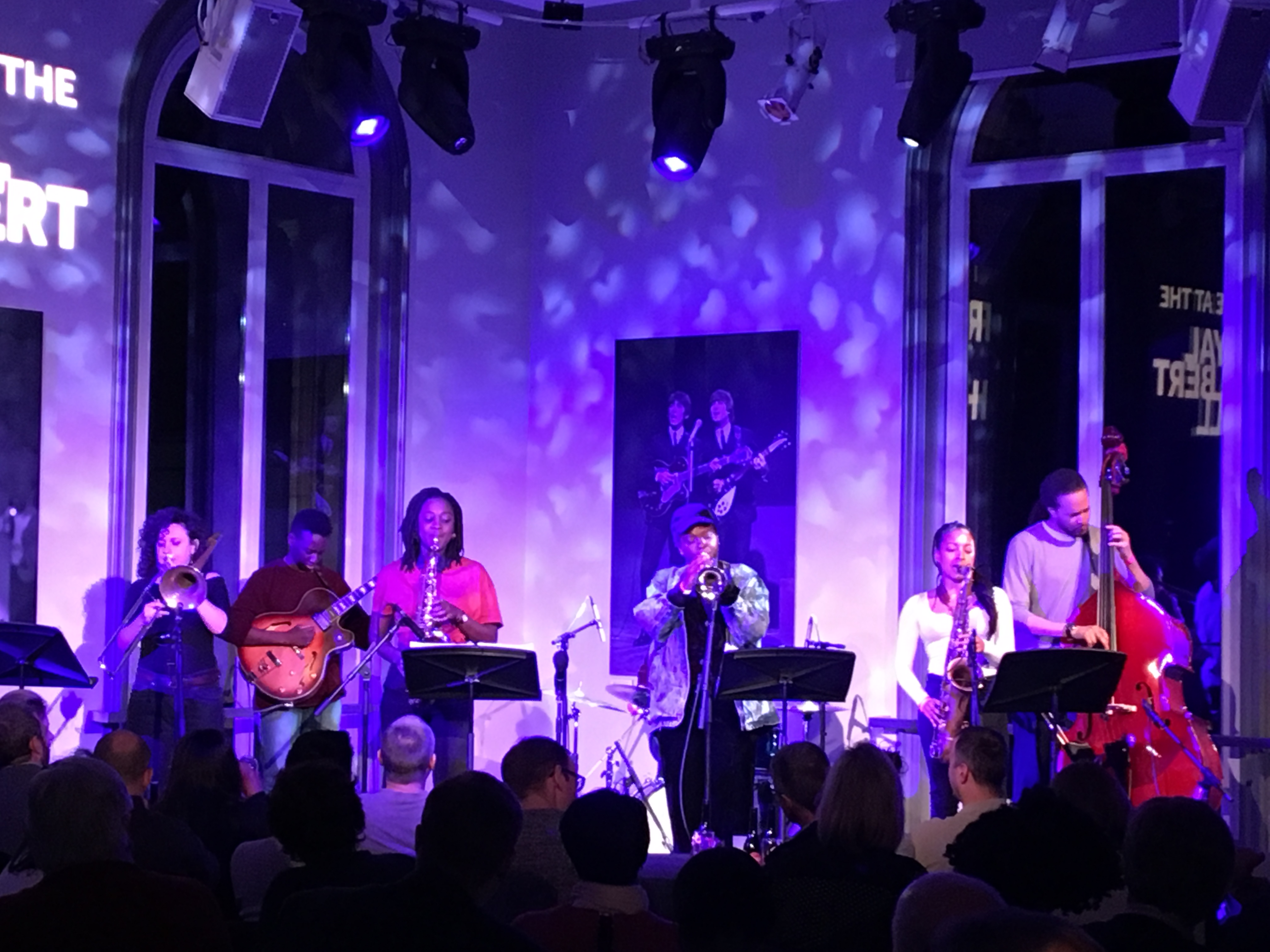
Nérija at the Albert Hall

Nérija 1

So maybe this London jazz boom is for real, after all. There was another piece about it in the New York Times last week, in which Giovanni Russonello extolled the Sons of Kemet’s new album while correctly praising the vibrancy of the scene that incubated Shabaka Hutchings and his colleagues. Last night I heard a bit more evidence in the intimate surroundings of the Albert Hall’s Elgar Room, where the septet called Nérija pulled a big and enthusiastic crowd.

Nérija are Sheila Maurice-Grey (trumpet), Rosie Turton (trombone), Cassie Kinoshi (alto saxophone), Nubya Garcia (tenor saxophone), Shirley Tetteh (guitar), Rio Kai (double bass) and Lizy Exell (drums). Several of them are graduates of the invaluable Tomorrow’s Warriors programme run for young musicians by Gary Crosby and Janine Irons. Last year they released an EP — you can listen to and download it here — which showed off qualities that were illustrated in greater depth during two half-hour sets packed with substantial original compositions, some of them written collectively and each showing a different facet of their character.

Their grooves are made for dancing, their tunes and solos for listening. The four-horn front line makes a pleasingly warm, fat sound, but is used with flexibility, sometimes dividing up within the written sections: trumpet and trombone together, or alto and tenor, or other combinations, thus keeping the textures fresh and the densities surprising. The solos are strategically placed within each composition so that the listener never gets the feeling of hearing a routine in progress. Often a piece has an unexpected ending: an epigrammatic tag, a rhythm section coda, a sudden diminuendo.

As soloists, the horn players are still developing but already show self-confidence and imagination. The formidable Garcia is currently the best known of them, but Maurice-Grey and Turton played several solos that would be outstanding in any context, while Kinoshi — whose playing has a bit of the Blue Notes’ Dudu Pukwana and the Skatalites’ Lester Sterling in it — preached with particular fervour on a composition of her own.

I love how they mix West and South African and Jamaican influences with hard bop and modal jazz, hip-hop, and no doubt other ingredients. The place where they all meet — the prism through which everything passes — seems to be the guitar of Tetteh, who powers the grooves with a fast, staccato chordal approach closer to funk than jazz, as well driving Kai and Exell to spirited climaxes behind the soloists. Her own improvisations are episodic but often contain startling juxtapositions of chordal passages with rippling single-note figures. I hear echoes of all sorts of things metabolised in her playing: Ernest Ranglin, Gabor Szabo, Michael Hampton, Grant Green, and the guys who played guitar with King Sunny Adé. I think she’s finding her way towards something special.

Although Nérija’s approach has been carefully planned, the music never feels tricksy. There are music stands on stage, but they don’t get in the way of spontaneity and a compelling immediacy. There are rough edges, but in a Mingus-y sort of way, which can only be good. You feel that if they were ever completely smoothed away, the fun would stop. Which hardly seems imminent.

The story of Al Duncan

Al Duncan

Long before I knew his name, I was hooked on Al Duncan’s playing. In the autumn of 1963 the Impressions’ “It’s All Right” came on the radio, with its beautiful drum fills. Over the next couple of years there followed a procession of Curtis Mayfield-written songs by the Impressions and Major Lance, driven — like “Delilah” and “I Need You” — by that very distinctive drumming, so clean and relaxed.

Along with Motown’s Benny Benjamin in Detroit and Stax’s Al Jackson Jr in Memphis, Duncan propelled the cream of mid-’60s soul. Eventually I discovered his name, along with the information that he played a lot of blues, R&B and soul sessions in Chicago for Vee-Jay, Chess and other labels before being supplanted by a younger man, Maurice White (later, of course, the co-founder of Earth Wind & Fire). But I didn’t know anything else until this week, when I bought the new issue of Blues & Rhythm, the fine British monthly magazine, and there he was on the cover.

The story is an interview taped in 1975 in Santa Monica by the writer Bill Greensmith, and never previously published. Duncan talks at length about his entire career, from his early days as an aspirant jazz drummer in Texas and Kansas City, playing with the bandleaders Ernie Fields and Jay McShann, to his collaborations with Mayfield, Little Walter, John Lee Hooker, Jimmy Reed, Willie Dixon, Phil Upchurch and many others, and his move in the 1970s to Los Angeles, where he played with people like Red Holloway but seemingly failed to break into the session scene.

He died on January 3, 1995, aged 68. For me, this interview is priceless testimony from a man whose playing has been part of my life for more than half a century. So thanks, Bill Greensmith, for disinterring it, and to the editors of Blues & Rhythm for not only publishing it but making Al Duncan their cover star.

Buell Neidlinger 1936-2018

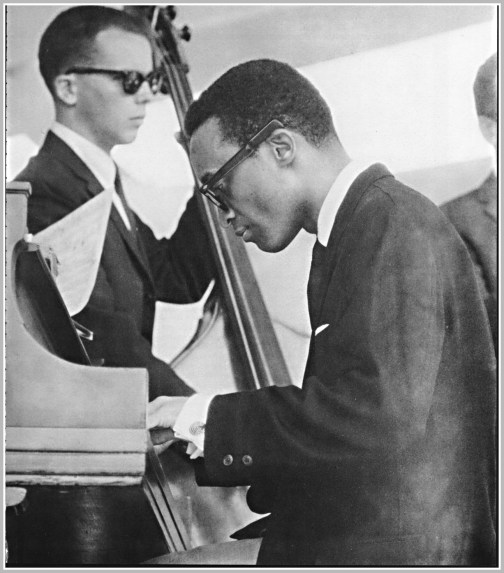
Buell Neidlinger w CT at Newport 57

Buell Neidlinger (bass) and Cecil Taylor (piano) at Newport in 1957

What turned out to be Buell Neidlinger’s final contribution to this blog arrived on March 9, in response to a piece about Keith Jarrett’s latest release. Buell had seen the accompanying photograph of Jarrett, Gary Peacock and Jack DeJohnette relaxing on stage at Boston’s Symphony Hall: “Thought I recognised the floor… worked there for three years,” he wrote. In 1967 he had joined the Boston Symphony Orchestra and also the faculty of the New England Conservatory of Music, where he taught bass and chamber music and, with George Russell, established the first jazz department of a major music school.

It astonished me when Buell sent some words to this blog, commenting on something I’d written about Cecil Taylor. His participation in Cecil’s trio version of “This Nearly Was Mine” made a huge impression on me when I first heard it in the early ’60s. It remains a favourite, not least for the way Buell’s bass shadows Taylor’s piano inventions with such devotion and beautiful note-choice.

As a young cello prodigy, born in New York City and brought up in Connecticut, Buell studied with Gregor Piatigorsky and had lessons from Pablo Casals. After switching to double bass, he played with Billie Holiday and Lester Young, with Hot Lips Page and Herbie Nichols, with Igor Stravinsky and Leopold Stokowski, with Cecil Taylor and Ornette Coleman, with Barbra Streisand and Frank Sinatra, with John Cage and George Crumb, with Duane Eddy and Roy Orbison, with Sir John Barbirolli’s Houston Symphony and Neville Marriner’s LA Chamber Orchestra, with the Beach Boys and Earth Wind & Fire, with Frank Zappa and the Eagles.

The instrument he played on “This Nearly Was Mine” was the same one he used on “Hotel California”. Once owned by King George III, it had been played in the first performance of Handel’s Messiah. “I sold it years ago to a girl in Hollywood for $15,000,” he told me during the course of our only conversation, on the telephone from his home in Washington State.

He also talked about his friendship with James Jamerson, whom he had met in a Hollywood studio. Buell had acquired his first bass guitar in 1953, but by the time he bumped into Jamerson on a Michael Jackson date he had become a first-choice double bassist in the studio orchestras. “Basically he was through already,” Buell said. “When Berry Gordy moved to LA, he basically signed the death warrants of a bunch of great musicians.”

Neidlinger remembered the Motown studio in Hollywood as the first place he worked where they had a transmitter. “You’d cut your shit,” he said, “and you’d go out to the car park and listen to it on the radio. If it didn’t sound good, you’d go back and do it again.”

He also remembered Jamerson’s addiction to alcohol. “He was living in a motel on Hollywood Boulevard. It was pretty ugly. After we had a meal on Santa Monica Boulevard, he invited me back. Whisky and gin bottles everywhere. He had a sliding closet. There weren’t many clothes in there, but there was his upright bass with no case. He played Fender bass on the Motown hits, of course, but really he was an upright bass player.”

Buell had strong views about everything, including bass players. He thought Paul Chambers was the greatest bass player who ever lived. He liked players who didn’t try to play the instrument as if it were a guitar, playing too many notes at the top of the instrument’s range. (This was a man whose first paying job in New York was as a dep for the ailing Walter Page, who had been the bassist in Count Basie’s pre-war band.) When Maurice White died, he sent a note to the blog saying that the EW&F man was the greatest drummer he’d ever recorded with.

In his later years Buell moved to Washington State, where he lived with his wife, Margaret Storer, another bassist. He had a group called Buellgrass, including the fiddler Richard Greene, which played his version of bluegrass music, and he and Margaret played baroque music with friends — he back on cello, she on violin.

Did I mention that he depped in Thelonious Monk’s quartet for a night at the Five Spot in 1957, alongside John Coltrane and Shadow Wilson? And for Charlie Haden in Ornette’s quartet in 1959, also at the Five Spot? And that his first No 1 was Tony Bennett’s “I Left My Heart in San Francisco”, on which he played in the string section? He seemed to have cherished every note, every encounter, every experience. I’m not sure there’s ever been anyone quite like him, or will be again.

Keith Jarrett’s ‘After the Fall’

Keith Jarrett TrioIn the summer of 2000 I spent an hour across a table from Keith Jarrett in a rooftop restaurant overlooking the Baie des Anges in Nice. Infuriatingly, he chose to conduct the conversation while wearing mirror shades. An interviewer tries to establish some kind of rapport with his/her subject, in which eye contact plays a part; the shades meant that I spent the hour staring at reflections of myself. I thought it was discourteous, and possibly a bit passive-aggressive. Somewhat wryly, I thought back to the morning 30 years earlier when he had wandered unannounced into the offices of the Melody Maker, a couple of days after his appearance with Miles Davis at the Isle of Wight, hoping to persuade someone to interview him.
Anyway, he talked interestingly. He was in Nice with Gary Peacock and Jack DeJohnette, his fellow members of what had become known as the Standards Trio. They were on their first tour since Jarrett’s recovery from a bout of chronic fatigue syndrome, which had left him unable to play for two years. His gradual recovery had been indicated by the release of a solo album titled The Melody At Night, With You. Its gentle, almost unadorned treatments of standards and folk tunes, recorded at his home, make it a special favourite of mine. “I learnt something about playing the piano,” he told me when I asked him about it. “The heart determines where the music comes from, and there was more heart in that recording than there was virtuosity, but what I had as a pianist I put into the heart place, and that can translate into other contexts.” (You can read the whole interview, published by the Guardianhere.)

Now we have a new release of a trio album made during that period (in November 1998, in fact) at the New Jersey Performing Arts Centre in Newark, not far from Jarrett’s home. Called After the Fall, it’s a document — like The Melody at Night — of a man testing the state of his physical powers, on this occasion with the support of his two musical soulmates.

Wanting to keep things simple, they stuck to bebop and standards. “When I first came back to playing, I didn’t want to play as hard,” Jarrett told me in Nice. “I didn’t want to dig in to the piano as much. Bebop was the right thing to do, because there’s a lightness to it.” But isn’t bebop a notably athletic and competitive idiom, perhaps unsuited to convalescent therapy? “Yes, but it’s light-footed, if you think about it. Playing in large halls with the trio, and trying to project to the people, I ended up playing hard, and I didn’t want to do that. With bebop the phrasing is more like a voice phrasing, because most of the bebop players – except maybe Bud – were horn players. I wanted to have a chance to phrase like that.”

There’s no sense of frailty in evidence. Instead there’s a leanness and a clarity that make it exceptional. Jarrett is a great bebop player: a passage six minutes into Bud Powell’s “Bouncin’ with Bud” finds him unspooling a line that would make the tune’s composer stand and applaud, and there are moments of similar exhilaration on Charlie Parker’s “Scrapple from the Apple” and John Coltrane’s “Moment’s Notice”. He plays the blues elegantly on Pete La Roca’s “One for Majid”, produces characteristically lustrous ballad readings of “Late Lament” and “When I Fall in Love”, and exposes his sense of humour on “Santa Claus Is Coming to Town”. A 15-minute version of “The Masquerade Is Over” devolves from its medium-up tempo through a beautiful collective transition into the coolest lope imaginable, while a 13-minute “Autumn Leaves” ends on a glorious Latin groove, rocking along to Peacock’s bass riff .

The fact that many of these tunes feature on the trio’s earlier albums shouldn’t deter anyone from investigating After the Fall. This is Jarrett with the shades off, the defences down, temporarily shorn of the extremes of his virtuosity but looking us straight in the eye. The music’s limitations, such as they may be, turn out to be the foundation of its strength.

* After the Fall is out now on the ECM label. The photograph of Jack DeJohnette, Keith Jarrett and Gary Peacock is by Patrick Hinely.

‘Rhythm & Reaction’

Rhythm and Reaction 3

William Waldorf Astor, the richest man in America, had made a new home in England by the time he bought the late-Victorian Gothic mansion known as Two Temple Place in 1895. Set on the north bank of the Thames between Waterloo and Blackfriars bridges, it became the headquarters for his various business and philanthropic interests. At a cost of $1.5m — imagine how much that would represent in today’s money — he turned the interior into a riot of mahogany staircases, ebony pillars, marble floors, cedar panelling and staggering stained glass. He was 71 when he died in his bath at home in Brighton in October 1919, six months after the Original Dixieland Jazz Band had arrived in London to play at the Palladium, the Hippodrome and Hammersmith Palais and, astonishingly, at Buckingham Palace for King George V.

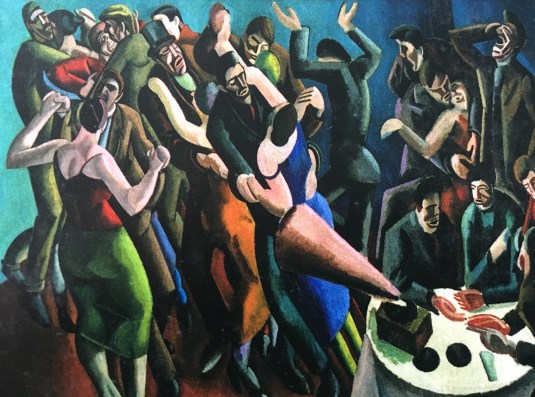
A century later, there’s a less tenuous connection between the building and the band. Rhythm & Reaction: The Age of Jazz in Britain is an exhibition illustrating aspects of Britain’s embrace of the music in its early decades, from minstrel shows to the end of the inter-war period. Curated by Professor Catherine Tackley, head of music at Liverpool University, it does a pretty good job of conjuring the atmosphere of Britain in the Jazz Age, via ancient banjos and drum kits, 78rpm discs, books (including Al Bowlly’s guide to crooning), blown-up photographs (Ellington arriving at Southampton docks in 1933, for example), early copies of publications such as the Melody Maker and Rhythm, paintings (including William Patrick Roberts’s “The Dance Club” of 1923, above), fabrics and ceramics, bakelite wirelesses, and Wyndham Lewis’s 1912 design for the programme and menu at the Golden Calf, a West End cabaret club.

Rhythm and reaction 4

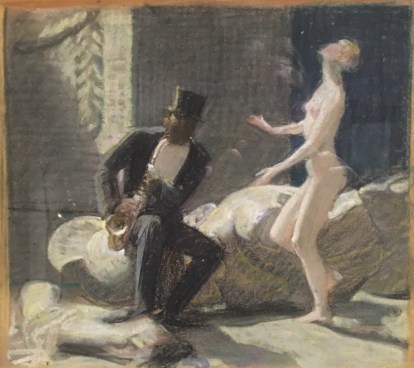
Perhaps the most haunting exhibit is a pastel study for a work called “The Breakdown”, painted in 1926 by the Scottish artist John Bulloch Souter for the summer exhibition of the Royal Academy of Arts. At least one of the layered meanings of this study of a formally dressed black saxophonist sitting on a broken piece of classical statuary as a naked white woman dances to his music was provocative enough to upset the Colonial Office, which complained that it was “obnoxious to British subjects living abroad in daily contact with a coloured population.”

The Melody Maker had already joined in with an extraordinary editorial which, after admiring the artist’s technique, inveighed on behalf of dance-band musicians against “the habit of associating our music with the primitive and barbarous negro derivation…” The painting, it claimed, was “not only a picture entirely nude of the respect due to the chastity and morality of the greater part of the young generation but in the degradation it implies to modern white women there is the perverse anger to the community and the best thing that could happen to it is to have it… burnt!”

Forced to withdraw his painting, Souter destroyed it, leaving only the pastel study (above) and a version he recreated in oils in 1962, which is also on show.

Almost every aspect of Rhythm & Reaction deserves study in greater depth — e.g. minstrelsy, “jazz” motifs in the decorative arts, the “rhythm clubs” formed by the music’s early adherents — but as it stands the exhibition does an effective job of prompting reflection on an important phenomenon. It would be of particular interest, I think, to young members of the newest and highly multicultural generation of British jazz musicians, who might find it enlightening and (despite the fate of “The Breakdown”) even inspiring.

* Rhythm & Reaction is on show at Two Temple Place until April 22, daily except Tuesdays (information on opening hours and special events: https://twotempleplace.org). “The Dance Party” is on loan from Leeds Museum and Art Gallery. The pastel study of “The Breakdown” is from a private collection. Those who want to know more about the subject should read the late Jim Godbolt’s A History of Jazz in Britain 1919-1950, republished in 2010 by Northway Books.

Elaine Mitchener’s ‘Sweet Tooth’

Elaine MitchenerThe architect Nicholas Hawksmoor completed St George’s, Bloomsbury, one of his half-dozen London churches, in 1730, at a time when the transport of slaves from Africa to the New World was booming, with Britain the biggest trafficker. It was built to serve a prosperous parish, although its tower can be glimpsed in the background of Hogarth’s ‘Gin Lane’ engraving of 1751, the artist’s depiction of the low-life inhabitants of the Rookery, as the tenements of nearby St Giles were known. More recently, in 1937, the church welcomed Emperor Haile Selassie at a requiem for the dead of the Second Italo-Abyssinian war, a particularly bloody three-year conflict featuring the use of mustard gas by Mussolini’s troops on the Ethiopian army.
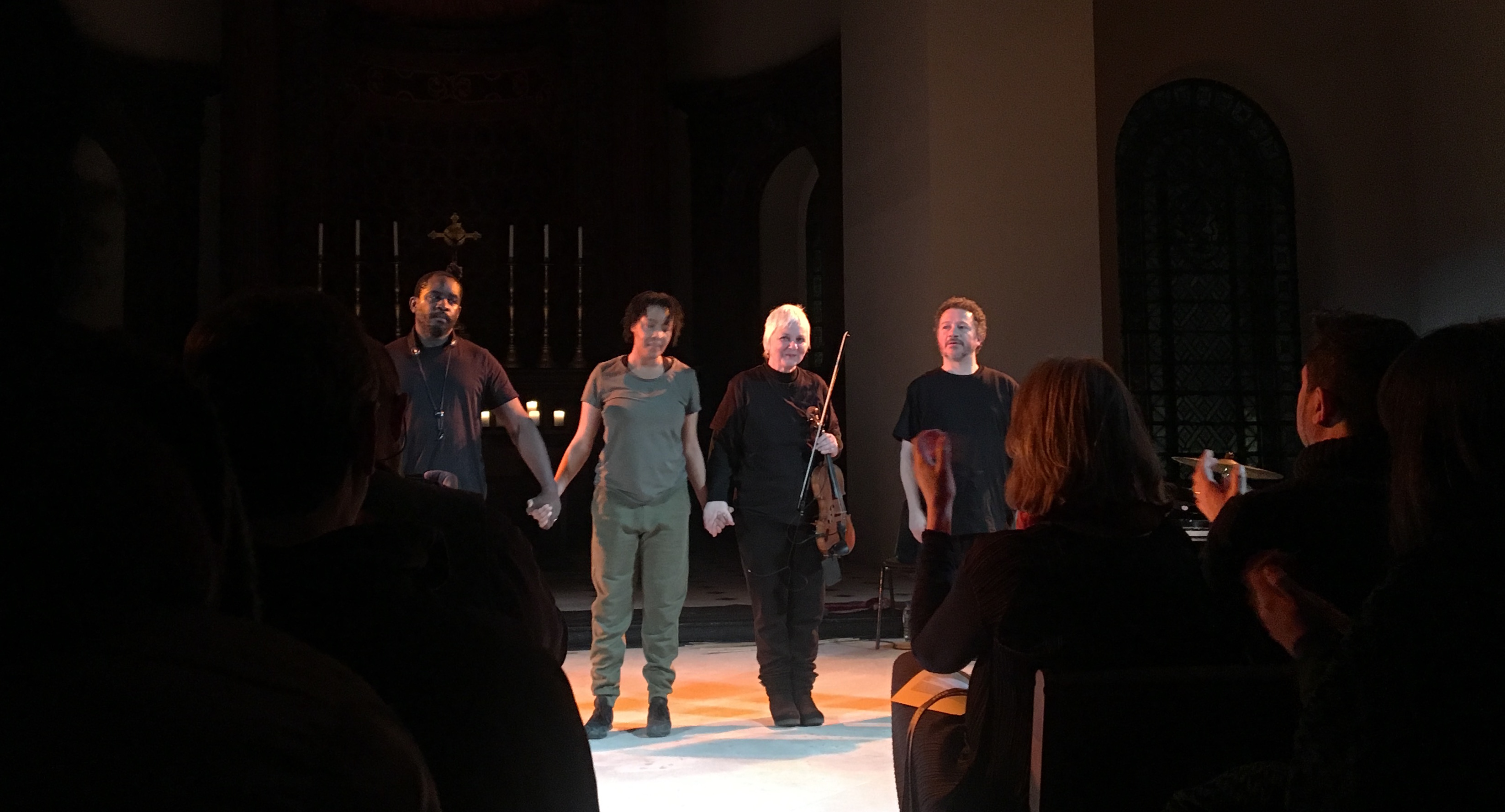
Slavery and, by association, colonialism are the subjects of Elaine Mitchener’s “Sweet Tooth”, which received its first London performance in the beautifully restored interior of St George’s last night. A theatre piece, specifically related to the use of slaves in the sugar industry, it makes use of Mitchener’s talents as singer, dancer and actor, as well as those of three distinguished improvisers: the violinist/accordionist Sylvia Hallett, the saxophonist Jason Yarde and the drummer Mark Sanders. All four become performers in the piece, choreographed by Dam Van Huynh and lit by Alex Johnston.

Hallett began alone, accompanying her scraped double stops with strange amplified vocal ululations. Mitchener entered, wailing and shrieking in a wordless expression of fear and anguish, writhing as if resisting the constraint of chains, joined in duets first by the yelps and barks of Yarde’s baritone saxophone and then by Sanders’s small hand drums.

The piece proceeded through six “chapters”. In one, Mitchener re-enacted an auction by reciting the names, attributes and prices of individual slaves, at one point continuing to list them while lying face-down on the stone floor of the central aisle. In another, she used the third finger of each hand to stretch her mouth, creating the terrifying effect of the “scold’s bridle”; this went on for several minutes as the distortion reduced her attempts to speak to a whimper (and you feared her mouth might never return to its proper shape). Towards the end each performer took up a bundle of thin canes, using them to brush the floor and whip the air as they moved freely around the space. Some of the music — which included passages of intense free improvisation — was inspired by an invocation song collected by musicologists in Jamaica and traced back to the BaKongo tribe of West Central Africa.

It was highly dramatic, of course, and at times harrowing, as it needed to be. Mitchener — who recently collaborated with the pianist Alexander Hawkins on an album of material including songs by Jeanne Lee, Archie Shepp and Patty Waters for the Intakt label, titled UpRoot — is a performer of great passion and uncompromising commitment. Those qualities, allied to a technical command of her various disciplines, are likely to make her a significant presence in the years to come. Last night she made Hawksmoor’s old stones shake.

* There is a further performance tonight — Friday, February 23 — at the John Hansard Gallery in Southampton. ‘Sweet Tooth’ was commissioned by Bluecoat, Liverpool; the Stuart Hall Foundation; and the International Slavery Museum.

Reuben Fowler’s ‘Black Cow’

reuben fowler 2

In my experience, jazz musicians tend to approve of Steely Dan. The mixture of sardonic outlook, funny chords and respect for fine improvisers seems to do it. Herbie Hancock, Ahmad Jamal, Christian McBride and Mel Tormé were among those who covered their songs. A few months ago I enjoyed hearing the students of the Guildhall School of Music’s jazz course performing variations on Donald Fagen’s classic album, The Nightfly. Now comes Reuben Fowler, a gifted young London-based trumpeter, composer and arranger, with a download-only big band version of “Black Cow” — track one of the Dan’s album Aja — whose proceeds will go to Cancer Research’s oesophageal cancer unit, in memory of Walter Becker.

Steely Dan’s music wasn’t jazz. A rock body with a jazz head, maybe. Anyway, it responds well to being played by jazz musicians, as it usually was on the original albums, as long as they don’t try to play tricks with it. Fowler’s “Black Cow” is respectful to the work put in on the slinky groove of the original by the likes of Joe Sample, Victor Feldman, Larry Carlton, Chuck Rainey and Paul Humphrey. Jason Rebello (Fender Rhodes piano), Rob Luft (guitar), Lawrence Cottle (bass guitar) and Ian Thomas (drums) hit all the marks, while Paul Booth’s muscular tenor solo loses nothing by a comparison with Tom Scott’s original. The Average White Band’s Hamish Stuart does a great job with the enigmatic lyric — a little hoarser and more wearied than Fagen, but that works, too. Fowler’s arrangement wisely plays it cool until the finale, when the power of four trumpets, four trombones and eight reeds filters through to stirring effect.

I’m not normally a fan of downloads and streaming, for reasons mostly to do with the shamefully inadequate way they remunerate the artists. In this instance, however, the music and the motive make it a must. It’s also a nice way to celebrate Aja‘s 40th anniversary (which was actually last September). And at some time in the future Fowler — who was born 12 years after that album made its appearance — might put together a whole album of this stuff, which would be a very nice thing indeed to have.

* “Black Cow” by the Reuben Fowler Big Band is released on the Ubuntu label and can be found on the regular download and streaming platforms, including Apple Music, Spotify, Deezer and Tidal. The photograph of Fowler is by James Gardiner Bateman.

Michael Mantler’s ‘Comment c’est’

Michael Mantler 1

What sort of music do we most need in these disturbed times? Something to soothe and console, certainly. Something to help us dance our way through the gloom, of course. Something to ensure, as well, that the finer instincts of the human mind remain open to stimulus. But perhaps most of all just now we need music that observes and warns. That’s the task of Comment c’est, a new extended work from the trumpeter-composer Michael Mantler which seems likely, at least to me, to be one of the most significant recordings of the year.

Born in Vienna in 1943, Mantler is probably still best known for what happened after he moved to New York in 1961 and teamed up with Carla Bley, with whom he founded the Jazz Composers Orchestra Association. His compositions for large ensemble were heard on the JCO’s first album in 1968, a series of bold compositions designed for soloists such as Cecil Taylor, Don Cherry, Gato Barbieri and Pharoah Sanders, all of whom were known at the time for their work with small groups. Since then his many recordings have included a symphony, an opera, and settings of the words of Samuel Beckett, Harold Pinter, Paul Auster and others, often featuring a regular cast of collaborators including Jack Bruce and Robert Wyatt. With Bley, he was also a member of the first edition of Charlie Haden’s Liberation Music Orchestra.

Comment c’est is an agitprop song cycle in 10 parts, written for the voice of Himiko Paganotti, Mantler’s own trumpet, and the Max Brand Ensemble, a 12-piece chamber group, augmented by the piano of David Helbock and conducted by Christoph Cech. Its subject is the hell we are in the process of creating: a 21st century hell, but with immemorial echoes.

The lyrics are in French — perhaps because that’s the language in which Beckett, a long-time inspiration for Mantler’s work, chose to write. (Beckett wrote a novel in 1961 called Comment c’est. The English translation is called How It Is, which is also Mantler’s subtitle. The two works are not otherwise related, as far as I can tell, although Mantler quoted some paragraphs from the Beckett in the booklet that came with the JCO album.) Here’s how the first song begins, in the English translation provided in the album’s booklet: “Today / like everyday / facing the news / ignorance, intolerance, chauvinism, bigotry, nationalism, dictatorships, hostilities, assaults, invasions, wars, methodical violence, ethnic cleansing, genocide, hatred, the horror / and again, and again, and again, again…”

So humanity repeats its follies, from which Mantler doesn’t flinch. The lyrics deal with fear of the other, the military-industrial complex, the spread of hatred, the return of torture (if it ever went away), and other currently relevant concerns. There is definitely a kind of bleak poetry here, in the mostly unadorned language which cuts from the eye of an all-seeing observer to the first-person testimony of a nameless participant, witness, or victim, and back again.

These are art songs, making use of Mantler’s command of both contemporary classical music and jazz to create an idiom perfectly suited to the through-composed structures. The voice of Ms Paganotti, a member of Magma for the last few years, is grave and poised, avoiding melodrama even in its most impassioned moments (such as on the song called “Sans fin”), matching its poignancy to the sober textures drawn from the ensemble of flute, oboe, clarinet, bass clarinet, French horn, tuba, two violins, viola, cello, double bass and vibraphone/marimba. The rhythms, although sometimes making use of a tuned-percussion ostinato, are usually episodic or rubato.

The prevailing mood is inevitably sombre but never gratuitously austere. Although restrained, the music is suffused with humanity. There are melodies here, if not necessarily the kind you sing along with, and Mantler’s concise solos — the music’s only improvised element, often responding to Ms Paganotti’s lines — stick in the mind. On a journey from Mike Westbrook’s Marching Song through Liberation Music Orchestra’s Not In Our Name, this could be seen as the next stop. Every minute of the album, all the way to its bleak ending, rewards concentrated attention. It would be wonderful to hear it performed live; it would be even better if, somehow, it could help to change the world.

* Comment c’est is released on the ECM label. The photograph of Michael Mantler is by Rainer Rygalyk.

Bebop and Basquiat

Basquiat Bird 3

There’s only another week in which to see Boom for Real, the big Jean-Michel Basquiat retrospective at the Barbican, before it closes on January 28. I left it until last week to pay my first visit and I’m going to try to go again. There’s a lot to see and I want to spend a bit more time thinking about his relationship with modern jazz in general and Charlie Parker in particular, which is what struck me most of all as I was going around the show.

Basquiat, who came to fame as a teenage graffiti artist on the streets of New York and died in 1988 at the age of 27, must have really loved Parker’s music. It can’t have been a pose. The names and phrases scrawled in many of the paintings show an intimate knowledge of Bird’s work. Crispus Attucks High School was the one Parker attended in Kansas City. Buster Smith was the alto saxophonist he admired in his apprentice years. Doris Sydnor was his third wife. Joe Albany was one of his pianists. Dial and Savoy were two of the labels for which he made his finest recordings. “Half Nelson”, “KoKo”, “Now’s the Time” and “Warming Up a Riff” were some of the tunes he cut. The Stanhope Hotel was where he died.

There’s a real feeling for jazz here. Not just Parker but Louis Armstrong, Duke Ellington, Thelonious Monk and Dizzy Gillespie are referenced in the works included in Boom for Real. Basquiat’s blend of the heroic and the grotesque seems to me a fair representation of an art form that had to fight its way first into existence and then towards acknowledgement. The harshness and challenges of a jazz musician’s life are as present in the paintings as the aesthetic value of what they produce. There’s a title of a Monk tune that sums it up: “Ugly Beauty”.

“Jean-Michel says his paintings are jazz on canvas,” Jennifer Clement writes in Widow Basquiat, a portrait of the painter’s relationship with his girlfriend, Suzanne Mallouk, first published in 2002. There’s a passage in which, having discovered that Billie Holiday’s grave has no headstone, he spends a weekend designing one with the help of his friend, the art curator Diego Cortez, while Suzanne makes trips to get them cocaine.

There are people who don’t appreciate the way Basquiat turned street art into something for which collectors now pay vast sums. To them, the $110.5m paid for one of his canvases last May, setting a record for a painting by any American artist sold at auction, represents an insult to the history of art. But I think he did something important in getting the spirit of the music on to canvas. I wish he could have done it without feeling the need to copy Parker’s heroin habit, but I’ve felt that about a lot of people and there’s really no point. Just go and look.

* Untitled (Charlie Parker) was painted in 1983 and is in the Barbican exhibition, on loan from the Schorr Family Collection.