Generally speaking, I prefer Bob Dylan to make his own cover versions, just the way he’s been doing for the best part of 60 years. There are maybe not even a dozen exceptions, mostly the obvious ones: Presley’s “Tomorrow is a Long Time”, Jimi’s “Watchtower”, Stevie’s “Blowing in the Wind”, the Fairports’ “Si tu dois partir”, Ferry’s “Hard Rain”, Betty LaVette’s “Things Have Changed”. But now there’s a definite addition to the list: Dave Alvin’s version of “Highway 61 Revisited”, a highlight of From an Old Guitar, his new album of rare and unreleased stuff.
To be honest, I haven’t followed the career of the singer/guitarist from Downey, California who started out at the very end of the ’70s with the Blasters and more recently led bands known variously as the Guilty Ones and the Guilty Women. My bad, as the young people say. From an Old Guitar is full of great stuff, drawing on country, blues, R&B and, in Lil Hardin Armstrong’s “Perdido Street Blues”, old-time jazz, with other songs from Mickey Newbury, Earl Hooker, Doug Sahm and Marty Robbins.
Dylan’s parable is set to a low-riding shuffle beat, the layered guitars of Alvin and Greg Leisz howling, nudging and screeching from multiple perspectives as the magnificent verses are recited in appropriately biblical tones. Alvin’s voice is one that wears its bruises, scars and calluses lightly, weighting and timing every line perfectly, drawing out the dark humour, simultaneously absurdist and apocalyptic. The video is well assembled and cut, particularly the chase towards the end between a hot rod and a Highway Patrol car on a two-lane blacktop.
My other favourite is a song called “Peace”, credited to Willie Dixon. It bears no resemblance to a song of the same name that gave the title to a 1971 Dixon album, but it carries the hallmarks of the composer of “Hoochie Coochie Man” and “The Seventh Son”. The buried hook — the thing that makes we want to listen to it again, straight away — is a funky little chorded figure from Joe Terry’s electric piano: peeping through two or three times, it seems to want to take the song in a different direction before thinking better of it and withdrawing.
I can happily listen to this album from start to finish, and then over again. Even better, I imagine, would be to wander into some bar or other — Dingwalls, perhaps, or the old Tramps on 15th Street in NYC — and drink a beer or two while listening to Alvin and his band working their way through the whole thing. One day, maybe. But whatever, that “Highway 61” is going to stick around.
* Dave Alvin’s From an Old Guitar is out now on the Yep Roc label.
GuitaristShirley Tetteh at Church of Sound during the EFG London Jazz Festival
Half an hour into BBC4’s special Jazz 625 programme on Saturday night, the journalist Emma Warren remarked that everybody in London’s new jazz scene has their own role to play. You might be making your contribution as a musician, or taking the money on the door. Or, she suggested, your role might be as the first person on the dance floor that night, leading the way for the rest of the audience to join in. That sense of collective commitment was strong throughout the programme.
Timed to coincide with the 2020 London Jazz Festival, the 90-minute show featured many of the most prominent names of the current scene: the drummer Moses Boyd and his band Exodus, the tenor saxophonist Nubya Garcia’s quartet, the trumpeter Sheila Maurice-Grey’s irresistible Kokoroko, the singer Poppy Ajudah with a searing Black Lives Matter song, the powerful Ezra Collective, the drummer Sarathy Korwar, the clarinetist Shabaka Hutchings with Sons of Kemet, the tuba-player Theon Cross with the rapper Consensus, and others. There were interludes exploring the work of Gary Crosby’s Tomorrow’s Warriors project in mentoring so many of the new generation, and a shift up to Manchester reflected the contributions of the trumpeter Matthew Halsall and the saxophonist Nat Birchall.
Boyd co-hosted the show with Jamz Supernova, and something he said was also striking. Every young black jazz musician, he remarked, knows what it feels like to play to a room full of middle-aged white people. And that’s fine, he added. But sometimes you want to play to people like yourself. A sequence of clips from Steam Down in Deptford, the Fox & Firkin pub in Lewisham, Total Refreshment Centre in Hackney Downs and other London venues in pre-pandemic times showed what he meant.
This music restores a sense of jazz’s old physicality. While strong on a belief in the tradition, it blends in elements of the music absorbed by younger players: hip-hop and its offshoots, reggae, Afro-beat. In that way, too, it recalls jazz’s origins as a musical broth, a bouillabaisse, a gumbo, embracing influences rather than distilling the flavour out of them.
It believes in rhythm and it believes in warmth. Communication is the priority, but without compromise. Lessons from the more abstract directions of contemporary jazz are deployed as extra tools. There are rough edges and signs of what some older listeners might see as naivety. But to watch and listen to the development of these musicians, to hear them stretching their limbs and discovering their own potential, is a thing of wonder and infinite pleasure.
In Saturday’s show the various groups were playing without an audience and in a socially distanced format. The same was true of the livestreams of the festival gigs I was able to watch. What really impressed me was that a movement nourished by the spontaneity and feedback of an intimate live setting proved able to flourish in a completely different environment. If they were being set a test, they passed it en bloc, with distinction.
The BBC4 programme is available now on iPlayer. Some of the livestreams from the festival are also free to watch, like the Charlie Parker centenary tribute from Church of Sound in Hackney, featuring Gary Crosby’s Groundation, with Nathaniel Facey on alto, Shirley Tetteh on guitar, Hamish Moore on bass and Moses Boyd on drums: a quicksilver set of Bird tunes and originals. Facey’s own quartet, completed by two of his fellow members of Empirical, the drummer Shaney Forbes and the bassist Tom Farmer, and the guitarist Dave Preston, were captured at the Green Note in Camden Town, letting air and light into knotty themes by the leader and the guitarist. And at Total Refreshment Centre the impressive young trumpeter/singer Emma-Jean Thackray led her quintet — Lyle Barton on keyboards, Matt Gedrych on bass guitar, Dougal Taylor on drums and Crispin Robinson on percussion — through a wholly absorbing, convincing and thoroughly contemporary investigation of the moods suggested by Bitches Brew 50 years ago.
Tickets were £12.50 to livestream Cassie Kinoshi’s SEED Ensemble and their guests performing an 80th birthday tribute to Pharoah Sanders at the Barbican, and that’s what it’ll cost you to catch up with it via the Barbican’s website. I can only urge everyone do make the investment, since Kinoshi presents an hour of music of the highest quality, carefully devised and packed with all the best qualities of the new London scene.
The core SEED line-up — Kinoshi (alto), Sheila Maurice-Grey and Jack Banjo-Courtney (trumpets), Joe Bristow (trombone), Hannah Mbuya (tuba), Chelsea Carmichael (tenor, flute), Shirley Tetteh (guitar), Rio Kai (bass) and Patrick Boyle (drums) — kicked off with the ever-hypnotic riff of “Upper and Lower Egypt” before being joined by the clarinet of Shabaka Hutchings (on a beautifully flighted “Astral Travelling”), the pianist Ashley Henry (a heartfelt “Greeting to Saud”), the percussionist Yahael Camara-Onono (“Elevation”) and the singer Richie Seivwright (“Love Is Everywhere”). The horn arrangements were perfect, the rhythm section subtle and skilful, each of the soloists offering something of substance.
“Catch you soon, when life is normal again,” Kinoshi told her invisible audience at the end of the set. But if it was sad not to be able to witness this music in person, to share the experience with the players and to make them feel the listeners’ response, it was wonderful to be able to hear it all, staged and played and recorded so beautifully in all the venues.
If you browse the festival’s website, you’ll find other fine performances available: the trumpeter Yazz Ahmed, the guitarist Hedvig Mollestad and the poet Moor Mother with Irreversible Entanglements are some of them. But maybe watch Jazz 625 first, all the way through. At a time when the streets of the city are drained of life, it’s a reminder of what’s waiting around the corner. If it doesn’t fill you with the kind of optimism that’s been in short supply for the past nine months, I’ll be very surprised.
Val Wilmer’s classic portrait of Ronnie Scott leaning against the entrance of his Frith Street club captures the man as most of us thought we knew him: the epitome of Soho cool. Ronnie’s, a new documentary written and directed by Oliver Murray, goes deeper to show us the man known to his intimates. Something that could easily have been banal and superficial becomes a sensitive and finely nuanced depiction of a life lived under pressures both external and internal.
The film is being shown on BBC4 this weekend and should be watched by everyone who ever set foot in the club, or even wished they had. It starts out conventionally enough, as if it is going be a straightforward celebration of the 60-year-old institution that has played host to Miles Davis, Sonny Rollins, Ella Fitzgerald, Dizzy Gillespie, Nina Simone, Chet Baker, Sarah Vaughan, Buddy Rich, Count Basie, Roland Kirk, Bill Evans and so many other famous names. Before long, however, it is describing the relationship between Ronnie and Pete King, his business partner, the man who kept the wheels turning when times got tough, as they often did.
They’re both gone now, but Murray brings them back to life through their own words and those of others, building a picture of two men united by stoicism, sardonic wit, and a love of music and (mostly) musicians. Ronnie’s complex character is fully explored, including his near-ruinous gambling habit and the depression that afflicted him — which, combined his inability to play the saxophone following extensive dental treatment, probably led to his death from what the coroner described as “an incautious dose of sedatives”.
Clips of many great musicians at the club keep things swinging along, but darker undertones gather in the second half and the final section is elegiac and extremely affecting. By acknowledging the darker truths, this superlative film makes us cherish the continued existence of Ronnie Scott’s Jazz Club even more.
* Ronnie’s is transmitted on BBC4 this Sunday, November 15, at 9pm.Here’sthe trailer.Val Wilmer’s photograph is used by her kind permission.
The challenge of putting on a jazz festival in November 2020 would be hard to overestimate. But for four days last week the 57th edition of Jazzfest Berlin presented music to the world with imagination and ingenuity, making the most of the available technology to bring musicians and listeners together in the era of social distancing.
The event’s customary home, the Haus der Berliner Festspiele, is currently being refurbished, so the festival’s director, Nadin Deventer, built a digital bridge between her alternative choice of home venue, Silent Green (a repurposed crematorium in the Wedding district), and the Roulette club in Brooklyn. Bands played in both spaces, alternating sets. Forty separate performances totalled 1,500 minutes of music, all of it broadcast via the ARTE Concerts network (and available to view for the next 12 months).
So, for instance, from Berlin we got to hear two of the expatriate American drummer Jim Black’s groups, a trio and a sextet, and the saxophonist Silke Eberhard’s expanded Potsa Lotsa band playing pieces by Henry Threadgill, who was to have been the festival’s special guest until the pandemic made physical travel from the US impossible. From Brooklyn we heard the intense saxophone/piano duo of Ingrid Laubrock and Kris Davis, the drummer Thomas Fujiwara’s sextet, with Ralph Alessi on trumpet and Mary Halvorson on guitar, the altoist Lakecia Benjamin paying homage to Coltrane, and the pianist Craig Taborn’s new trio, with Halvorson and the drummer Ches Smith. And many others in both locations.
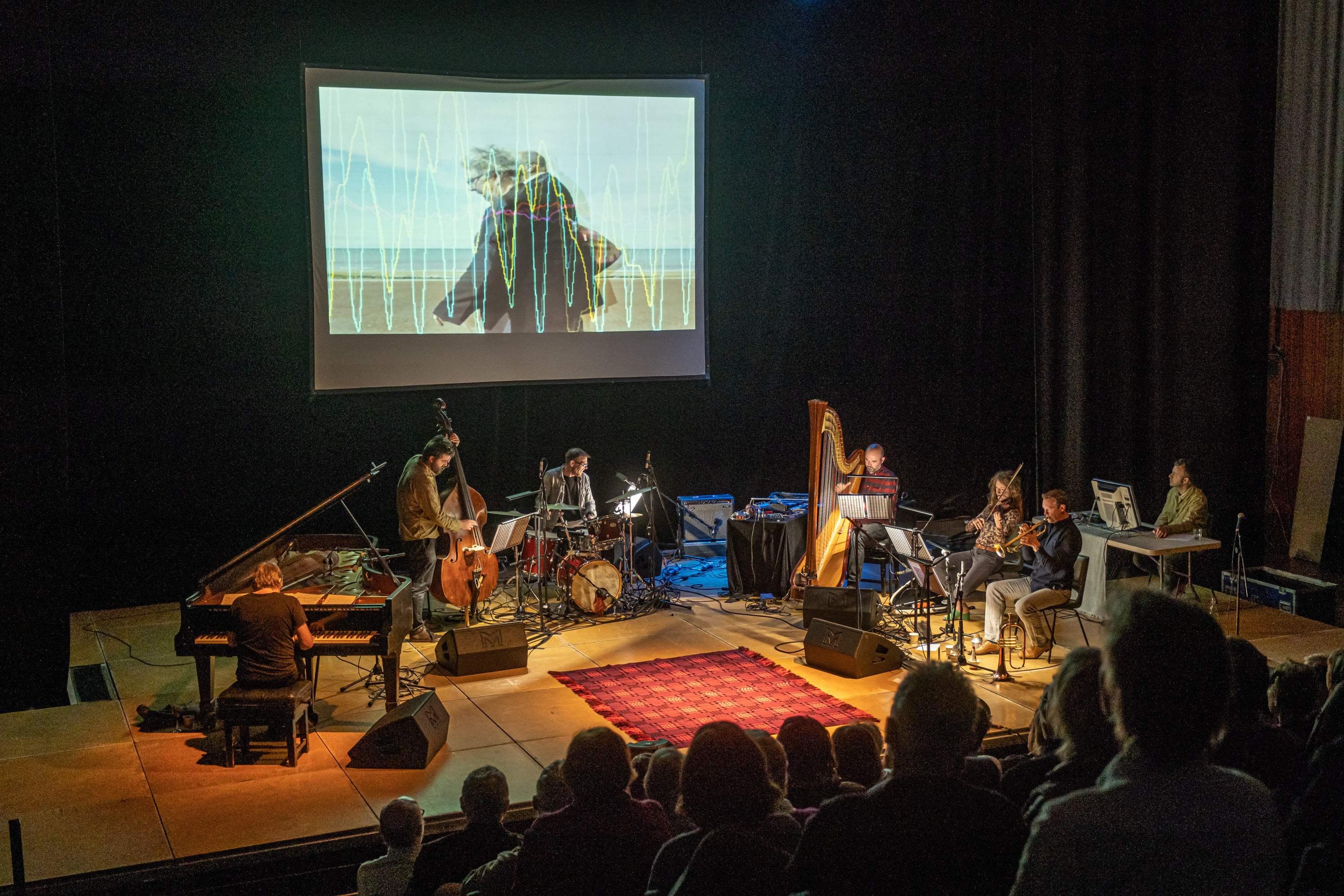
The set that nailed my attention was a 57-minute composition/performance by the British pianist Alexander Hawkins and the Berlin-based Lebanese poet, rapper and visual artist Siska, whose collaboration had to overcome the enforced inability of Hawkins and his two UK-based collaborators, Matt Wright (electronics) and Shabaka Hutchings (clarinet), to travel to Berlin. Instead they recorded their contributions to the piece, with Siska, the trumpeter Lina Allemano and the bassist Nick Dunston located in Silent Green and improvising on the template of Hawkins’s graphic and notated score, with the occasional appearance of film of First and Third World scenes and social rituals on a suspended screen sharing the space with the musicians and a large mirror ball used as a reflective light source.
The recent explosion in Beirut, Siska said, had inspired him to use Arabic lyrics he had written in the Lebanese capital between 2001 and 2008. Allemano contributed strikingly expressive interludes and accompaniments, while Dunston provided sonorous arco playing, a fluid drive when necessary and, to introduce the final section, a memorable solo of his own.
The composition began with plain electronic drones and overtones like something from a La Monte Young installation or a Necks studio album. Slowly unrolling through passages supported by prepared gamelan-like patterns, a clarinet ostinato and the whirring of a 16mm projector, it gradually gained emotional weight until achieving something very like catharsis in its closing passages: imagine, if you can, a fruitful meeting between the Art Ensemble of Chicago and Arthur Jafa, with a global perspective. If the meaning of Siska’s urgently whispered and muttered words was inscrutable to non-Arabic speakers, the accretional impact of the whole work was undeniable, at least in this corner of the digital auditorium. Here it is.
Jeremy Marre made so many great documentaries about music and musicians that a full retrospective would probably fill a 24-hour TV channel for the rest of the year, from Roots Rock Reggae in 1977 and Rhythm of Resistance (which inspired Paul Simon to write and record Graceland) two years later to profiles of Roy Orbison, Otis Redding, the Grateful Dead, Youssou N’Dour and countless others, plus Soul Britannia, Reggae Britannia and episodes of the Classic Albums series, including the one dedicated to Amy Winehouse’s Back to Black. When he died in March, aged 76, Marre left us a parting gift: a film on the life of the enigmatic Count Basie, shown on BBC4 last week and now available on iPlayer.
Bill Basie’s music was anything but enigmatic. Rooted in the cadences of the blues and the imperatives of 4/4 swing, it avoided the sophistication found in the work of Duke Ellington and Jimmie Lunceford and demanded nothing of those looking for straightforward enjoyment, as I found when I was lucky enough to see a late edition of the band at the Roseland Ballroom in New York City almost 50 years ago. Nevertheless it invited study that was always rewarded.
In 1930s recordings like “One O’Clock Jump” and “Taxi War Dance”, the Basie band brought the concept of riffing — as an armature for soloists and a lure for dancers — to a peak. And by pairing the contrasting elemental approaches of the tenor saxophonists Lester Young (air) and Herschel Evans (earth), the leader created one of the great stylistic juxtapositions. His own piano-playing, a minimalist reduction of his entire orchestral concept, epitomised the creative use of economy.
In public, however, Basie wore a mask. A genial, gracious mask, but still a mask. His greatest contemporary wore one, too, but Ellington’s relative effusiveness conveyed the illusion of intimacy with his audience. Basie was never aloof, but he gave away nothing of his own feelings.
The masterstroke of Marre’s film is to give us an insight, through the use of letters, autobiographical notes and home movies, into Basie’s existence offstage, and in particular with his family. He was, of course, out on the road almost all his adult life, but the revelation of the close relationship he and his second wife, Catherine, shared with their daughter Diane, who was born severely handicapped by what would now be diagnosed as cerebral palsy, is extraordinarily moving.
Count Basie Through His Own Eyes concentrates on the man rather than the music, which is lightly sketched through an excellent selection of clips and interviews with associates, including the drummer Harold Jones and the arranger Quincy Jones, and the critics Gary Giddins and Will Friedwald. The man himself comes alive in his own words and in those of surviving relatives.
Ten months a year on the road for 30 years took the man once billed as the Sepia Swing Sensation from the grind of touring the kind of towns where hotels turned blacks away to the sort of acclaim that enabled him to buy a retirement home in the Bahamas. He died in 1984, almost exactly a year after Catherine, whom he had met soon after his arrival in New York in the late ’30s, when she was a 15-year-old exotic dancer (her active involvement in the civil rights movement led her to take part in the March on Washington in 1963).
Marre takes us behind the imperturbable half-smile Basie wore while sharing the stage with Frank Sinatra or becoming the first African American to receive a Grammy (for The Atomic Mr Basie in 1958), showing us a man whose 42-year marriage had its ups and downs and who, as Jones puts it, “loved anything he could gamble with.” If I don’t quite buy Friedwald’s claim that Basie’s band was the favourite of the Luftwaffe’s wartime fighter aces, that’s a small hiccup in a valuable piece of work.
Fifty years ago Keith Jarrett wandered into the Fleet Street office of the Melody Maker, unannounced. He’d stayed on in London after playing with Miles Davis at the Isle of Wight and now he was looking for someone to interview him. I’d seen that performance from close quarters, and I was familiar with his work as the pianist in the Charles Lloyd Quartet — a band famous for taking jazz to the hippie audience — between 1966-68. So I told him that although it was a Monday morning and we were all busy chasing up news stories, I was happy to talk. I sat him down and took out my notebook and pen.
That interview came to mind the other day while I was writing about the revelation that health problems may have ended his performing career. So I searched for the cutting and found that — although it wasn’t what you’d call an in-depth piece — his words captured the thoughts of a man who was clearly ambitious but at that stage had no idea of what would begin happening to him a couple of years later. And what he said about his attitude to live performance is interesting in the light of his subsequent reputation for demanding the highest standards of audience etiquette.
That morning in London, his immediate priority was to let it be known that he was looking for work. He had his own European trio, and so far they’d played in Scandinavia, Belgium and Ireland. In the UK, however, no luck so far. “I’ve always found it difficult to get work in this country,” he told me. “Ronnie Scott’s expressed some interest, but they told me they’re booked up until March and I’ll probably be going home to the States for the winter.”
His European trio, he said, featured the bassist Gus Nemeth, formerly with Bernard Peiffer, and the drummer Bob Ventrelo. In America his trio was completed by Charlie Haden and Paul Motian. “Charlie’s working with Ornette Coleman and Paul’s gone with Arlo Guthrie, so I couldn’t bring them over.”
The lukewarm response from Ronnie’s reflected the fact that none of Jarrett’s three albums for the Vortex label, an Atlantic subsidiary, had been released in Britain. “They tell me that my albums don’t sell,” he said, “but how do they expect them to sell if people can’t buy them?”
Life Between the Exit Signs and Somewhere Before were trio sessions with Haden and Motian, while Restoration Ruin struck out in a different direction, featuring him singing and playing a variety of instruments, including guitar, harmonica and tambourine, sometimes with a string quartet. He was also now playing soprano saxophone and flute with his groups.
“I don’t think I’m getting away from jazz,” he said, “but I’m not as narrow. I don’t think about it, but if I believed I was playing jazz all the time, half my repertoire wouldn’t exist. There are a lot of variables in the group. Sometimes we play free for a whole set, and then sometimes we’ll play nothing but tunes. When I sing, it’s not like ordinary singing. It’s more like chanting, I guess.
“I haven’t been successful in getting people to let me record on soprano or flute. They say the audience thinks of me as a pianist, and they don’t want to hear me playing a horn. In fact I feel more like a drummer, although I don’t play drums with the group. I can really lose myself on drums, and my playing on other instruments relates either to my singing or my drumming — for instance, I try to make the piano sing, although it’s really a percussion instrument. I get a great feeling when I use it as percussion, but it’s too easy.
“I’m trying to make the soprano sound like a voice. That’s a big challenge, to push yourself through that little reed. I have no formal training on soprano, and that’s why I enjoy it so much. I’m not glued to making voicings by putting notes together like I am on the piano.”
Returning to the theme of getting work, he observed that although Europe was better than the scene at home, he could see it deteriorating. “Most of the places, even the Golden Circle in Stockholm, are turning into discotheques. The people sit there, half-listening to you and waiting for the records to come on. People still come up to me and ask me to play ‘Sombrero Sam’ and some of the other things I did with Charles (Lloyd), but I tell them that’s part of another era. The music we play is much more elusive than Charles’s, but people come in expecting to hear me play the old things. Audiences haven’t heard me properly until now because I’ve always been trying to escape from the groups I’ve been in. That made me play well, just to escape, and it’s much harder now I’m on my own.
“Wherever we go, the audiences have a need. If they’re talking, they may have to be shocked out of it, or caressed out of it, if they’re listening and expecting to be given something else, That’s what I’m struggling with, and it should make the music good.
“If everything is perfect, if the piano is in tune, if everyone is sitting quiet and expectant and all the audience are Keith Jarrett fans, then I don’t feel the need to play. It’s the worst possible situation. If the audience know that they like the group, it doesn’t matter what you play. It’s like someone giving a lecture when the audience knows what he’s going to say. That’s why I don’t play piano when I’m by myself. I couldn’t tell myself anything I don’t already know. So when I’m alone I play soprano or guitar, and I can still surprise myself on those instruments.”
As I started to close my notebook, he said that if he’d followed everybody’s suggestions, he would probably have achieved commercial success already. “But I’d be in a situation that would be too perfect, and when you’ve got nothing to bother about, you don’t say anything.” And off he went into the London streets, 25 years old and looking for work, with million-selling albums and packed concert halls still the faintest of lights behind a far horizon.
Many people around the world will be profoundly saddened by the announcement, made today in an interview with the New York Times, that a pair of strokes in the early months of 2018 are likely to have ended Keith Jarrett’s career as a public performer. The journalist Nate Chinen elicited the information that, after the second of those attacks, Jarrett spent the period from July 2018 to May this year in a nursing facility.
The pianist is back home now but the use of his left arm and hand have been lost, perhaps permanently. Just learning to pick up a cup again is a challenge. There have been memory issues, too: while trying to play long-familiar bebop tunes with his right hand, he finds he has forgotten them. It seems likely that his solo concert at Carnegie Hall in February 2017, during which he spoke out against a newly elected US president, will turn out to have been his last.
This is not the first time Jarrett’s career has been interrupted by a serious health problem: a long bout of chronic fatigue syndrome put him out of action for much of the second half of the 1990s. Its effects were apparent in The Melody at Night, with You, a home-recorded solo recital of restrained and quietly luminous versions of familiar tunes that constitutes one of the most cherished items in his extensive discography. He told me about the illness and his return to activity in a Guardian interview preceding a London concert 20 years ago. From what he says now, his recent problems are unlikely to reach such a welcome resolution.
The famous Köln Concert of 1975 doesn’t have the place in my heart that it occupies in those of many others, and I’ve sometimes grown exasperated with his solo recordings (two listens to the 10 LPs of the Sun Bear Concerts, recorded in Tokyo in 1976 and released a couple of years later, felt like more than enough). His self-belief has sometimes felt overpowering. But I loved Facing You, the first of his solo albums, on its appearance in 1972, and the Standards Trio (as the group with Gary Peacock and Jack DeJohnette became known) could perform miracles.
Coinciding with this week’s announcement is the release of a recording of the first date from his last European tour in the summer of 2016. The two-CD Budapest Concert presents 90 minutes of free improvisation (divided into 12 units) ranging from high-tension explorations of contemporary-classical techniques, pounding grooves, elegant extemporised balladry, refined but exuberant gospel-inflected outbursts, an astonishing two-part invention (Part VI) and, in the form of encores, romantic variations on two standards, “It’s A Lonesome Old Town” and “Answer Me, My Love”.
The repertoire strongly resembles that of Munich 2016, the set released last year, taken from the tour’s last concert. His devotees will want to explore the contrasts between the two, recorded a fortnight apart; for me, it’s a wholly satisfying summary of all the finest aspects of his playing.
Once can only wish Jarrett, who is now 75, the best of luck with his health, in the hope that his powers return — for his own sake, rather than for the benefit of an audience to whom he has already given the fruit of a lifetime’s work, and then some.
* Keith Jarrett’s Budapest Concert is released on the ECM label. The photograph, from the sleeve, is by Daniela Yohannes.
In normal times, the vibraphonist, drummer and percussionist Martin Pyne is involved in collaborations with dancers. When the Covid-19 lockdown began, he compensated for the enforced halt in that activity by spending part of May and June in his home studio, recording music for imaginary choreography. The result is Spirit of Absent Dancers, an album of 19 short solo pieces ranging from Tibetan prayer bowls to a standard drum kit.
In terms of percussion improvisation, try to imagine something that runs from the Zen sound-painting of Frank Perry to the light swing of Billy Higgins. There’s nothing loud, nothing showy, nothing esoteric. Just a delight in the deft touch of a stick, a mallet, a finger or a wire brush on metal, skin or wood, and in the process of transforming sound into a sense of movement.
When he’d finished recording, he sent the results to Yorke Dance Project, a contemporary dance company based in south-west London. Here’s a clip of what the dancer and choreographer Laurel Dalley Smith did with a solo vibraphone piece called “Enchantment”. And here’s a piece for drum kit called “Eidolon”, interpreted by Abigail Attard Montalto. And another, titled “Banshee”, danced by Jordan Ajadi.
We’ve needed a lot of protest music this year, for obvious reasons. But during a period of general anxiety, there has also been a place for music offering a diversion into reflective tranquillity. Spirits of Absent Dancers takes its place among a group of recent albums — others include Pete Judge’s Piano 2, Mino Cinelu and Nils Petter Molvaer’s SullaMadiana, and Stillefelt, by Percy Pursglove, Thomas Seminar Ford and Chris Mapp — that I’ve found particularly valuable in that respect.
* Martin Pyne’s album is on the Discus label. He took the photograph while on tour with Images Ballet Company in 2019. His recordings with his various jazz groups can be found at martinpyne.bandcamp.com
Torch singing wore thin for me a long time ago, around the time when all young female singers suddenly wanted to sound like Julie London and look like Rita Hayworth. Charlie Haden briefly rekindled the flame when he embedded Jo Stafford’s 1944 recording of “Alone Together” in his Quartet West album Always Say Goodbye in the early ’90s, and then did the job more thoroughly in a 2010 album called Sophisticated Ladies, for which invited a group of well known female singers to perform standards with the quartet plus strings. In the meantime I’d also fallen for Shirley Horn’s version of Tom Jobim’s “Once I Loved“, included by the film director Pedro Almodóvar on a compilation album called Viva La Tristeza.
Among Haden’s sophisticated ladies was Diana Krall, chosen by Haden to sing Gordon Jenkins’ “Goodbye”, one of my favourite ballads. I knew who she was, of course, but I always thought that if I needed what she did, I’d turn to Ms Horn. Now she’s proved me completely wrong with a new self-produced album called This Dream of You, consisting of 11 standards plus the title song, which is by Bob Dylan: pure torch singing in all its sloe-eyed sultriness, but controlled by an intelligence that knows how to turn its facets to catch the flickers of candlelight.
Krall has the regulation come-hitherness, but she also has the musicianship that inspired her to call on the services of several different musical units to join her own piano and voice: the guitarist Anthony Wilson, the bassist John Clayton Jr and the drummer Jeff Hamilton for lovely versions of “But Beautiful” and “Almost Like Being in Love”, Christian McBride’s bass and Russell Malone’s guitar for “Autumn in New York” and “There’s No You”, and the piano of Alan Broadbent (who arranged Sophisticated Ladies) to accompany her singing on “More Than You Know” and “Don’t Smoke in Bed”.
The most intriguing group, however, consists of Marc Ribot (guitar), Stuart Duncan (violin), Randall Krall (accordion), Tony Garnier (bass) and Karriem Riggins (drums). Together they’re heard on a light-fingered “Just You, Just Me”, the lovely Tex-Mex-tinged title track (plucked from Dylan’s Together Through Life), and “How Deep Is the Ocean”. The last of those, which you can click on above, is — as I’m sure you’ll agree — a complete stunner, Irving Berlin’s blithe love song transformed into a blues aria and perfect in every respect, particularly the short piano improvisation preceding the final chorus: 10 exquisitely funky bars of which Ray Charles or Bobby Timmons would be proud. Compliments to Ms Krall on that, and on everything else making up a quietly outstanding album.
Amid the flood of music commenting on the various crises confronting our world in the twenty-first century, it’s interesting to see that some of those who work with conventionally structured big bands are finding new ways to make their voices heard. In 2016, Darcy James Argue’s Real Enemies explored the paranoia of a society under surveillance while the Liberation Music Orchestra released Time/Life, in which Charlie Haden and Carla Bley did for environmental concerns what they had previously done for political protest movements. Now comes Maria Schneider’s Data Lords, a series of pieces in which the American composer expresses her disquiet over where the unscrupulous use of technology and our carelessness with the earth’s resources are leading us.
“I mourn the loss of our internal landscapes just as I mourn the loss of our external landscapes,” she writes in the notes. Data Lords not a sermon. It’s music, finely wrought: a suite of 11 movements, divided in two, on a pair of CDs. But it does have driving impulses. The first disc, The Digital World, reacts to the threat posed by mass data collection and artificial intelligence (in her notes, she quotes Stephen Hawking’s claim that beyond a certain point in the evolution of AI, it will turn on humanity and destroy it). The second, Our Natural World, reflects on what we stand to lose unless we find a way of turning back the tide of destruction.
Schneider was a pupil of Gil Evans, whose benign influence can be heard in the care with which she selects and combines her textures, with a special emphasis on rich and resonant writing for brass. Like him, she is brilliant at creating settings for the individual soloists among the 18-piece band on this recording. Those who distinguish themselves in their featured slots include the altoists Steve Wilson and Dave Pietro, the trombonist Ryan Keberle, the tenorists Rich Perry and Donny McCaslin, the baritonist Scott Robinson, the trumpeter Mike Rodriguez, the pianist Frank Kimbrough, the accordionist Gary Versace, the guitarist Ben Monder, the bassist Jay Anderson and the drummer Johnathan Blake.
The mood on the first disc is predominantly dark, ominous, fretful. Monder opens “A World Lost” with ruminative flights of sustain and light-touch distortion that show how profoundly Jimi Hendrix has influenced younger guitarists. McCaslin is eloquent on “CQ, CQ, Is Anybody There?” and Robinson is marvellously affecting on “Sputnik”, delivering pathos without sentimentality. The track “Data Lords” features Rodriguez making imaginative use of electronics over sombre writing that coils its tensions in a manner recalling some of Mingus’s late big-band pieces, with Anderson and Blake providing a free-flowing commentary.
The pieces on the second disc variously celebrate a temple in Kyoto, the work of the potter Jack Troy, the night sky, the words of the poet Ted Kooser, and birdlife. The mood is lighter, gentler, more optimistic, the tone set on the opening “Sanzenin” by Versace’s nimble, piping accordion: the sound of wind through reeds, the gentle swells of the brass and reeds echoing the surge of the instrument’s bellows. “Look Up” is a vehicle for Gilkes’s burnished tone and liquid articulation, over a gloriously mellow groove, while Pietro shines on the glowing “Braided Together”.
Concluding her notes, Schneider observes: “The internet doesn’t have to be all about secret surveillance, data exploitation, overreaching terms of use, and systems designed to make every human addicted to their services. It can be used to assist us all in making the world a better place.” She’s doing her bit, and Data Lords is highly recommended as a vigorous, vital, imaginative and lustrously beautiful part of the soundtrack to our times.
* The photograph of Maria Schneider is from the booklet accompanying Data Lords, and is by Briene Lermitte. The beautifully packaged album was made through and is available from ArtistShare, which facilitates fan-funded projects: http://www.artistshare.com