Skip to content

Posts from the ‘Jazz’ Category

Music for absent dancers

In normal times, the vibraphonist, drummer and percussionist Martin Pyne is involved in collaborations with dancers. When the Covid-19 lockdown began, he compensated for the enforced halt in that activity by spending part of May and June in his home studio, recording music for imaginary choreography. The result is Spirit of Absent Dancers, an album of 19 short solo pieces ranging from Tibetan prayer bowls to a standard drum kit.

In terms of percussion improvisation, try to imagine something that runs from the Zen sound-painting of Frank Perry to the light swing of Billy Higgins. There’s nothing loud, nothing showy, nothing esoteric. Just a delight in the deft touch of a stick, a mallet, a finger or a wire brush on metal, skin or wood, and in the process of transforming sound into a sense of movement.

When he’d finished recording, he sent the results to Yorke Dance Project, a contemporary dance company based in south-west London. Here’s a clip of what the dancer and choreographer Laurel Dalley Smith did with a solo vibraphone piece called “Enchantment”. And here’s a piece for drum kit called “Eidolon”, interpreted by Abigail Attard Montalto. And another, titled “Banshee”, danced by Jordan Ajadi.

We’ve needed a lot of protest music this year, for obvious reasons. But during a period of general anxiety, there has also been a place for music offering a diversion into reflective tranquillity. Spirits of Absent Dancers takes its place among a group of recent albums — others include Pete Judge’s Piano 2, Mino Cinelu and Nils Petter Molvaer’s SullaMadiana, and Stillefelt, by Percy Pursglove, Thomas Seminar Ford and Chris Mapp — that I’ve found particularly valuable in that respect.

* Martin Pyne’s album is on the Discus label. He took the photograph while on tour with Images Ballet Company in 2019. His recordings with his various jazz groups can be found at martinpyne.bandcamp.com

Relighting the torch

Torch singing wore thin for me a long time ago, around the time when all young female singers suddenly wanted to sound like Julie London and look like Rita Hayworth. Charlie Haden briefly rekindled the flame when he embedded Jo Stafford’s 1944 recording of “Alone Together” in his Quartet West album Always Say Goodbye in the early ’90s, and then did the job more thoroughly in a 2010 album called Sophisticated Ladies, for which invited a group of well known female singers to perform standards with the quartet plus strings. In the meantime I’d also fallen for Shirley Horn’s version of Tom Jobim’s “Once I Loved, included by the film director Pedro Almodóvar on a compilation album called Viva La Tristeza.

Among Haden’s sophisticated ladies was Diana Krall, chosen by Haden to sing Gordon Jenkins’ “Goodbye”, one of my favourite ballads. I knew who she was, of course, but I always thought that if I needed what she did, I’d turn to Ms Horn. Now she’s proved me completely wrong with a new self-produced album called This Dream of You, consisting of 11 standards plus the title song, which is by Bob Dylan: pure torch singing in all its sloe-eyed sultriness, but controlled by an intelligence that knows how to turn its facets to catch the flickers of candlelight.

Krall has the regulation come-hitherness, but she also has the musicianship that inspired her to call on the services of several different musical units to join her own piano and voice: the guitarist Anthony Wilson, the bassist John Clayton Jr and the drummer Jeff Hamilton for lovely versions of “But Beautiful” and “Almost Like Being in Love”, Christian McBride’s bass and Russell Malone’s guitar for “Autumn in New York” and “There’s No You”, and the piano of Alan Broadbent (who arranged Sophisticated Ladies) to accompany her singing on “More Than You Know” and “Don’t Smoke in Bed”.

The most intriguing group, however, consists of Marc Ribot (guitar), Stuart Duncan (violin), Randall Krall (accordion), Tony Garnier (bass) and Karriem Riggins (drums). Together they’re heard on a light-fingered “Just You, Just Me”, the lovely Tex-Mex-tinged title track (plucked from Dylan’s Together Through Life), and “How Deep Is the Ocean”. The last of those, which you can click on above, is — as I’m sure you’ll agree — a complete stunner, Irving Berlin’s blithe love song transformed into a blues aria and perfect in every respect, particularly the short piano improvisation preceding the final chorus: 10 exquisitely funky bars of which Ray Charles or Bobby Timmons would be proud. Compliments to Ms Krall on that, and on everything else making up a quietly outstanding album.

Maria Schneider’s ‘Data Lords’

Amid the flood of music commenting on the various crises confronting our world in the twenty-first century, it’s interesting to see that some of those who work with conventionally structured big bands are finding new ways to make their voices heard. In 2016, Darcy James Argue’s Real Enemies explored the paranoia of a society under surveillance while the Liberation Music Orchestra released Time/Life, in which Charlie Haden and Carla Bley did for environmental concerns what they had previously done for political protest movements. Now comes Maria Schneider’s Data Lords, a series of pieces in which the American composer expresses her disquiet over where the unscrupulous use of technology and our carelessness with the earth’s resources are leading us.

“I mourn the loss of our internal landscapes just as I mourn the loss of our external landscapes,” she writes in the notes. Data Lords not a sermon. It’s music, finely wrought: a suite of 11 movements, divided in two, on a pair of CDs. But it does have driving impulses. The first disc, The Digital World, reacts to the threat posed by mass data collection and artificial intelligence (in her notes, she quotes Stephen Hawking’s claim that beyond a certain point in the evolution of AI, it will turn on humanity and destroy it). The second, Our Natural World, reflects on what we stand to lose unless we find a way of turning back the tide of destruction.

Schneider was a pupil of Gil Evans, whose benign influence can be heard in the care with which she selects and combines her textures, with a special emphasis on rich and resonant writing for brass. Like him, she is brilliant at creating settings for the individual soloists among the 18-piece band on this recording. Those who distinguish themselves in their featured slots include the altoists Steve Wilson and Dave Pietro, the trombonist Ryan Keberle, the tenorists Rich Perry and Donny McCaslin, the baritonist Scott Robinson, the trumpeter Mike Rodriguez, the pianist Frank Kimbrough, the accordionist Gary Versace, the guitarist Ben Monder, the bassist Jay Anderson and the drummer Johnathan Blake.

The mood on the first disc is predominantly dark, ominous, fretful. Monder opens “A World Lost” with ruminative flights of sustain and light-touch distortion that show how profoundly Jimi Hendrix has influenced younger guitarists. McCaslin is eloquent on “CQ, CQ, Is Anybody There?” and Robinson is marvellously affecting on “Sputnik”, delivering pathos without sentimentality. The track “Data Lords” features Rodriguez making imaginative use of electronics over sombre writing that coils its tensions in a manner recalling some of Mingus’s late big-band pieces, with Anderson and Blake providing a free-flowing commentary.

The pieces on the second disc variously celebrate a temple in Kyoto, the work of the potter Jack Troy, the night sky, the words of the poet Ted Kooser, and birdlife. The mood is lighter, gentler, more optimistic, the tone set on the opening “Sanzenin” by Versace’s nimble, piping accordion: the sound of wind through reeds, the gentle swells of the brass and reeds echoing the surge of the instrument’s bellows. “Look Up” is a vehicle for Gilkes’s burnished tone and liquid articulation, over a gloriously mellow groove, while Pietro shines on the glowing “Braided Together”.

Concluding her notes, Schneider observes: “The internet doesn’t have to be all about secret surveillance, data exploitation, overreaching terms of use, and systems designed to make every human addicted to their services. It can be used to assist us all in making the world a better place.” She’s doing her bit, and Data Lords is highly recommended as a vigorous, vital, imaginative and lustrously beautiful part of the soundtrack to our times.

* The photograph of Maria Schneider is from the booklet accompanying Data Lords, and is by Briene Lermitte. The beautifully packaged album was made through and is available from ArtistShare, which facilitates fan-funded projects: http://www.artistshare.com

Bird at 100

Bird WD 1

Charlie Parker was born on August 29, 1920. A lot has been written in acknowledgment of his centenary**, about how he changed the way players of all instruments approached the business of playing jazz and about how his improvisations still sound newly minted. I’ve been thinking about those things, too, but also about what he might have left undone.

His final session in a recording studio, on December 10, 1954, three months before his death, saw him record two standards, “Love for Sale” and “I Love Paris”, at Fine Sounds in New York City for Norman Granz’s Verve label. Five takes of one, two takes of the other. Something caused the three-hour session, which would normally have produced five or six masters, to be truncated. Later the best takes of the two tunes formed part of an album called Charlie Parker Plays Cole Porter, the fifth volume of a posthumous series titled The Genius of Charlie Parker. His solos were adequate, but the deployment of the quintet format — alto, piano, guitar, bass and drums — offered him nothing new, no fresh stimulus. The Latin vamp behind the theme statement of “I Love Paris” is tired and lugubrious.

And that, mostly, was the story of his last few years. The increasingly tragic chaos of his personal life and the imperatives that came with it militated not just against artistic rigour and discipline but against any sustained attempt at further artistic development.

In musical terms, what had Bird needed for two or three years before his death was some kind of new challenge. Instead he was corralled by his own supreme mastery of the idiom he had helped invent. The rare attempts to venture beyond the head-solos-head format of small-group bebop, in the dates with strings or the sessions with Gil Evans and the Dave Lambert Singers, saw the compass set for the land of easy listening. Although on the recordings with strings and woodwind — arranged by Jimmy Carroll and Joe Lipman, a pair of journeymen — Parker occasionally produced some celestial playing (and, as it happens, I’m very fond of them), the context was not inherently stimulating.

Yet we know that in the late 1940s Parker had spent time at 14 West 55th Street, Gil Evans’s basement apartment, where George Russell, John Lewis and Gerry Mulligan were among those who met to discuss the future of music and how they might shape it. We know he listened to Bartók and Stravinsky, and that Edgard Varèse had offered to give him lessons in composition. We know he was interested in what Lennie Tristano was up to. He had an omnivorous intellect and was not hidebound by his own genre.

In February 1954 there was a hint, in a very unlikely setting, of how things might have been different. According to Ross Russell in Bird Lives!, it was when Stan Getz went missing after the first date of a 10-city national tour titled the Festival of Modern American Jazz that the Billy Shaw Agency paid Parker a good fee to fly out to San Francisco and take the place of the absent star. Ken Vail’s Bird’s Diary tells a different story, which has Parker playing on every concert from the start of the tour.

The line-up featured Kenton’s 18-piece orchestra — with Stu Williamson among the trumpets, Frank Rosolino on trombone, Charlie Mariano and Bill Perkins in the reed section, Don Bagley on bass and Stan Levey on drums — and a selection of star guests: Erroll Garner (with his trio), Dizzy Gillespie, June Christy, Lee Konitz and Candido Camero. The tour started in Wichita Falls, Texas, and made its way in an anti-clockwise direction around America, its stops including the Ryman Auditorium in Nashville, the Brooklyn Paramount and Toronto’s Massey Hall before ending up at the Shrine Auditorium in Los Angeles.

On February 25 the 18th concert of the tour took place at the Civic Auditorium in Portland, Oregon. Someone made a recording of Bird with the Kenton band, playing “Night and Day”, “My Funny Valentine” and “Cherokee”, all subsequently available on a variety of bootleg LPs and CDs (e.g. The Jazz Factory’s Charlie Parker: Live with the Big Bands, which has better sound than these YouTube clips). These days I find I play them as much as any of Bird’s better known recordings.

From the photograph of him in front of the band, he looks to be in good physical shape. His tone is firm but warm and pliable, his phrasing unquenchably inventive as he sails over the contours of the standards, lifted by the excellent rhythm section. The arrangements are standard big-band stuff, which makes you wonder how Bird would have handled some of the more adventurous material in the Kenton repertoire, by composer/arrangers such as Bill Russo or Bob Graettinger.

It seems to me that if Parker lacked anything in musical terms, it was someone to play Gil Evans to his Miles Davis: someone to envision the kind of setting that would have spurred him on towards new dimensions. Maybe that man could even have been Gil Evans himself, doing for Bird what he did for Miles with the arrangements for Birth of the Cool and Miles Ahead. Their one session together, in 1953, turned out to be the most curious item in his entire discography: mushy choir-and-woodwind arrangements of “In the Still of the Night”, “Old Folks” and “If I Love Again” written to order in a misconceived stab at broadening Bird’s audience (although, once again, they spark some defiantly brilliant alto work, like Basquiat graffiti on a suburban white picket fence).

Imagine if Parker and Evans had been able to work together towards the end of the ’50s, with a good budget and plenty of time to plan and prepare a serious project. Imagine if a healthy Parker, in his mid-forties, had engaged with a coming generation. Imagine a Blue Note date in 1964 under Andrew Hill’s leadership, with Lee Morgan, Richard Davis, Bobby Hutcherson, Grachan Moncur III, Sam Rivers, Tony Williams and Bird tackling Hill’s tunes. Imagine him actually taking a course of study with Varèse, and finding his own compositional voice for a large ensemble, synthesising everything he knew. Imagine Eric Dolphy arranging Bird’s tunes — for Bird.

These are idle thoughts, obviously. He did more than enough. But still… Happy 100th birthday, anyway, Mr Parker.

Bird as a baby

* The stone bust of Charlie Parker was made by the sculptor Julie Macdonald, a friend with whom Bird stayed in Los Angeles at the end of the Festival of Modern American Jazz tour. The photograph was taken by its present owner, William Dickson, and is used by his permission. I told the story of the sculpture here in the Guardian a few years ago. The photo of Parker as an infant is from To Bird with Love by Francis Paudras and Chan Parker, published by Editions Wislov in 1981.

** More stuff on Bird’s centenary: Ethan Iverson’s Do the Math, a New York Times special, and the start of a multi-part series on Ted Gioia’s Jazz Wax blog.

On August 29, 1970

IoW Miles 2

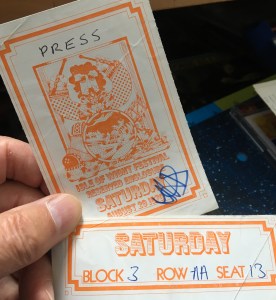
Saturday at the 1970 Isle of Wight Festival started at lunchtime with a two-hour solo set by John Sebastian during which, after delivering “Daydream”, “Nashville Cats”, “You’re a Big Boy Now” and others, he was unexpectedly joined by his former Lovin’ Spoonful colleague Zal Yanovsky, who had sent a note up to the stage asking to be invited to join in. Together they ran through some more of the Spoonful’s hits, including “Do You Believe in Magic” and the gorgeous “Darling Be Home Soon”. Sebastian finished off with “Younger Girl” and “Red-Eye Express”, leaving the crowd feeling beatific at the start of a day of unbroken sunshine.

An hour and half later came a different kind of singer-songwriter: Joni Mitchell, three albums into her career, already known for “Chelsea Morning”, “Both Sides, Now”, “Woodstock” and “Big Yellow Taxi”, wearing a long dress the colour of goldenrod, a few shades darker than her hair, and a discreet assortment of silver and turquoise jewellery. And she was about to face an ordeal that no one present would forget.

She came on with her guitar and began with “That Song About the Midway”. “Chelsea Morning” was next, but as she started the third verse she appeared to lose her way. After strumming on for a few more bars, she announced: “I don’t feel like singing that song so much.” She gave a little laugh and got a round of sympathetic applause, but already the strain of being alone on the stage in front of more than half a million people, delivering such intimate music, was beginning to tell, and her unease seemed to communicate itself to the crowd.

It’s hard to get that many people to be completely silent on a sunny afternoon. Her next little speech expressed annoyance. “When I hear someone saying, ‘Joni, smile for Amsterdam!’ it really puts me off and I get uptight and I forget the words and I get really nervous and it’s a drag. Just give me a little help, will you?” And then just as announced that she was going to play “Woodstock”, a disturbance in front of the stage led her to stand up and move away as a stoned boy was removed from the crowd.

She sat back down and started again. As she finished the song, a bearded man in a dark T-shirt who had been crouching behind the piano rose to his feet and asked if he could use her microphone. He wanted to make an announcement to the people in the encampment on the hill beyond the perimeter fence. Elliot Roberts, Mitchell’s manager, led a group of half a dozen people who quickly surrounded him and moved him away from the singer.

All the tensions of the weekend were coming to the surface. Some of the people in the crowd had chanted “Let him speak!” Was a rock festival a commercial enterprise or a free-for-all? Were the anarchists and situationists and freaks right to try and tear down the fences? Rikki Farr, the organisers’ spokesman, sensibly ordered the uniformed security guards to leave the stage. But how, in 1970, were you supposed to deal with a moment like that? For a minute, even in that brilliant Saturday sunshine, the atmosphere was closer to Altamont than Woodstock.

Shaken but determined to continue, Mitchell tried to resume her performance. Behind her back, the bearded man was finally being dragged away, and the crowd didn’t like the way it was done. So she stopped and made another speech, an angry and distressed plea for the chance to do her work: “Last Sunday I went to a Hopi ceremonial dance in the desert and there were a lot of people there and there were tourists who were getting into it like Indians and Indians who were getting into it like tourists, and I think that you’re acting like tourists, man. Give us some respect!”

It was brave, and it worked. She was able to complete her performance in relative peace, the crowd now more attentive and the atmosphere lightened appreciably by “Big Yellow Taxi”. Having been led away by Roberts at the end of the set, the sound of cheering brought her back for encores that washed away the memory of the earlier interruptions.

And that was just the start of an extraordinary sequence. Here’s what I wrote in the Melody Maker about the next performer: “Mr Herbert Khaury, alias Tiny Tim, alias Larry Love the Singing Canary, bounded on stage to sing ‘a few tunes from the early part of the century.’ Blowing kisses to the audience and strumming his ukelele, he seemed unlikely to retain the audience’s interest for long. But his rock and roll medley, with some of the most untogether playing ever heard (‘This is my wonderful English band… my wonderful English band’) was very amusing. The master stroke was his final medley of ‘There’ll Always Be an England’ and ‘Land of Hope and Glory’, which somehow got the audience on its feet to sing these ridiculously patriotic songs.”

Tiny Tim’s bizarre bonhomie had removed the last trace of bad vibes. While the road crew rearranged the stage, Jeff Dexter, the festival’s DJ, made two crowd-pleasing choices: Otis Redding’s “Respect” and Free’s “All Right Now”, during which a multicoloured hot-air balloon floated above the crowd, its two occupants exchanging peace signs with the mass of humanity below.

Now it was late afternoon, and into the last rays of the sun slid Miles Davis, a 44-year-old jazz trumpeter who had served his apprenticeship almost a quarter of a century earlier with Charlie Parker and now faced the challenge of captivating 600,000 hippies. He took the stage in a thin red leather jacket over an orange knitted top, with studded blue jeans and silver boots. His sidemen — the saxophonist Gary Bartz, Chick Corea and Keith Jarrett on electric keyboards, Dave Holland on bass guitar, Jack DeJohnette on drums and Airto Moreira on percussion — had come as they were.

In August 1970 Miles was moving from a freer version of the complex music his quintet played in the second half of the ’60s to a direct engagement with funk. He’d already played to young audiences at the Fillmores in San Francisco and New York, on bills with the Grateful Dead and the Steve Miller Band. But the ties to the earlier music were not yet cut. The rhythm section he brought to the Isle of Wight ensured that however groove-centred the music became, it retained its freedom and complexity.

An unbroken set alluded to five compositions from the previous couple of years — “Directions”, “Bitches Brew”, “It’s About that Time”, “Sanctuary” and “Spanish Key” — before finishing with a fragment of his usual fanfare. Shrewdly, he played for barely 35 minutes: enough to intrigue and even beguile the hippies who didn’t know his music, not enough to try their patience.

The opening salvo took no prisoners. Miles wanted the music to burn, and he was concentrating hard as he led the way with fierce stabs and insolent runs on his lacquered instrument. The stage was bracketed by Jarrett, on an RMI keyboard that gave him the sounds of an electric piano and an organ, and Corea, who had what looks like a ring modulator on the top of his Hohner instrument and used it to make bleeps and squiggles of sound. Holland brought a jazz musician’s inventiveness to the funk bass lines, which was not what Miles would ultimately want, but there was a passage when he and DeJohnette meshed into a kind of broken second-line rhythm that lifted the music right up. Bartz flighted his brief soprano and alto solos with a keening sound and a striking trajectory, while Airto added the exotic noises of the shaker, the pandeira, the agôgo, and the cuica, a Brazilian friction drum with a distinctive whooping sound.

Miles prowled the stage, never far from the action. A quarter of an hour in, midway through “It’s About that Time”, virtually unrecognisable from its treatment on In a Silent Way a year earlier, the music took off. As it seethed and roiled, Miles returned to centre-stage and played two short, quiet phrases that redirected everything. Then he sketched the exposed theme of “Sanctuary” before cueing up the riff of “Spanish Key”.

He let the band get on with it for five minutes before raising his horn and lowering it back to the microphone, the signal for the funk to back off and textures to be laid over the simmering pulse behind his exquisite open-horn phrases, some of the them hinting at old Moorish influence. As he returned to the staccato jabs, the rhythm section, which had been simmering quietly, rose up again in response, coming back to the boil.

And suddenly the time was up. The music shuddered towards a halt. While the rhythm section wound down, Miles bent down to pick up his silver mute, waved his trumpet once to the crowd, grabbed his shoulder bag and his jacket, and was gone, into the dusk, leaving us to talk about the extraordinary nature of what we’d heard, and what it meant to hear it in the context of a giant rock festival. When they asked him the names of the pieces he’d played, he said, “Call it anything.”
IoW tickets

* The full sets by Joni Mitchell and Miles Davis are on YouTube, filmed by Murray Lerner for his documentary on the festival. Miles’s set can also be found on the album Bitches Brew Live, released in 2011 by Columbia Legacy, and on Electric Miles: A Different Kind of Blue, an Eagle Rock DVD from 2004.

The Japanese for ‘pathos’

Sonny Clark F Wolff

The hip Sonny Clark album, as everyone knows, is Cool Struttin’, a quintet date from 1958 which has come to epitomise what we think of as the Blue Note style: relaxed but compact hard bop, rooted in a deep swing and with the blues never far away. Clark died of a heroin overdose in 1963, aged 31, with nothing to his name beyond his appearances on some exceptional recordings. He would no doubt be astonished to learn that his most celebrated album would sell over 200,000 copies between 1991 and 2009 — almost 180,000 of those copies in Japan, where Cool Struttin’ mysteriously became one of the biggest jazz albums of all time.

My favourite Clark album is something different: a trio session that didn’t see the light of day until its release in Japan more than three decades after the pianist’s death. Blues in the Night is a comparatively modest effort: only 26 minutes long, or 33 minutes if you count the alternate take of the title track. Presumably that’s why it wasn’t released at the time: simply not enough music to make a full 12-inch LP.

Clark was a fine composer, but Blues in the Night is all standards: “Can’t We Be Friends”, “I Cover the Waterfront”, “Somebody Loves Me”, “Dancing in the Dark”, “All of You”. It’s a supper-club set, with nothing to upset the horses. But it’s also, in its quiet and unassuming way, pure treasure. With the great Paul Chambers on bass and Wes Landers — otherwise unknown to me — on drums, Clark makes his way through these tunes at a variety of comfortable tempos with a wonderful touch perfectly highlighted by the simplicity of the setting. I can listen to it all the way through just concentrating on how he articulates a triad: putting down his fingers in a way that makes the chord far more than three notes being played at the same time, the minute unsynchronisations that make it human. And what he finds, I suppose, is a sweet spot between Bud Powell’s probing, restless single-note lines and the swinging, transparently joyful lyricism of Wynton Kelly. Which is a place I’m very happy to be.

I’m indebted for the Cool Struttin’ sales figure to an extraordinary chapter devoted to Clark in a book by Sam Stephenson called Gene Smith’s Sink, a kind of discursive biographical appendix to The Jazz Loft, an earlier book in which Stephenson gave a detailed history of the rackety loft apartment on New York City’s Sixth Avenue, in what used to be called the Flower District, where the great photographer W. Eugene Smith kept a kind of open house for beatniks and other outsiders, recording all their comings and goings on camera film and reel-to-reel tape. From 1957 to 1965 Smith’s loft was the location of an endless jam session featuring the likes of Thelonious Monk and Zoot Sims. Sara Fishko’s 2015 documentary film, The Jazz Loft According to W. Eugene Smith, is based on the book and is highly recommended.

Clark was a regular at the loft, and in Gene’s Sink the author recounts how Smith’s obsession with recording everything around him — even TV and radio news bulletins — extended to the sound of the pianist barely surviving another overdose. Stephenson himself fell in love with Clark’s playing when hearing another posthumous Blue Note release, Grant Green’s The Complete Quartets with Sonny Clark. He writes about him with enormous sensitivity, piecing together the story of a life that began as the youngest of a family of children in a Pennsylvania town called Herminie No 2, named after the mineshaft that gave the place its reason for existence.

If you’re interested in Sonny Clark’s progress from Pennsylvania coal country via Southern California to the New York jazz scene of the late 1950s, Stephenson’s beautiful piece of writing is the thing to read. And it was while following in Gene Smith’s footsteps to Japan (where the photographer documented the horrendous effects of mercury poisoning on the people of the fishing village of Minamata in the 1970s) that the author came across the ideograms most commonly used by Japanese jazz critics in discussions of Clark’s playing: they can be translated as “sad and melancholy”, “sympathetic and touching”, “suppressed feelings”, and one which combines the symbols for “grieving”, “autumn” and “the heart” to suggest “a mysterious atmosphere of pathos and sorrow”.

That mood isn’t really reflected in my favourite Sonny Clark record. What I hear, funnily enough, is an expression of pleasure in being alive to play the music he loved and for which he had such a precocious talent. I’m guessing he sometimes felt like that, too.

* Sam Stephenson’s Gene’s Sink: A Wide-Angle View was published by Farrar, Straus and Giroux in 2017. The Jazz Loft Project was published by Knopf Doubleday in 2012. The portrait of Sonny Clark is from Blue Note Jazz Photography of Francis Wolff, by Michael Cuscuna, Charlie Lourie and Oscar Schnider, published by Universe in 2000 (photo © Mosaic Images). Clark’s Blues in the Night was first released in Japan in 1979 and issued on CD in 1996. The tracks are also available on Clark’s Standards CD, released in 1998.

A Spanish sketch

Hardly anything from the three prime albums Miles Davis made with Gil Evans between 1957 and 1960 — Miles Ahead, Porgy & Bess and Sketches of Spain — was played live during the period in which they were written, recorded and released. To hear the original scores of such rich music brought to life in a concert hall or club, as with last November’s wonderful recreation of the full Porgy suite by alumni of the Royal Academy of Music, is to acquire a deeper appreciation of a music that has always inspired an unusually profound affection.

One of the biggest treats of lockdown listening has been last Thursday’s online release of the video of a socially distanced version of “Concierto de Aranjuez”, the centrepiece of Sketches of Spain, by the 21 musicians of the Gil Evans Project, a New York ensemble led by the composer and arranger Ryan Truesdell. Their two albums of Evans’s lesser known music, Centennial (which I wrote about here) and Lines of Color, have given me enormous pleasure since their appearance in 2013 and 2015 respectively, but this is a little different.

Riley Mulherkar, who takes on the daunting task of playing the soloist’s role, does an exceptional job, staying true to the sound and flight-path of Davis’s original playing while adding just enough inflections and inventions of his own to remind us that this is no mere impersonation but something with a life of its own. The true value of this performance, however, lies elsewhere. As with the Royal Academy’s version of the Gershwin arrangements, Truesdell was given the original scores by the Davis family, and again the scale of his band’s resources enables him to give full value to Evans’s orchestrations, which ranged far beyond the conventional jazz big-band instrumentation.

Those of us who love Evans’s music are very familiar with the effect of his favourite sounds, which included the alto flute and the bass clarinet, muted trumpets and French horns, a tuba and piccolo. But it was always hard to identify the individual components of the sound-washes that he created behind Davis. Now, thanks to the brilliant editing of this socially distanced performance, it’s possible to see exactly how he combined his colours to such magical effect.

To take just one example from this 17-minute recomposition of Joaquin Rodrigo’s guitar concerto, go to 11:50: there you’ll find four muted trumpets, three French horns, a bass trombone, a tuba, three flutes, a bassoon, a contrabass clarinet. It was Evans’ special gift to make such an elaborate combination feel so weightless.

As well as being deeply felt, the ensemble’s performance is so clear and precise that it’s amazing to think the musicians weren’t playing in the same room at the same time. If you want to know their names — and you should — go to Truesdell’s website: http://www.ryantruesdell.com. And maybe think about making a donation. In the present circumstances, it’s the only way we can subsidise something like this, while giving our thanks to performers whose skills and devotion bring a little light to our dark time. And, of course, to the eternal Gil Evans.

Eddie Gale’s Ghetto Music

Eddie Gale

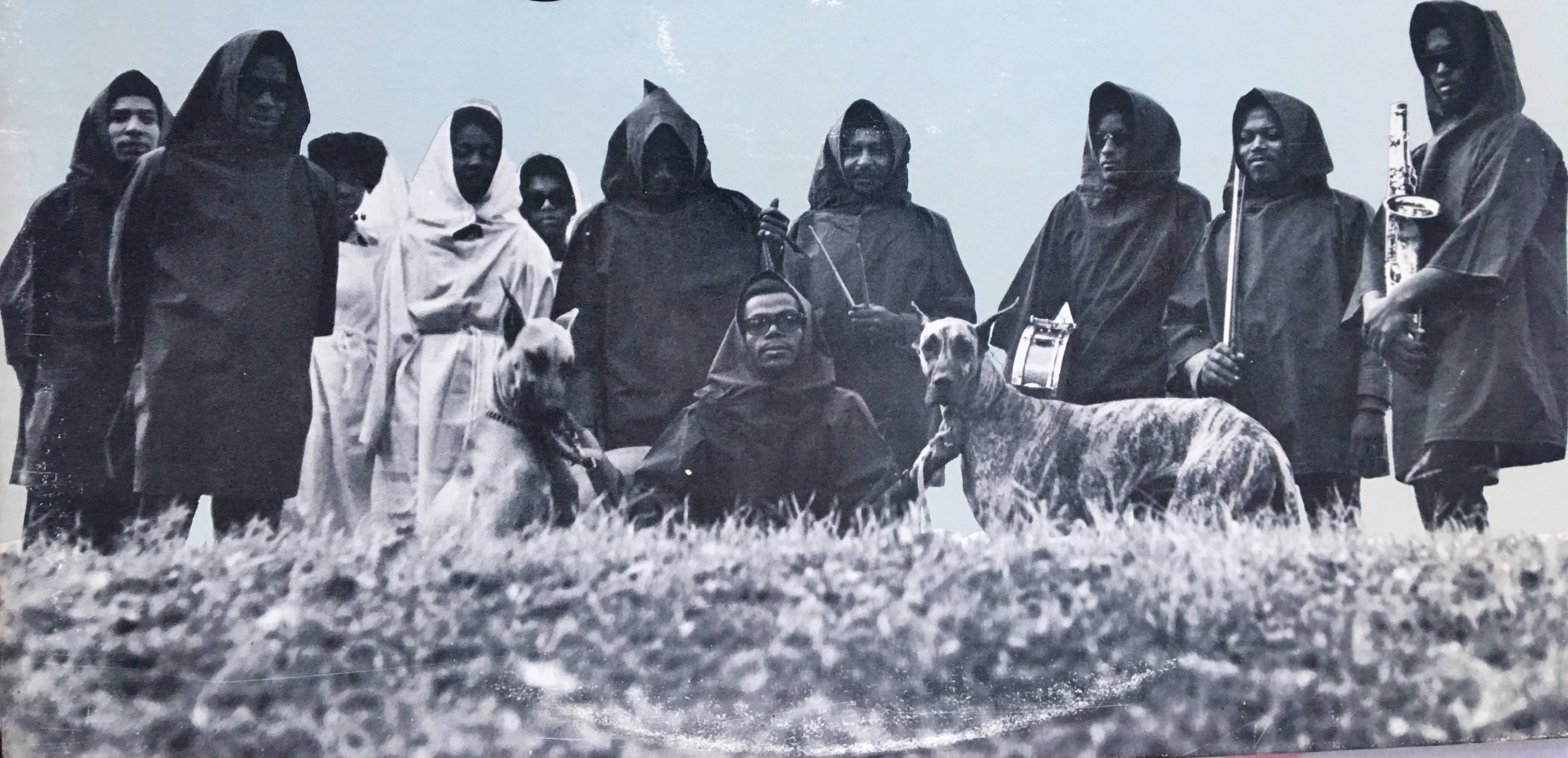
The thing I know best about the trumpeter Eddie Gale, who has died at the age of 78, is the first of two albums he made for Blue Note at the end of the 1960s: Eddie Gale’s Ghetto Music, an uncompromising title for a piece of music designed to reflect the black experience. In mood and message, it aligns with Max Roach’s slightly earlier We Insist! and Archie Shepp’s slightly later Attica Blues.

Gale had already played with Sun Ra in the mid-’60s and appeared on Cecil Taylor’s first Blue Note album, Unit Structures, in 1966. As a child he’d listened to gospel music and hung around outside a Brooklyn club to listen to Lester Young. He’d taken lessons from Kenny Dorham and sat in with Coltrane at the Half Note: a life-changing experience. He would also be featured on Larry Young’s Of Love and Peace for the same label in 1969. Recording his Ghetto Music project was one of Blue Note’s more unexpected moves. The producer was not Alfred Lion, who took that role on just about every one of the label’s releases, but his partner in the business, Francis Wolff. (Lion had retired when Blue Note was sold to Liberty Records in 1967.)

The five compositions on this album use an instrumental sextet of trumpet (Gale), tenor (Russell Lyle), two basses (Judah Samuel and James “Tokio” Read) and two drummers (Richard Hackett and Thomas Holman), plus a choir of 11 voices, including two lead singers (Elaine Beener and Joann Gale). The leader apart, I’d never heard of any of these musicians before I got the album on its original release, and I’ve never heard of any of them outside of Gale’s orbit since. They seem to have been part of a collective based in Brooklyn.

Whoever they were, they made music with a raw edge and a powerful immediacy. You can hear that on A Walk With Thee, my favourite track from the album. The bass vamp, the martial/bolero drumming, the unison of the horns and voices: it’s a strong brew. Gale has a big sound with a wild edge. Lyle, the tenorist, solos with a kind of suppressed hysteria. It’s an offshoot of what Albert and Donald Ayler were doing a little earlier in the decade. It doesn’t need to be judged according to anyone else’s idea of finesse or sophistication.

A year later the singers and two of the players, Lyle and Judah, were on Gale’s second and last Blue Note album, Black Rhythm Happening, a year later, joined by Jimmy Lyons, the altoist, and Elvin Jones. Gale himself recorded with Sun Ra’s group in the ’70s (Lanquidity on Ra’s Saturn label) before moving to California, where he was an artist in residence at Stanford University, ran a workshop in Oakland and organised music-education programmes in San Jose, where he became the city’s official ambassador of jazz. In 2001 he received an award for his work from the California Arts Council.

Breaking the mode of graphic presentation Blue Note had established under the art director Reid Miles, Eddie Gale’s Ghetto Music was released with a strikingly confrontational cover, at least by the standards of the time. A bunch of black men in hoods with women in white robes and mean-looking hounds? In 1969, that sent a message. And still it speaks.

* Originally issued on Blue Note in 1969, Eddie Gale’s Ghetto Music was reissued on CD by Water Music in 2003. The photograph of the musicians is from the original sleeve and was taken by Richard Graf. Some of the details of Gale’s life are from this interview in Jazz Times by Andy Tennille: https://jazztimes.com/archives/eddie-gale/

Measuring the heart

ambrose-akinmusire

The great figures of jazz are the people who, as the decades pass, you can set your compass by. For me, in my generation, that meant Miles, Coltrane, Ornette. It’s always tempting to think that they don’t make people like that any more, but it’s not true. And I’m thinking that the trumpeter, composer and bandleader Ambrose Akinmusire might be one of them.

Akinmusire’s music has a moral heft that makes it a good place to turn to in times like these. Not many artists can so successfully maintain a commitment to beauty while bringing  intellect and rigour to bear on the issues of the day, never letting us forget what got him (and us) here: the history of African Americans.

In 2014, on The Imagined Savior Is Far Easier to Paint, the second of his five Blue Note albums, Akinmusire included a piece called “Rollcall for Those Absent”, in which a small child recites the names of black victims of police homicide, including Amadou Diallo and Trayvon Martin. It still rings in my head every time a new atrocity occurs. Throughout that and his other albums, even when there is no explicit text, a sense of mourning is mixed with the celebration.

On his new one, called On the Tender Spot of Every Calloused Moment, that underlying emotion is redoubled. Even when this music is at its most complex, rippling and sparkling with detail, it moves on an undertow of the blues. The album begins with Akinmusire’s beautifully pure natural trumpet sound, all alone, introducing a track called “Tide of Hyacinth” which moves through dazzling interplay with the members of his regular quartet — Sam Harris (piano), Harish Raghavan (bass) and Justin Brown (drums) — and incorporates a recitation in Yoruba by the Cuban-born singer and percussionist Jesús Díaz. That’s a taste of the various approaches explored here, which range from a lovely little song pairing the voice of Genevieve Artadi (the singer with the LA electro-funk duo Knower) with Akinmusire’s Fender Rhodes piano, through the Monkish angularity of “Mr Roscoe” and the tender balladry of “Reset (Quiet Victories & Celebrated Defeats)” to a sombre, hymn-like dedication to the late Roy Hargrove, whose work with D’Angelo and others paved the way for Akinmusire’s appearance on Kendrick Lamar’s To Pimp a Butterfly.

One track, only half a minute long, is for unaccompanied trumpet, the squeezed half-valve sounds reminiscent of Rex Stewart. Akinmusire goes that far back, and all the way forward. I don’t know of a trumpeter from the generations after Don Cherry who uses vocalised effects so brilliantly. He does it again on the penultimate track, “Blues (We Measure the Heart With a Fist)”, where the notes are compressed so tightly that they can barely escape over Harris’s damped notes before the mood switches into a passage of fantastic trumpet/bass/drums improvisation that seems to explore a new way of swinging.

The album ends with the ringing, carefully-spaced chords of the Fender Rhodes, bringing the album to a close with a short piece titled “Hooded Procession (Read the Names Aloud)”, the latest in Akinmusire’s series of threnodies for the victims of police violence. The timeliness of this does not require emphasis. Once again, he has created a soundtrack for our time that will live long beyond its moment.

* On the Tender Spot of Every Calloused Moment is released on the Blue Note label.

Misha Mullov-Abbado’s ‘Dream Circus’

5I5kun-L

In normal times, I’d be keenly anticipating a live launch of Misha Mullov-Abbado’s Dream Circus, the third album by the London-based composer and bassist who won the Kenny Wheeler Prize in 2014, his final year as a student at the Royal Academy of Music. Instead I’ll have to stay at home and enjoy the music on record, which is no hardship at all.

His first album, New Ansonia (2015), was by a quintet. His second, Cross-Platform Interchange (2017), was by a septet. Dream Circus is by a sextet: James Davison (trumpet and flugelhorn), Matthew Herd (alto), Sam Rapley (tenor), Liam Dunachie (piano), and Scott Chapman (drums). It gives evidence of an increasing maturity: the writing, the playing and the recording are of such high quality that once you’ve put the record on, you need a very good reason to take it off.

This is modern jazz with a powerful imagination and a sense of variety that never compromises its integrity. It’s a music with roots in hard bop but a strong commitment to melody. If I had to identify Mullov-Abbado’s spiritual predecessor as a composer, it would probably be Benny Golson. Some of the things I was reminded of while listening to it were Oliver Nelson’s original “Stolen Moments”, Herbie Hancock’s Maiden Voyage, and Manu Katché’s ECM albums. It stands quite distinct from the new London jazz movement associated with Trinity Laban and Tomorrow’s Warriors. There are no attempts to incorporate influences from outside the mainstream jazz tradition, but it still sounds contemporary. It’s not particularly on-trend, but it really doesn’t need to be.

Individually, the musicians are remarkable. The leader’s introduction to the opening track, “Some Things Are Just So Simple”, establishes the presence and flexibility of his playing. Davison is one of the finest young trumpeters around, with the bright, broad sound and confident projection of Freddie Hubbard, and Herd and Rapley are ideal foils, each with a tone full of human warmth. The passages in which they work together, either as separate contrapuntal voices in the poised “Equinox” or in the full-on free blowing of the exhilarating “The Infamous Grouse”, are outstanding. The subtle dovetailing of the three horns on the opening of “Stillness”, a luminous ballad, is very beautiful, opening out into a tenor solo of which Wayne Shorter would be proud.

The album’s moment of humour is the playful Fats Wallerish theme of “Little Astronaut”, which precedes the absolute highlight: a composition called “The Bear” in which, over a loose but sombre ostinato, the written horn lines are allowed to braid and fray and change weight, giving the feeling of improvisation. It’s interesting to think of these strategies as techniques absorbed (via Mingus and the Blue Notes) from black church music and metabolised into something quite different. The closing “Blue Deer” opens with a lovely pastoral theme that emphasises the gorgeous blend of the three horns before intensifying through an out-of-tempo passage in which the alto rises sweetly to become the lead voice in a moment of absolute radiance. Here is where the importance of Dunachie and Chapman is most evident as the rhythm section switches from time to no-time to complex written passages with a grace that makes everything sound completely natural.

It seems likely that the contribution of the producer, Jasper Høiby, best known as the bassist with Phronesis, has much to do with the project’s success. Captured over a week in Copenhagen’s Village studios last September, the musicians sound relaxed but completely alert, and the tone and balance of the recording are perfect for this music. You can’t play like this unless you’re at ease. And that quality communicates itself to the grateful listener.

* Dream Circus is released by Edition Records on June 12 and is available via Bandcamp: https://mishamullov-abbado.bandcamp.com/. The photograph of the sextet is by Aga Tomaszek.