Skip to content

Posts by Richard Williams

The artwork of British jazz

Who could have imagined, as the music and those who made it were fighting for their existence, the three-figure sums that British jazz albums from the ’60s and ’70s would be fetching in a new century? To some, Richard Morton Jack’s Labyrinth: British Jazz on Record 1960-75, a large-format book containing threequarter-size reproductions of the front and back sleeves of 161 albums, plus another 140 at a smaller scale, will be a catalogue of longing and desire.

Look! Original copies (cond: VG) of Joe Harriott’s Abstract and David Mack’s 12-tone New Directions on Columbia, of Poetry and Jazz in Concert on Argo, of Mike Westbrook’s Celebration on Deram, of The People Band on Transatlantic, Bob Downes’s Open Music on Philips and Ric Colbeck’s The Sun Is Coming Up on Fontana! The first LPs by Howard Riley on the Opportunity label and Back Door on the Blakey imprint! The SME’s debut on Eyemark! Mike Taylor’s Pendulum! The only recording of the Chitinous Ensemble, directed by Paul Buckmaster! Guy Warren of Ghana! Lots of Michael Garrick, Graham Collier, Gordon Beck, Tony Oxley, Tubby Hayes, Stan Tracey, Keith Tippett, Alan Skidmore, Rendell & Carr, Ray Russell… all the way to the Nottingham Jazz Orchestra’s Festival Suite, released on Doug Dobell’s Swift label.

Richard Morton Jack gives a brief commentary on each album, with quotes from reviews, and there’s an introduction by Tony Reeves, probably most famous as the bass player with Jon Hiseman’s Colosseum, who describes how he, a Lewisham schoolboy, found his way into the scene as a player and a producer, with Neil Ardley’s New Jazz Orchestra, whose Western Reunion and Le Déjeuner sur l’herbe are featured, and others.

What a time it was — although, as I said, it was always a struggle for those trying to make a living in jazz clubs up and down the country, despite the efforts of intrepid A&R men/producers like Denis Preston, Terry Brown, Peter Eden and Giorgio Gomelsky to persuade Decca, EMI, Philips, Pye, Polydor and CBS to record this adventurous music.

Labyrinth finds a different and very enjoyable way of telling the story, exploiting the artwork and the information contained within 12 x 12 album jackets, back in the days of helpful sleeve notes. And if I had the choice of all these albums, but could keep only one? It would probably be the Blue Notes’ Very Urgent, their first recording after landing in the UK from South Africa. Produced by Joe Boyd at Sound Techniques and issued on Polydor under Chris McGregor’s name, it’s as exhilarating today as it was back in 1968, and its long-term influence is still to be felt, even in the work of young musicians then unborn.

* Richard Morton Jack’s Labyrinth: British Jazz on Record 1960-75 is published by Lansdowne Books (£60)

The Ballad of Bob and Rita

On the way to the cinema to see One Love last night, my thoughts went back to 1967, and buying the Wailers’ “Put It On” on an Island 45 at the West Indian record shop on Union Street in Nottingham, near the bus station. And to 1972, and spending hours at Harry J’s studio in Kingston, listening to them recording tracks for Catch A Fire, sharing Chris Blackwell’s pleasure as he realised what a good decision he’d made when he advanced them — in a move so unusual in the Jamaican record industry as to be unique — enough money to make an album. Who could have imagined then that Bob Marley, having first become a global symbol, would eventually turn into an industry, the generator of posthumous books, exhibitions, a musical and now a feature film?

So I was going to the film slightly reluctantly, in a mood of mild pessimism, even cynicism. How sensible, after all, is it to expect Hollywood to treat something you know a bit and care quite a lot about with sensitivity and respect? An hour and a half later I emerged in a very different frame of mind.

Reinaldo Marcus Green’s film concentrates on one short period of Marley’s life, from his shooting by political gunmen two days before a planned Peace Concert in December 1976 through the 18 months in London during which he recorded Exodus before returning home for the One Love concert, in which he stood between the prime minister, Michael Manley, and the leader of the opposition, Edward Seaga, and made them join hands.

It isn’t a biopic, although there are flashbacks to Marley’s early years: to the departure of his father, to his introduction to the cult of Rastafari, to the day the producer Clement Dodd invited the nascent Wailers into the studio. The earliest of these are framed, very effectively, as dreamlike childhood memories. But the bulk of the film concentrates on the narrow span of time in which he rose to his fullest artistic height (Exodus is his What’s Going On or Innervisions) while first surviving the would-be assassins’ bullets and then receiving the diagnosis of the cancer that would kill him in 1981, aged 36.

No praise is too high for Kingsley Ben-Adir, the British actor playing Marley. Ben-Adir, who portrayed Malcolm X in the brilliant One Night in Miami a few years ago, doesn’t look much like Marley, and his speaking voice is deeper, but he finds the physical litheness, the fleeting expressions and the inflections of speech, and the distinctive air of watchfulness, that evoke the man very clearly and accurately.

He’s well matched by Lashana Lynch as Rita Marley, Bob’s wife, the mother of three of his 11 children, and a member (with Judy Mowatt and Marcia Griffiths) of the I-Threes, his backing singers. Lynch does the long-suffering thing with a light touch and a range of nuance to match that of Ben-Adir. The family’s involvement in the production might call the accuracy of the depiction of their relationship into question, but the two actors make you believe in it for an hour and a half, at least, giving the film its emotional core.

The dramatis personae includes many of the characters who made contributions to Bob’s life, from Mortimer Planno, the Rasta philosopher, through Joe Higgs, his musical mentor, and Gilly the cook to Neville Garrick, the brilliant graphic designer, who died last year. And, of course, the musicians, who populate the scenes in rehearsals and recording studios that bring the songs from Exodus fully to life. It helps to have Aston Barrett Jr, one of Family Man’s sons, playing bass, but the actor-musicians playing Tyrone Downie, Carlton Barrett, Seeco Patterson, Junior Marvin and the rest are completely convincing, as is the depiction of the atmosphere within Island’s London studios.

The film is unfair, I think, on Chris Blackwell, who is played by James Norton — a reasonable match in visual terms, but coming across as far smoother and more superficial and ingratiating than the real thing. Blackwell’s concentration on Marley’s career eventually brought him the enmity of Bunny Livingston and Peter Tosh, but his vision and commitment created the opportunity for Jamaican music, spearheaded by the Wailers, to establish itself as a creative contributor to the music of the world.

But, you know, this is a story about black creativity and culture, told for once by black people, and if it’s the white people — record executives, promotion people and journalists — who look like the outsiders, then that’s more than fine. The use throughout of unsubtitled Jamaican patois is a way of making people like me aware that we’re being invited to enter another world.

And, of course, you come out of the cinema with the music in your ears, brilliantly rendered: the war cries and lamentations and songs of seduction and redemption, all still gloriously full of that defiant sweetness.

Oh, Yoko

The first time I met Yoko Ono, at the Apple HQ in Savile Row in September 1969, I was impressed by her obvious engagement. She and John Lennon were doing a day of interviews, and I got my couple of hours on behalf of the Melody Maker. At that stage she was being treated by the media as a bit of a sour joke. The film she’d made of people’s bottoms got her in the papers, and her relationship with Lennon rendered her, in the eyes of many, what we would nowadays call toxic. Not only did she look weird, she thought weird. But at that first meeting, it was impossible to ignore the way the two of them shared the burden of the interview as equal voices.

The second time, two years later, was just after they’d moved to New York and temporarily sequestered themselves in a suite in the St Regis Hotel on East 55th Street. I spent a few days with them in the hotel, at the Record Plant studio a dozen blocks south, and on a trip to the West Village during their hunt for a permanent address. And that time I could see, much closer up, what it was that he liked so much about her: she was funny, and physical, and assertive, and full of life and ideas — all the characteristics that are currently on very clear display at Tate Modern in Yoko Ono: Music of the Mind, an exhibition of her life’s work.

The wittiest T-shirt around just now carries the message JOHN LENNON BROKE UP FLUXUS — a play on the belief that Yoko destroyed the Beatles. Her work while a member of Fluxus, the informal avant-garde art movement founded in New York by her friend George Maciunas in 1961, also involving La Monte Young, John Cage, Joseph Beuys, Nam June Paik, Jonas Mekas and many others in events often held in her downtown loft, is to me the most interesting part of the show, occupying several rooms.

It features documentation of the notorious Cut Piece of 1964, in which she sat on a chair in the Carnegie Recital Hall while members of the audience cut off her clothes, and Bag Piece of the same year, which I saw her re-enact with Lennon at the ICA in London in 1969, and Ono’s Sales List of 1965, in which she offered such items as a blank tape labelled “Sound tape of snow falling at dawn”, a Light House constructed from light, and custom-made underwear, including “special defects underwear for men — designed to accentuate your special defects: in cotton $10, in vicuna $175.”

Like a lot of people wandering through the rooms, I found myself smiling a lot, and occasionally laughing out loud at something like a 1962 work called Audience Piece to La Monte Young, in which the 20 performers simply lined up across the stage and stared at the audience until the audience left, and Smoke Piece of 1964: “Smoke everything you can / Including your pubic hair.”

The exhibition shows off her imagination and her indefatigability, as well as the way she was influenced by pre-existing Japanese culture (Zen koans, haiku, kabuki theatre) and the experience of living, as a child evacuated from her family home in Tokyo, through the final stages of World War Two.

On the morning I spent there, the show was full of women and small children who were having a good time with the all-white chess set, the wall-hung board into which visitors are invited to hammer a nail, and the room called Add Colour (Refugee Boat), whose walls, floor and eponymous centrepiece are covered in blue graffiti. In the final room, many people had accepted another of her invitations: to write something about their mothers on a small piece of paper and tape it to the wall.

I thought of Yoko’s own mother, a descendant of an aristocratic family forced — in the absence of her captured husband — to scuffle for her family’s existence amid the postwar ruins before, reunited, they left to resume a comfortable existence in the US. And, too, of the scar tissue of Lennon’s “Mother” (“You left me, but I never left you…”), written after he and Yoko had undergone a course of Arthur Janov’s Primal Therapy. That’s something else they were mocked for, along with the bottoms movie and the riddles and the naked cover of Two Virgins and the Bed Peace event in Amsterdam.

Ah, peace. Remember that? WAR IS OVER!, they announced in 1969 via the medium of billboards plus a concert at at the Lyceum. All we are saying is GIVE PEACE A CHANCE. Send a bag of ACORNS FOR PEACE to world leaders. You can mock all that, too, if you want, but it wouldn’t really seem right in 2024.

I don’t mean to sound patronising when I say that I was surprised by how much the exhibition made me think, even when those thoughts were not necessarily the sort that can be followed to a conclusion. The first thing to do with a mind is open it.

* Yoko Ono: Music of the Mind, curated by Julia Bingham and Patrizia Dander, is at Tate Modern until 1 September. There’s an illustrated book of the same name to accompany the exhibition, its selection of short essays including a good one on Yoko’s relationship to sound and silence by David Toop (Tate, £32).

Songs for a mother

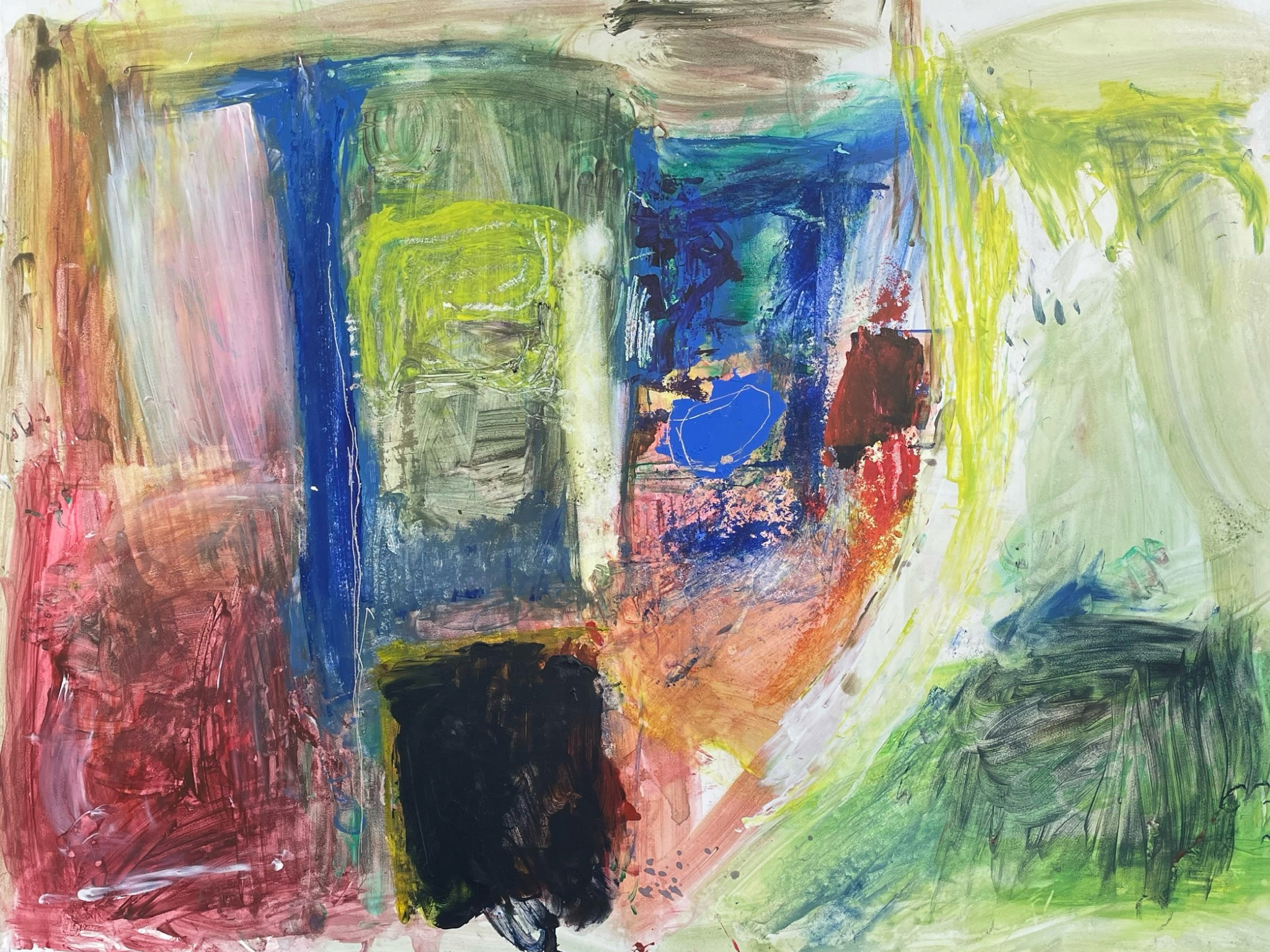
When the painter Penny Marrows was given a diagnosis of terminal cancer in March 2023, her son, the London-based composer and guitarist Billy Marrows, began writing pieces for her. Some of them were recorded and played to her before her death five months later, aged 72. In the aftermath Billy carried on writing and recording, and compiled the pieces in an album, Penelope, for which one of his mother’s paintings provides the cover (you can see it above).

One good reason for buying the album is that the proceeds will go to World Child Cancer, a charity providing help in countries that don’t have the benefit of the sort of organisations that cared for Billy’s mother, such as the NHS and Macmillan Cancer Support. But the music is reason enough.

The aggregation of musicians heard on the album is known as Grande Família. Five of the pieces, interspersed throughout the running order, are for solo guitar or baritone guitar. One is a duo for guitar and viola (Teresa Macedo Ferreira). Another is a trio for guitar, piano (Angus Bayley) and clarinet (Gustavo Clayton Marucci). The remaining three are by a 12-piece chamber-jazz ensemble including trumpet, trombone, French horn, flute, clarinets, saxophones and viola.

I’ve been playing the album a lot over the last few days, and it’s made a friend of me. The solo guitar pieces are pitched somewhere between Bill Frisell (a refined backporch sensibility) and Mary Halvorson (the sparing and subtle use of effects, and a sense that a surprise isn’t far away). The solo version of “Shenandoah” (the only non-original) which provides the album’s coda is lovely; when I do my “Shenandoah” mixtape, it’ll go nicely between Frisell’s interpretation (with Ry Cooder on Good Dog, Happy Man) and Bob Dylan’s (one of the saving graces of Down in the Groove).

The most striking of the ensemble pieces is “L’Heroïsme”, which features the tenor saxophone of Tom Ridout and the trumpet of Mike Soper. You can see them playing it here. But what I really like about the album is how its 10 separate pieces, for all their variety of means and approach, behave as though they belong together, like a family.

* Penelope by Billy Marrows + Grande Família is available as a CD and download. Details here:http://www.billymarrows.com. They’ll be playing at the Pizza Express in Soho on 13 May. Penny Marrows’ painting is used by kind permission.

‘Rhapsody in Blue’ at 100

The first public performance of George Gershwin’s “Rhapsody in Blue” was given 100 years ago this week, on 12 February 1924, at the Aeolian Hall on West 43rd Street in New York City, by Paul Whiteman and his Concert Orchestra, with Gershwin himself at the piano. Whiteman had commissioned the piece from its composer specially for the evening, which was billed as ‘An Experiment in Modern Music’.

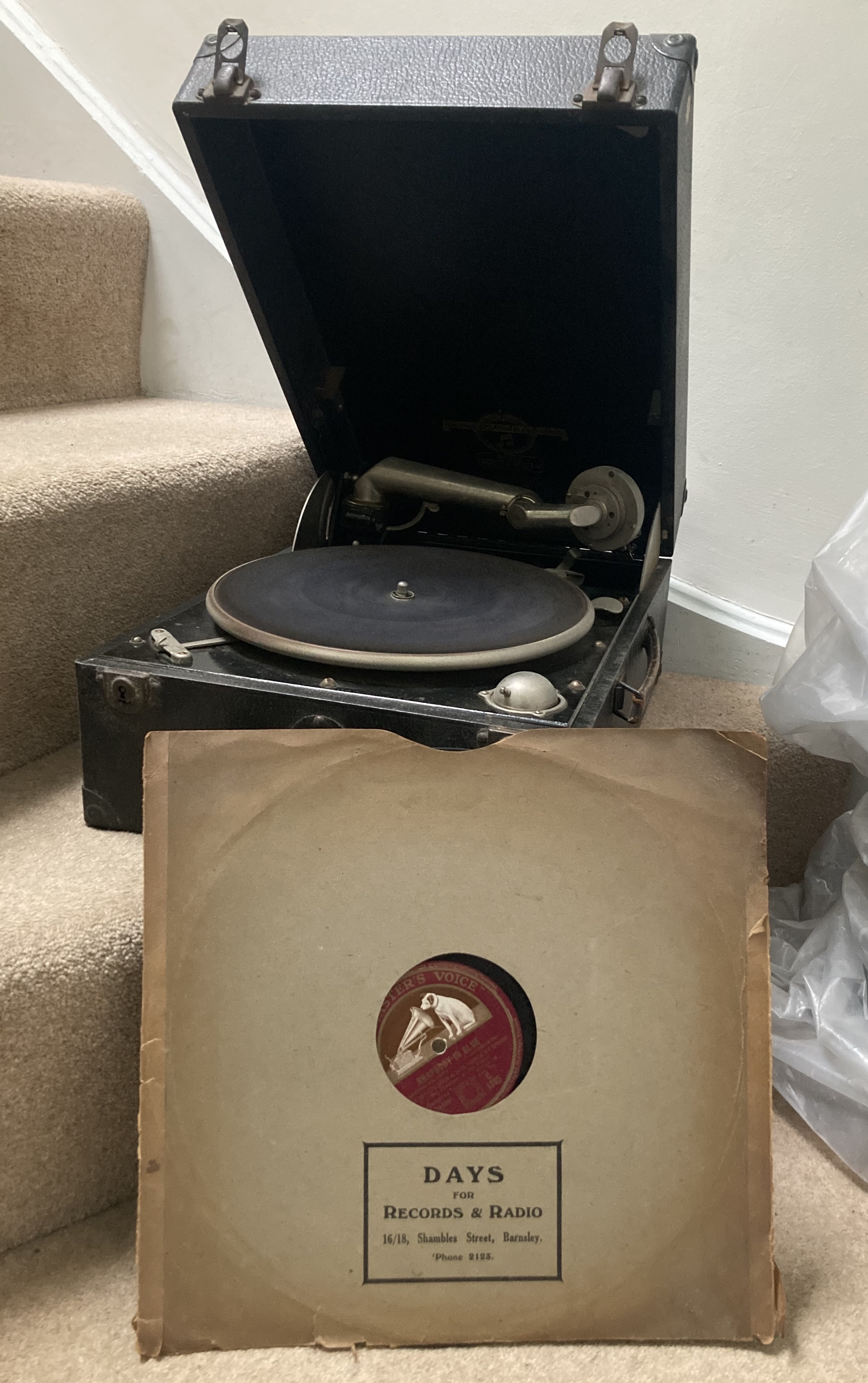
I first heard “Rhapsody in Blue” in childhood, played by the same Whiteman/Gershwin combination, on the 12-inch 78rpm record you see above, which my mother would have bought from a record shop in Barnsley, South Yorkshire, in the 1930s. Nine minutes long, it’s split over both sides of the disc. The gramophone — a Columbia Viva-Tonal Grafonola — is the one on which she played it, along with her other 78s.

To mark the centenary, the pianist Ethan Iverson started a lively debate the other day with a piece for the New York Times in which he examined the artistic impact, then and now, of what he called “a naive and corny” attempt to blend the superficial characteristics of jazz with European classical music. If “Rhapsody in Blue” is a masterpiece, he wrote, it’s surely “the worst masterpiece”: an uncomfortable compromise that blocked off the progress of what would later be called the Third Stream, and with which we are both “blessed and stuck”.

Thanks to my mother’s influence, I view it from a slightly different angle. For me, in childhood, it became a gateway drug. I loved the spectacular clarinet introduction, and the shifting melodies and the hints of syncopation, but more than anything I responded to the tonality that reflected its title, expressed in the exotic flattened thirds and sevenths of the blues scale.

It didn’t take very long before I was following a path that led to Louis Armstrong, Duke Ellington, Charlie Parker, Thelonious Monk, Miles Davis, Charles Mingus, John Coltrane, Ornette Coleman and Cecil Taylor, right up to the Vijay Iyers, Matana Robertses and Tyshawn Soreys of today’s jazz. Pretty soon I’d worked out that an ounce of Ellington was worth a ton of Gershwin’s instrumental music*, but I retain a respectful gratitude to “Rhapsody in Blue” and its role as a gateway, just as I do to The Glenn Miller Story and “Take Five”.

A few weeks after the world première Gershwin’s piece, F. Scott Fitzgerald and his young family would set off for France, where he spent the summer knocking the early draft of his third novel into shape. When The Great Gatsby was published the following April, it contained a vivid scene in which the society guests at one of Jay Gatsby’s Long Island parties were entertained by a band described by the author as “no thin five-piece affair, but a whole pitful of oboes and trombones and saxophones and viols and cornets and piccolos, and high and low drums.”

The bandleader — who is unnamed, but it’s easy to imagine him as Paul Whiteman, with his tuxedo, bow-tie and little moustache — makes an announcement. “At the request of Mr Gatsby,” he says, “we are going to play for you Mr Vladimir Tostoff’s latest work, which attracted so much attention at Carnegie Hall last May.” The piece is known, he adds, as “Vladimir Tostoff’s Jazz History of the World”. I’ve always idly wondered what it would sound like, but I imagine Mr George Gershwin’s “Rhapsody in Blue”, with its bustling bass saxophone eruptions and flamboyantly choked cymbal splashes, is as close as we’ll get.

* A few people have picked me up on this statement, and I tend to agree with them. I was trying to make a specific point, rather clumsily. George Gershwin was a genius songwriter, as any fule kno.

At Peggy’s Skylight

Some jazz clubs are intimidating to the first-time visitor, and maybe that’s how they’re supposed to be. Not all of them, though. I’d been meaning to visit Peggy’s Skylight in Nottingham for ages, and on Saturday afternoon I walked in there for the first time and felt right at home.

A Saturday afternoon might seem an odd time to visit a jazz club. But I’d just got off the train from London, with a couple of hours to spare in my old home town before the start of the football match I’d come up to see, so I walked from the station to George Street, just off Hockley, a narrow but always busy street on the edge of the historic Lace Market.

Peggy’s Skylight occupies the double-frontage of a nice old building. The club was opened in 2018 by Rachel Foster and Paul Deats, and it’s named after Charles Mingus’s “Peggy’s Blue Skylight”; you can see a visual reference above the bandstand in the photo. The Mingus track was recorded in 1961 and featured Roland Kirk, who in 1964 played a concert one street away from where Peggy’s now stands, at the Co-operative Arts Centre on Broad Street (I wrote about it here and here).

On Saturday afternoons Peggy’s has an Unplugged session, with free admission. Deats was playing piano when I walked in. He was sharing the stage with a seriously good local tenor saxophonist, Ben Martin, and they were playing “My One and Only Love”, one of my favourite ballads. The room was full, and I was lucky that they could find me a seat. People of several generations were eating, drinking, chatting and occasionally checking their phones while Martin and Deats produced accomplished, unflashy, nicely proportioned duets that were soon putting me in mind of how Hank Mobley and Tommy Flanagan might have sounded together.

At this session, the music had a different vibe. It was part of a social setting, absorbed in a way that didn’t devalue it at all. If you wanted to listen to as good version of “Alone Together” as you’re likely to find this side of Jo Stafford, or a lively “On the Sunny Side of the Street”, you could do happily do so, joining the warm applause at the end of each tune. But the voices from the tables around you were part of the environment. It wasn’t like that oaf guffawing for posterity over Scott LaFaro’s final notes on the Bill Evans Trio’s sublime version of “Milestones” at the Village Vanguard in 1961. Here, the ambient sounds were perfectly natural and unobtrusive.

Normally I don’t like eating while I listen to music, and I’m not much interested in food anyway. But I was hungry and it seemed fine to enjoy an excellent pan of eggs with harissa while keeping my ears open. (Deats is also a chef, and Peggy’s menu has a North African and Middle Eastern tilt.)

Last year the club’s partners were required to resist plans to sell the building by the local council, which owns the freehold and has recently become one of several around England to announce its own bankruptcy. The day before I walked in had brought news the reduction of the city’s entire culture budget to zero. Nottingham Playhouse, opened with great pride 60 years ago almost to the month and whose artistic directors included John Neville and Richard Eyre, will see its council subsidy, which stood at an annual £430,000 a decade ago, reduced from last year’s £60,000 to £0.

This is mostly due, of course, to the severe reduction, during 14 years of Tory misrule, in the government funding on which local authorities depend. The present generation of Conservative Party politicians seems to regard the arts as something that might open minds and encourage independent thought, and therefore to be stamped on.

On the train from London I’d been reading a depressing piece in the FT about the boom in giant high-tech music arenas — the sort of place where you might go to see Taylor Swift or U2 — being built around the country, paralleled by a crisis affecting small-scale venues, almost one in six of which closed or stopped scheduling music during 2023. That made a first visit to Peggy’s Skylight seem even more precious.

* The very nice new album by the guitarist John Etheridge and his organ trio was recorded live at Peggy’s Skylight. It’s called Blue Spirits, it’s on the DYAD label and appropriately enough it concludes with Etheridge’s solo treatment of a favourite Mingus tune, “Goodbye Pork Pie Hat”. Forthcoming attractions at the club include the saxophonist Tony Kofi and the trombonist Dennis Rollins. Full programme: peggysskylight.co.uk

For Martin Davidson

Martin Davidson, who died just before Christmas at the age of 81, was a valued friend of improvised music in Britain and elsewhere. Most significantly, he ran the Emanem label, which made its debut in 1974 with Steve Lacy’s first album of unaccompanied soprano saxophone pieces. Emanem went on to amass a catalogue of new and archive vinyl releases featuring the first generation of London-based improvisers — John Stevens, Trevor Watts, Evan Parker, Derek Bailey, Paul Rutherford and so on — and then, following its re-emergence as a CD label in the mid-’90s, of their successors and many others.

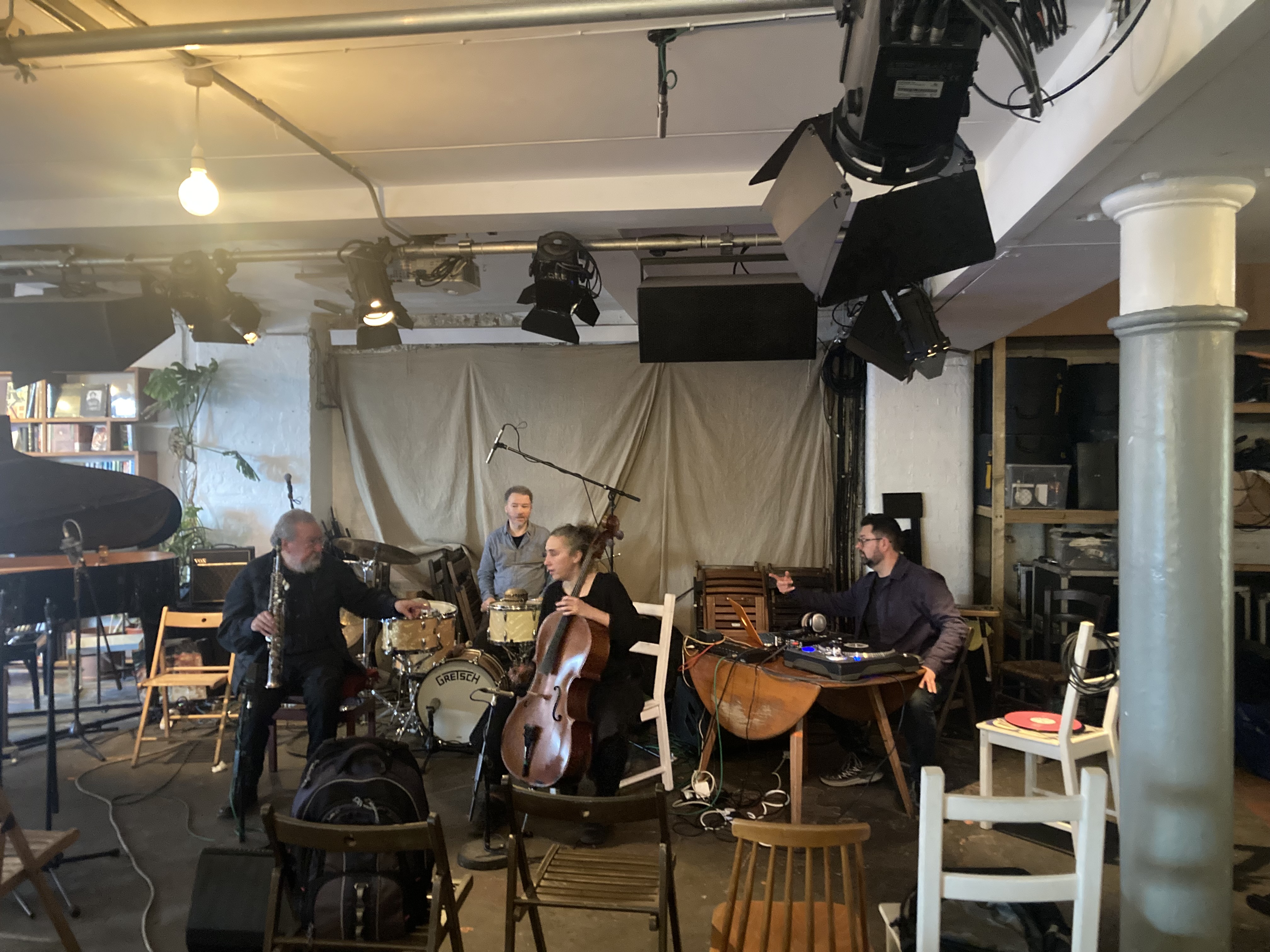
Today at Café Oto and the Vortex many of those artists performed in celebration and commemoration of Martin’s life. It was my privilege to introduce the Café Oto gig, which began with a set from the quartet pictured above during their soundcheck — Parker, Mark Sanders, Hannah Marshall and Matt Wright — and continued with the duo of the altoist Caroline Kraabel and the pianist Veryan Weston before concluding with the 27-strong London Improvisers Orchestra.

I met him 11 August 1969. I remember it because it was my first day in London, my first day at the Melody Maker, and I was sent to review Mike Westbrook’s band at the 100 Club that night. Martin was the man with a box of very desirable albums for sale, set up on a table in the space between the end of the bar and the stage. I soon learned that he was a man of views that were carefully considered and firmly held, some of them expressed in reviews for the MM over the next couple of years.

I was able to share with the audience a handful of the characteristic aphorisms from his New Musical Dictionary, which he posted online. Easy Listening: Music that is extremely difficult to listen to for anyone who really listens to music. Post-modernism: New things for people who don’t like new things. An Improviser: A musician who combines the roles of both composer and interpreter, yet usually receives less respect and remuneration than either.

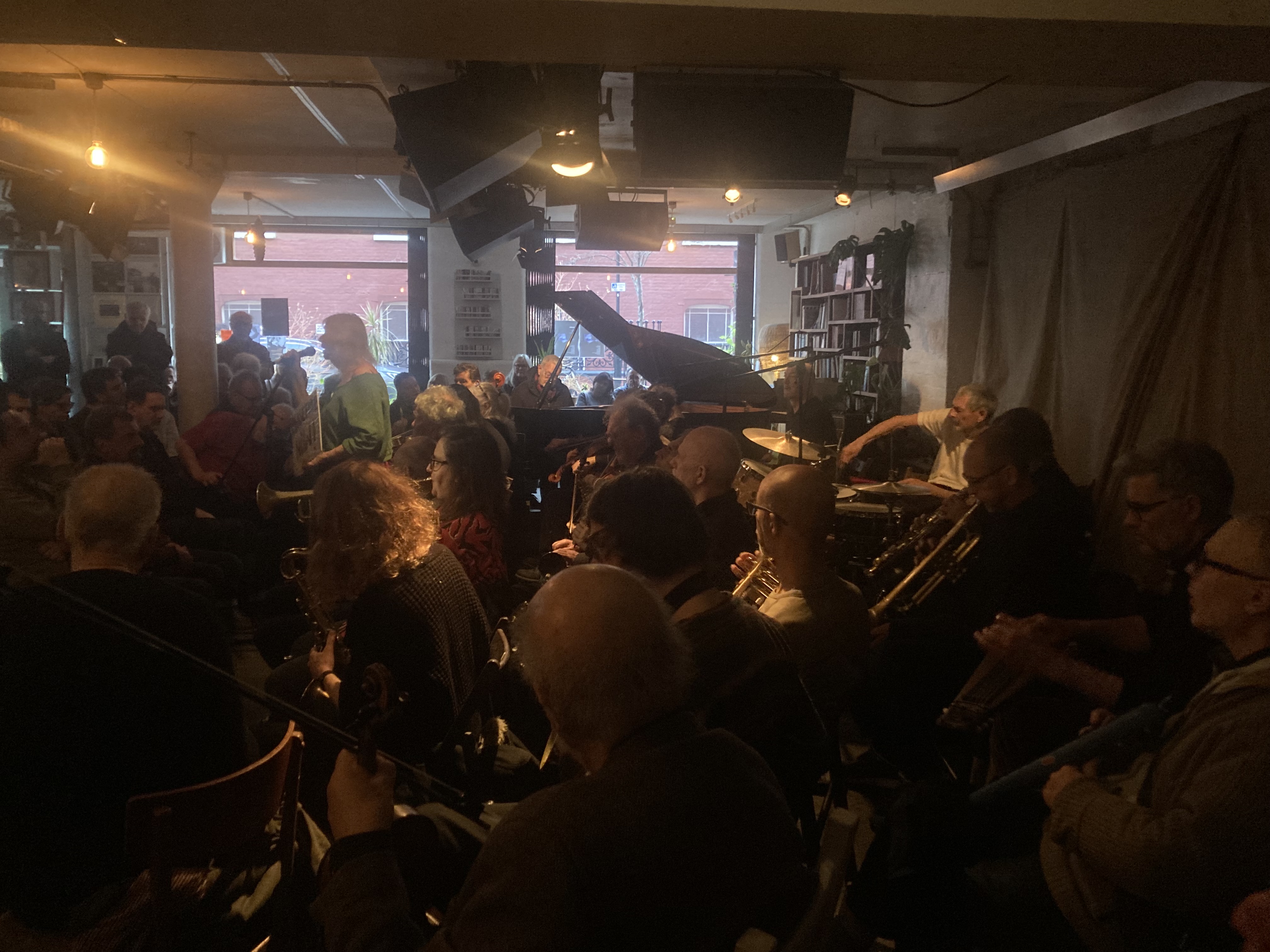
At the request of Mandy Davidson, Martin’s widow (and the other Em in Emanem), all the proceeds from the gigs, for which the musicians waived their fees, will go to B’Teselem, a Jerusalem-based non-profit organisation documenting human rights violations in Israeli-occupied Palestine. At the end of the LIO set, which consisted of ensemble improvisations conducted by Terry Day, Ashley Wales and others, Maggie Nichols — who met Martin when she was a member of the SME — read a verse by a Palestinian poet killed in the Gaza fighting. That’s what you can see in the picture below, as she holds up a placard saying CEASEFIRE NOW!!

Son of a drum

Vinnie Sperrazza grew up in Utica, New York as the son and great-grandson of drummers. He’s played the drums all his life, while thinking about drums and drumming and drummers. We’ll get to his own playing in a minute, but what first alerted me to his existence were his Substack posts, which appear under the heading of “Chronicles”. They’re not always about drumming, but they’re always interesting. And the ones that are about drumming contain the most perceptive and eloquent writing about drummers that I’ve ever read.

Sperrazza doesn’t describe the art of a drummer with the kind of literary eloquence with which the New Yorker‘s Whitney Balliett could bring, say, a solo piece by Papa Jo Jones to life on the page. (But then Balliett once claimed that Max Roach didn’t swing.) Sperrazza finds different but equally compelling ways to tell you what a Roach, a Gerald Cleaver, a Billy Hart or an Ed Blackwell is doing, and perhaps why, and certainly how it affects the surrounding music.

When I had a cup of coffee with Sperrazza during in London before Christmas, he was keen to hear my memories of seeing Tony Williams, who is his special subject, and about whom he writes with great insight. I was able to tell him about things he’s too young to have seen for himself, like Lifetime’s gigs at Ungano’s and the Marquee, a later edition of the band in Berlin, VSOP at the Grosvenor House and the Albert Hall, the quartet with Herbie Hancock, Ron Carter and Wynton Marsalis in Nice, and Tony’s own great quintet — the one with Wallace Roney, Bill Pierce and Mulgrew Miller — in Camden.

Most of all, I think he liked me describing the unforgettable experience of listening to Tony tuning his drums during the soundcheck for the gig in the Grosvenor House ballroom, for a gig that, believe it or not, was part of the 1977 Columbia Records international sales convention. That music is still in my ears.

Before we parted, he gave me a copy of Sunday, the third album in 10 years by his quartet, which is called Vinnie Sperrazza Apocryphal and also includes Loren Stillman on soprano and tenor saxophones, Brandon Seabrook on guitar, mandolin and banjo, and Eivind Opsvik on double bass — all great players from the contemporary New York scene. Frankly, I didn’t much mind whether I was going to like it or not, because I admire his writing so much and enjoyed his company. But when I put it on, it had me entranced.

The eight pieces making up the album are intended, he says, to depict “the moods and actions of one man in NYC on a random Sunday.” It’s probably typical of Sperrazza that the opening track doesn’t feature him at all: just Stillman’s affectingly human tenor tone, Seabrook’s pinched harmonics and distortions and Opsvik’s rich arco playing in an enticing prologue full of hints of what’s to come. But then the drums have the second track more or less to themselves, creating a subtly shaded, carefully developed, bombast-free soliloquy that Max or Papa Jo would surely applaud.

All four musicians then come together on a low-down, behind-the-beat groove with a blues feeling given its spice by Seabrook’s spacey and increasingly asymmetrical guitar chords, which fade away to the ticking of Sperrazza’s rimshots. Banjo colours the next piece, a solemn chink above shivering bass and sombre drums, shadowing Stillman’s lyrical ruminations, before Seabrook cuts loose with a jittering, jabbing solo.

And those four pieces are just the half of it. Like them, each of the remaining four creates its own microclimate, exploiting the available resources with a sense of variety and wit. When Stillman switches to soprano, something about the open rhythm reminds me of John Coltrane with Steve Davis and Elvin Jones on Coltrane Plays the Blues. There’s a joyful guitar feature with an 8/8 backbeat, not entirely unlike the early Lifetime. The banjo reappears for a quiet piece that could reasonably be described as giving Americana a good name.

It made me think of The President, Wayne Horvitz’s old band, as does a lot of this album, in its ability to to make sure that every track has its own little story to tell, while presenting music that, without compromising its spirit of inquiry, is extremely easy to like.

* Sunday by Vinnie Sperrazza Apocryphal is on the Loyal Label: https://vinniesperrazzaapocryphal.bandcamp.com/album/sunday His Substack archive is here: https://substack.com/@vinniesperrazza

The history of Les Cousins

Named after a 1959 Claude Chabrol film, Les Cousins operated as a folk club from 1964 to 1972, having taken over a basement in Soho run by John Jack as the Skiffle Cellar during the 1950s. On the ground floor was the restaurant of Loukas and Margaret Matheou, immigrants from Cyprus. Les Cousins, down a steep staircase, was run by their son, Andy. On stage at 49 Greek Street every night of the week he presented singers and musicians whose work would create a platform for the folk-rock and singer-songwriter movements of the late 1960s and early ’70s.

There were other important folk venues in London, notably Bunjie’s, just the other side of Charing Cross Road, and the Troubadour in Earl’s Court. But the Cousins had a special place in history, very well memorialised in a new three-CD box from the Cherry Red label, compiled and annotated by Ian A. Anderson, the singer, guitarist and editor of fRoots magazine.

It is, as you’d expect, a splendidly varied selection, starting and ending with big names — Bert Jansch and the Strawbs — and containing both even bigger ones (Paul Simon, Al Stewart, Ralph McTell, Nick Drake, Roy Harper and Cat Stevens) as well as many more of those whose reputations never really escaped the folk world, like the brilliant guitarists Davy Graham, Mike Cooper, John James, Sam Mitchell and Dave Evans.

So far I’ve mentioned only male performers, but the Cousins was a place where women shone: not just Shirley Collins, Sandy Denny, Bridget St John and Maddy Prior but Dorris Henderson, Jo Ann Kelly, Beverley Kutner (later Martyn) and Nadia Cattouse. And, of course, the sublime Anne Briggs. They’re all here, represented among the 72 tracks licensed from labels such as Topic, Island, Transatlantic, Village Thing and Harvest.

There are the traditionalists: Bert Lloyd singing “Jack Orion”, the Watersons delivering “The Holmfirth Anthem”, and Dave and Toni Arthur’s “A Maiden Came from London Town”. And there are the influential Americans: Jackson C. Frank (“Milk and Honey”), Dave Van Ronk (“Baby, Let Me Lay It On You”), and Tim Hardin (“If I Were a Carpenter”).

You can hear the music going off in all sorts of directions, with weirder stuff coming from the Third Ear Band, Kevin Ayers, the Incredible String Band and Dr Strangely Strange. Ron Geesin’s “Two Fifteen String Guitars for Nice People” is in a class of brilliant weirdness all by itself.

The well produced brochure includes facsimiles of a couple of pages from Andy Mattheou’s diary in April 1965, listing the people he’s booked: Sandy Denny for £3 on a Wednesday night, Davy Graham for £15 on the Saturday, Van Morrison for £3 on a Tuesday, the American guitarist Sandy Bull on a Friday for £10 against half the door takings. Sandy Bull! How I wish I’d been there for that.

The programme isn’t predictable. There’s no “Scarborough Fair”, no “May You Never”, no “She Moved Through the Fair”. The sequencing is thoughtful: tracks from John Martyn and Duffy Power follow immediately after those by their respective mentors, Hamish Imlach and Alexis Korner. I’d only quibble with the inclusion of a small handful of songs — including Drake’s “Northern Sky” and Beverley’s “Get the One I Want To” — where the presence of orchestral arrangements takes them away from the mood of a basement folk club.

If I had to pick some personal favourites, the first would be would be the dazzling violin and guitar of Dave Swarbrick and Martin Carthy on “Byker Hill” and the second would be the magical guitar interplay of Jansch and John Renbourn on “Soho”. The third would be the intense voice and bottleneck guitar of Sam Mitchell’s “Leaf Without a Tree”: a hellhound stalking the lanes of Soho, half a century ago.

* Les Cousins: The Soundtrack of Soho’s Legendary Folk & Blues Club is out now on the Cherry Red label. The image is the club’s logo, the wagon wheel a reference to a feature of its décor.

Written in air

Jan Bang is one of the people responsible for the great wave of creative music from Norway over the past three decades. As a producer and player, he’s collaborated with Dhafer Youssef, Nils Petter Molvaer, Arve Henriksen, David Sylvian, Bugge Wesseltoft and many others. In the fishing port of Kristiansand, where he was born in 1968, he and his friend Erik Honoré founded the annual Punkt Festival, where since 2005 live performances have been subjected to immediate remixes. (I wrote about a visit to the 2019 edition here.)

His new album, Reading the Air, is a sequence of songs with music mostly by himself and lyrics by Honoré. The musicians include Henriksen on trumpet, the singers Simin Tander and Benedikte Kløwe Askedalen, the guitarist Eivind Aarset, the bassist Audun Erlien, the drummer Anders Engen and the percussionist Adam Rudolph.

What does it sound like? I was put in mind of late Blue Nile filtered through Jon Hassell’s Fourth World recordings: fragile-sounding melodies, introspective lyrics, voices singing from some private sphere, gauzy textures shaped and layered with great care, on the edge of decay. Through the 10 tracks, there’s a consistency of mood, elegant and reflective.

Here are the opening lines of Honoré’s lyric for the exquisitely beautiful title song: Moving on /We’re planning our escape / Preparing to leave / The disconnected state / Bridges burned / The tables turned / Reading the air / To reconnect with fate. A piano is played in an empty ballroom. A swaying groove emerges and simmers quietly. Bang’s ruminative vocal is sometimes doubled by a female singing over his shoulder. What sounds like a section of shakuhachis turns out to be overdubbed trumpets played by Henriksen, who steps forward for a lighter-than-air solo. I could easily imagine successful covers of this by Annie Lennox, Bryan Ferry or Beth Gibbons with Rustin Man.

The other track I want to mention is the only non-original composition, a version of the old folk-blues song called “Delia” or “Delia’s Gone”, which exists in many versions. This is not the murder-ballad variant recorded by Bob Dylan on World Gone Wrong in 1993 (credited as “traditional”) or the bloodier iteration that Johnny Cash included on the first volume of his American Recordings in 1994 (credited to Cash, Karl Silbersdorf and Dick Toops). Curiously, it’s the smoother and more lyrical variation that Harry Belafonte sang in 1954 on his debut album, “Mark Twain” and Other Folk Favourites, credited to Lester Judson and Fred Brooks. Judson was a commercial songwriter. Brooks was a temporary nom de plume for Fred Hellerman, a member (with Pete Seeger) of the Weavers, who were then under investigation by the FBI for alleged Communist sympathies.

Bang’s version is a sort of Nordic Americana: the bell of a wooden church in the snow, muffled drums, the refined twang of Arset’s lightly picked guitar. No murders in the lyric, but three-part vocal harmony like a bluegrass family stranded up a fjord, in danger of death from exposure to the cruel elements. The line about “everything I had is gone” can rarely have sounded so final.

* Jan Bang’s Reading the Air is released on 19 January on the Punkt Editions label. The photo of Bang is by Alf Solbakken. You can hear “Delia” on this link: https://janbang.bandcamp.com/album/reading-the-air