Hello (and goodbye), Jimmy Reed
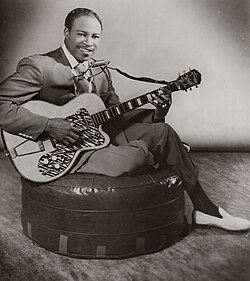
Half a century after his death at the age of 50, the great bluesman Jimmy Reed turned up yesterday in the New York Times obituaries section. The NYT has an excellent habit of memorialising, under the rubric ‘Overlooked’, people who weren’t seemed worthy of inclusion at the time of their death. Nice to see Reed getting his due, however belated.
While he’s not forgotten today, his influence is certainly underrated. The records he cut in Chicago for the Vee-Jay label between 1953 and 1965 were the ones that white British teenagers hoping to become musicians were most likely to start off by studying and copying in the early ’60s. Their rudimentary nature made them the easiest first lessons in the language of the blues.
The tempo of the basic shuffle didn’t vary much, usually from a slow-medium slouch to a medium lope. The characteristic twist to the basic blues chords was extremely powerful but straightforward and easy for a beginner to learn. This was what a young guitarist would master before feeling confident enough to tackle Chuck Berry’s intros or Elmore James’s slide figures. Reed’s harmonica style, with its long, high held notes, was relatively easy to imitate, as was the engaging mushmouth vocal style in which he sang his simple but compelling songs: “Hush Hush”, “Big Boss Man”, “Shame Shame Shame” and the rest. For British kids, it was like sitting the 11-plus exam: the entrance to a world of possibilities.
Reed liked having his own rhythm guitar supported by those of his friends, particularly Eddie Taylor and Lefty Bates. Somehow they never fell over each other. Sometimes there was a bass player (the young Curtis Mayfield played bass on a handful of sides in 1959) and always a drummer, first Earl Phillips and then Al Duncan, who also knew how to stay out of the way. Nowadays we can smile fondly when the beat gets turned around or Reed comes in a bar early, and yet still the record was deemed fit for release.
With those materials, Reed won the allegiance of a generation. His records were covered by those who were on their way to fame via the adopted medium of R&B — the Stones with “Honest I Do”, the Yardbirds with “I Ain’t Got You”, Them with “Baby What You Want Me to Do”, the Animals with “”Bright Lights, Big City”, the Grateful Dead with “Big Boss Man”, the Steve Miller Band with “You’re So Fine”. And the covers continued to proliferate, from Elvis Presley’s “Big Boss Man” in 1967 through Aretha Franklin’s “Honest I Do” in 1970 to Boz Scaggs’ “Down in Virginia” in 2018. And on his most recent album, Rough and Rowdy Ways, Bob Dylan recorded a new song called “Goodbye Jimmy Reed”, which has since become a regular part of his concert repertoire.
About 20 years ago I put together a proposal for a book about Reed. I’d read that he was broke when he died, and I started asking myself where all the money had gone. He’d written almost all of his hits, sold a lot of records, and seen his songs included on big-selling albums by other artists. Over the years, that would have been a great deal of money, very little of which made his way to him before his death after an epileptic attack in 1976.
I had in mind to do some serious research into what happened to his publishing copyrights — how many hands they had passed through, and who were the people, probably sitting behind large desks in Midtown Manhattan office blocks, who really made the money from them. That way I could tell the story behind the remark once made by the R&B singer Ruth Brown, who said of Ahmet Ertegun, the boss of her record company, that “for every Picasso on his wall, I had a damp stain on mine.”
I was going to call the book Meet Me in Your Home Town, after one of my favourite Reed songs. It was a reference to the way a sharecropper’s son from rural Mississippi, one of 10 children, had escaped plantation life, finding his way to Chicago and thence into the world of teenagers in just about every town in Britain, among whose number I included myself.
Sadly, the book never got written. Something else got in the way. But I’m pleased to see him being remembered in the columns of the New York Times, in an obit with which I have only one quibble. The author suggests that Reed’s delivery was “not as mesmerising, for example, as the reverberating braggadocio of Muddy Waters or the otherworldly moaning of Howlin’ Wolf.” Oh, dear writer, mesmerising is exactly what Jimmy Reed was. And still is.
* All Jimmy Reed’s Vee-Jay recordings were collected by Charly Records in 1994 in a six-CD set titled The Vee-Jay Years.

 thebluemoment.com
A lovely tribute
Fabulous piece. And I never knew Curtis Mayfield played bass on some of those Vee-Jay sides
Thanks Richard for a piece on Jimmy Reed. It` is 2026, but not yet 50 years .It is said he died on 29th August 1976.
If I remember rightly, the first release he had in England was one of his greatest : “Baby what you want me to do” on the rather under-promoted Top Rank label.
Soon after issue , multiple copies were available -one shilling each- in the Army Surplus store on High Holborn where Top Rank`s liquidated stock was unloaded.
The use of harmonica in a harness (copied by Dylan) enabling him to play rhythm guitar was unknown here in 1960. Larry Adler was the only harmonica player the UK ever saw.
Jimmy`s harmonica style was original -deceptively simple and recognizably different from the other Chicago players Sonny Boy and Little Walter .
What younger readers may not realise is that Jimmy Reed records regularly made the USA Hot 100s in the sixties.
Two really big ones you missed mentioning were “You don`t have to go ” and “Ain`t that loving you baby”.
You are right to say that with covers by Elvis, Aretha, Everly Brothers , Stones….even Jimi Hendrix and (yes) Pink Floyd…he should have had substantial royalties to receive.
Most of his songs were with Conrad ,the publishing arm of Vee Jay Records for whom nearly all the hits were made.
Only Vee Jay could go bankrupt with the Beatles on their label .
Jimmy Reed was one of many black artistes who never received their proper dues. The story of Jackie Wilson is incredibly painful. I personally spent a few years trying to catch up with those who took Bobby Parker`s money .It`s a hard task without a lawyer who may well cost heavily or simply swindle you even further. The music industry was rotten to the core.
I think your book project could cover a plethora of artistes not just Jimmy. Let me know if you want to share the task.
Really enjoyed reading this, a perfect compliment to Richard’s excellent article and both great and timely reminders of the wonderful Jimmy.
It was great to read both Richard’s original piece and the ‘footpath records’ follow-up.
In 2004, Charly Records issued a 3-CD set entitled JIMMY REED – THE ESSENTIAL BOSS MAN, a 75-track compilation with liner notes by Les Fancourt. It is sub-titled THE VERY BEST OF THE VEE-JAY YEARS 1953-1966, which is pretty much what it is – obviously not as comprehensive as its 6-CD predecessor but well worth considering.
Reed came to Britain in the early part of 1964 and I had read that he appeared on READY STEADY GO. I found a colour photo on-line headed “Jimmy Reed on Ready Steady Go -1964” but there was no other information. I certainly don’t recall that appearance; can anybody recall it?
In 1964, there were two multi-artist ‘blues’ tours in Britain (I attended both) but he was not on the bill for either, so I guess it was a solo tour.
He was in Britain in May 1964 when he appeared on Ready Steady Go backed by John Mayall’s Bluesbreakers. He returned in November for a tour of about a dozen dates, backed first by a band called the Plebs, who were replaced by the Groundhogs. During that tour he appeared again on RSG, miming (according to Max Jones’s eyewitness account in the Melody Maker) to “Ain’t That Lovin’ You Baby” and “Shame Shame Shame”.
Many thanks for the information.
I have my pocket diaries for every year in the 1960s – EXCEPT 1964, so that’s gap. I can recall seeing Sonny Boy Williamson and (separately) Little Walter at a club near where I then lived in late-1964 but not Jimmy Reed if he played that club around the same time.
And, as I said, I don’t recall him on RSG (but that would only have happened if I had gone back home to see my parents – and only then if I was back in time on a Friday).
I do recall an article about Jimmy Reed in BLUES UNLIMITED and it must have been around that time as I only subscribed from mid-1964 to mid-1965. I must still have those issues around somewhere.
Again, thanks for your reply.
Ian
Brilliant piece. Dead right on those times when Jimmy Reed was the number one go to as we navigated thro the Blues. Great music, unfortunately overlooked.
Your beautiful obituary woke up Jimmy Reed’s vitality after 50 years, I’ve been under the spell of his soulful music for hours now. Thank you
Great to read a piece about the wonderful Jimmy Reed. I think I first heard some of his recordings when I was about 13 ( in 1963 or 1964) and I’ve loved his music ever since. His music really is a case of ‘less is more.’ Often imitated, never bettered.
Thank you for this excellent piece, Richard. Lately The New York Times has been quite negligent reporting the passing of notable musicians: Mike Ratledge, Lô Borges, Richie Beirach, to name a few.