‘Rhapsody in Blue’ at 100
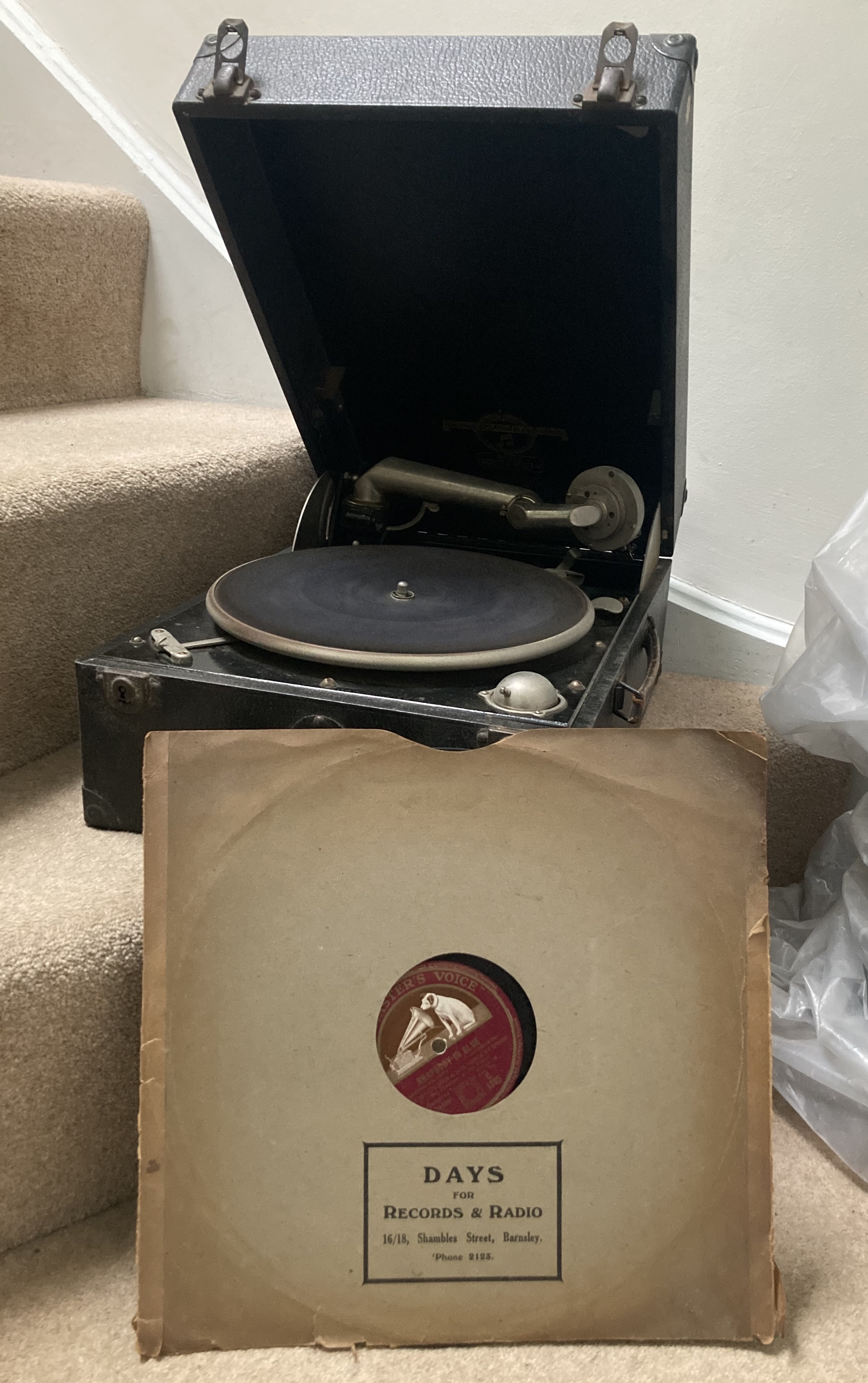
The first public performance of George Gershwin’s “Rhapsody in Blue” was given 100 years ago this week, on 12 February 1924, at the Aeolian Hall on West 43rd Street in New York City, by Paul Whiteman and his Concert Orchestra, with Gershwin himself at the piano. Whiteman had commissioned the piece from its composer specially for the evening, which was billed as ‘An Experiment in Modern Music’.
I first heard “Rhapsody in Blue” in childhood, played by the same Whiteman/Gershwin combination, on the 12-inch 78rpm record you see above, which my mother would have bought from a record shop in Barnsley, South Yorkshire, in the 1930s. Nine minutes long, it’s split over both sides of the disc. The gramophone — a Columbia Viva-Tonal Grafonola — is the one on which she played it, along with her other 78s.
To mark the centenary, the pianist Ethan Iverson started a lively debate the other day with a piece for the New York Times in which he examined the artistic impact, then and now, of what he called “a naive and corny” attempt to blend the superficial characteristics of jazz with European classical music. If “Rhapsody in Blue” is a masterpiece, he wrote, it’s surely “the worst masterpiece”: an uncomfortable compromise that blocked off the progress of what would later be called the Third Stream, and with which we are both “blessed and stuck”.
Thanks to my mother’s influence, I view it from a slightly different angle. For me, in childhood, it became a gateway drug. I loved the spectacular clarinet introduction, and the shifting melodies and the hints of syncopation, but more than anything I responded to the tonality that reflected its title, expressed in the exotic flattened thirds and sevenths of the blues scale.
It didn’t take very long before I was following a path that led to Louis Armstrong, Duke Ellington, Charlie Parker, Thelonious Monk, Miles Davis, Charles Mingus, John Coltrane, Ornette Coleman and Cecil Taylor, right up to the Vijay Iyers, Matana Robertses and Tyshawn Soreys of today’s jazz. Pretty soon I’d worked out that an ounce of Ellington was worth a ton of Gershwin’s instrumental music*, but I retain a respectful gratitude to “Rhapsody in Blue” and its role as a gateway, just as I do to The Glenn Miller Story and “Take Five”.
A few weeks after the world première Gershwin’s piece, F. Scott Fitzgerald and his young family would set off for France, where he spent the summer knocking the early draft of his third novel into shape. When The Great Gatsby was published the following April, it contained a vivid scene in which the society guests at one of Jay Gatsby’s Long Island parties were entertained by a band described by the author as “no thin five-piece affair, but a whole pitful of oboes and trombones and saxophones and viols and cornets and piccolos, and high and low drums.”
The bandleader — who is unnamed, but it’s easy to imagine him as Paul Whiteman, with his tuxedo, bow-tie and little moustache — makes an announcement. “At the request of Mr Gatsby,” he says, “we are going to play for you Mr Vladimir Tostoff’s latest work, which attracted so much attention at Carnegie Hall last May.” The piece is known, he adds, as “Vladimir Tostoff’s Jazz History of the World”. I’ve always idly wondered what it would sound like, but I imagine Mr George Gershwin’s “Rhapsody in Blue”, with its bustling bass saxophone eruptions and flamboyantly choked cymbal splashes, is as close as we’ll get.
* A few people have picked me up on this statement, and I tend to agree with them. I was trying to make a specific point, rather clumsily. George Gershwin was a genius songwriter, as any fule kno.

 thebluemoment.com
Larry Adler ( in his biography ‘Me and My Big Mouth’) recounts how he first met Gershwin. Paul Whiteman’s Orchestra was playing at the Roxy Theater. A very young Adler was outside playing his harmonica to ‘anyone who would listen’. One of the musicians was impressed and beckoned him inside along the passage to the bandleader’s dressing room insisting Whiteman ‘listen to this kid’. After Adler played an initial song, Whiteman said ‘Let me hear you play Rhapsody in Blue’.
Adler who didnt know the piece yet replied: ‘I dont like Rhapsody in Blue’. Whiteman ‘turned to the young man sitting across from him – “What do you think of that, George? This kid doesnt like Rhapsody in Blue” ‘. But it subsquently became an orchestral party piece for Adler whom Gershwin befriended.
I heard Adler play it live c.1982 at the Pizza on the Park in a duo accompanied by George Gershwin’s original piano roll recording adapted to a Yamaha Upright midi piano.
Just read this after I was sitting at the first Gershwin piano that was gifted to songwriter Jimmy McHugh. His nephew runs the Jimmy publishing company and Michael Feinstein the Gershwin scholar was in the office and he played the legendary piano. Jimmy did a lot of demos and masters at Gold Star that ended up in movies.
This piece, like some other Gershwin music, has its flaws, but it is also wonderfully vivid and a great route into other, more rewarding music. Let us never forget, too, that it was Gershwin who probably influenced Ravel’s Piano Concerto, for which we should be eternally grateful. The path to the jazz maestros you mention also led elsewhere.
Interesting post Richard. I’ve always liked Iverson both his music (saw him in Cheltenham almost exactly 4 years ago with a fine quartet he co-led with Martin Speake) and his writings (his blog is a treasure trove) but IMHO he’s wrong here. I like, as opposed to love, ‘Rhapsody..’ (particularly the Tilson Thomas version and a live, almost totally solo, Larry Coryell take) and I feel your ‘gateway’ comment is just about right. That said your ‘ounce/ton’ comparison to Duke, whilst very nicely phrased, does short change Gershwin a little!
I’ve always loved it as a piece of music, regardless of ‘classification’. It was always evocative of my notion of New York, back when I was 14 or 15. That made sense to me with the introduction to Woody Allen’s ‘Manhattan’, with the rhapsody, imagery and Woody’s character’s voiceover trying to draft the opening to his new book. Marvellous! https://youtu.be/g2akLhosPEg?si=dFUtN3DdVq9vSHRd
Shambles Street. If there isn’t a novel with that name, you’d better write one, Richard :>
Part of Ethan Iverson’s lively debate is on Reddit – https://www.reddit.com/r/Jazz/comments/1ac01ea/iverson_draws_nytimes_readers_ire_for_the_worst/ – where there is also a link to the NYT article not behind a paywall.
The thread also mentions Béla Fleck’s version which you may find an interesting listen https://www.youtube.com/watch?v=8DHPxRZFWQE
What a cheap, sneering attack in the NY Times. I wonder if the author of the piece knew that Duke Ellington greatly respected both Paul Whiteman and was impressed by ‘Rhapsody In Blue’ – according to Terry Teachout’s ‘The Life of Duke Ellington’ (2013).
Page 118: He would never have a bad word to say about Paul Whiteman who he described in 1932 as his ‘favourite musician.’ Duke continued: “there is no doubt he has carried jazz to the highest position it has ever enjoyed….he’s done a lot (for our music) especially with his concerts where he gave composers a chance to write new, extended works.”
Teachout establishes that Ellington disliked ‘Porgy and Bess’ with its embedded racial attitudes but adds that he was interested in writing piece like ‘Rhapsody In Blue’ that ‘burst out of the straitjacket of song form.’
It’s half-term week and we have our grandsons with us for a few days. As I began to read Richard’s blog, I played the audio track. My 11-year old grandson was passing and called out, “Rhapsody in Blue”. I pressed ‘pause’; the track had been playing for 21 seconds.
When I asked, “You know this?”, his reply was, “Yes, George Gershwin.”. And this from the grandson who is less out-going and , hitherto, has shown just about zero interest in music.
___________________
Later that evening, I picked GERSHWIN IN HIS TIME off the bookshelf and re-read an article on the concert by Whiteman himself (“An Experiment”, JAZZ magazine,1926) and various mid-1920s articles by Gershwin (in SINGING and THEATRE MAGAZINE). It is interesting to reflect on their aims and ambitions for the concert and for the music composed and performed in that period, as expressed in their own words.
I could provide several excerpts but I’ve chosen this one from Gershwin himself:
If you are a singer, don’t ignore jazz. Study it, love and cherish it, give it free rein in your heart. It will repay you a hundredfold. It will help you over many tough spots in your classics. It will add a new rhythmic meaning to your whole repertoire, old and new. It will be your good friend and companion, through sunshine and shadow. (SINGING, July 1926).
____________________
As for Mr Iverson, I wish him luck, even as I disagree with his sentiments. While I will not myself be around to find out, I doubt that our equivalents will be discussing his works 100 years after they were written.
And I doubt my grandson’s grandchildren will know his music 100 years from now.
I love the melody of those sweeping strings that come in around the 11-minute mark. Always reminded me of a song called ‘Younger Than Springtime’ from South Pacific that my mum used to play on the piano when I was quite young.I like your wind-up record player too RW. Do you control the volume by stuffing socks into the sound hole? That’s how we did it on a mate’s wind-up back in the 50s.
I have always loved Rhapsody in Blue from the moment I first heard it. It just sinewed its way into my brain and took over my heart.
Difficult to dislike Take Five and the soundtrack for The Glenn Miller Story is outstanding with a superb band featuring the great Conrad Gozzo
Glen Miller and George Gershwin in the same bracket? No, that doesn’t feel right at all. For me In the Mood and the rest of James Stewart’s, sorry Glen Miller’s oeuvre long ago grew distinctly tiresome. Since my initial, juvenile, interest.
Rhapsody in Blue? Those bars have never lost their resonance.
Feels right to me. Each to their own. Perhaps you haven’t studied Bobby Hackett’s solo on “String of Pearls”. And it’s Glenn, by the way — not Glen.
As you say, each to their own.
For me Hackett’s interpretation proves the point about Glenn Miller.
“100 years of Gershwin’s Rhapsody in Blue: An interview with performer and archivist of the “Great American Songbook” Michael Feinstein”
100 years of Gershwin’s <em>Rhapsody in Blue</em>: An interview with performer and archivist of the “Great American Songbook” Michael Feinstein – World Socialist Web Site (wsws.org)
I enjoyed reading your post on Rhapsody in Blue. Is the 78rpm yours?