Jazz in Britain, Part 2
 The first instalment of this two-part series dealt with new releases. This one looks at recent reissues and archive discoveries from the second half of the last century.
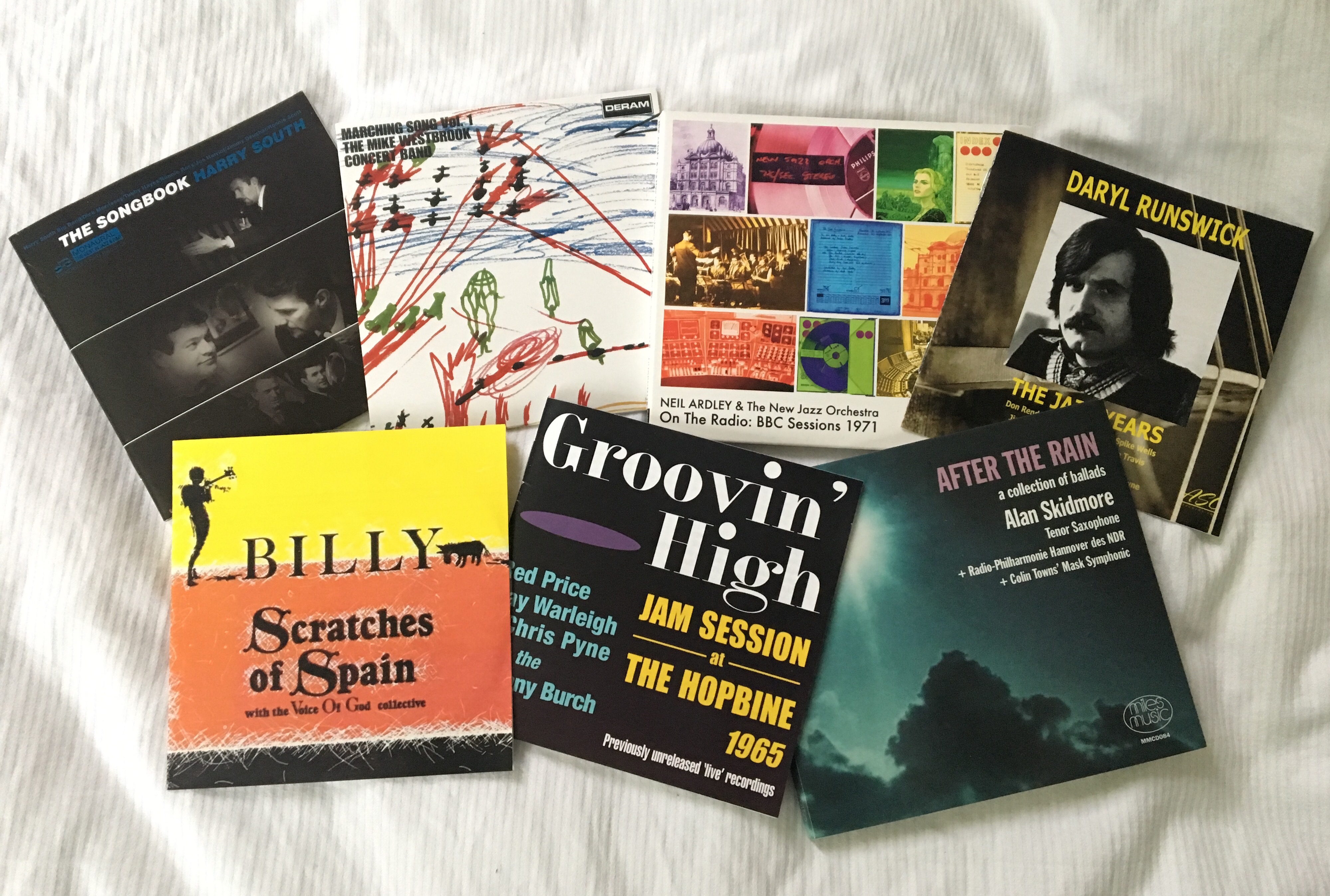
Harry South: The Songbook (Rhythm and Blues Records). Some readers of this blog will most readily associate the name of Harry South with the big-band arrangements for Sound Venture, the 1965 album with which Georgie Fame demonstrated his jazz chops. Others will know that South, a Londoner who died in 1990, aged 60, had a distinguished career as a pianist, bandleader and composer. This four-CD set, lovingly compiled by Nick Duckett and Simon Spillett, brings together a wealth of music from the mid-’50s onwards, much of it by South’s big band but also featuring him with the small groups of Tubby Hayes, Ronnie Ross, Joe Harriott and others. “Hall Hears the Blues”, a 14-minute down-tempo blues recorded for Tempo by Hayes’s quintet in 1956, is almost worth the price of admission by itself, as is the gorgeously swinging “Minor Incident” by the Dick Morrissey Quartet, from 1963. Of the wide range of big-band material, much of its previously unissued, I’d pick out an unnamed and undated piece (disc 3, track 15) which sounds like a lost Gil Evans chart, and “The Rainy Season”, from 1970, which shows South integrating exotic elements into his music very interestingly. Solos throughout, although individually unidentified, are by the likes of Kenny Wheeler and Tony Coe. There’s also the theme tune to The Sweeney, which presumably made South some money. Taken together, these 64 tracks represent an exemplary tribute to an unjustly neglected figure.
Mike Westbrook Concert Band: Marching Song (Turtle). Of all the many fine British modern jazz records made in the last 50 years, the ones that probably most deserve to survive another half-century are Mike Westbrook’s large-scale pieces, including Metropolis, Citadel/Room 315 and The Cortège. In a sense, Marching Song is where it all began: released in its entirety as two LPs on the Deram label in 1969, representing a statement of scale and intent. And of moral purpose, too: this is every bit as much a portrait of the pity and horror of war as Picasso’s Guernica, making a similarly startling use of modernist techniques. This reissue also contains a third disc of previously unheard material including a nine-minute sketch of the piece recorded in 1966 by a sextet including Mike Osborne, John Surman, Malcolm Griffiths, Harry Miller and Alan Jackson — its approach very heavily influenced by Mingus — and two wonderful extended quartet tracks by Osborne with the rhythm section, making this just about an essential purchase.
Neil Ardley / New Jazz Orchestra: On the Radio: BBC Sessions 1971 (BBC Records). Much of this album is taken up by six tracks from a Jazz Club session by the 19-piece NJO, conducted by the gifted Neil Ardley and including pieces by Mike Taylor, Barbara Thompson and Jack Bruce, with solos from Ian Carr, Harry Beckett, Dick Heckstall-Smith, Don Rendell and others. It’s good stuff. But the special interest comes in “The Time Flowers”, an extended piece written by Ardley and the electronic composer Keith Winter and recorded for Jazz in Britain with the quintet of Carr, Rendell, Frank Ricotti (vibes), Barry Guy (amplified bass) and Winter, plus the London Studio Strings. Inspired by a J. G. Ballard story, it evolves from a Vaughan Williamsesque pastorale into a futuristic soundscape, settings that provoke fine solos from Carr on flugelhorn and Rendell, unusually, on alto rather than soprano or tenor. The two broadcasts are introduced by Humphrey Lyttelton and Brian Priestley — another contrast of styles, to say the least…
Daryl Runswick: The Jazz Years (ASC Records). There were some pretty handy bass players on the London jazz scene in the late ’60s and early ’70s, and Daryl Runswick was up there with Jeff Clyne, Ron Mathewson, Harry Miller and others. He left the jazz world towards the end of the ’70s, preferring studio employment and regular work with Electric Phoenix, the King’s Singers and other ensembles. This two-CD set of mostly live recordings is a reminder of how good he was, whether in the London Jazz Quartet (with Jim Philip, Mike McNaught and Mike Travis, a really wonderful drummer) on extended versions of Jim Webb and Harry Nilsson songs or playing his own compositions in his quartet with the likes of Stan Sulzmann, Tony Hymas, Don Rendell, Alan Branscombe and Harold Fisher. There’s also a very funny solo bass-and-vocal recording, from a gig in 1967, of “The Song of the Double Bass Player”, with a lyric written for him by Clive James, a fellow member of the Cambridge Footlights: “It isn’t cute, it isn’t sweet, it isn’t small, it isn’t skinny / It needs flags on it when you tie it to the roof rack of the Mini…”
Billy Jenkins / Voice of God Collective: Scratches of Spain (VOTP Records, download only). On its first appearance in 1987 this album caused my sense of humour to fail: the point of Jenkins pastiching the cover of a Miles Davis classic for his collection of British-eccentric jazz, with a heavy brass-band and circus influence, escaped me. It seemed disrespectful, and it made me angry. Maybe I was being a bit po-faced. But I’ve listened to again, 30 years later, and I still feel the same way — except for one thing. Near the end there’s a track called “Cooking Oil” that breaks the prevailing mood. It’s an adagio for cello (Jo Westcott) and vibes (Jimmy Haycraft) over a bowed-bass pedal point (Steve Watts, possibly with a little electronic treatment), and it’s spellbinding in its restrained melodic beauty. If I were a film director, I’d use it for something or other, and people would notice. And then, after five absolutely celestial minutes, it’s back to the circus.
Red Price etc: Groovin’ High (Acrobat Music). This is a recording from a night at the Hopbine pub in North Wembley in 1965, featuring Red Price on tenor, Ray Warleigh on alto, Chris Pyne on trombone, John Burch on piano, Ron Mathewson on bass and Alan “Buzz” Green on drums. Four long blowing vehicles, including “Billie’s Bounce” and “Groovin’ High”, and a chance in particular to get some extra helpings of Warleigh and Burch, both under-recorded throughout their careers. Price, a veteran of the Squadronaires and the bands of Jack Parnell and Ted Heath, takes “Alexander’s Ragtime Band” for himself, displaying a Hawkins/Byas tendency that makes a good contrast with Warleigh’s approach, still heavily under the Parker influence. Simon Spillett’s exhaustive sleeve note provides all the context you could need.
Alan Skidmore: After the Rain (Miles Music). First I’ll declare an interest, albeit a mild and non-financial one. When this album first appeared, almost 20 years ago, I was invited to write the sleeve note. I agreed because I thought, and still do, that Alan Skidmore’s decision to devote an album to a set of standard ballads associated with John Coltrane, with orchestral accompaniment from the Hannover Radio Philharmonic on 10 tracks and Colin Towns’ Mask Symphonic on three others, was a good one. The arrangements of things like “Nature Boy”, “My One and Only Love”, “In a Sentimental Mood” and Coltrane’s “Naima” and “Central Park West” are not ground-breaking — much closer to Nelson Riddle than Eric Dolphy, you might say — but they suit the songs, and Skidmore responds to the harps and violins with some beautifully mature and gently heartfelt playing. It’s good to see it back in circulation.
 The title of this two-part series is a homage to John Muir, a friend of 40-odd years ago. As a BBC radio producer, Muir saved John Peel’s career at the corporation in 1968 by giving him a Radio 1 show called Night Ride. He also booked Roxy Music for their first broadcast on Sounds of the Seventies, and supervised a series titled Jazz in Britain, devoted to the emerging generation of John Stevens, John Surman, Tony Oxley, Trevor Watts, Howard Riley and so on. John died recently, aged 80. I thought of him as being the best kind of BBC person: calm, civilised, culturally literate and unobtrusively fearless. Here are eight new albums by artists he would certainly have booked for a series of Jazz in Britain in 2017. Together they demonstrate that we are experiencing a new golden age of British jazz.
 Donald Trump’s attempt to turn the United States back into the country once shaped by Richard Nixon and J. Edgar Hoover took another step today when he signed a document reversing Barack Obama’s rapprochement with Cuba. There’s probably not much most of us can do about that, except maybe book a holiday there to replace the Americans who will no longer be able to travel to the island so easily, but it’s a good excuse to mention the reissue in expanded form of Introducing… Rubén González, one of the finest albums to come out of the Buena Vista Social Club phenomenon 20 years ago.
 In the Rialto Theatre, Montreux, with only their technicians and a TV crew for company, the Rolling Stones were rehearsing for the Exile on Main St tour. It was May 1972, and the first date in Canada was a fortnight away. The small theatre on the shore of Lac Leman was the kind of setting that always showed them to best advantage, far from the stadiums in which they became a rock and roll circus act. The rhythm section locked in as played “Tumbling Dice”, “Shake Your Hips” and various boogie jams. In those surroundings even a sceptic (which I was) could have listened to them all night.
 Of the handful of Americans who landed in the UK in the 1960s to try and reverse the tide of the British Invasion, none had a more profound impact than Shel Talmy. A 25-year-old studio engineer with virtually no experience as a record producer but with a handful of Beach Boys and Lou Rawls acetates given to him by his mentor, Nik Venet, in order to persuade prospective employers of his bona fides, Talmy arrived from California in the summer of 1962. Dick Rowe, Decca’s A&R chief, was impressed enough to assign him to work with the Bachelors. It wasn’t really his idea of pop music, but when “Charmaine” was a hit, he was on his way. And after that came a handful of sessions that changed the way British pop records sounded.
 thebluemoment.com