Skip to content

Posts tagged ‘Wadada Leo Smith’

Under the same sky

In the 55 years since the discreet arrival of the first ECM album, Mal Waldron’s Free At Last, Manfred Eicher’s label has released somewhere north of a thousand albums. Contrary to a cynical early view, they don’t all sound the same. They are, however, distinguished by the presence of set of qualities — musical, aesthetic and philosophical — that appear, in varying proportions, in just about every one of them. You can detect those qualities in four of their recent releases, each of which exemplifies a certain characteristic taken to the very highest level.

1 Vijay Iyer / Wadada Leo Smith: Defiant Life

American jazz from the tradition continues to make its presence central to ECM’s output. Smith’s trumpet and Iyer’s keyboards and electronics weave their way through spellbinding duets subtextually infused with a sense of history. Smith’s “Floating River Requiem” is a dedication to Patrice Lumumba, the Congolese independence leader murdered by colonial forces in 1961, while Iyer’s “Kite” acknowledges Refaat Alareer, a leading Palestinian poet killed along with two siblings and four nephews during an Israel air strike on Gaza in late 2023. Sorrow and outrage are present in this music, but it also serves, in Iyer’s words, as a statement of “faith in human possibility.”

2 Anouar Brahem: After the Last Sky

Modes from all over the world find their way into the ECM matrix. The Tunisian oud player and composer Anouar Brahem first recorded for the label 35 years ago. On his latest album he is in the company of three of the company’s regulars: the cellist Anja Lechner, the pianist Django Bates and the bassist Dave Holland. Taking its title from a book by the late Edward Said, this album, too, is driven by reflections on the suffering, recent and historic, of the people of Gaza, as outlined in Adam Shatz’s fine sleeve essay. Unfolding with patience and elegance, metabolising elements from Arabic maqam, jazz and European classical music, these quartet pieces ache with grief.

3 Alexander Knaifel: Chapter Eight

By cultivating a widespread audience for the work of the Estonian composer Arvo Pärt via its New Series offshoot, ECM helped create the genre known as “holy minimalism”. Alexander Knaifel (1943-2024), born in Tashkent, studied cello with Rostropovich in Moscow in the 1960s before making a reputation writing operas and film music. A kind of an Uzbek version of Anthony Braxton, he also wrote an extended piece for 17 double basses and another for 35 Javanese gongs. But the pieces on this album, performed by an ensemble of three Latvian choirs and the Swiss cellist Patrick Demenga, are settings of verses from the Song of Solomon. Proceeding with great deliberation under the baton of Andres Mustonen, they achieve the required meditative glow to very satisfying effect, fully exploiting the acoustic resonance of the Jesuit church in Lucerne, where they were recorded in 2009.

4 Arve Henriksen / Trygve Seim / Anders Jormin / Markku Ounaskari: Arcanum

The crucial role played by ECM in the emergence of Nordic jazz needs no acknowledgement. Here are four leading players — the trumpeter Henriksen and the saxophonist Seim from Norway*, the bassist Anders Jormin from Sweden, and the Finnish drummer Ouaskari — at the height of their powers, taking memories of Ornette Coleman’s quartet as a starting point from which to develop conversations of great beauty and originality. All four of these albums are outstanding, but this is the one that sounds to me like a future classic.

* Due to a moment of brain-fade, this piece originally claimed that Henriksen and Seim are Finnish. My thanks to those who noticed and gently pointed out the error.

A stroll in the park

Although Wadada Leo Smith and Amina Claudine Myers are both longtime members of Chicago’s Association for the Advancement of Creative Musicians, they had never recorded together before going into the studio to make Central Park’s Mosaics of Reservoir, Lake, Paths and Gardens. Both are originally from the South — Wadada from Mississippi, Amina from Arkansas — but here they are in a suite of duets for trumpet and keyboards whose title refers to Manhattan’s 843-acre green space.

All but one of the pieces were written by Wadada, who likes to tie his compositions to specific sources of inspiration. In the past, these have included Rosa Parks, Thelonious Monk, Emmett Till, Billie Holiday, Martin Luther King and America’s national parks. His six pieces on Central Park find the two musicians conjuring solemn meditations, perhaps informed by the knowledge that part of the vast acreage was seized by compulsory purchase from the inhabitants of Seneca Village, a largely black settlement on what is now the Upper West Side, with a population of just over 200 (some of them Native Americans and Irish immigrants) in about 50 houses when it was taken and razed in 1857.

Individual sections are named after the Conservatory Garden — formal gardens located near 105th street — and two water features: the Harlem Meer, a man-made lake in the north-eastern corner, created at the confluence of three streams, and the Jacqueline Kennedy Onassis Reservoir, a little further south, between 86th and 96th Streets. Two others are titled “Albert Ayler — A Meditation in Light” and “Imagine — A Mosaic for John Lennon”. Ayler lived mostly in Harlem between 1963 and his death in 1970. Lennon died outside the Dakota building, where he and Yoko Ono lived, on Central Park West.

There’s nothing programmatic about these pieces, nothing to provide an explicit reminder of Jackie O, Ayler, Lennon or large expanses of water, although I suppose “Central Park at Sunset”, the sixth piece, could be described as a tone poem, at a push. But there is a sense of weight and contemplation to them all, and a powerful continuity of mood. These are veterans — both are 82 — but their playing is poised, firm, probing and heartfelt. Variations are provided by Wadada’s occasional use of a mute and Amina’s switch to a Hammond B3 on the Jackie dedication. And at the midpoint of the album she gets five minutes to herself for a solo called “When Was”, the piano ringing with echoes of hymns and ragtime airs until she gathers them up and and shakes them out in a terse, pounding finale.

From Louis Armstrong with Earl Hines through Ruby Braff with Ellis Larkins to Arve Henriksen with Harmen Fraanje, trumpet and piano duets are a precious jazz tradition. This, from two of the elders, is a very special one.

* Central Park’s Mosaics of Reservoir, Lake, Paths and Gardens is on the Red Hook label. The composite photo of Wadada Leo Smith and Amina Claudine Myers is by Luke Marantz.

Sylvie Courvoisier x 2

Sylvie Courvoisier and Mary Halvorson at Café Oto 30 October 2023

One way and another, Sylvie Courvoiser’s new album, Chimaera, contains the most sheerly beautiful music I’ve heard this year. Inspired by the paintings and drawings of Odilon Redon (1840-1916), these pieces recall the words of the French artist about his own work: “They place us, as does music, in the ambiguous realm of the undetermined.” Without getting remotely literal about it, Courvoisier finds ways of creating a music parallel to such works as “Partout des prunelles flamboient (Everywhere eyeballs are ablaze)” and “Le pavout rouge (The red poppy)”, summoning dream-like textures that swirl and mingle, float and evaporate, creating pictures of their own.

Courvoisier, the Swiss-born pianist and composer, has lived in Brooklyn for the past 25 years, becoming an important figure in the New York downtown scene. Her band for the new album unites her partners in her regular trio, the bassist Drew Gress and the drummer and vibraphone-player Kenny Wollesen, with the trumpeters Wadada Leo Smith and Nate Wooley and the Austrian guitarist Christian Fennesz, who brings along his array of electronic tools. The broad palette of instrumental colours is used with immense care and subtlety, and with a sense of spatial resolution that invites the listener’s engagement.

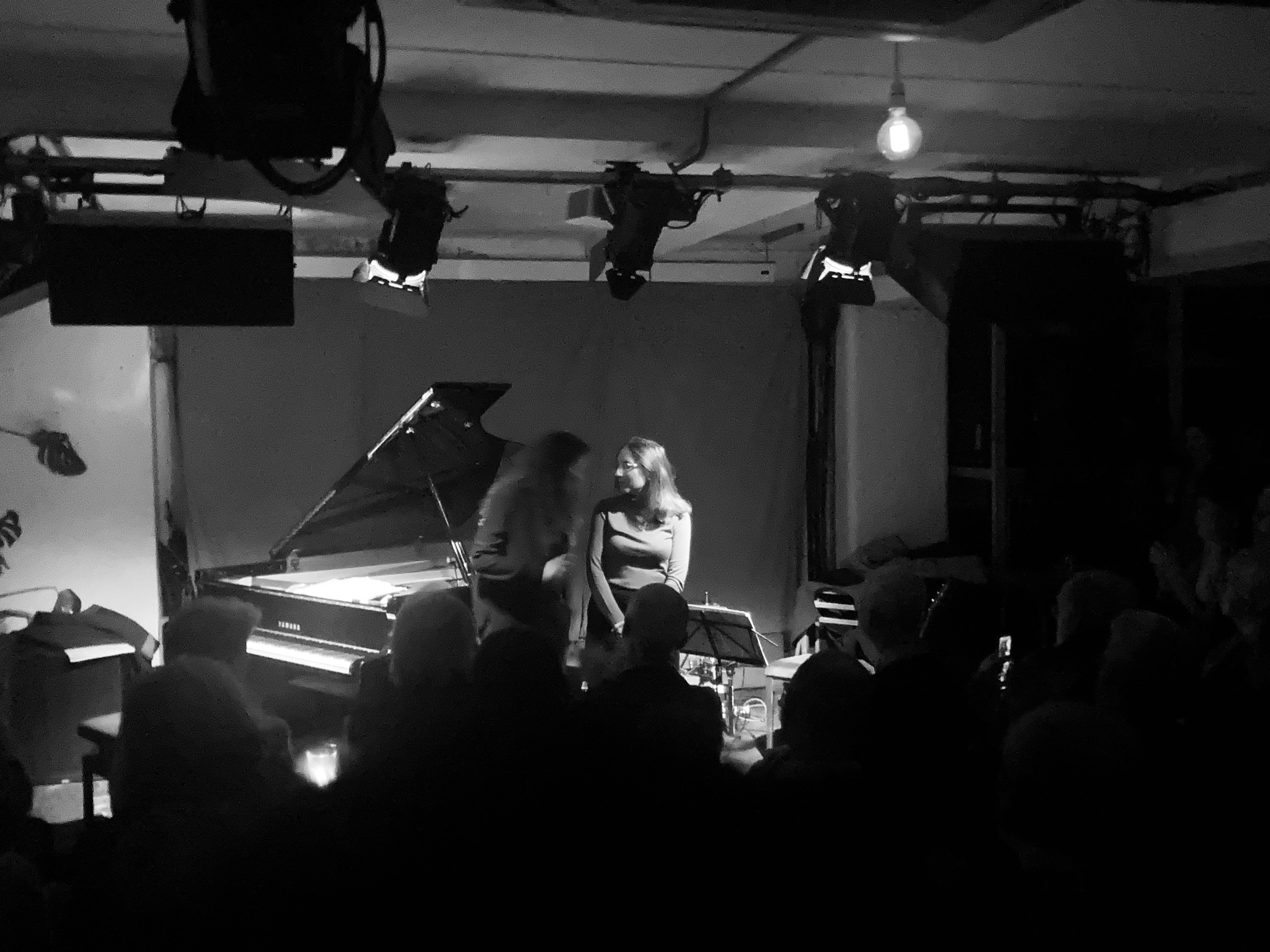
She was at Café Oto in London last night with another regular partner, the guitarist Mary Halvorson, to present music based on their most recent album together, Searching for the Disappeared Hour. As piano-guitar duos go, this was neither Bill Evans with Jim Hall nor Cecil Taylor with Derek Bailey, although it contained elements of both those rare partnerships: the elegance of detail of the first and the fearless extended vocabularies of the second. This was music characterised by exactitude and generosity, making its own unique world, in which dizzyingly rapid written passages, never gratuitous, opened out into spellbinding improvised solo passages.

* Sylvie Courvoisier’s Chimaera is on the Intakt label. Couvoisier and Mary Halvorson’s Searching for the Disappeared Hour is on Pyroclastic Records.

ECM at 50

manfred-eicher

By the end of the 1960s, jazz had gone right out of fashion. If it was by no means dead in creative terms, it was no longer good business for the music industry. So the arrival of a new jazz record label was quite an event, which is why I can remember quite clearly the first package from ECM arriving on my desk at the Melody Maker‘s offices in Fleet Street, and opening it to extract Mal Waldron’s Free at Last. I knew about Waldron from his work with Charles Mingus, Eric Dolphy and others. But an album from the pianist, recorded in Europe and packaged with unusual care on an unfamiliar label based in Munich, came as a surprise.

Pretty soon it was followed by Paul Bley with Gary Peacock, and then by Marion Brown’s Afternoon of a Georgia Faun. Before 1970 was out further packages had included an album by the Music Improvisation Company (with Evan Parker and Hugh Davies) and Jan Garbarek (Afric Pepperbird). It became obvious that something special was happening under the aegis of ECM’s founder, Manfred Eicher.

I guess it was in 1971, with solo piano albums from Chick Corea and Keith Jarrett, Terje Rypdal’s first album and two albums of duos teaming Dave Holland with Barre Phillips and Derek Bailey, that the label’s character really became clear. Eicher stood for jazz with a high intellectual content, saw no reason to privilege American musicians over their European counterparts, and set his own high standards in studio production and album artwork. All these things — particularly his fondness for adding a halo of reverb to the sound of acoustic instruments, inspired by how music sounded in churches and cathedrals — were eventually turned against him by the label’s critics. The sheer volume of great music produced over the past 50 years is the only counter-argument he ever needed. His greatest achievement has been to make us listen harder, deeper and wider.

ECM’s golden jubilee is being marked by events around the world. On January 30 and February 1 there will be a celebration over two nights at the Royal Academy of Music in London, featuring the pianists Craig Taborn and Kit Downes, the bassist and composer Anders Jormin and the Academy’s big band playing the music of Kenny Wheeler with guests Norma Winstone, Evan Parker and Stan Sulzmann. I thought I’d add to the festivities by choosing 20 ECM albums that have made a particularly strong impression on me since that first package dropped on my desk half a century ago; they’re listed in chronological order. Although there are many other contenders, I stopped at 19; the 20th is for you to nominate.

1 Terje Rypdal: Terje Rypdal (1971) The guitarist’s debut was an early sign of Eicher’s determination to capture and promote the new sounds coming from northern Europe, and from Norway in particular. Rypdal was one of the first to present himself as a wholly original voice.

2 Paul Bley: Open, to Love (1972) For my money, the finest of ECM’s early solo piano recitals, with Bley examining compositions by Carla Bley (“Ida Lupino”), Annette Peacock (“Nothing Ever Was, Anyway”) and himself.

3 Old and New Dreams: Old and New Dreams (1979) Don Cherry, one of Eicher’s favourites, is joined by Dewey Redman, Charlie Haden and Ed Blackwell in this homage to the music of their former colleague, Ornette Coleman. The 12-minute “Lonely Woman” is astonishingly lovely.

4 Leo Smith: Divine Love (1979) The trumpeter and composer Wadada Leo Smith was among the squadron of American innovators who arrived in Europe at the end of the ’60s and whose influence gradually became apparent in the ECM catalogue. Divine Love is a classic.

5 Bengt Berger: Bitter Funeral Beer (1981) A Swedish ethnomusicologist, composer and percussionist, Berger put together a 13-piece band — Don Cherry being the only famous name — to record this strange and compelling multicultural mixture of jazz and ritual music.

6 Charlie Haden / Carla Bley: Ballad of the Fallen (1983) Fourteen years after the historic Liberation Music Orchestra, Haden and Bley reunited for a second studio album featuring music of resistance.

7 John Surman: Withholding Pattern (1985) A solo album in which Surman developed his skill at overdubbing soprano and baritone saxophones, piano and synths, this opens with “Doxology”, in which Oslo’s Rainbow studio is turned into an English church.

8 Bill Frisell: Lookout for Hope (1988) One of several guitarists whose careers were nurtured at ECM, Frisell recorded this with a lovely quartet — Hank Roberts (cello), Kermit Driscoll (bass) and Joey Baron (drums) — before moving on.

9 Keith Jarrett Trio: The Cure (1991) Includes an eight-minute version of “Blame It on My Youth” in which Jarrett, Gary Peacock and Jack DeJohnette achieve perfection, no matter how many times I listen to it in search of flaws.

10 Kenny Wheeler: Angel Song (1996) In a dream line-up, the Canadian trumpeter is joined by the alto of Lee Konitz, the guitar of Bill Frisell and the bass of Dave Holland.

11 Tomasz Stanko: Litania (1997) The Polish trumpeter interprets the compositions of his compatriot and sometime colleague Krzysztof Komeda. A wonderful group features the saxophonists Joakim Milder and Bernt Rosengren, with a core ECM trio — Bobo Stenson (piano), Palle Danielsen (bass) and Jon Christensen (drums) — as the rhythm section plus Terje Rypdal’s guitar on two of the tunes.

12 Trygve Seim: Different Rivers (2000) Most ECM music is for small groups, but here the Norwegian saxophonist and composer permutates 13 musicians in an exploration of subtle textures and gestures. The great trumpeter Arve Henriksen is among the soloists.

13 Manu Katché: Neighbourhood (2005) Ever listened to Herbie Hancock’s “Maiden Voyage” and wished there had been more post-bop jazz with that kind of relaxed intensity and melodic richness? Here it is. Tomasz Stanko and Jan Garbarek are the horns, Marcin Wasilewski and Slawomir Kurkiewicz the pianist and bassist.

14 Masabumi Kikuchi: Sunrise (2012) Kikuchi, who was born in Tokyo in 1939 and died in upstate New York in 2015, was a pianist of exquisite touch, great sensitivity and real  originality: a natural fit with Eicher, who recorded him with the veteran drummer Paul Motian and the quietly astounding bassist Thomas Morgan.

15 Nik Bärtsch’s Ronin: Live (2012) The label that released Steve Reich’s Music for 18 Musicians in 1978 is the perfect home for the group led by the Swiss pianist and composer, who explores the spaces between minimalist repetition and ecstatic groove, between gridlike structures and joyful improvisation.

16 Giovanni Guidi: This Is the Day (2015) With equal creative contributions from Thomas Morgan and the drummer João Lobo, the young Italian master leads a piano trio for the 21st century: always demanding close attention but never short of refined lyricism.

17 Michel Benita + Ethics: River Silver (2016) Led by an Algerian bassist, a quintet including a Japanese koto player (Mieko Miyazaki), a Swiss flugelhornist (Matthieu Michel), a Norwegian guitarist (Eivind Aarset) and a French drummer (Philippe Garcia) create music that incarnates the ECM ideal of reflective, frontierless beauty.

18 Roscoe Mitchell: Bells for the South Side (2017) A double album recorded live in Chicago in 2015, featuring Mitchell with four trios — including the trumpeter Hugh Ragin and the percussionist Tyshawn Sorey — who finally come together in a memorable celebration of the legacy of the Art Ensemble of Chicago.

19 Vijay Iyer Sextet: Far From Over (2017) Knotty but exhilarating compositions, solos packed with substance from Graham Haynes (cornet), Steve Lehman (alto) and Mark Shim (tenor): a statement of the art as it moves forward today.

20

* The photograph is a still from the 2011 film Sounds and Silence: Travels with Manfred Eicher, by Peter Guyer and Norbert Wiedmer. There’s a chapter containing further thoughts on ECM’s place in the evolution of modern music in my book The Blue Moment: Miles Davis and the Remaking of Modern Music, published in 2009 by Faber & Faber.

Ten Freedom Summers / 2

Leo Smith 1His Ten Freedom Summers may have been shortlisted for this year’s Pulitzer Prize, but that doesn’t mean Wadada Leo Smith has stopped work on the epic composition which he began writing more than three decades ago (and about which I wrote here back in August). During last night’s performance at Cafe Oto in London, the first of three across which he will deliver the entire sequence, he inserted an entirely new movement, and it turned out to be the most memorable of the lot.

Smith arrived in East London with a slightly reduced version of the double ensemble that appeared on the 4CD version released by Cuneiform Records last year. Alongside his trumpet, the piano of Anthony Davis, the bass of John Lindberg and the drums of Anthony Brown were the Ligeti Quartet — Mandhira de Saram (first violin), Patrick Dawkins (second violin), Richard Jones (viola) and Ben Davis (cello) — with the video artist Jesse Gilbert operating from a desk next to the sound mixer.

A clue to the inspiration behind the new movement, called “That Sunday Morning”, arrived when an image of a church appeared on the screens behind the players, followed by the faces of four young African American girls. They were Addie Mae Collins, Cynthia Wesley, Carole Robertson and Denise McNair, the four members of the congergation who died on September 15, 1963 when a group of Ku Klux Klan members set a bomb under the steps of the 16th Street Baptist Church in Birmingham, Alabama. It was one of the most terrible incidents of the long struggle commemorated by Smith through the titles of the other movements, which mention Dred Scott, Medgar Evers, Emmett Till, Rosa Parks, Martin Luther King, the Freedom Riders, and others.

As you might have expected, the new piece adopted the mood of a threnody, a quiet and reflective lament that contained moments of striking beauty, particularly in Smith’s brief outbursts and in the rolling gospel phrases that Anthony Davis used sparingly but to very powerful effect. It was heartbreaking and spellbinding, and I hope the composer finds a way to record it in this form one day soon.

Two hours of music, with hardly a break, passed quickly, as I imagine they will tonight and tomorrow. I found myself thinking that the rearrangement of the pieces for the string quartet, rather than the nine-piece ensemble used on the album, worked extremely well, and perhaps even better, thanks not least to the talent and commitment of the young British quartet, rising to the challenge of a masterpiece.

Ten Freedom Summers / 1

Wadada Leo SmithFifty years ago, a wholehearted embrace of American culture made even those of us 3,000 miles away feel we had a stake in the country’s destiny. So although we may have been neither American, nor black, nor even socially or economically disadvantaged, the March on Washington — which took place on August 28, 1963 — in some way felt as though it involved us, too, even if all we could do was cheer from the sidelines.

Tens of thousands of people gathered in Washington DC this weekend to mark the anniversary. What I’ve been doing is reading my sometime colleague Gary Younge’s fine new book The Speech, which describes the process by which the Rev Martin Luther King came to write his “I Have a Dream” address, and listening to Ten Freedom Summers, a suite by the trumpeter and composer Wadada Leo Smith. If you don’t already know the latter, this is a set of four CDs containing four and a half hours of music divided into 19 individual movements based on themes from the civil rights struggle, performed by Smith’s quartet/quintet and a nine-piece chamber ensemble. Recorded over a three-day period in November 2011 and released last year on the Cuneiform label, it was one of three finalists for this year’s Pulitzer Prize.

The titles of the individual pieces are sometimes suggestive — “Black Church”, “Democracy” — but usually more explicit in their references. “Dred Scott: 1857” is the first movement, referring to the Missouri slave who unsuccessfully sued for his freedom in that year. “Rosa Parks and the Montgomery Bus Boycott: 381 Days” is another. There are references in other titles to Medgar Evers and Emmett Till, to JFK and LBJ, to the Supreme Court justice Thurgood Marshall and to Malik Al Shabazz, better known as Malcolm X.

Unlike some of the music that accompanied the civil rights struggle, from John Coltrane’s miniature masterpiece titled “Alabama” (a threnody for the four black schoolgirls killed in the Birmingham church bombing in September 1963, barely a fortnight after the March on Washington) to Bob Dylan’s “The Lonesome Death of Hattie Carroll”, there is nothing in Smith’s work here that explicitly evokes his subject, no overt gestures that would indicate a relationship to his chosen titles. This does nothing to diminish its extraordinary power.

Smith, who was born 71 years ago in Leland, Mississippi, first came to notice at the end of the ’60s, as a member of the Association for the Advancement of Creative Musicians in Chicago, along with Roscoe Mitchell, Anthony Braxton, Muhal Richard Abrams and others. His bands included the Creative Construction Company, with Braxton and the violinist Leroy Jenkins, and New Dalta Ahkri, whose personnel included  Henry Threadgill, Oliver Lake and Anthony Davis. Along with other members of the AACM, he spent time in Paris in 1969 and became acquainted with the new generation of European free jazz musicians. His many recordings have appeared on the Kabell, Nessa, ECM, Leo and Tzadzik labels, as well as Cuneiform.

As a trumpeter, he had his own character from the beginning. If you wanted a shorthand description, I suppose you could say that he occupies the space between Don Cherry and Lester Bowie. But the originality and substance of his playing are more than enough to command the attention all the way through this mammoth undertaking, in which his is necessarily the dominant voice. I’ve always liked his tone, open or muted, and the crisp assertiveness of his phrasing, and the sense of poise he conveys.

The long-standing nature of his partnership with the pianist Anthony Davis, who appears here, is evident in the closeness of their dialogues. Like Smith, Davis is a quietly original musician who, in his own compositions as well as his playing here, demonstrates complete comfort with the idea of bringing together elements from African American and European musical practices. The basic group is completed by John Lindberg, an exceptional bassist, and two drummers, Susie Ibarra and Pheeroan Ak Laff, who alternate on some pieces and play together on others.

Sometimes Smith employs gestures immediately identifiable as drawn from jazz: “Thurgood Marshall and Brown vs Board of Education” finds Lindberg anchoring the piece with a slow-grooving funky bass figure, while the interplay between Davis and Ibarra on “The Little Rock Nine” is outstanding. Elsewhere the climate resembles that of classical chamber music: passages for flute, harp and strings in “Medgar Evers: A Love Voice of a Thousand Years’ Journey for Liberty and Justice” have a watercolour delicacy that reminds me of Toru Takemitsu. But more often it seems, to employ Duke Ellington’s phrase, beyond category. The chamber group — basically a string quartet plus harp, clarinet, flute, percussion and an extra violin — appears both by itself and with the quartet/quintet. So organic and unselfconscious is Smith’s writing that the frontier between the two groups disappears, as does the line between composition and improvisation.

The prevailing mood, not surprisingly, is soberly reflective. Even so many years after the events Smith is commemorating, there is much to reflect on. This is not a bruising experience;  the writing and playing are characterised by a sustained lyricism. Nevertheless few  will want to absorb all four and a half hours in at one sitting, and it may a take listener years to become as familiar with these individual pieces as with the much shorter jazz classics of earlier eras. But that doesn’t seem to matter. Smith’s work exists on its own terms, a marvellous tribute to its immense subject.

* The photograph of Wadada Leo Smith was taken by Steve Gunther and is from the booklet accompanying Ten Freedom Summers. Gary Younge’s The Speech is published by Guardian Books.