Skip to content

Posts tagged ‘Vijay Iyer’

Under the same sky

In the 55 years since the discreet arrival of the first ECM album, Mal Waldron’s Free At Last, Manfred Eicher’s label has released somewhere north of a thousand albums. Contrary to a cynical early view, they don’t all sound the same. They are, however, distinguished by the presence of set of qualities — musical, aesthetic and philosophical — that appear, in varying proportions, in just about every one of them. You can detect those qualities in four of their recent releases, each of which exemplifies a certain characteristic taken to the very highest level.

1 Vijay Iyer / Wadada Leo Smith: Defiant Life

American jazz from the tradition continues to make its presence central to ECM’s output. Smith’s trumpet and Iyer’s keyboards and electronics weave their way through spellbinding duets subtextually infused with a sense of history. Smith’s “Floating River Requiem” is a dedication to Patrice Lumumba, the Congolese independence leader murdered by colonial forces in 1961, while Iyer’s “Kite” acknowledges Refaat Alareer, a leading Palestinian poet killed along with two siblings and four nephews during an Israel air strike on Gaza in late 2023. Sorrow and outrage are present in this music, but it also serves, in Iyer’s words, as a statement of “faith in human possibility.”

2 Anouar Brahem: After the Last Sky

Modes from all over the world find their way into the ECM matrix. The Tunisian oud player and composer Anouar Brahem first recorded for the label 35 years ago. On his latest album he is in the company of three of the company’s regulars: the cellist Anja Lechner, the pianist Django Bates and the bassist Dave Holland. Taking its title from a book by the late Edward Said, this album, too, is driven by reflections on the suffering, recent and historic, of the people of Gaza, as outlined in Adam Shatz’s fine sleeve essay. Unfolding with patience and elegance, metabolising elements from Arabic maqam, jazz and European classical music, these quartet pieces ache with grief.

3 Alexander Knaifel: Chapter Eight

By cultivating a widespread audience for the work of the Estonian composer Arvo Pärt via its New Series offshoot, ECM helped create the genre known as “holy minimalism”. Alexander Knaifel (1943-2024), born in Tashkent, studied cello with Rostropovich in Moscow in the 1960s before making a reputation writing operas and film music. A kind of an Uzbek version of Anthony Braxton, he also wrote an extended piece for 17 double basses and another for 35 Javanese gongs. But the pieces on this album, performed by an ensemble of three Latvian choirs and the Swiss cellist Patrick Demenga, are settings of verses from the Song of Solomon. Proceeding with great deliberation under the baton of Andres Mustonen, they achieve the required meditative glow to very satisfying effect, fully exploiting the acoustic resonance of the Jesuit church in Lucerne, where they were recorded in 2009.

4 Arve Henriksen / Trygve Seim / Anders Jormin / Markku Ounaskari: Arcanum

The crucial role played by ECM in the emergence of Nordic jazz needs no acknowledgement. Here are four leading players — the trumpeter Henriksen and the saxophonist Seim from Norway*, the bassist Anders Jormin from Sweden, and the Finnish drummer Ouaskari — at the height of their powers, taking memories of Ornette Coleman’s quartet as a starting point from which to develop conversations of great beauty and originality. All four of these albums are outstanding, but this is the one that sounds to me like a future classic.

* Due to a moment of brain-fade, this piece originally claimed that Henriksen and Seim are Finnish. My thanks to those who noticed and gently pointed out the error.

The Necks at Cafe Oto

“We’ve never really been an emotional band,” Lloyd Swanton observed drily after the first set on the last of the Necks’ four nights at Cafe Oto in London this week, “but it seems to be creeping in.”

I’d been trying to tell him, somewhat incoherently, how moved I’d been by what they’d just played, and in particular how it seemed to express something about the current state of the world. His reflexive response indicated that what he and his colleagues in the Australian trio do is principally about the notes, about the process of three musicians improvising together with no preset material and certainly with no programmatic content in mind. Which is not to say that listening to them isn’t an emotional experience. It is, almost invariably, but the emotions they generate are usually non-specific.

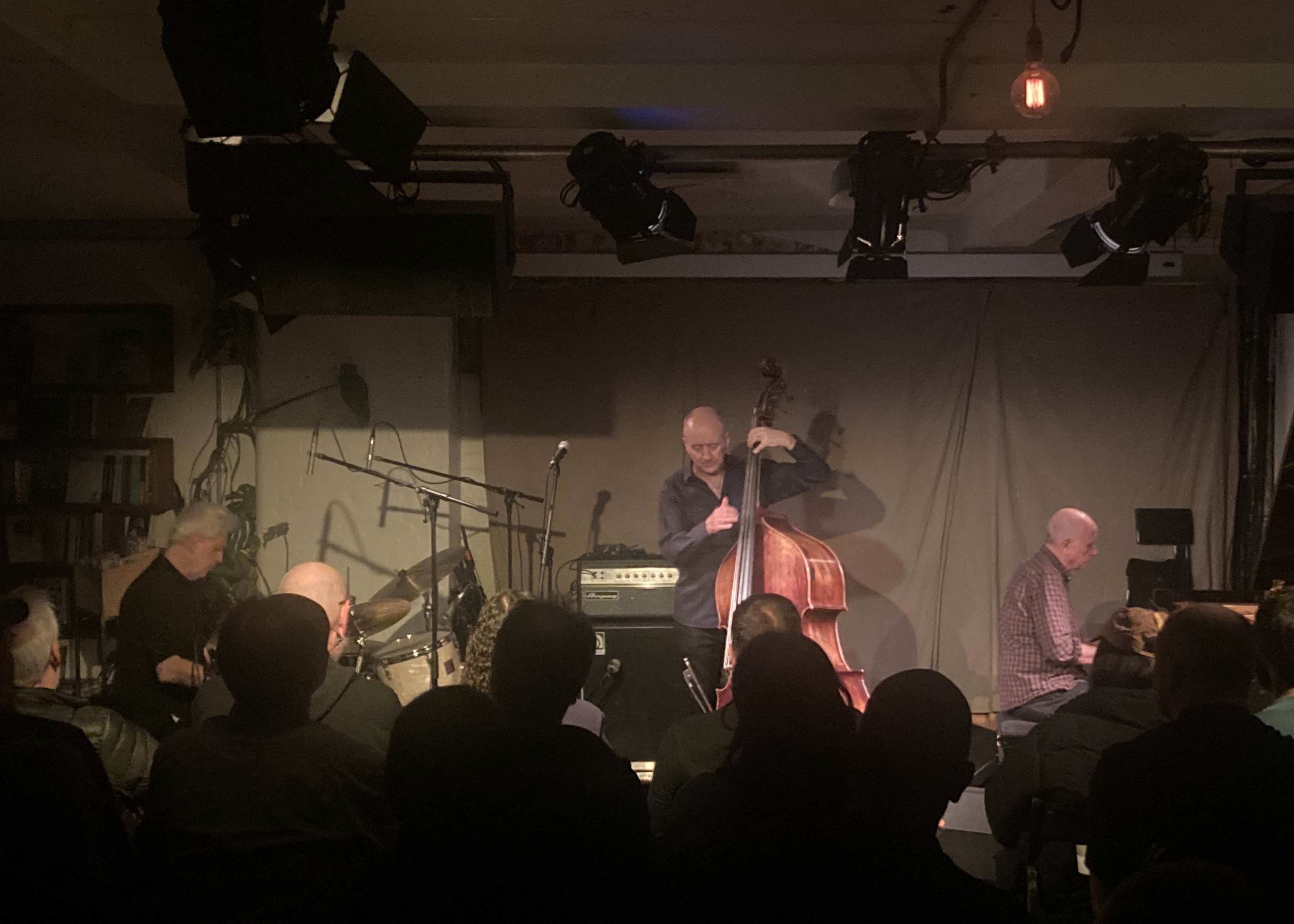
To me, at least, it seemed that there was something different about Thursday’s first set. It started out normally enough, after they and the audience had settled, with one member — Swanton, on this occasion — breaking the silence. As he plucked an isolated note on his double bass, repeating it and echoing it an octave down, sometimes switching to his bow, and initially with long pauses, Tony Buck joined in with mallets gently rolling around his tom-toms and cymbals, followed by Chris Abrahams picking out pensive Moorish figures in the middle-upper octaves of the piano.

For a while, not much seemed to be happening. No surprise there, necessarily. Later Buck said that he’d worried it had started out “a bit washy”. But in 20 years of attending their performances I’ve learnt to wait, to show the kind of patience as a listener that they show as players, in the knowledge that the surprise will come. In fact, they are the proof that the sound of surprise can emerge slowly, by gradual accretion.

This time the process of accretion led to something extraordinary. As the playing of all three grew busier, the textures thickened, the spaces closed and the volume increased, all of it occurring almost imperceptibly, you began to feel that you were hearing things: bells, cries, gunfire. It was an illusion. They weren’t there, and neither was anyone trying to produce them. But somehow they were present — for me, anyway — in the harmonics reflecting off the piano lid, the scrabbling and keening of the bass, and the hard crack of the bass drum against the overlapping splashes of the cymbals.

Eventually it reached a pitch of intensity that was sustained for maybe 15 minutes before being gradually wound down through a collective diminuendo into silence once again. And in those 15 minutes I couldn’t help replaying the images we’ve been seeing on the TV news every night for months — images of buildings, streets, whole cities lying in ruins, of the dead being counted and the living in flight, the sort of total war we may stupidly have believed was safely consigned to a distant past.

That’s not, I’m sure, what the members of the Necks were thinking of while they were summoning the music into being. It’s more the sort of thing the pianist Vijay Iyer had in mind when, with the bassist Linda May Han Oh and the drummer Tyshawn Sorey, he recorded a new trio album whose title, Compassion, explicitly indicates its theme. “Music is always about, animated by, and giving expression to the world around us: people, relations, circumstances, revelations,” Iyer writes in the sleeve note, describing the responsibility, as he sees it, of making art in a time of suffering.

I’ve heard the Necks play music unafraid of ugliness before (a hair-raising triple-forte set at Café Oto in 2013 stands out in the memory), but never anything in which the kind of responses they normally evoke — including but not restricted to euphoria and elevation — were so strikingly replaced by this very different kind of transcendence, a sustained howl expressing something beyond words yet somehow very specific.

So that was the fifth of the six sets I heard them play this week, and the sixth was, as usual, quite different. Abrahams opened it with a reversion to the sort of thing that provokes the use of adjectives like “luminous” and “lambent”. But again there was a surprise when the piece evolved into an essay in the use of asynchronous rhythms, a field they’ve opened up in recent years, in which each one establishes his own pulse or metre and, without forfeiting closeness of listening to the others, maintains it as the piece develops. At its best, it leads to a kind of higher interplay — and this was the practice at its very best, creating a rhythmic maelstrom that activated a very different response in the audience.

All a long way from the sort of passive music for Zen meditation with which they are sometimes erroneously associated, and irrefutable evidence of their commitment, now extending well into its fourth decade, to a constant self-regeneration of which we are the fortunate beneficiaries.

* The Necks continue their European tour at Peggy’s Skylight in Nottingham on Monday (already sold out) and the Tung Auditorium in Liverpool on Tuesday, April 8 and 9 respectively. Their most recent album, Travel, was released in 2022 on the Northern Spy label. Compassion, by Vijay Iyer, Linda May Han Oh and Tyshawn Sorey, was released earlier this year by ECM.

London Jazz Festival 1: The peak of their art

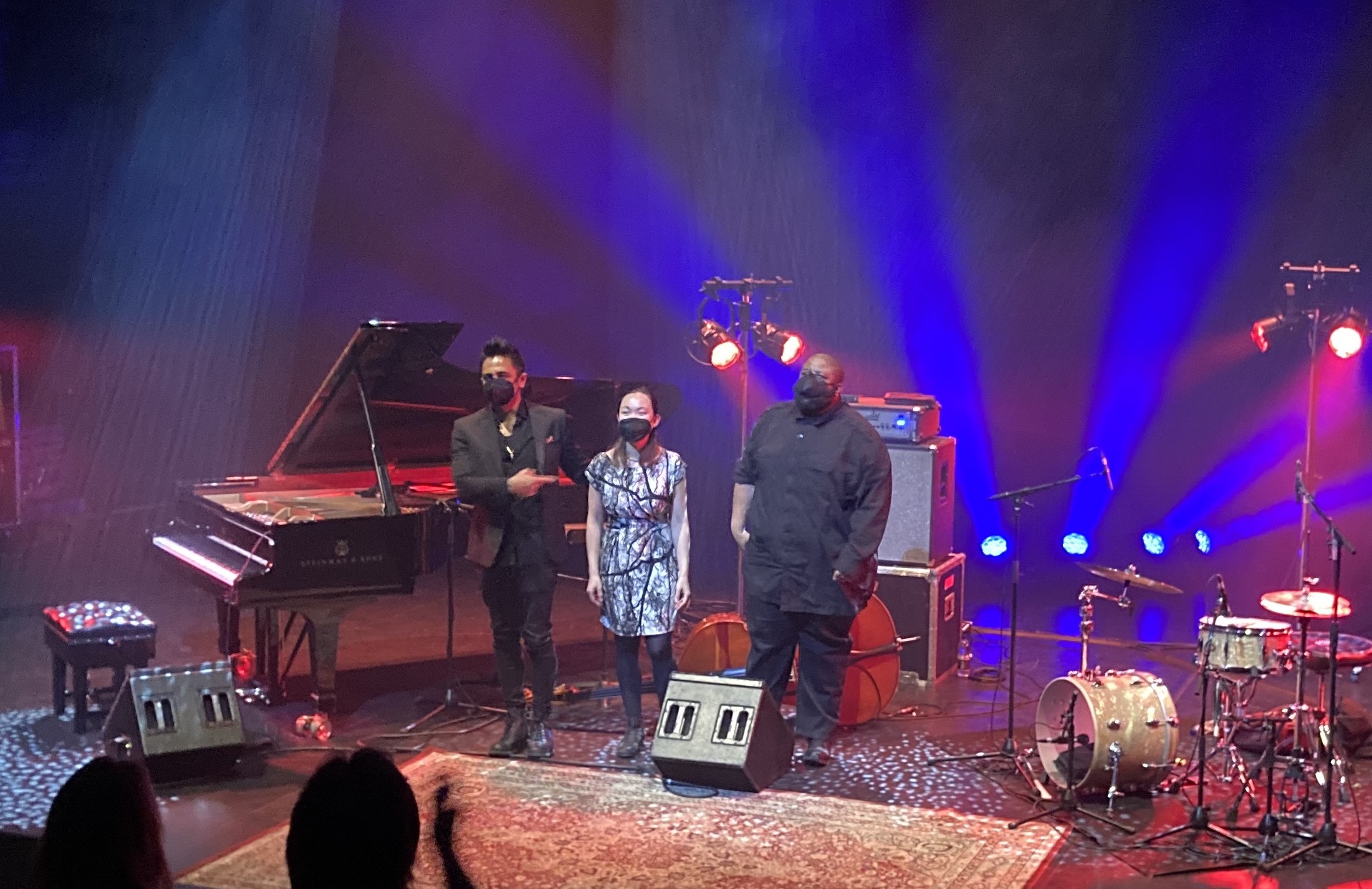
After an hour of Mike Westbrook’s autumnal musings at the Pizza Express’s piano on Sunday afternoon, in which the great composer, arranger and bandleader stitched together the memories of a life in music into a seamless reverie with a quiet intensity that held the room in thrall, the scene at the 2021 London Jazz Festival moved to the South Bank, where Vijay Iyer, Linda May Han Oh and Tyshawn Sorey stormed the Queen Elizabeth Hall with something belonging entirely to the here and now.

Sometimes you get lucky and witness something that makes you realise how high the standards can be. Doesn’t matter what it is. Tennis, poetry, carpentry. On Sunday night it was jazz. A pianist, a bassist and a drummer dropped in to examine the art of the possible, demonstrating over the course of two hours of high-density interplay what can happen when three like-minded virtuosi get it into their heads to create something in which 1+1+1 = infinity.

Basically, they played their way through their recent album, Uneasy. It’s one of the year’s finest releases, but here they stretched it, expanded it, tossed its elements around, and gave it a completely new existence. So many bases were covered — 21st century takes on bebop, Latino patterns, reggae, the circular rhythms of Tyner-Garrison-Jones — that the time passed very quickly.

Linda Oh is the least known of the three, but her bass playing was the heart of the group: slight build, total physical commitment, wonderful tone, great agility, an endless flow of ideas. Vijay Iyer is a cerebral pianist who nevertheless relishes any involvement with rhythm (one night at the Lido in Berlin a few years ago, he and his regular acoustic trio — completed by the bassist Stephan Crump and the drummer Marcus Gilmore — locked into an endless groove that any funk band would have envied). Tyshawn Sorey operates with complete comfort at the absolute extremities of the dynamic range, from whisper-quiet to shatteringly loud, plus every setting in between. On this occasion he made you wonder why anyone would ever need more than a small bass drum, a medium-sized snare, a single cymbal and a hi-hat, from each of which he drew an astonishing variety of tones and timbres.

Their music rattled, jolted, cruised, purred, broke apart, blended back, cantered, swung, faked a stumble, slowed to a sigh. The audacity made you gasp. Solos were taken, but were always part of the whole. Oh’s leaping grooves made you want to dance. Iyer’s upper-register filigree made your mind soar. Sorey’s sudden whipcracks straightened your back.

Another side of the multi-dimensional Sorey is on view in For George Lewis / Autoschediasms, a two-CD set in which his compositions are performed by Alarm Will Sound, a New York-based 16-piece chamber orchestra here made up of brass, woodwind, strings and percussion, tuned and untuned. “For George Lewis”, a 50-minute piece dedication to his mentor and fellow composer, conducted by Alan Pierson, bears the imprint of Sorey’s interest in the music of Morton Feldman: fully composed, based on a process of accretion and subtraction of single held notes, it moves with mesmerising deliberation through austere and refined layers of sound, creating the musical equivalent of colour-field painting.

“Autoschediasms” is Sorey’s name for his version of the approach to creating real-time music with large ensembles pioneered by Butch Morris (who called it “conduction”) and Anthony Braxton. In these two performances, recorded in St Louis in May 2019 and in various US cities via internet video chat in October 2020, Sorey takes the rostrum, giving the musicians prompts via gestures and prepared cue-cards. “The method can involve the use of up to four batons simultaneously by the conductor,” he writes in his informative notes, and anyone who has seen him at a drum kit will know that this is a challenge well within his scope. The result is a much more obviously active ensemble music, its details and densities sometimes clashing or overlapping, but with an emerging coherence and, like a master of action painting, an excellent sense of drama.

* Uneasy by Vijay Iyer, Linda May Han Oh and Tyshawn Sorey is on ECM. For George Lewis / Autoschediasms by Tyshawn Sorey and Alarm Will Sound is on Cantaloupe Music (www.cantaloupemusic.com).

The uneasy trio

It’s possible that, like me, you think there are already quite enough jazz piano trio albums in your collection. Think again. Uneasy, the new recording by Vijay Iyer, Linda May Han Oh and Tyshawn Sorey, demands attention.

The realignment of the piano-bass-drums hierarchy from “piano with rhythm accompaniment” to a full three-way conversation of equals has been going on for decades, and Uneasy is about as elevated as the format currently gets. Listen to the opener, “Children of Flint”, to appreciate the level of interaction between three musicians with virtuoso-level skills and giant imaginations. It sounds lyrical, even simple. But just concentrate on the astonishing touch displayed by each of the trio, whether on piano keys, bass strings, drums or cymbals, and the sense of three seamlessly interlocking and interdependent components.

As you work your way through the 10 tracks — eight compositions by Iyer, plus Geri Allen’s “Drummer’s Song” and Cole Porter’s “Night and Day” — you’ll also notice a complete absence of ego-projection. No one is showing off. On the sole standard, it’s easiest to hear how far Iyer can take the line of piano-playing founded by Bud Powell. Oh displays the deep sense of swing, nimble melodic imagination and beautiful sound of a 21st-century Paul Chambers. Sorey creates a momentum at once light but deep, exploiting a combination of technique and intellect that redefines the investigation of rhythm.

Recorded in a studio in Mount Vernon, NY three months before pandemic arrived, the album comes with a cover photograph of the Statue of Liberty seen through mist and against clouds. In his sleeve note, Iyer writes that Uneasy was originally the title of a collaborative piece with the choreographer Karole Armitage in 2011, exploring “the instabilities that we then sensed beneath the surface of things… the emerging anxiety within American life. A decade later, as systems teeter and crumble, the word feels like a brutal understatement.”

That heightened disquiet, however, remains implied. You’re not thinking about the end of the world. You’re remembering how even the darkest of times can’t extinguish such astonishing creativity. One of the records of the year, no doubt.

* Uneasy is on ECM Records. The photographs of (from top) Iyer, Oh and Sorey are from the CD’s booklet and were taken by Craig Marsden.

ECM at 50

manfred-eicher

By the end of the 1960s, jazz had gone right out of fashion. If it was by no means dead in creative terms, it was no longer good business for the music industry. So the arrival of a new jazz record label was quite an event, which is why I can remember quite clearly the first package from ECM arriving on my desk at the Melody Maker‘s offices in Fleet Street, and opening it to extract Mal Waldron’s Free at Last. I knew about Waldron from his work with Charles Mingus, Eric Dolphy and others. But an album from the pianist, recorded in Europe and packaged with unusual care on an unfamiliar label based in Munich, came as a surprise.

Pretty soon it was followed by Paul Bley with Gary Peacock, and then by Marion Brown’s Afternoon of a Georgia Faun. Before 1970 was out further packages had included an album by the Music Improvisation Company (with Evan Parker and Hugh Davies) and Jan Garbarek (Afric Pepperbird). It became obvious that something special was happening under the aegis of ECM’s founder, Manfred Eicher.

I guess it was in 1971, with solo piano albums from Chick Corea and Keith Jarrett, Terje Rypdal’s first album and two albums of duos teaming Dave Holland with Barre Phillips and Derek Bailey, that the label’s character really became clear. Eicher stood for jazz with a high intellectual content, saw no reason to privilege American musicians over their European counterparts, and set his own high standards in studio production and album artwork. All these things — particularly his fondness for adding a halo of reverb to the sound of acoustic instruments, inspired by how music sounded in churches and cathedrals — were eventually turned against him by the label’s critics. The sheer volume of great music produced over the past 50 years is the only counter-argument he ever needed. His greatest achievement has been to make us listen harder, deeper and wider.

ECM’s golden jubilee is being marked by events around the world. On January 30 and February 1 there will be a celebration over two nights at the Royal Academy of Music in London, featuring the pianists Craig Taborn and Kit Downes, the bassist and composer Anders Jormin and the Academy’s big band playing the music of Kenny Wheeler with guests Norma Winstone, Evan Parker and Stan Sulzmann. I thought I’d add to the festivities by choosing 20 ECM albums that have made a particularly strong impression on me since that first package dropped on my desk half a century ago; they’re listed in chronological order. Although there are many other contenders, I stopped at 19; the 20th is for you to nominate.

1 Terje Rypdal: Terje Rypdal (1971) The guitarist’s debut was an early sign of Eicher’s determination to capture and promote the new sounds coming from northern Europe, and from Norway in particular. Rypdal was one of the first to present himself as a wholly original voice.

2 Paul Bley: Open, to Love (1972) For my money, the finest of ECM’s early solo piano recitals, with Bley examining compositions by Carla Bley (“Ida Lupino”), Annette Peacock (“Nothing Ever Was, Anyway”) and himself.

3 Old and New Dreams: Old and New Dreams (1979) Don Cherry, one of Eicher’s favourites, is joined by Dewey Redman, Charlie Haden and Ed Blackwell in this homage to the music of their former colleague, Ornette Coleman. The 12-minute “Lonely Woman” is astonishingly lovely.

4 Leo Smith: Divine Love (1979) The trumpeter and composer Wadada Leo Smith was among the squadron of American innovators who arrived in Europe at the end of the ’60s and whose influence gradually became apparent in the ECM catalogue. Divine Love is a classic.

5 Bengt Berger: Bitter Funeral Beer (1981) A Swedish ethnomusicologist, composer and percussionist, Berger put together a 13-piece band — Don Cherry being the only famous name — to record this strange and compelling multicultural mixture of jazz and ritual music.

6 Charlie Haden / Carla Bley: Ballad of the Fallen (1983) Fourteen years after the historic Liberation Music Orchestra, Haden and Bley reunited for a second studio album featuring music of resistance.

7 John Surman: Withholding Pattern (1985) A solo album in which Surman developed his skill at overdubbing soprano and baritone saxophones, piano and synths, this opens with “Doxology”, in which Oslo’s Rainbow studio is turned into an English church.

8 Bill Frisell: Lookout for Hope (1988) One of several guitarists whose careers were nurtured at ECM, Frisell recorded this with a lovely quartet — Hank Roberts (cello), Kermit Driscoll (bass) and Joey Baron (drums) — before moving on.

9 Keith Jarrett Trio: The Cure (1991) Includes an eight-minute version of “Blame It on My Youth” in which Jarrett, Gary Peacock and Jack DeJohnette achieve perfection, no matter how many times I listen to it in search of flaws.

10 Kenny Wheeler: Angel Song (1996) In a dream line-up, the Canadian trumpeter is joined by the alto of Lee Konitz, the guitar of Bill Frisell and the bass of Dave Holland.

11 Tomasz Stanko: Litania (1997) The Polish trumpeter interprets the compositions of his compatriot and sometime colleague Krzysztof Komeda. A wonderful group features the saxophonists Joakim Milder and Bernt Rosengren, with a core ECM trio — Bobo Stenson (piano), Palle Danielsen (bass) and Jon Christensen (drums) — as the rhythm section plus Terje Rypdal’s guitar on two of the tunes.

12 Trygve Seim: Different Rivers (2000) Most ECM music is for small groups, but here the Norwegian saxophonist and composer permutates 13 musicians in an exploration of subtle textures and gestures. The great trumpeter Arve Henriksen is among the soloists.

13 Manu Katché: Neighbourhood (2005) Ever listened to Herbie Hancock’s “Maiden Voyage” and wished there had been more post-bop jazz with that kind of relaxed intensity and melodic richness? Here it is. Tomasz Stanko and Jan Garbarek are the horns, Marcin Wasilewski and Slawomir Kurkiewicz the pianist and bassist.

14 Masabumi Kikuchi: Sunrise (2012) Kikuchi, who was born in Tokyo in 1939 and died in upstate New York in 2015, was a pianist of exquisite touch, great sensitivity and real  originality: a natural fit with Eicher, who recorded him with the veteran drummer Paul Motian and the quietly astounding bassist Thomas Morgan.

15 Nik Bärtsch’s Ronin: Live (2012) The label that released Steve Reich’s Music for 18 Musicians in 1978 is the perfect home for the group led by the Swiss pianist and composer, who explores the spaces between minimalist repetition and ecstatic groove, between gridlike structures and joyful improvisation.

16 Giovanni Guidi: This Is the Day (2015) With equal creative contributions from Thomas Morgan and the drummer João Lobo, the young Italian master leads a piano trio for the 21st century: always demanding close attention but never short of refined lyricism.

17 Michel Benita + Ethics: River Silver (2016) Led by an Algerian bassist, a quintet including a Japanese koto player (Mieko Miyazaki), a Swiss flugelhornist (Matthieu Michel), a Norwegian guitarist (Eivind Aarset) and a French drummer (Philippe Garcia) create music that incarnates the ECM ideal of reflective, frontierless beauty.

18 Roscoe Mitchell: Bells for the South Side (2017) A double album recorded live in Chicago in 2015, featuring Mitchell with four trios — including the trumpeter Hugh Ragin and the percussionist Tyshawn Sorey — who finally come together in a memorable celebration of the legacy of the Art Ensemble of Chicago.

19 Vijay Iyer Sextet: Far From Over (2017) Knotty but exhilarating compositions, solos packed with substance from Graham Haynes (cornet), Steve Lehman (alto) and Mark Shim (tenor): a statement of the art as it moves forward today.

20

* The photograph is a still from the 2011 film Sounds and Silence: Travels with Manfred Eicher, by Peter Guyer and Norbert Wiedmer. There’s a chapter containing further thoughts on ECM’s place in the evolution of modern music in my book The Blue Moment: Miles Davis and the Remaking of Modern Music, published in 2009 by Faber & Faber.

Piano trios at XJAZZ

Vijay Iyer TrioXJAZZ is the name of an annual festival held in Kreuzberg, a district of Berlin that is home to a large immigrant population. The four-day event is dispersed between a dozen or so venues, all within walking distance of each other. Most of them are rock or dance clubs, but there are also the very striking 19th century Emmaus Church, reconstructed after 1945, and the Lido, built in the 1950s as a cinema.

Of the events I attended this year, the two most striking were both by piano trios. Vijay Iyer’s group (pictured above), completed by the bassist Stephan Crump and the drummer Marcus Gilmore, arrived at a packed Lido on Friday night intending to play the usual hour or so after being presented with the German jazz critics’ association album of the year award for their latest ECM album, Break Stuff. Such was the crowd’s enthusiasm that they ended up playing only a minute or three short of two hours.

They began by playing without pause for more than half an hour, and the applause that greeted the closing notes might have gone almost as long had a rather bemused Iyer not manage to bring it to a halt. The response was the same throughout the set as the trio explored complex but irresistible grooves that created and released tension with an exhilarating effect. They played many original compositions, several of which — such as “Hood” — showed off a love of playing rhythmic games, as well as Thelonious Monk’s “Work” and Henry Threadgill’s “Little Pocket Size Demons”.

Sooner or later the deluge of creative piano-trio music will dry up, but perhaps not for a while yet. The following evening another interesting group took the stage at Watergate, a house and techno club whose bar looks out on to the River Spree. As the light faded on the water through the windows behind them, the Bosnian-born drummer Dejan Terzic, the Danish bassist Jonas Westergaard and the German pianist Florian Weber created three-way conversations characterised by an astringent lyricism and a wonderful ability to play with full commitment while giving each other plenty of room.

These two trios operate at a dauntingly high level of intellectual activity, but the spontaneous enthusiasm of both sets of listeners demonstrated the music’s ability to warm the spirit as well as stimulate the mind.

Matana Roberts in Alphabet City

The StoneMatana Roberts was reminiscing about the first time she played with the great bassist Henry Grimes. It was during the New York blackout of 2004, when she was scheduled to appear at the Jazz Gallery with a group including Grimes and the pianist Vijay Iyer. She had been travelling on the L train from her home in Queens, and it had  just emerged from the tunnel under the East River when all power vanished across the length and breadth of the city.

The passengers were allowed to get out and clamber up to the surface, and she set off to cross Manhattan to the club, which in those days had its home on the west side. She got there to discover that she and Grimes were the only members of the band who had made it to Hudson Street. In response to the situation, they played duets for stranded workers. Afterwards she walked all the way back to Queens. “I would never wear heels again,” she said. “You never know when you might have to walk home.”

She told the story on Sunday, the last night of the season she was curating at the Stone, John Zorn’s bare-bones performance space in Alphabet City, on the corner of Avenue C and 2nd Street (seen in the photograph above). Twice nightly for six days, with a different line-up for each show, she invited groups varying in size from three to six members to improvise together for an hour or so. I made it to four of the shows, and some of the musicians I missed included the pianists Myra Melford and Jason Moran, the flautist Nicole Mitchell, the cellist Tomeka Reid, the trumpeter Peter Evans and the guitarist Liberty Ellman.

The first show I caught featured Roberts with Iyer and the koto player Miya Masaoka, creating three-part inventions of great delicacy and intricacy, the set culminating in a short piece in which they discovered a swelling, hymn-like lyricism. The following night I was impressed by the contributions of the trumpeters Nate Wooley, in the first set, and Forbes Graham, in the second.

Roberts was at pains to explain how important this season, first proposed two years ago, was to her. I suspect that the penultimate set, the one that featured a quartet including Grimes, the guitarist Kyp Malone and the drummer Mike Pride, offered particular satisfaction. Malone, she said, was one of the first people she played with after she arrived in New York. Pride had pointed her towards the paid work that kept her going. “And Mr Grimes,” she added, “has been an inspiration for ever.”

With Pride using bells and gongs as well as his regular kit and Malone flicking out fast-moving note clusters while Roberts deployed her throaty tone in a series of powerful incantations, the blend of textures and the rapt mood of the opening passages reminded me that Grimes had been a participant on Pharaoh Sanders’ Tauhid, a favourite (and nowadays somewhat under appreciated) album from 1966. But then the players stepped up their intensity, Roberts responding with passionate cries recalling Albert Ayler. It was a wonderful performance, full of wisdom and empathy, with Grimes — who turned 80 in November — a marvel throughout.

Regular readers of this blog will know that I think very highly of Matana Roberts (I wrote about her last year here and here). At the Stone she led off every performance that I saw with great energy, and listened to her colleagues with the same intensity with which she played. She could be proud of the whole mini-season, but of that hour on Sunday in particular.