Skip to content

Posts tagged ‘Tyshawn Sorey’

Tour de force

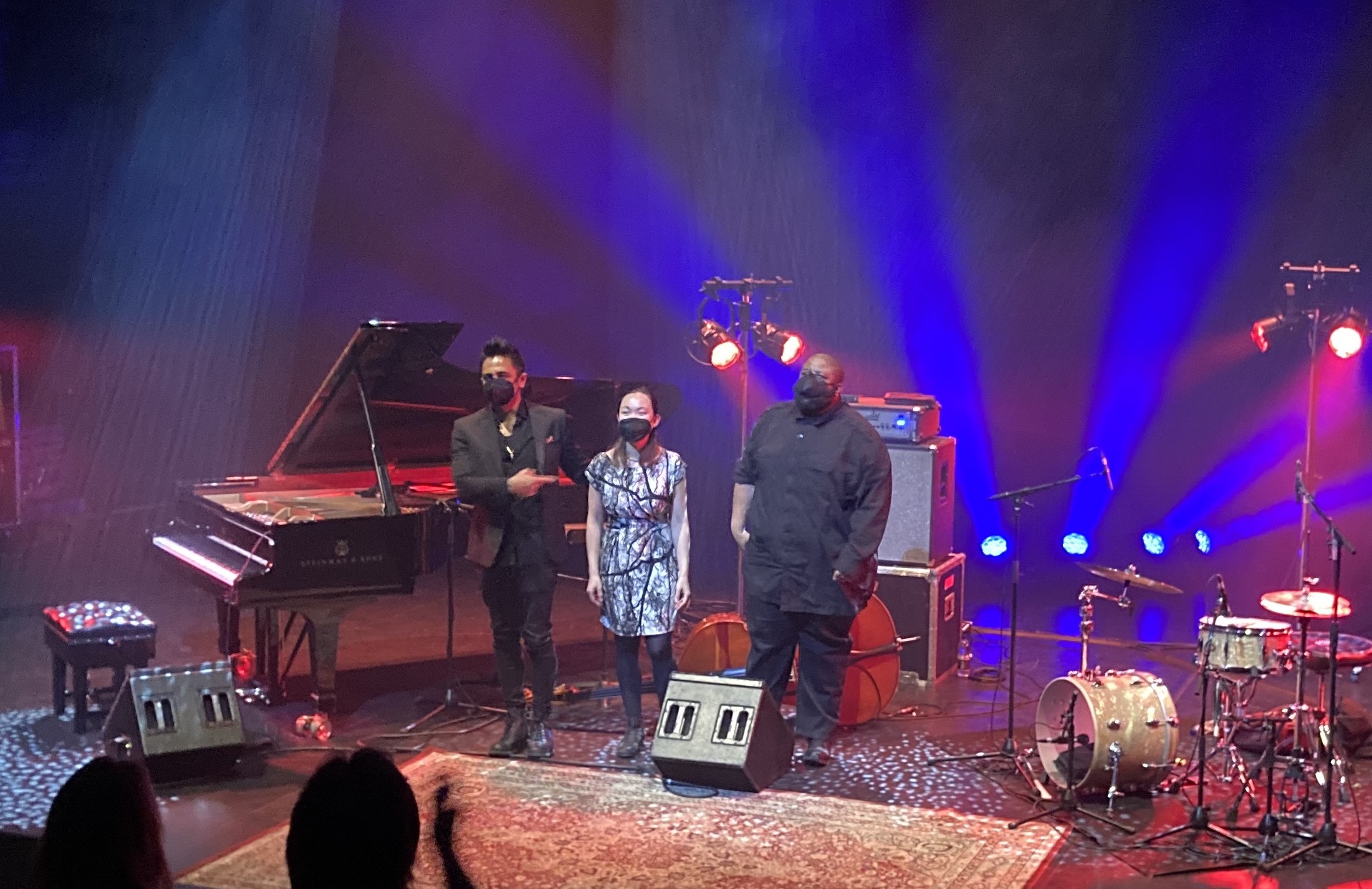
As we queued in the Dalston drizzle outside Cafe Oto for last night’s sold-out show by the Tyshawn Sorey Trio, I don’t suppose many of us realised quite the extent to which we were about to enter a better world.

Outside: the return of territorial conquest as a mode of historical change, the revived persecution of minorities, the increasing contrast between private affluence and public squalor, the plight of bankrupt councils trying not to close libraries and other basic services, the destruction of humanities courses in universities, the malign manipulation of such digital-era innovations as AI and cryptocurrency, the exaltation of spite, revenge and mistrust in public life, and the general deprecation of the public good. Inside: playing non-stop, without a break, for two and a quarter hours, Sorey and his colleagues, the bassist Harish Raghavan and the pianist Aaron Diehl, reminding us of what human beings can do, at their very best.

There was too much to describe. This is a group that thinks in long durations, in slow development, in whispers as well as roars. Its three albums (the first two of which had Matt Brewer on bass) fully demonstrated those priorities. In person, however, the effect is more than redoubled, thanks to the brilliance with which they manage the flow and its sometimes radical transitions through nothing more than eye-contact cues, twice managing gradual and beautifully calibrated accelerations that transported the crowd as well as the musicians.

Each player is a virtuoso, a product of intense learning and dedication as well as innate talent. But the machine they build, as with any great group, is superior to the sum of its constituent parts. There were elements of blues and gospel in some of the vast, surging climaxes that drew shouts from the audience, and of ballads and different shades of blues in the passages that flirted with silence. Sorey’s rattling Latin rhythms bounced off the walls; his gossamer shuffle barely disturbed the air. Diehl’s dizzyingly fast upper-register filigree phrases spun with a centripetal force. Raghavan’s assertive agility was balanced by deep thoughtfulness.

Their repertoire avoids original material in favour of extended explorations and dissections of generally lesser known pieces by significant jazz composers: Ahmad Jamal, Duke Ellington, Muhal Richard Abrams, Wayne Shorter, Horace Silver, Brad Mehldau, McCoy Tyner, Harold Mabern. Since the chosen themes are not the obvious ones, and are not identified in performance, the audience listens with fresh ears, unaffected by the comfort of familiarity, open to everything they do.

“See you on the other side,” Sorey had said before the start of the journey. After an hour or so, during a quiet passage, he asked: “Y’all still with us?” Not only were we still with them, both then and at the reluctant end of the performance, but many of us were probably still with them on the journey home and on the morning after, and will be with them for some time to come. An unforgettable night.

* The Tyshawn Sorey Trio’s three albums — Mesmerism, Continuing and The Susceptible Now — are on Pi Recordings, available at tyshawn-sorey@bandcamp.com

** In the original version of this I had a moment of brain fade and wrote “public affluence and private squalor”. Now corrected.
The Necks at Cafe Oto

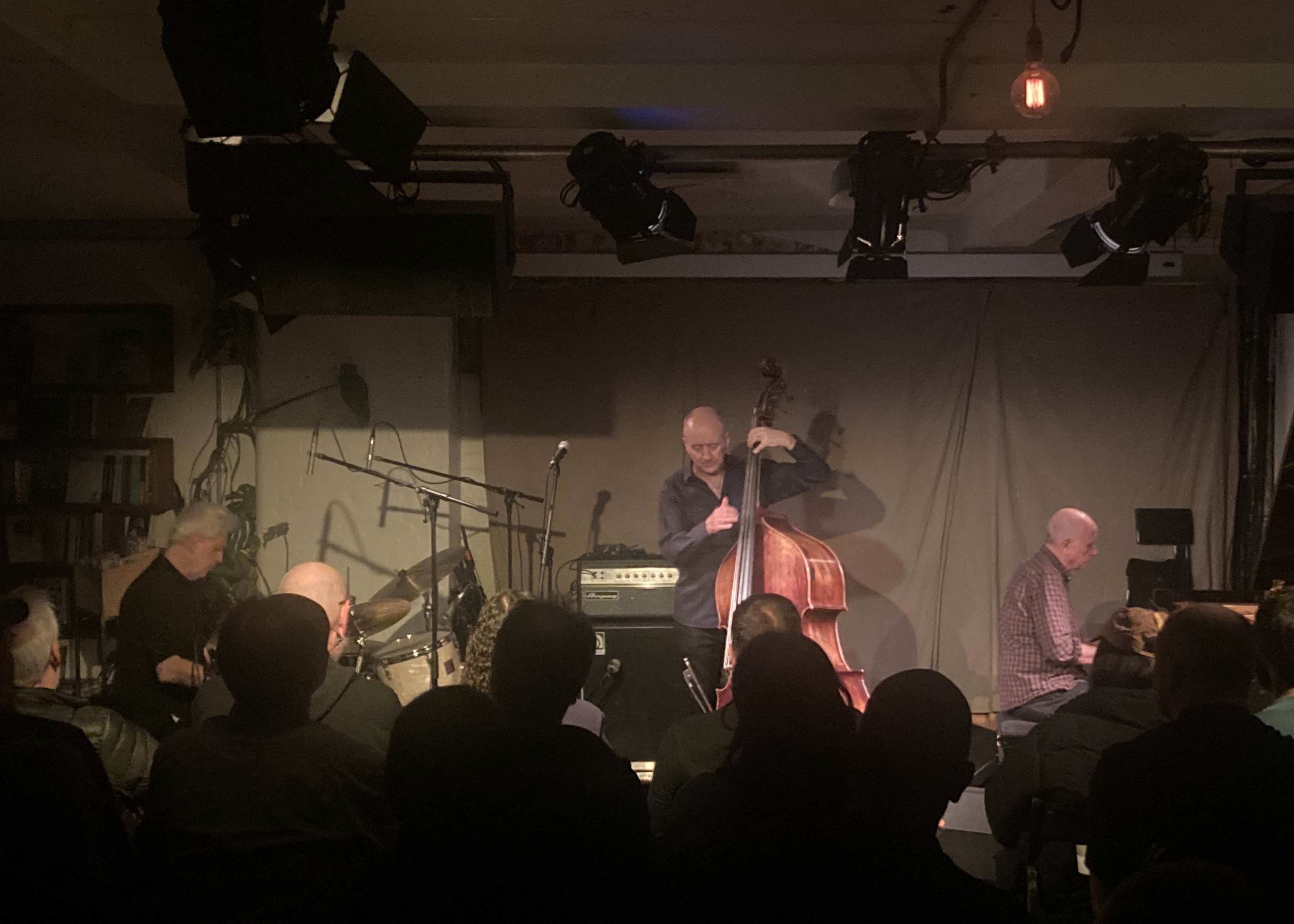
“We’ve never really been an emotional band,” Lloyd Swanton observed drily after the first set on the last of the Necks’ four nights at Cafe Oto in London this week, “but it seems to be creeping in.”

I’d been trying to tell him, somewhat incoherently, how moved I’d been by what they’d just played, and in particular how it seemed to express something about the current state of the world. His reflexive response indicated that what he and his colleagues in the Australian trio do is principally about the notes, about the process of three musicians improvising together with no preset material and certainly with no programmatic content in mind. Which is not to say that listening to them isn’t an emotional experience. It is, almost invariably, but the emotions they generate are usually non-specific.

To me, at least, it seemed that there was something different about Thursday’s first set. It started out normally enough, after they and the audience had settled, with one member — Swanton, on this occasion — breaking the silence. As he plucked an isolated note on his double bass, repeating it and echoing it an octave down, sometimes switching to his bow, and initially with long pauses, Tony Buck joined in with mallets gently rolling around his tom-toms and cymbals, followed by Chris Abrahams picking out pensive Moorish figures in the middle-upper octaves of the piano.

For a while, not much seemed to be happening. No surprise there, necessarily. Later Buck said that he’d worried it had started out “a bit washy”. But in 20 years of attending their performances I’ve learnt to wait, to show the kind of patience as a listener that they show as players, in the knowledge that the surprise will come. In fact, they are the proof that the sound of surprise can emerge slowly, by gradual accretion.

This time the process of accretion led to something extraordinary. As the playing of all three grew busier, the textures thickened, the spaces closed and the volume increased, all of it occurring almost imperceptibly, you began to feel that you were hearing things: bells, cries, gunfire. It was an illusion. They weren’t there, and neither was anyone trying to produce them. But somehow they were present — for me, anyway — in the harmonics reflecting off the piano lid, the scrabbling and keening of the bass, and the hard crack of the bass drum against the overlapping splashes of the cymbals.

Eventually it reached a pitch of intensity that was sustained for maybe 15 minutes before being gradually wound down through a collective diminuendo into silence once again. And in those 15 minutes I couldn’t help replaying the images we’ve been seeing on the TV news every night for months — images of buildings, streets, whole cities lying in ruins, of the dead being counted and the living in flight, the sort of total war we may stupidly have believed was safely consigned to a distant past.

That’s not, I’m sure, what the members of the Necks were thinking of while they were summoning the music into being. It’s more the sort of thing the pianist Vijay Iyer had in mind when, with the bassist Linda May Han Oh and the drummer Tyshawn Sorey, he recorded a new trio album whose title, Compassion, explicitly indicates its theme. “Music is always about, animated by, and giving expression to the world around us: people, relations, circumstances, revelations,” Iyer writes in the sleeve note, describing the responsibility, as he sees it, of making art in a time of suffering.

I’ve heard the Necks play music unafraid of ugliness before (a hair-raising triple-forte set at Café Oto in 2013 stands out in the memory), but never anything in which the kind of responses they normally evoke — including but not restricted to euphoria and elevation — were so strikingly replaced by this very different kind of transcendence, a sustained howl expressing something beyond words yet somehow very specific.

So that was the fifth of the six sets I heard them play this week, and the sixth was, as usual, quite different. Abrahams opened it with a reversion to the sort of thing that provokes the use of adjectives like “luminous” and “lambent”. But again there was a surprise when the piece evolved into an essay in the use of asynchronous rhythms, a field they’ve opened up in recent years, in which each one establishes his own pulse or metre and, without forfeiting closeness of listening to the others, maintains it as the piece develops. At its best, it leads to a kind of higher interplay — and this was the practice at its very best, creating a rhythmic maelstrom that activated a very different response in the audience.

All a long way from the sort of passive music for Zen meditation with which they are sometimes erroneously associated, and irrefutable evidence of their commitment, now extending well into its fourth decade, to a constant self-regeneration of which we are the fortunate beneficiaries.

* The Necks continue their European tour at Peggy’s Skylight in Nottingham on Monday (already sold out) and the Tung Auditorium in Liverpool on Tuesday, April 8 and 9 respectively. Their most recent album, Travel, was released in 2022 on the Northern Spy label. Compassion, by Vijay Iyer, Linda May Han Oh and Tyshawn Sorey, was released earlier this year by ECM.

Trio x 3

Ahmad Jamal may have left us recently, but the jazz piano trio — the format to which he gave so much — refuses to die. Although the spurt of intense activity that gave birth to such inventive genre-benders as E.S.T., the Necks, the Bad Plus, the trios of Vijay Iyer and Brad Mehldau, Plaistow, Phronesis and others in the years either side of the beginning of this century may have abated, three new albums demonstrate that a meeting of piano, bass and drums retains every bit of its potential for creativity and diversity.

The Swedish pianist Bobo Stenson recorded his first trio album for the producer Manfred Eicher in 1971. Sphere, made in partnership with the bassist Anders Jormin and the drummer Jon Fält, is his ninth for Eicher’s label, continuing a process of refinement that has seen his music become more meditative in cadence and transparent in texture as the years go by.

In the past, Stenson’s albums have included jazz compositions such as Ornette Coleman’s “War Orphans” and Tony Williams’s “There Comes a Time”, standard ballads like Gordon Jenkins’s “Goodbye” and George Gershwin’s “My Man’s Gone Now”, Latin pieces from Astor Piazzolla and Silvio Rodríguez and classical works by Berg, Purcell and Ives. The repertoire on Sphere is focused almost entirely on Europe: two pieces by Jormin, one by the Danish composer Per Norgard, two by Sven-Erik Bäck, a Swedish composer who specialised in sacred music, one by the Norwegian pianist Alfred Janson, Sibelius’s “Valsette” and the geographical outlier, a contribution by the Korean composer Jung-Hee Woo.

Beginning and ending with limpid versions of Norgard’s “You Shall Plant a Tree”, the trio slide through the nine tracks so fluidly that each becomes a part of the whole, a single mood smoothing out (but not degrading) the very different contours and emotions of Bäck’s “Communion Psalm”, the gentle entanglements of Janson’s “Ky and the Beautiful Madame Ky” and Woo’s “The Red Flower”, a springy waltz. The result is a very personal evolution of the impressionistic approach pioneered by Bill Evans, Scott LaFaro and Paul Motian, the jazz piano trio in its modern classical guise.

Alexander Hawkins is after something different with Carnival Celestial, in which he, the bassist Neil Charles and the drummer Stephen Davis confront the possibilities offered by combining the acoustic piano, string bass and drum kit with synthesisers, samplers and the kind of post-production techniques not often applied in this context. As Bill Shoemaker observes in his sleeve note, there is nothing self-consciously trendy about the way Hawkins approaches these possibilities. It’s easy to hear the unfamiliar sonorities — flutters, pings, shuffling and rustling sounds — as organic outgrowths of the natural sounds, and as another form of connective tissue.

On the hyperactive “Puzzle Canon” and the pensive “Unlimited Growth Increases the Divide”, you can hear the group au naturel, improvising astringent melodies built on reverse angles and sprung rhythms, taking its place in the lineage of piano trios Hawkins loves, including those of Herbie Nichols, Elmo Hope and Andrew Hill (with Monk always in the deep background). On “Canon Celestial”, by contrast, and on “If Nature Were a Bank, They Would Have Saved It Already” (my favourite title of the year, borrowed from a graffito spotted by the Uruguayan writer Eduardo Galeano) and “Echo Celestial”, the electronics and additional percussion are deployed as the sound-bed, the rhythms hinting at the broken beats of contemporary hip-hop. But there’s no dichotomy or divergence here. The plug-in stuff is used not to tart up but to add dimensions. This is new music.

It translates perfectly to live performance, too, as was demonstrated last night in front of an audience at the Vortex in London, the final night of the trio’s short European tour. The moments of peak emotion produced by this power trio were genuinely extraordinary, particularly in a piano solo towards the end of the first set in which the pianist took off on a flight of supercharged mambo variations. Hawkins also inserted brief samples of the voices of Sun Ra, Louis Moholo and Wayne Shorter to striking effect.

Tyshawn Sorey’s Continuing is something different again, seeming to exist both within and beyond any of the usual considerations. The drummer and his colleagues, the pianist Aaron Diehl and the bassist Matt Brewer, take four compositions — Wayne Shorter’s “Reincarnation Blues”, Ahmad Jamal’s “Seleritus”, Harold Mabern’s “In What Direction Are You Headed” and the standard “Angel Eyes” — as material for a meditation on the form itself.

Space is the dominant factor, along with trueness of sound. The notes breathe, the instruments breathe, even when the traffic is at its heaviest, as in the Mabern tune, where Sorey whacks out four-to-the-bar on his snare and Brewer elaborates a kind of Delta blues riff. In “Angel Eyes”, the musicians pursue their thoughts at a pace through which time almost comes to a standstill, forcing the close listener to adjust breathing, heartbeat, depth of focus; interestingly, even this classic ballad is seen through a transparent lens, the sound of the instruments free of the familiar gauze of studio reverb. It may be the compelling slow-motion anatomisation of a commercial song by a piano trio since Cecil Taylor’s “This Nearly Was Mine”.

All the conventional accoutrements of the jazz piano trio are present in Continuing, whose title could be (but probably isn’t) intended to reference its position in a tradition. But the brilliance of the musicians — their ability to burn away layers of sentiment, their willingness to give each other and themselves that extraordinary degree of space, and the adamantine power of their execution — gives it a meaning entirely its own.

* Bobo Stenson’s Sphere is on the ECM label. Alexander Hawkins’s Carnival Celestial is on Intakt Records. Both are out now. Tyshawn Sorey’s Continuing is released on June 24, on the Pi label.

London Jazz Festival 1: The peak of their art

After an hour of Mike Westbrook’s autumnal musings at the Pizza Express’s piano on Sunday afternoon, in which the great composer, arranger and bandleader stitched together the memories of a life in music into a seamless reverie with a quiet intensity that held the room in thrall, the scene at the 2021 London Jazz Festival moved to the South Bank, where Vijay Iyer, Linda May Han Oh and Tyshawn Sorey stormed the Queen Elizabeth Hall with something belonging entirely to the here and now.

Sometimes you get lucky and witness something that makes you realise how high the standards can be. Doesn’t matter what it is. Tennis, poetry, carpentry. On Sunday night it was jazz. A pianist, a bassist and a drummer dropped in to examine the art of the possible, demonstrating over the course of two hours of high-density interplay what can happen when three like-minded virtuosi get it into their heads to create something in which 1+1+1 = infinity.

Basically, they played their way through their recent album, Uneasy. It’s one of the year’s finest releases, but here they stretched it, expanded it, tossed its elements around, and gave it a completely new existence. So many bases were covered — 21st century takes on bebop, Latino patterns, reggae, the circular rhythms of Tyner-Garrison-Jones — that the time passed very quickly.

Linda Oh is the least known of the three, but her bass playing was the heart of the group: slight build, total physical commitment, wonderful tone, great agility, an endless flow of ideas. Vijay Iyer is a cerebral pianist who nevertheless relishes any involvement with rhythm (one night at the Lido in Berlin a few years ago, he and his regular acoustic trio — completed by the bassist Stephan Crump and the drummer Marcus Gilmore — locked into an endless groove that any funk band would have envied). Tyshawn Sorey operates with complete comfort at the absolute extremities of the dynamic range, from whisper-quiet to shatteringly loud, plus every setting in between. On this occasion he made you wonder why anyone would ever need more than a small bass drum, a medium-sized snare, a single cymbal and a hi-hat, from each of which he drew an astonishing variety of tones and timbres.

Their music rattled, jolted, cruised, purred, broke apart, blended back, cantered, swung, faked a stumble, slowed to a sigh. The audacity made you gasp. Solos were taken, but were always part of the whole. Oh’s leaping grooves made you want to dance. Iyer’s upper-register filigree made your mind soar. Sorey’s sudden whipcracks straightened your back.

Another side of the multi-dimensional Sorey is on view in For George Lewis / Autoschediasms, a two-CD set in which his compositions are performed by Alarm Will Sound, a New York-based 16-piece chamber orchestra here made up of brass, woodwind, strings and percussion, tuned and untuned. “For George Lewis”, a 50-minute piece dedication to his mentor and fellow composer, conducted by Alan Pierson, bears the imprint of Sorey’s interest in the music of Morton Feldman: fully composed, based on a process of accretion and subtraction of single held notes, it moves with mesmerising deliberation through austere and refined layers of sound, creating the musical equivalent of colour-field painting.

“Autoschediasms” is Sorey’s name for his version of the approach to creating real-time music with large ensembles pioneered by Butch Morris (who called it “conduction”) and Anthony Braxton. In these two performances, recorded in St Louis in May 2019 and in various US cities via internet video chat in October 2020, Sorey takes the rostrum, giving the musicians prompts via gestures and prepared cue-cards. “The method can involve the use of up to four batons simultaneously by the conductor,” he writes in his informative notes, and anyone who has seen him at a drum kit will know that this is a challenge well within his scope. The result is a much more obviously active ensemble music, its details and densities sometimes clashing or overlapping, but with an emerging coherence and, like a master of action painting, an excellent sense of drama.

* Uneasy by Vijay Iyer, Linda May Han Oh and Tyshawn Sorey is on ECM. For George Lewis / Autoschediasms by Tyshawn Sorey and Alarm Will Sound is on Cantaloupe Music (www.cantaloupemusic.com).

The uneasy trio

It’s possible that, like me, you think there are already quite enough jazz piano trio albums in your collection. Think again. Uneasy, the new recording by Vijay Iyer, Linda May Han Oh and Tyshawn Sorey, demands attention.

The realignment of the piano-bass-drums hierarchy from “piano with rhythm accompaniment” to a full three-way conversation of equals has been going on for decades, and Uneasy is about as elevated as the format currently gets. Listen to the opener, “Children of Flint”, to appreciate the level of interaction between three musicians with virtuoso-level skills and giant imaginations. It sounds lyrical, even simple. But just concentrate on the astonishing touch displayed by each of the trio, whether on piano keys, bass strings, drums or cymbals, and the sense of three seamlessly interlocking and interdependent components.

As you work your way through the 10 tracks — eight compositions by Iyer, plus Geri Allen’s “Drummer’s Song” and Cole Porter’s “Night and Day” — you’ll also notice a complete absence of ego-projection. No one is showing off. On the sole standard, it’s easiest to hear how far Iyer can take the line of piano-playing founded by Bud Powell. Oh displays the deep sense of swing, nimble melodic imagination and beautiful sound of a 21st-century Paul Chambers. Sorey creates a momentum at once light but deep, exploiting a combination of technique and intellect that redefines the investigation of rhythm.

Recorded in a studio in Mount Vernon, NY three months before pandemic arrived, the album comes with a cover photograph of the Statue of Liberty seen through mist and against clouds. In his sleeve note, Iyer writes that Uneasy was originally the title of a collaborative piece with the choreographer Karole Armitage in 2011, exploring “the instabilities that we then sensed beneath the surface of things… the emerging anxiety within American life. A decade later, as systems teeter and crumble, the word feels like a brutal understatement.”

That heightened disquiet, however, remains implied. You’re not thinking about the end of the world. You’re remembering how even the darkest of times can’t extinguish such astonishing creativity. One of the records of the year, no doubt.

* Uneasy is on ECM Records. The photographs of (from top) Iyer, Oh and Sorey are from the CD’s booklet and were taken by Craig Marsden.

Live at the Village Vanguard

Something Sonny Rollins said in an excellent interview in the March issue of Uncut magazine reminded me of how much I miss being in clubs. The thing with live music, Rollins told John Lewis, is that “everybody has a role — even the audience. The guy nodding his head, the girl who’s smiling, the sceptic who’s not impressed — they all make you play better.” He was answering a question about his youthful experiences in clubs on 52nd Street, but the thought is eternal.

The Village Vanguard, the legendary club on Seventh Avenue South where John Coltrane, Bill Evans and many others made historic recordings, is currently programming a series of livestreamed gigs. You pay $10 and you can either watch the performance live or at any time in the following 24 hours. It’s a way of staying close to the practitioners of an idiom that places such a premium on communication, as well as supporting an institution.

I caught the second of the weekend’s two gigs by the drummer Tyshawn Sorey, the saxophonist Joe Lovano and the guitarist Bill Frisell. Sorey was billed as the leader, and I guess the tunes must have been his, but this was a meeting of three creative minds in a relaxed chamber-jazz environment. I particularly enjoyed seeing Tyshawn — who can do anything — at work on a small jazz kit, swinging with a loose, easy but totally alert feeling that makes me think of Billy Higgins and Tony Williams at the same time.

Lovano and Frisell played together for many years in a trio with the late drummer Paul Motian. There’s no replacing the kind of rapport those three developed over time, but it was fascinating to hear the music the two of them made with Sorey deepen and intensify over the course of an hour. One day maybe we’ll be in the same room as these musicians again, playing our little parts in the ceremony.

* The Vanguard’s coming attractions include the trio of the great pianist Kris Davis and solo performances by the guitarist Ben Monder and the drummer Bill Stewart. Go to http://www.villagevanguard.com and hit the livestream button. You’ll need to register.