Skip to content

Posts tagged ‘Tom Challenger’

On Kit Downes

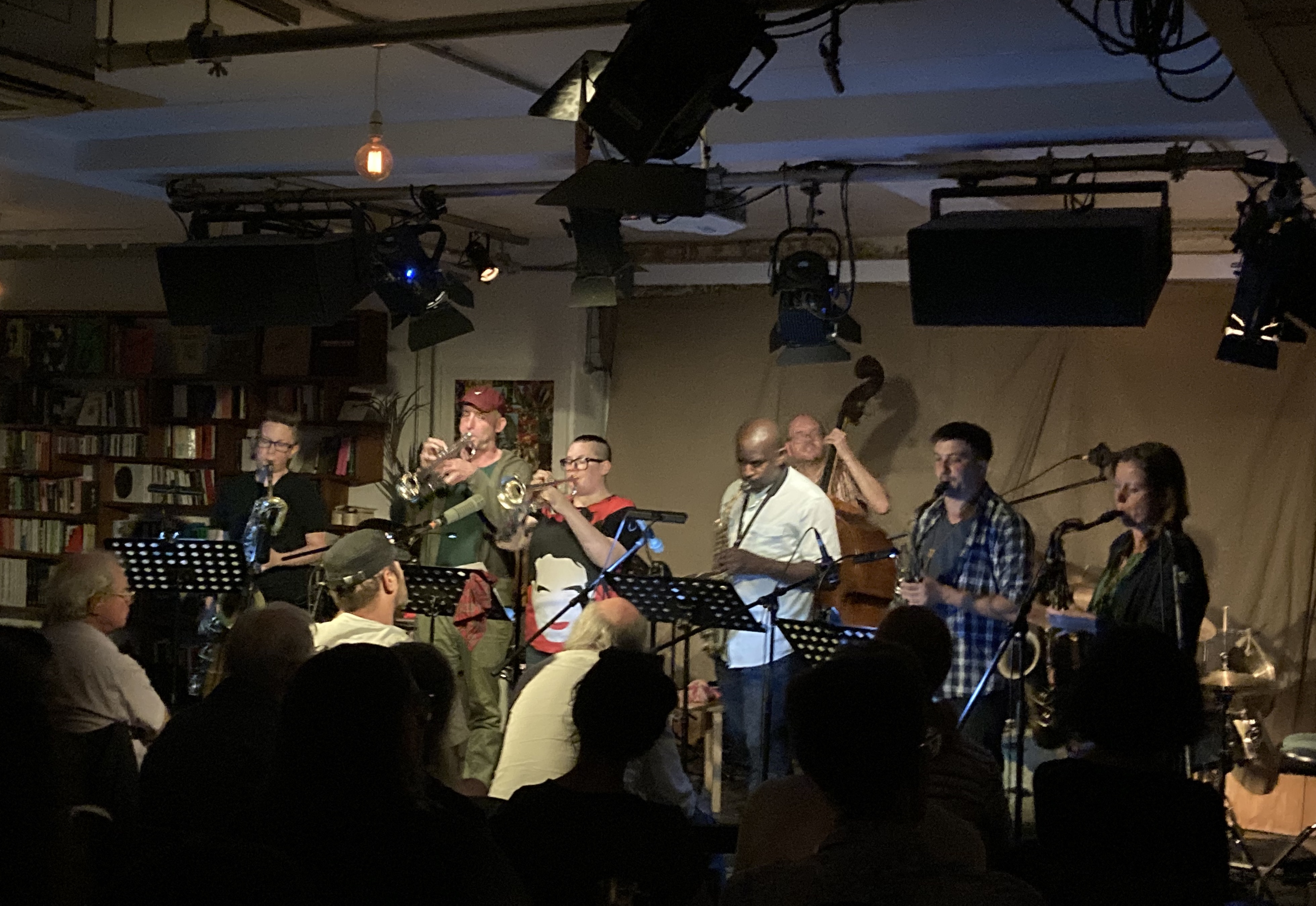
One night a few weeks ago I was at the Vortex, listening to a hour of free improvisation performed in the downstairs bar by the pianist Kit Downes with the saxophonist Tom Challenger, his familiar colleague, the drummer Andrew Lisle, and two names new to me; the guitarist Tara Cunningham and the bassist Caius Williams. It was a lovely set, full of lyricism and surprises. Downes, Challenger and Lisle are entirely at home in such an environment; it was a pleasure to hear the contributions of Cunningham, making an intriguing adaptation of the innovations associated with Derek Bailey, and Williams, who produced not just supple and responsive lines but the loveliest tone I’ve heard from an upright bass for ages.

Then I went home to resume listening to a new CD sent to me from Amsterdam, where the celebrated Bimhuis club had recorded Downes’s multinational 10-piece band playing an extended piece titled Dr Snap — one of a series of four “composition assignments reflecting the current zeitgeist” commissioned, under the overall heading of Reflex, from four different composers — and to Outpost of Dreams, Kit’s new album of duets with Norma Winstone on the ECM label.

Recorded live at the Bimhuis in November 2022, Dr Snap consists of seven pieces by Downes, one by Challenger and two by the bassist Petter Eldh. It begins in a deceptively mild manner — twitchy rhythms, knotty woodwind themes — before broadening and deepening as it goes on, opening out to expose exceptional work from the trumpeter Percy Pursglove, the saxophonists Ben van Gelder and Robin Fincker, the flautist Ketije Ringe Karahona, the guitarist Reinier Baas, the bassist Petter Eldh, and the drummers and percussionists Sun-Mi Hong, James Maddren and Veslemøy Narvesen, Plus, of course, the composer’s piano.

Like a lot of today’s jazz writing, it requires 11 fingers on one hand and seven on the other if you want to try and decipher the time signatures. But no such technical analysis is required for a simpler enjoyment of the music as it passes by, hastening without rushing, guided through its endless twists and turns by the highly inventive rhythm section.

There’s a lot of variety here, from passages of hustling density to a lovely stretch of serenity in “Pantheon 4”, a feature for Karahona, via the use of free-jazz techniques behind Pursglove on “Snapdraks”. The solos arise naturally, part of the overall design — as they did, for instance, in the recordings of Steve Lehman’s octet. Three-quarters of a century after what became known as the Birth of the Cool sessions, this kind of jazz for medium-sized ensembles continues to evolve in a very stimulating way.

Downes’s duo with Winstone is a meeting of minds as well as generations (he is 38, she is 82). His tunes join those of John Taylor, Ralph Towner and Adam O’Rourke as vehicles for her lyrics, which are full of elegant, often wistful references to nature and the seasons, to sky and light and wind and their effect on the senses. There are also fine versions of “Black Is the Colour of My True Love’s Hair” and of a traditional tune arranged by the late Bob Cornford, titled “Rowing Home”. From the latter, was there ever a more ECM-evoking opening to a lyric than “Upon the lake in winter sun / A sun that bleaches the sky…”?

As further evidence of Downes’s scope, there’s a forthcoming trio LP called Breaking the Shell on which he plays pipe organ with the guitarist Bill Frisell and the drummer Andrew Cyrille. A track called “Este a Székelyeknél”, released on Bandcamp by the Red Hook label this week, suggests that this, too, will be a notable addition to the body of work being assembled by one of the most consistently stimulating musicians of our time.

* Dr Snap is on the Bimhuis label and Outpost of Dreams is on ECM, both albums out now. Breaking the Shell is released by Red Hook on September 27. The photograph of Kit Downes with the Dr Snap band was taken at the Bimhuis by Maarten Nauw.
Michael Gibbs / Vortex

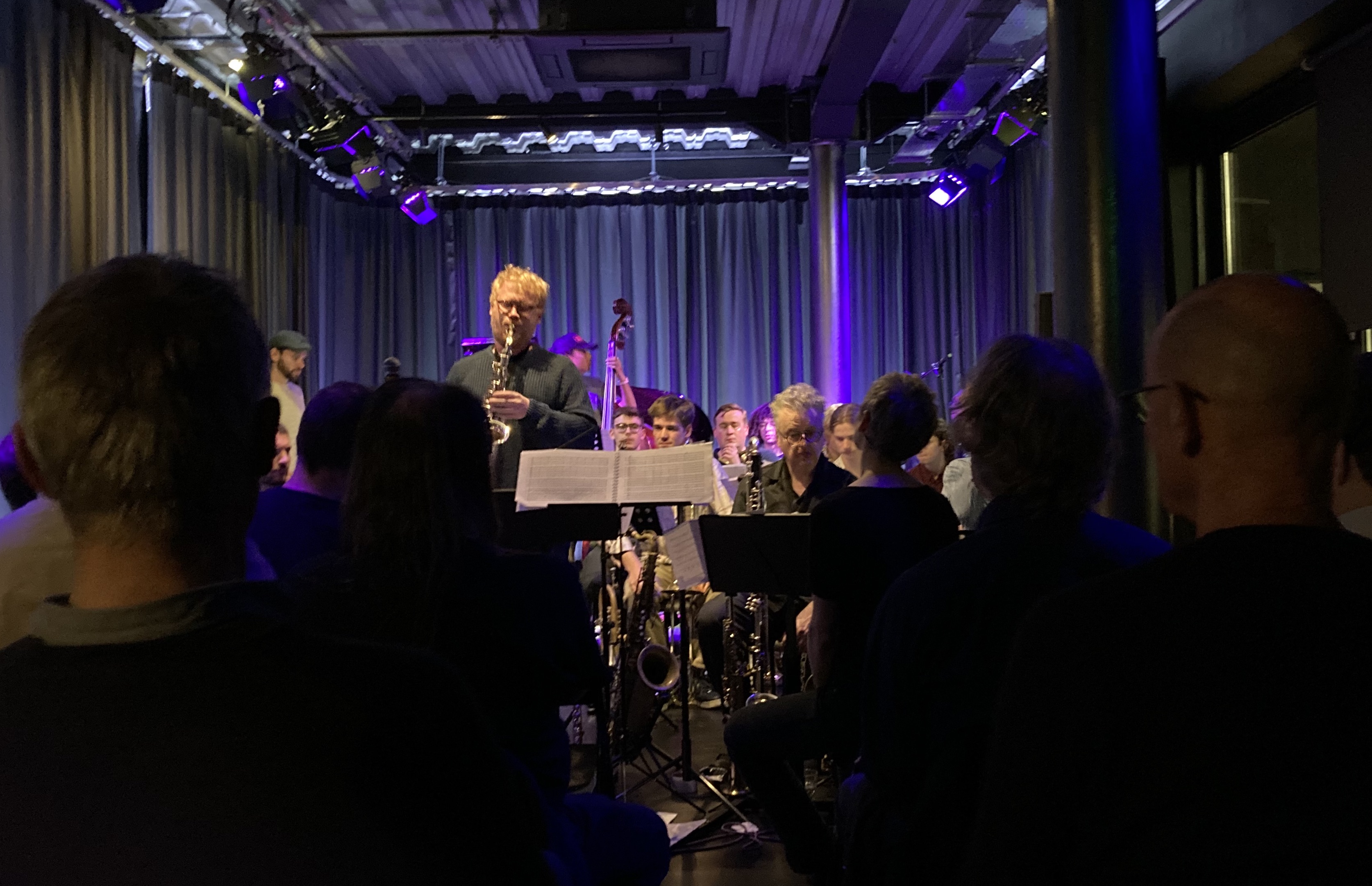
Tom Challenger soloing with the Trinity Laban Jazz Orchestra at the Vortex

Small space, big band. Can’t beat it. Five trumpets, four trombones, four reeds, five rhythm, making the air move within the confines of a proper jazz club. Even the smallest concert hall wouldn’t be the same. And sitting just behind me at the Vortex last night was Mike Gibbs, smiling and cheering as the Trinity Laban Jazz Orchestra, conducted by Josephine Davies, performed a selection of his compositions and arrangements in one of four sets arranged over two nights as part of the EFG London Jazz Festival, in celebration of his recent 85th birthday.

The finest tribute to the great man was the spirit shown by the young musicians of the orchestra, buttressed by a few distinguished elders, including Julian Siegel and Tom Challenger on saxophones, Lewis Wright on vibes, Hans Koller on piano and Gene Calderazzo on drums. Challenger’s alto soared unstoppably on a heart-lifting “Almost Ev’ry Day”, Wright proved yet again on “Ramblin'” that he doesn’t know how to play an uninteresting phrase, Siegel took firm control of “Round Midnight”, and Calderazzo kept the music on its toes. But the newer faces also had points to make: Kobe Heath Ngugi’s bass matched the drummer’s power and agility, Talfan Jenkins delivered a poised alto solo on Gibbs’ fascinating arrangement of Eberhard Weber’s “Mauritius”, Alex Polack’s trumpet cut through on the closing sequence of “Round Midnight”, and the guitar comping of Joseph Leighton behind Koller and Wright on “Ramblin'” was stimulating enough to remind me of Ray Crawford’s contribution to Gil Evans’s “La Nevada”, than which there can be no higher praise. These are all student at the Trinity Laban Conservatoire, and all names to watch.

Gibbs has worked with many musicians and orchestras in his long career — Kenny Wheeler, Gary Burton, Joni Mitchell, John McLaughlin, John Scofield and so on — but not much can have been more fun than this. At the end of the set, he was presented with a birthday cake while the band stood to play “Happy Birthday”. The fizzing candle was only one of the night’s fireworks.

* If you hurry, there are two more sets tonight: https://www.vortexjazz.co.uk/events/?s=Mike+Gibbs

Olie Brice / JLG

Jean-Luc Godard once compared watching the great Hungarian football team of the 1950s to listening to free jazz. A few hours after the announcement of the great director’s death, it was possible to reflect on the meaning of his comparison during a performance at the Café Oto by the trio and octet of Olie Brice, launching the bassist’s new double album, Fire Hills.

Nowadays when we use the term free jazz we tend to mean music created from scratch, on the spot, with no prepared material. Back in the early ’60s, it tended to mean the use of composition to inspire improvisers to stretch the traditional boundaries, using the material as a launch-pad rather than a template while freeing soloists and accompanists to exchange roles. All that could be heard in the music made by Brice’s groups, both of them benefitting from his ability to use his role as a composer to guide rather than prescribe.

The first half featured the trio, completed by the tenor saxophonist Tom Challenger and the drummer Will Glaser, moving with great empathy through compositions dedicated to Johnny Dyani, Eric Dolphy and Andrew Hill. Linking two of the pieces, Glaser delivered a extraordinary solo that began with mallets rolling fast around his snare drum and two tom-toms, using the three pitches to produce something that had the quality of a song, before reversing one of the mallets to introduce a kind of counter-line. Drum solos are seldom poetic, but this was.

Between the two sets, the Oto sound system quietly played selections from the soundtracks of Godard’s movies, including Georges Delerue’s gorgeous orchestral compositions for Le Mépris: a nice touch on a day when a key figure of contemporary culture left the scene.

The six horns of Brice’s octet were assembled in a single line, but it soon became apparent that he would be using them as two units: a pair of trumpets (Kim Macari and Alex Bonney) and a baritone saxophone (Cath Roberts) to the left, an alto saxophone (Jason Yarde) and two tenors (George Crowley and Rachel Musson) to the right, with the drummer Johnny Hunter joining Brice in the rhythm section.

The short ensemble passages — sometimes just punctuations between the improvisations — had the kind of loose-woven, slightly ragged ebullience that could remind you of Mingus’s bands or Charlie Haden’s Liberation Music Orchestra, without borrowing moves from either. That made sense, since Mingus and Haden also figure strongly as inspirations for Brice’s own playing, in which virtuosity and passion are equally mixed.

The first two solos, by Macari and Musson, were the kind you want to wrap up and take home: on-the-nose power from the trumpet, beautifully controlled tonal distortion from the tenor. There were many duets, notably one between the soaring Yarde and the agile Bonney. One or two of the solos outstayed their momentum, but with this music that’s a risk worth taking. And what the evening showed was that Brice has his own way of applying organisation to music, shaping it in interesting ways without compromising the crucial spontaneity of expression and interaction.

* Olie Brice’s Fire Hills is on the West Hill label: https://westhill.bandcamp.com/album/fire-hills

Tom Challenger’s ‘Imasche’

In the gig-free year and a half that ended only a couple of weeks ago, among the things I missed most was free improvisation. There’s nothing like the experience of being there when it happens, watching something being created from scratch, seeing as well as hearing the music take shape through the interaction of the players in a particular environment. Very occasionally an album succeeds in capturing the ephemeral nature of collective improvisation in a way that loses none of the music’s dimensions. Into that category comes Imasche, a new recording on which the tenor saxophonist Tom Challenger is joined by the pianist Alexander Hawkins and the drummer and percussionist Mark Sanders.

Recorded in London last December, it consists of three pieces, each with an enigmatic title. The first, “BriXII”, 17 minutes long, is the most extroverted, uncoiling from a furtive opening into an active three-way conversation full of inventive responses. Challenger has a lovely way of playing that reminds me of Sam Rivers: a light, fine-grained tone, a certain way of phrasing that brings phrases back on themselves, swift touches of note-bending and flutter-tongueing, exploiting mobility without agitation and velocity without aggression.

The second piece, “GesS”, at nine minutes, has the exquisite delicacy of a Japanese watercolour: gentle rustles and small bells and gongs from Sanders, damped and lightly strummed piano strings from Hawkins, false-fingered long tones and harmonics undergoing shifts of timbre and register from Challenger.

If you’ve ever thrown up your hands and decided that free improvisation was a dead end, listen to the final piece, “TanN”. Stretching over half an hour, it takes its time as it shifts focus and momentum, becoming a compelling slow burn that provides a perfect example of how successfully this generation of musicians has metabolised and extended the experiments conducted at the Little Theatre Club and elsewhere in the 1960s. Throughout Imasche we hear three musicians refining a language that is now as eloquent as any other — and sometimes, because of the demands it makes and the qualities it brings out of its finest exponents, even more rewarding.

* Tom Challenger’s Imasche is available as a limited-edition CD and a download from his Bandcamp page: https://tomchallenger.bandcamp.com/album/imasche. The photograph of Challenger was taken by Alex Bonney.

Doubling Downes

Vyamanikal 2

Vyamanikal + 2: Tom Challenger, Alex Bonney, Lucy Railton, Kit Downes

The profound sense of peace that descended over Hall 2 of Kings Place last night as the set by an expanded version of Vyamanikal glided towards its close was unlike anything I’ve encountered all year. The pianist Kit Downes and the tenor saxophonist Tom Challenger, normally a duo in this guise, were joined on the stage by the cellist Lucy Railton and by Alex Bonney, who sat at a laptop. Bonney was processing the music and sounds recorded by Downes and Challenger in 2015 in the small churches of five Suffolk villages, collecting the sounds of organs in various states of repair for an album released last year, and feeding it into the live performance.

In the absence of a church organ, Downes alternated between a piano and a small hand-pumped harmonium. For the better part of an hour the musicians wove tapestries of sound in which individual elements blended seamlessly. There were certainly gorgeous details, but they fade in the memory next to the overall impression of a glowing organic whole.

If there was a kind of English pastoral vibe in the air, it was implicit rather than declarative, and never suffocating. I suppose the most obvious precedent might be some of John Surman’s recordings, from Westering Home onwards, but really this music seemed to stand alone, without need for comparison. As they neared the end, the three instrumentalists stopped playing but the music continued, thanks to Bonney, in a many-layered drone which seemed to distill everything that had been played in the previous 50 minutes. And then came a few moments of silence in which we could find our own way out of the trance.

The first half of the evening had featured Tricko, the duo in which Railton and Downes perform a kind of sui generis cello-and-piano chamber music that manages to be intricate without inducing strain and immediately attractive without becoming winsome. “I’m aware that this music is cripplingly quiet,” Downes said at one point. “If I were listening, I’d probably be asleep by now.” That might indeed be the initial impression. But the longer you listen to them, the more awake you feel.

* Vyamanikal’s album is on the Slip Imprint label. Downes’s solo organ album, Obsidian, will be released by ECM early next year.