Skip to content

Posts tagged ‘The Necks’

Silence and slow time

“Silence and slow time…” John Keats’s beautiful phrase finds an echo in some of the music I love, the kind that emerges from a stillness to which it eventually returns, taking its time and not raising its voice to attract attention. Here are five brand-new examples of music with healing qualities, all highly recommended.

1 The Necks: Disquiet (Northern Spy)

Three hours of glorious studio-recorded collective interplay on three CDs. “Rapid Eye Movement” is a 57-minute exploration of densities, starting with Chris Abrahams’ Rhodes piano, punctuated by Lloyd Swanton’s abrupt double bass figures. It changes slowly, like the weather, eventually reaching a passage of single-note cascades from the acoustic piano over Tony Buck’s rumbling tom-toms, leading to an exquisitely tapered ending. “Ghost Net” is 74 minutes of lurching, clattering, gradually darkening polyrhythmic layering, with each musician apparently playing in 12/8, but in three different 12/8s. Using what sounds like a Farfisa organ, it’s as though they’ve suddenly found the sweet spot between Thelonious Monk and ? and the Mysterians. The other two tracks divide an hour between them. “Causeway” opens with echoing guitar and celestial organ and contains a completely intoxicating E minor/B minor/A minor vamp — the Necks’ own three-chord trick — with piano above guitar and organ before a sudden gearchange, involving the addition of thrashing drums, turns a reverie into something soaringly urgent. “Warm Running Sunlight” is an essay in textures and the contemplative space between them: string bass going from plucked to bowed and back, splashing cymbals, Rhodes heavy on the reverb. A lot to take in, but among their very best, I’d say.

2 Tom Skinner: Kaleidoscopic Visions (Brownswood)

The drummer and composer whose Voices of Bishara project I liked so much, in both its studio and live incarnations, takes a slightly different tack here. The music is built around his regular bandmates — the saxophonists Chelsea Carmichael and Robert Stillman, the bassist Tom Herbert and the cellist Kareen Dayes — but with a handful of guests: Meshell Ndegeocello layering her voices on one track, Portishead’s Adrian Utley adding his guitar to a couple more, the singer Contour (Khari Lucas) from South Carolina gently intoning the poetic lyric of “Logue”, and Yaffra (London-born, Berlin-residing Jonathan Geyevu) reciting the poem “See How They Run” over his own piano and Skinner’s overdubbed keyboards, vibes, bass, guitar and percussion. Music without boundaries, full of human feelings, ancient to the future.

3 Jan Bang / Arve Henriksen: After the Wildfire (Punkt Editions)

The two Norwegians devise eight pieces featuring Henriksen’s distinctive trumpet with Bang’s samples, Eivind Aarset’s guitar, Ingar Zach’s percussion, three singers, the Fames Institute Orchestra, a cellist, two Balkan instruments — the tapan (a double-headed drum) and the kaval (an end-blown flute) — and the zurla, a Turkish double-reed instrument. Ravishing from beginning to end, starting with “Seeing (Eyes Closed)”, which made me think that Miles Davis and Gil Evans had been reincarnated as graduates of the contemporary Norwegian jazz scene, to “Abandoned Cathedral II”, a continuation of Henriksen’s classic 2013 album, Places of Worship.

4 Rolf Lislevand: Libro Primo (ECM New Series)

Another Norwegian, this time an exponent of the archlute and the chitarrone, examining the works written for the lute and its variants by the 16th and 17th century composers Johann Hieronymus Kapsberger, Giovanni Paolo Foscarini, Bernardo Gianoncelli and Diego Ortiz. Lislevand’s sleeve essay explains the revolution in which these composers were involved, and he brings them into the present day with free, fluid interpretations that make this music ageless. His own riveting “Passacaglia al Modo Mio” is both a salute and a declaration of possibilities. Anyone with a fondness for Davy Graham or Sandy Bull will enjoy this enormously.

5 Charles Lloyd: Figures in Blue (Blue Note)

For the latest in his series of drummerless chamber trios, the great saxophonist is joined by an old colleague, the pianist Jason Moran, and a newer one, the guitarist Marvin Sewell. This two-CD set begins with what is surely the first version of “Abide with Me” to appear on a jazz album Monk’s Music in 1957 and ends with a exquisite rumination on the standard “My One and Only Love”. In between Lloyd invokes the spirits of Duke Ellington, Billie Holiday, Langston Hughes and Zakir Hussain. On two tracks he also makes fine use of Sewell’s command of bottleneck techniques, leading one to wish that more modern jazz musicians would explore the blues in the way Gil Evans did with “Spoonful” and Julius Hemphill with “The Hard Blues”.
Meet the house band

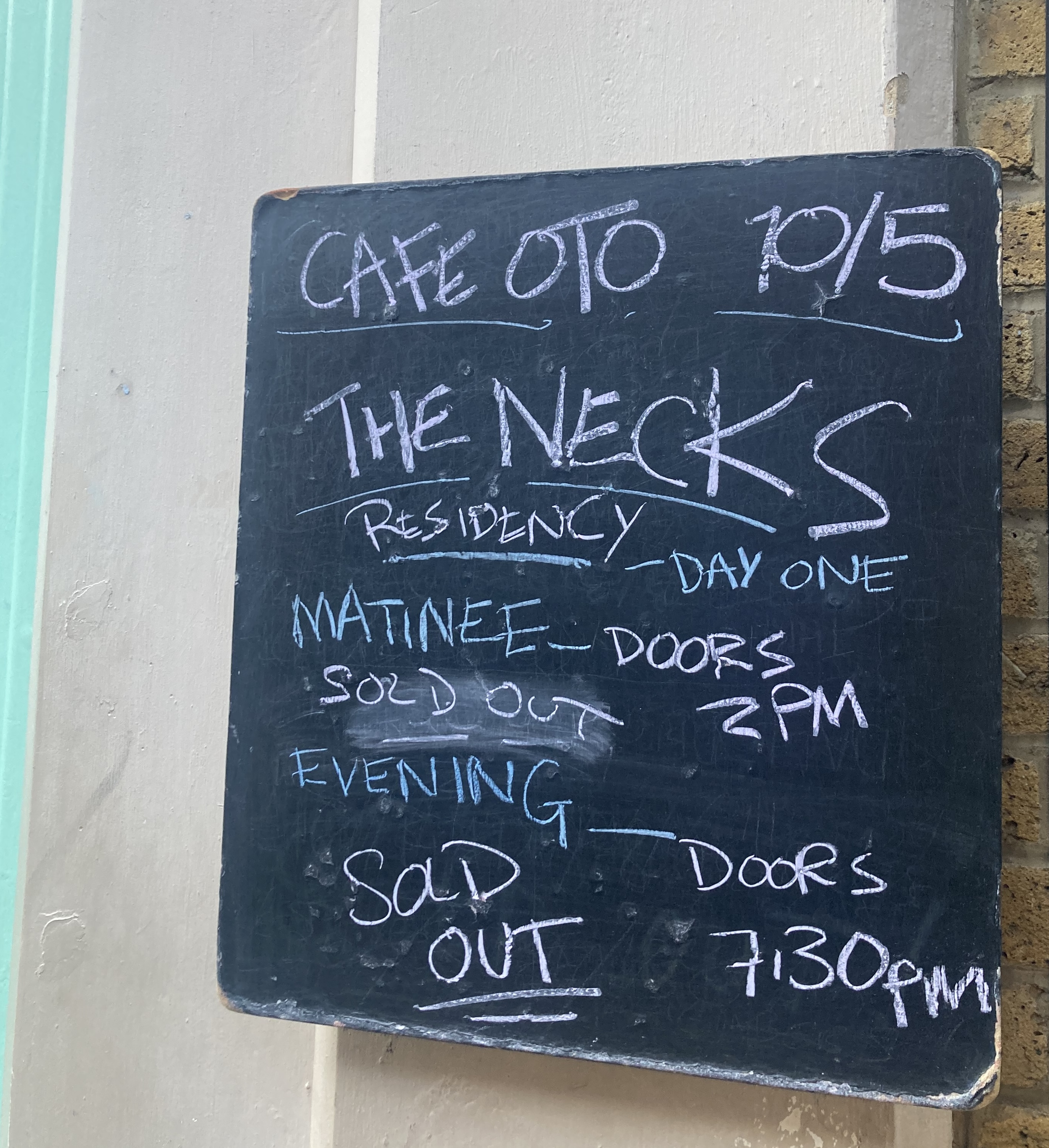
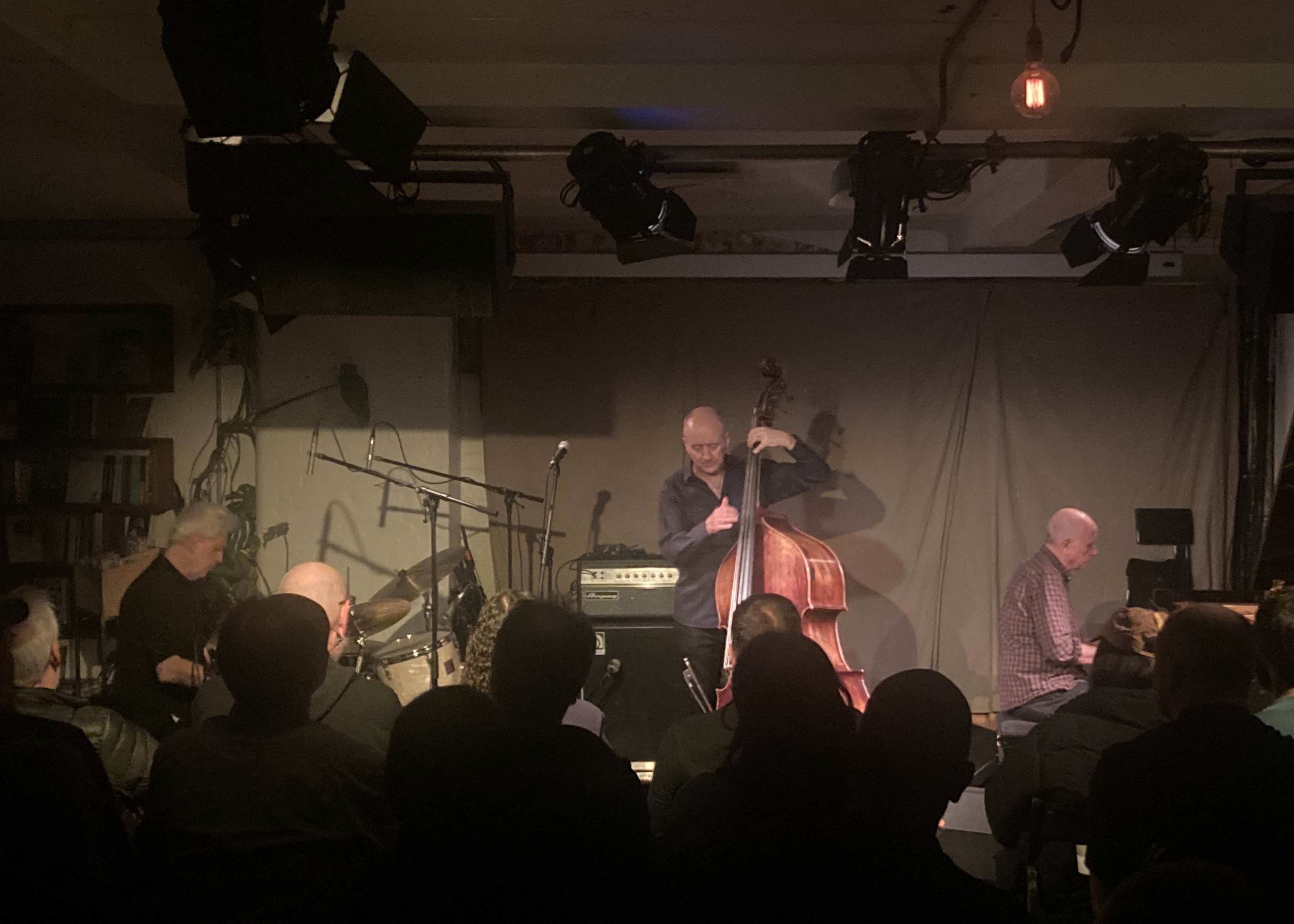
Before the evening show on the first of their two days at Cafe Oto on Saturday, the Necks were announced to the audience as “the house band”. We laughed, and so did they. But it seemed to fit. The Australian improvising trio have played in many London venues, but the little space on Ashwin Street in Dalston seems to suit them best.

Once the house was quiet, they began with Chris Abrahams picking out short melodic phrases in the piano, lightly hammering each note with the two fingers: the index finger of each hand. It was a lovely effect, almost like a santur or cimbalom. The phrases sounded vaguely Moorish, which might seem a bit vague and superficial as a description but is intended to suggest that they felt like fragments of ancient wisdom, conveyed without adornment.

Tony Buck was rubbing two old cymbals on the heads of his snare drum and floor tom-tom. They he began playing a medium fast 1-1-1-1 rhythm with his left hand on the top cymbal of his hi-hat, using a long slender stick. That cymbal stroke formed the basis of his contribution over the next 40 minutes, building in volume and density but retaining a silvery delicacy.

Meanwhile Lloyd Swanton plucked the open D string on his bass with emphasis, letting it ring. That became the tonal centre of the entire collective improvisation, the only fixed point as each of the three explored his own avenue of rhythmic and melodic creation, the symbiosis built up over 30 years enabling them to operate in seeming independence of each other and yet in complete communion. It takes the idea of listening to each other to a different place: listening without listening.

As is usual, but not inevitable, the music gathered power and volume until, by some unspoken intuition, the musicians broke it down, stripping back all the chosen materials until we were returned to the silence.

It’s always tempting to search for analogies and metaphors. Tempting, but unnecessary. Still, on Saturday I thought of the sea breaking on a shore, composed of countless waves and wavelets, all surging and cresting according to their own individual strengths and sub-trajectories, yet responding to a single tidal pulse. It’s an amazing thing to witness in person, when you see how these musicians never even look at each other in performance (Abrahams actually sits side-on, facing offstage) but are linked by something unique.

* The Necks are at Band on the Wall in Manchester tomorrow night (May 13), the Empire, Belfast (14), the Sugar Club, Dublin (15), and thereafter in Switzerland, Portugal, the Netherlands, Croatia, Greece, Poland, Spain, Italy and Belgium: https://shop.thenecks.com/tour-dates

The Necks at Cafe Oto

“We’ve never really been an emotional band,” Lloyd Swanton observed drily after the first set on the last of the Necks’ four nights at Cafe Oto in London this week, “but it seems to be creeping in.”

I’d been trying to tell him, somewhat incoherently, how moved I’d been by what they’d just played, and in particular how it seemed to express something about the current state of the world. His reflexive response indicated that what he and his colleagues in the Australian trio do is principally about the notes, about the process of three musicians improvising together with no preset material and certainly with no programmatic content in mind. Which is not to say that listening to them isn’t an emotional experience. It is, almost invariably, but the emotions they generate are usually non-specific.

To me, at least, it seemed that there was something different about Thursday’s first set. It started out normally enough, after they and the audience had settled, with one member — Swanton, on this occasion — breaking the silence. As he plucked an isolated note on his double bass, repeating it and echoing it an octave down, sometimes switching to his bow, and initially with long pauses, Tony Buck joined in with mallets gently rolling around his tom-toms and cymbals, followed by Chris Abrahams picking out pensive Moorish figures in the middle-upper octaves of the piano.

For a while, not much seemed to be happening. No surprise there, necessarily. Later Buck said that he’d worried it had started out “a bit washy”. But in 20 years of attending their performances I’ve learnt to wait, to show the kind of patience as a listener that they show as players, in the knowledge that the surprise will come. In fact, they are the proof that the sound of surprise can emerge slowly, by gradual accretion.

This time the process of accretion led to something extraordinary. As the playing of all three grew busier, the textures thickened, the spaces closed and the volume increased, all of it occurring almost imperceptibly, you began to feel that you were hearing things: bells, cries, gunfire. It was an illusion. They weren’t there, and neither was anyone trying to produce them. But somehow they were present — for me, anyway — in the harmonics reflecting off the piano lid, the scrabbling and keening of the bass, and the hard crack of the bass drum against the overlapping splashes of the cymbals.

Eventually it reached a pitch of intensity that was sustained for maybe 15 minutes before being gradually wound down through a collective diminuendo into silence once again. And in those 15 minutes I couldn’t help replaying the images we’ve been seeing on the TV news every night for months — images of buildings, streets, whole cities lying in ruins, of the dead being counted and the living in flight, the sort of total war we may stupidly have believed was safely consigned to a distant past.

That’s not, I’m sure, what the members of the Necks were thinking of while they were summoning the music into being. It’s more the sort of thing the pianist Vijay Iyer had in mind when, with the bassist Linda May Han Oh and the drummer Tyshawn Sorey, he recorded a new trio album whose title, Compassion, explicitly indicates its theme. “Music is always about, animated by, and giving expression to the world around us: people, relations, circumstances, revelations,” Iyer writes in the sleeve note, describing the responsibility, as he sees it, of making art in a time of suffering.

I’ve heard the Necks play music unafraid of ugliness before (a hair-raising triple-forte set at Café Oto in 2013 stands out in the memory), but never anything in which the kind of responses they normally evoke — including but not restricted to euphoria and elevation — were so strikingly replaced by this very different kind of transcendence, a sustained howl expressing something beyond words yet somehow very specific.

So that was the fifth of the six sets I heard them play this week, and the sixth was, as usual, quite different. Abrahams opened it with a reversion to the sort of thing that provokes the use of adjectives like “luminous” and “lambent”. But again there was a surprise when the piece evolved into an essay in the use of asynchronous rhythms, a field they’ve opened up in recent years, in which each one establishes his own pulse or metre and, without forfeiting closeness of listening to the others, maintains it as the piece develops. At its best, it leads to a kind of higher interplay — and this was the practice at its very best, creating a rhythmic maelstrom that activated a very different response in the audience.

All a long way from the sort of passive music for Zen meditation with which they are sometimes erroneously associated, and irrefutable evidence of their commitment, now extending well into its fourth decade, to a constant self-regeneration of which we are the fortunate beneficiaries.

* The Necks continue their European tour at Peggy’s Skylight in Nottingham on Monday (already sold out) and the Tung Auditorium in Liverpool on Tuesday, April 8 and 9 respectively. Their most recent album, Travel, was released in 2022 on the Northern Spy label. Compassion, by Vijay Iyer, Linda May Han Oh and Tyshawn Sorey, was released earlier this year by ECM.

The Necks at EartH

Necks EartH

At Cafe Oto, the Necks’ usual London home, we listeners are close enough to see the details: exactly which rattling device Tony Buck is wielding his right hand, or what use Chris Abrahams is making of the piano’s sustain pedal. The Oto programmers’ decision to invite them to play instead last night at EartH (Evolutionary Arts Hackney), the converted Savoy cinema barely a quarter of a mile up the road in Dalston, gave a different perspective on the Australian trio’s collective improvisations.

In front of an audience several times larger than Cafe Oto admits, they stuck to the familiar format of two sets of about 45 minutes each, with nothing premeditated. The first was opened with fluid rippling figures from Abrahams, soon joined by Buck’s percussion and Lloyd Swanton’s bass, gradually building a layered intensity, the surface textures and internal dynamics changing like the sky on a day of changeable weather as they worked their way towards a graceful conclusion, the fruit of 32 years of working together.

The second set, opened by Buck, was different in two significant respects. First, their lighting operator took a more prominent role, switching constantly between a limited array of floodlights. I found it distracting — the musicians weren’t playing to the lights — and spent much of the set with my eyes closed. And the music had also moments of much greater violence, clearly exerting a cathartic effect on the audience, who greeted its more abrupt conclusion with a sustained collective shout.

If the acoustics of EartH meant that the sounds of the individual instruments weren’t as clearly defined as they are in a more intimate setting, the size of the place nevertheless added its own dimension to the overall effect. The piano, bass and percussion often blended into each other, sometimes creating a thrilling roar of overtones. The amphitheatre layout and the semi-refurbished interior  — original ceiling mouldings, a tiered wooden floor to sit on — made for a sympathetic environment, although you feel that even were the Necks to play Wembley Stadium, they’d manage to transform its ambiance into that of a small club while finding ways to exploit the possibilities of the new environment. But, on balance, that might be a step you’d rather they didn’t take.

A little afternoon music

Necks matinee 1This is the line of ticket-holders waiting to enter Cafe Oto for the Necks’ sold-out lunchtime concert today. It might have seemed an unusual time of day to experience the intensity of free collective improvisation, but the Australian trio’s music tends to work its unique magic at any time of day or night, in any location.
In between a festival in Madeira and a concert in Helsinki, they were stopping in Dalston for this single show. As usual, they played two sets of approximately 45 minutes each, separated by a short break. And, again as usual, the two sets were contrasting in nature and effect. I wasn’t at all surprised when one confirmed admirer went into raptures about the first set, while another said the second set was the best he’d ever seen them play.

The three musicians themselves don’t talk about individual performances in terms of differing type or quality levels. Chris Abrahams, Lloyd Swanton and Tony Buck were there, doing what they do, exposing the process of creating music from scratch on the basis of three decades of shared experience. To them, in a sense, the existence of the Necks is one unbroken performance, divided for convenience into chunks that happen to be the length of an old-fashioned LP.

Necks matinee 3Abrahams began the first set with tentative piano figures, joined by Buck’s bass drum and, eventually, Swanton’s arco bass. The pianist tended to hold the initiative throughout, creating arpeggiated variations that slowly surged and receded, gradually building, with the aid of Buck’s thump and rattle and the keening of Swanton’s bow, to a roaring climax — including, from unspecified source among the three, a set of overtones that gave the illusion of the presence of a fourth musician — before tapering down to a perfectly poised landing.
After the interval it was Swanton’s turn to open up, his plucked octave leaps offered as an invitation to the others. This time Buck began with a stick on his open hi-hat and a mallet on his floor tom-tom, while Abrahams seemed to devote more time than usual to open single-note lines. At one point, about 10 minutes in, the pianist spent a few seconds picking out what sounded like a Moorish melody, but he declined to pursue its possibilities and after a brief pause moved on to something more like his familiar strumming and roiling techniques. About 20 minutes later, however, he returned to that melody, or something very like it, using it as the material from which to fashion his contribution to another supremely graceful conclusion.

What began in 1987 as a private experiment between three young Sydney-based musicians has evolved into an institution with a large and devoted worldwide audience. Somehow they manage to make it new every night, even when that night happens to be a Sunday lunchtime. They’ll be back at Cafe Oto next March.

The Necks at the Union Chapel

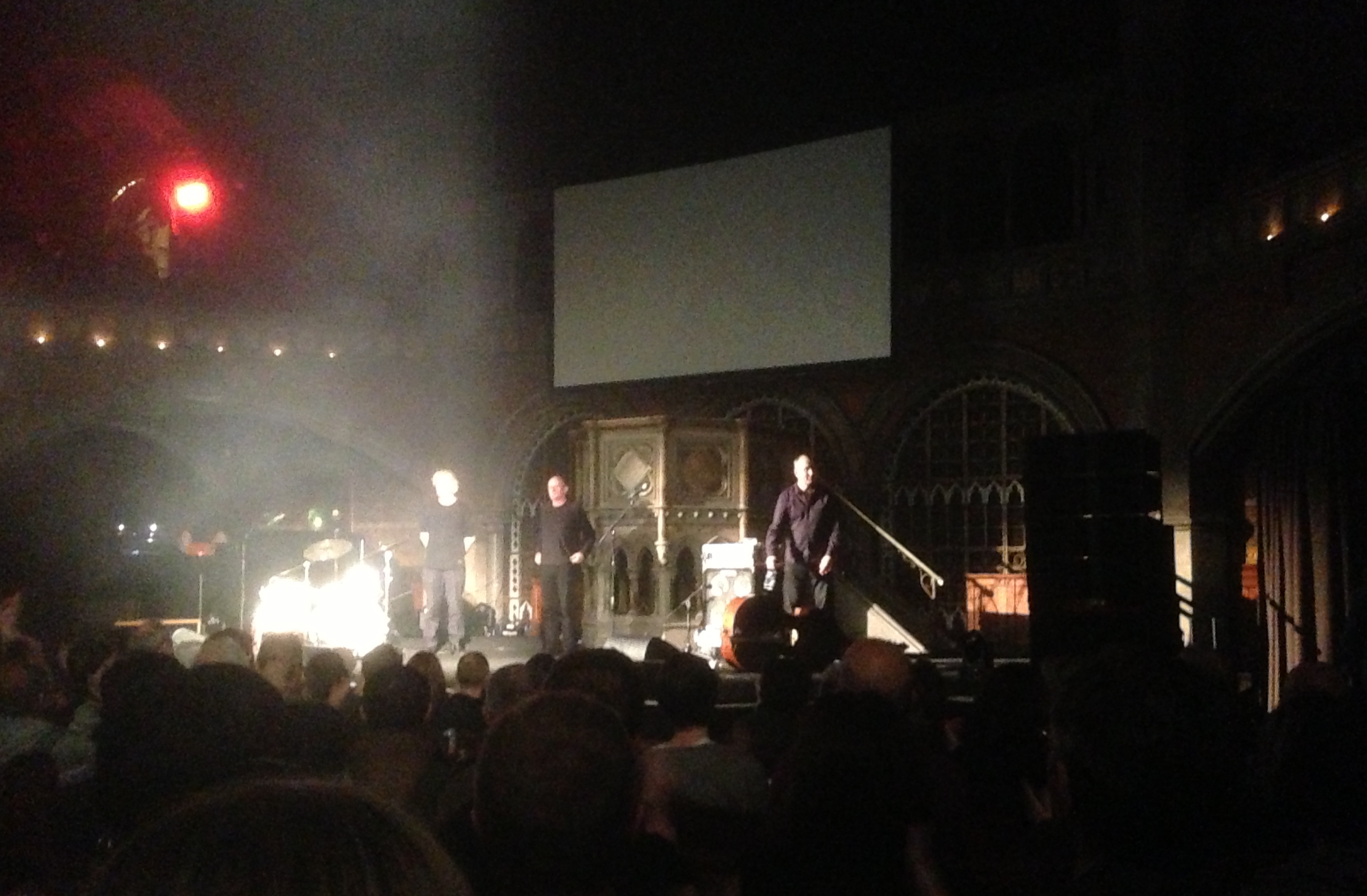
Necks at Union Chapel 1The beautiful Union Chapel in Islington proved to be the perfect final stop for the Necks’ short UK round of pipe organ concerts last night. They were sharing the series, titled The Secret Life of Organs, with James McVinnie, who opened the evening with two pieces by Philip Glass and two short suites by Tom Jenkinson (better known to electronica fans as Squarepusher).
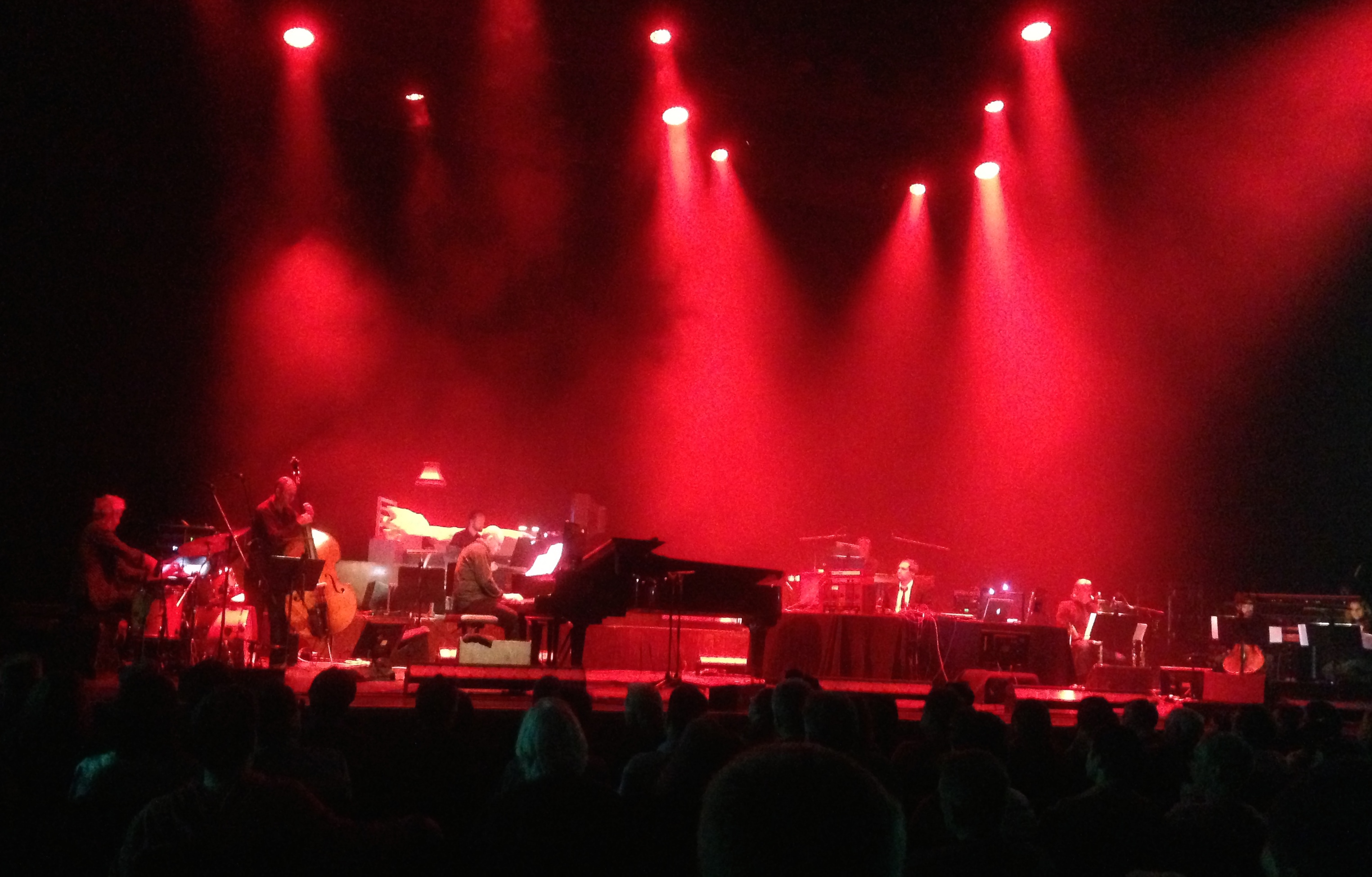
By comparison with the Necks’ appearance at the Kaiser Wilhelm Memorial Church in Berlin last November, this hour-long set more closely resembled what one often hears in their performances using the conventional piano-trio format: an initial gathering of resources leading to surging and slowly mutating waves of sound.

In Berlin most of the audience, facing the altar, could not see the musicians, who were perched in the organ loft/choir balcony above the main door. In London the listeners were facing a stage on which Lloyd Swanton (bass) and Tony Buck (drums) did their stuff. Chris Abrahams was hidden away at the organ console behind the huge central pulpit, but his hands — and the pipes and bellows of the organ — could be seen on a large screen.

Not surprisingly, the sound balance favoured the organ, which was built in 1877 and features 2,000 pipes. Buck’s chattering and rattling percussive commentary could be heard clearly enough, but you had to watch Swanton closely if you wanted to make out his individual contribution. The bass player’s job in this environment, with Abrahams having the organ’s foot pedals at his disposal, is the hardest of three.

It’s fascinating to hear these musicians adapting to the circumstances, and in particularly to the way the various organs “speak”. I hope they release an album of one of these performances. Meanwhile, Abrahams has a new solo CD, Fluid to the Influence, which contains a great deal of absorbing music assembled on a variety of acoustic and electronic keyboard instruments and one marvellous track, “Trumpets of Bindweed”, on which he plays the pipe organ at the Melbourne Town Hall, where the Necks gave their first organ concert in 2005.

Last night they brought the set back to silence with one of those conclusions whose combination of spontaneous mutual decision-making and intuitive aesthetic logic simply take your breath away. Only improvisers can do this.

* The Secret Life of Organs was part of the Barbican’s contemporary music series, co-presented with No-Nation. Future concerts feature the Kronos Quartet, the Bang on a Can All Stars, and Colin Stetson + Sarah Neufeld.

Discreet Music: 40 years on

Discreet Music 3

My contribution to the creation of Brian Eno’s Discreet Music was a tiny one, but I’m proud of it. Back in 1975 Eno was preparing the release of the first batch of four albums on his Obscure label, under the umbrella of Island Records, where I was in charge of A&R. Almost everything had been taken care of by the time he departed for a trip abroad (to New York, I think). I was left with a single task: to provide a title for a track on the album’s second side, the middle movement of a three-part suite based on Johann Pachelbel’s Canon in D. The titles for the first and third movements — “Fullness of Wind” and “Brutal Ardour” — had been chosen by Brian at random from the sleeve note to his favourite recording of the Pachelbel piece, by the conductor Jean-François Paillard on the Erato label, and he invited me to follow suit. My eye fell on the phrase “French Catalogues”. So there it is. Well, I told you it was tiny.

It was impossible to predict, 40 years ago, that Discreet Music would become so a significant a progenitor of what we hear around us today, or that it would eventually become the subject of a concert such as the one at the Barbican in London last night, when a nine-piece group directed by David Coulter and Leo Abrahams performed extended variations on both sides of the original album.

One third of the ensemble consisted of the members of the Necks: Chris Abrahams (piano), Lloyd Swanton (bass), and Tony Buck (drums). They were positioned on the left-hand side of the stage. On the extreme right were the great reeds player John Harle, the cellist Oliver Coates, and the violinist Emma Smith. In the middle, at the base of a deep V, were Coulter (vibraphone, musical saw and iPhone) and Leo Abrahams (guitar), with the desk containing the synthesiser and other hardware manipulated by the electronics specialist Benge (Ben Edwards) front and centre. Flanking the stage were a pair of large screens on which a selection of cards from the Oblique Strategies series devised by Eno and the late Peter Schmidt were projected, containing helpful counter-intuitive maxims and admonitions: “Repetition is a form of change”, “Abandon normal instruments”, “Disconnect from device”, and so on.

For the first half, devoted to an extended version of the piece titled “Discreet Music”, which was originally created by the composer with the modest means of a synthesiser, a sequencer, an echo unit and two tape recorders, a vertical screen above and behind the players showed the slowly changing images of Mistaken Memories of Medieval Manhattan, Eno’s 47-minute film of the New York skyline. Electronics opened this new treatment, outlining the two simple but rather haunting phrases — one ascending, the other descending — on which the piece is structured. Clarinet and bowed vibes took over, followed by gentle guitar, violin and cello, with Harle switching to bass clarinet. The Necks’ entry came about 20 minutes in: the first to join in was Swanton, playing sonorous arco phrases, then Buck, with a brush on his hi-hat, and finally Abrahams picking out liquid single notes. Over the course of the next 10 minutes, after the other instruments had fallen away, the performance evolved in a passage of full-strength Necks collective improvisation, their surges reaching a pitch of thunderous but beautifully controlled violence before receding as the other musicians rejoined for the finale. The arrangement both honoured the original and expanded it in several dimensions, investigating the flow and interplay of texture and line, producing something both intellectually absorbing and absolutely gorgeous. The ovation from a full house was entirely merited.

The stage lighting turned from blue to red for the Pachelbel piece, which first came to my attention when Eno used the Erato recording as the introductory music on an early Roxy Music tour. His refracted and discursive version on Discreet Music, arranged with the help of Gavin Bryars, was performed by the string players of the Cockpit Ensemble. Once again the expanded resources at the disposal of Coulter and Abrahams succeeded in opening out the work, allowing us glimpses of the Canon’s familiar phrases while introducing new elements: a duet for bowed saw and guitar, a poised solo piano interlude, some lovely clarinet/violin/cello counterpoint, and a double-trio passage for the two formations at opposite ends of the stage, eventually interrupted by harsh electronics that preceding the elegant closing diminuendo.

One thing that struck me about the evening was how the nine musicians, despite being strung out across the full width of the Barbican Hall stage, managed create such a powerful sense of intimacy. Aside from the individual phrases familiar from the original versions, it was often hard to tell where the new score ended and the improvising began. Everyone emerged with maximum credit, not least the man whose remarkable imagination and appetite for adventure had made it possible in the first place.

A new view from the Necks

The Necks Vertigo 1Because it’s impossible to predict what strategy they will have adopted, the arrival of a new studio album from the Necks is always an event. With Vertigo, the Australian trio maintain the habit.

I loved their previous album, Open, for its transparent beauty. Others, such as AquaticDrive By and Silverwater, I’ve loved for quite different reasons. Vertigo doesn’t resemble any of its predecessors; it’s like going into a familiar house and finding a new room with a window that opens on to a view not seen before.

A single piece of music, 44 minutes in duration, it uses the resources and time at their disposal in Studios 301 in Alexandria, a suburb of Sydney. While their live sets are the product of a mixture of spontaneous urges and the 30-year relationship between the three musicians, the studio albums aim for something different (and yet, in its essence, the same).

There are no grooves in Vertigo, or even any pulses, unless you count the slow oscillation of something that sounds like a contrabass theremin, which briefly enters the proceedings at around the 18-minute mark. There are no riffs and nothing that sounds like a tune. There is no obvious drama.

Glimpses of anything that could be called the Necks’ “sound” are infrequent. Early on, Chris Abrahams does some nice things with incomplete descending arpeggios. Tony Buck makes the occasional clattery percussion intervention (and is probably responsible for the bits that sound like a guitar being picked above the bridge). Lloyd Swanton uses his bow to create layers of groaning bass drones just after the half-hour.

But that’s not the point. The sounds are the sounds. The exact source of this scraping or that plinking is immaterial: the assembly is what matters, and that’s something of which they are masters. The sonorities and textures slide into view and drift away, like the weather on a long road trip. It’s probably not the album you’d give someone as their first Necks record, but it couldn’t be by anyone else.

* Vertigo is released in the UK on the ReR Megacorp label. The photograph is by Holimage.

The Necks in London

Necks Evan 11.

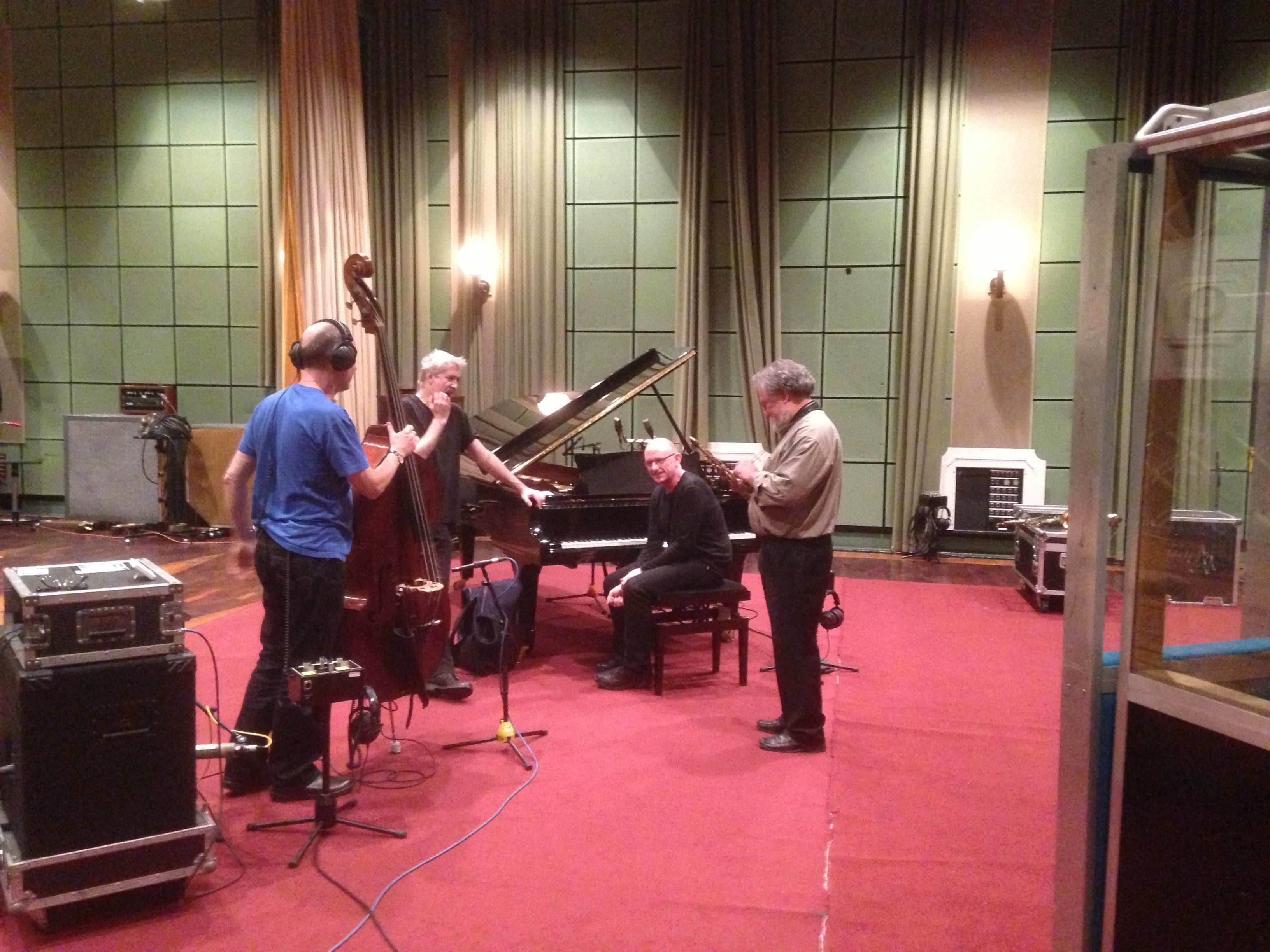
Originally built as a roller-skating rink, the BBC’s Maida Vale building was taken over by the corporation in 1934 as the principal location for the recording of its musical output. It contains six studios, some of which retain certain period features. The medium-sized Studio Three, for instance, still has what looks like its original art deco parquet floor, although the space occupied by the Necks and Evan Parker yesterday was covered by a large dark red rug.

Midway through their European tour, the Necks were in Maida Vale on the morning of the last of their three sold-out nights at Cafe Oto because Philip Tagney, a producer of Radio 3’s Late Junction, is in the habit of putting together combinations of musicians who have not played together before. When he asked the Australian trio to nominate someone with whom they would like to record a session, they nominated Parker. Only their pianist, Chris Abrahams, had previously collaborated with the great saxophonist, on a short duo improvisation at the end of a concert at the Bath Festival about four years ago, after both had played solo sets.

So the four of them met in the studio at 11 o’clock yesterday morning and, after a short warm-up, began the first of two collective improvisations. They started playing more or less simultaneously, and not surprisingly the first half of what turned out to be an hour-long piece contained passages in which it sounded as though they were waiting for something to happen, for someone to seize the initiative. Each member of the Necks has plenty of experience in free improvisation; however, having played together for more than a quarter of a century, it’s hardly surprising that they should fall naturally into certain patterns of response, and you could see and hear Parker looking for a way in.

The last 20 minutes, however, contained moments of outstanding and surprisingly gentle beauty, Abrahams coaxing filigree from the studio’s Steinway, Lloyd Swanton plucking notes with the fingers of his left hand at the top of double bass’s fingerboard, Tony Buck adding cymbal washes with one hand and rapid strokes on his floor tom-tom with the mallet in the other, and Parker exhaling feathery tenor saxophone phrases (this was the Parker of his solo on Tony Oxley’s celebrated “Stone Garden”, a track from the drummer’s 1969 album, The Baptised Traveller).

For the second piece, Swanton suggested using the Necks’ standard operating procedure, by which one of the players — it could be any of them — begins the piece with a repeated phrase of his choice, the others joining in when they feel ready. The bassist himself started this one off with double-stopped harmonics, Buck joining in with mallets on his snare drum (with the snare off), Parker — having switched to soprano — producing sustained notes with a hollow, reedy tone, and finally Abrahams entering to initiate a dialogue with the saxophonist, to which the others provided the backdrop of a thrumming, variable-speed bass ostinato and the soft clanking of a small Oriental cymbal struck with a mallet as it lay on the head of the floor tom-tom.

The difference between this piece and its predecessor was apparent throughout, in the suggestion of a constant tonal centre and an underlying pulse (characteristics that set the Necks’ live performances apart from those of the majority of free improvisers). The music surged and ebbed as it often does when the Necks play in concert (and as it had done in both halves of the previous night’s performance at Cafe Oto), inviting Parker to move with it, using circular breathing to weave his skeins and flurries of sound in and out of the group tapestry. After 30 minutes the piece ended with a sudden and unexpected moment of grace: subdued clicks and squeals from the saxophone, growls from the lower end of the piano keyboard, the bassist letting his bow bounce off the strings, more cymbal splashes, and suddenly a silence that, while abrupt and unpremeditated, seemed completely logical.

2.

I made it to the second and third nights at the Cafe Oto, on Tuesday and Wednesday, each of which consisted of two long sets. The first of those nights was very enjoyable, particularly for a pair of very graceful endings, although the music contained nothing wildly unexpected. Wednesday’s music, however, seemed to come from a different place.

Abrahams began the first set and dominated it throughout, maintaining a sense of unresolved harmony that kept the tension high. It was a powerful and beautifully shaped and proportioned performance, and during the intermission Buck said he thought that the experience of playing with Parker earlier in the day might have had something to do with it.

The set that followed it was something else altogether. The previous night, as the music began in a mood of quiet, serene rumination, I’d been wondering what would happen if the group ever started one of their collective improvisations with a really loud opening statement. Now I know the answer. Buck set this one off with a triple-forte snare-drum rattle, announcing three-quarters of an hour of music that became brutal — almost harrowing — in its volume and emotional intensity. To follow the process by which they found their way out of the maelstrom and wound down to closure was an education in itself, followed by perhaps 10 seconds of transfixed silence in which every member of the audience was thinking, “Did I really just hear what I think I heard?” Then the applause came, and it didn’t want to stop.

* The photograph above was taken before the start of the second improvisation at Maida Vale. Left to right: Lloyd Swanton, Tony Buck, Chris Abrahams and Evan Parker. An edited version of the session will be broadcast on Late Junction on Thursday, November 21. Part of Tuesday night’s performance at the Cafe Oto can be heard on Jazz on 3 next Monday, November 11. 

Two kinds of modern beauty

Necks1.
It was my friend and erstwhile Guardian colleague John L Walters who made the neat comparison between the experience of listening to the Necks and a stroll through an art gallery, during which the attention might wax and wane as the eye is caught, becomes absorbed, moves on, glances briefly at something else and moves on again. While listening to the Australian trio’s new CD, Open, which consists of a single 68-minute piece, I thought of a different analogy, one that works better for me. It’s like being on a long train journey, perhaps through several countries: the view can change many times in the course of the trip, gradually but inexorably, perhaps from vast wheatfields to industrial landscapes to valleys between snow-capped mountains, and the weather modulates along with the scenery. Occasionally you might dive into a tunnel, requiring the senses to adapt, and the landscape might have changed again when you re-emerge.

“Open”, which is also the name of the piece, starts with the gentle clanging of something that sounds like (but almost certainly isn’t) the strings of an abandoned piano being struck with a rubber mallet. Little cymbals are struck, a double bass enters (with the sort of sparse, sonorous, simple figure that so often provides an underpinning to the Necks’ long-form pieces), and a real piano makes its appearance, sounding a series of vaguely oriental arpeggios with the sustain pedal held down. Tony Buck, Lloyd Swanton and Chris Abrahams are all aboard, and we’re on our way.

The landscape changes pretty slowly on this trip. As it does, there’s always one element — perhaps the bass figure, or the tapping of a closed hi-hat, or the piano holding the key centre — to maintain a sense of continuity. There are quiet periods when nothing much seems to be happening, and passages of great intensity. In the first third there’s some fine drumming from Buck, whose ability to draw a lovely tone from his instruments reminds me of the young Tony Williams; around about the mid-point the oscillations of a single octave-doubled note held on a Hammond organ blend with a baleful industrial noise; there are several passages in which Abrahams moves between the quietly ecstatic approaches of Alice Coltrane and Charlemagne Palestine; and the gentle final stages feature what sounds like a choir of Swanton’s overdubbed basses.

It’s their 17th album, and even at this early stage of listening it sounds like one of their best, up there with Aquatic and Silverwater, in my view. And there are UK gigs — including three nights at Cafe Oto — to look forward to next month.

2.

Arve Henriksen is also visiting the UK in November, to play Andrew Smith’s Requiem (inspired by the Utoya massacre) with a choir and the organist Stale Storlokken at St Luke’s in London and elsewhere. In the meantime there’s his new CD, Places of Worship, a work of very special beauty.

I’ve never heard Henriksen’s trumpet (or his counter-tenor vocals, for that matter) sound as profoundly and consistently expressive, that ability to mutate tone and attack matched by some wonderful phrase-making and a powerful sense of continuity. Nor has he ever benefited from more lustrous electronic backgrounds, the samples and programming mostly manipulated by Jan Bang and Erik Honore, with occasional help from Eivind Aarset’s guitar and Jon Balke’s keyboards. As a tailpiece, there’s a pretty song called “Shelter from the Storm” (not that one), sung by Honore.

In his five-star review in this morning’s Guardian, John Fordham drew a comparison with Sketches of Spain. That had been going through my head, too, particularly when listening to “Le Cimetiere Marin” and “Bayon”, two of the album’s 10 tracks. I was also reminded of Siesta, Miles Davis’s soundtrack to a 1987 film (directed by Mary Lambert) that nobody seemed to like but for which Miles, with the help of Marcus Miller, produced some beautiful moments at a time when conventional ideas of beauty did not seem to be high on his agenda.

Where Open demands a proper degree of commitment, Places of Worship opens its arms to any listener. In their different but equally wonderful ways, these are likely to be the albums by which I’ll remember the year.

* The photograph of the Necks — left to right: Lloyd Swanton, Tony Buck and Chris Abrahams — is by Camille Walsh. Their album is released on the RnR MEGACORP label. Henriksen’s album is on Rune Grammofon.