Skip to content

Posts tagged ‘The Association’

Requiem for a soft-rocker

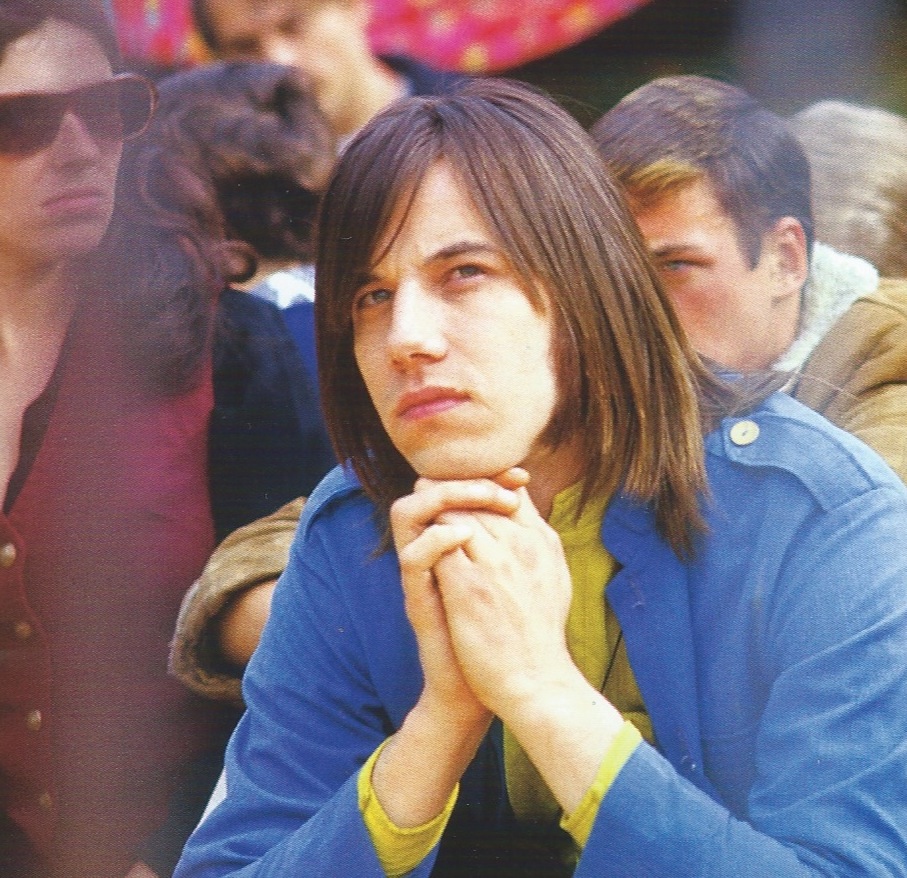
Terry Kirkman (extreme left) with the Association at the Monterey Pop Festival

The members of the Association were still wearing suits and ties when they played the Monterey Pop Festival in 1967, the opening act on a bill including Jimi Hendrix, the Who, Jefferson Airplane, Big Brother and the Holding Company and other heroes of the new counter-culture. Their qualification for inclusion might have been their first Top 10 single, “Along Comes Mary”, a three-minute proto-psychedelic masterpiece written by Tandyn Almer.

The follow-up, “Cherish”, a No. 1, had swiftly recast them as purveyors of soft-rock before the great “Pandora’s Golden Heebie Jeebies”, with its koto intro and inner-light lyric, earned praise from no less a psychedelic authority than Dr Timothy Leary, despite going no higher than No. 35. But then “Windy” (another No. 1) and “Never My Love” (No. 2) put them firmly back in the middle of the road, where they have remained in the public mind ever since.

Anyone interested enough to turn over “Never My Love”, however, found a B-side that restated their claim to hippie credibility. It was called “Requiem for the Masses” and it begins with military snare drum rolls introducing a choir singing acappella: “Requiem aeternam, requiem aeternam…” Then a young man’s voice sings the opening lines against an acoustic guitar: “Mama, mama, forget your pies / Have faith they won’t get cold / And turn your eyes to the bloodshot sky / Your flag is flying full / At half-mast…” The snare drum tattoo continues behind the second verse: “Red was the colour of his blood flowing thin / Pallid white was the colour of his lifeless skin / Blue was the colour of the morning sky / He saw looking up from the ground where he died / It was the last thing every seen by him…” The backing falls away and the unaccompanied choir returns: “Kyrie eleison, kyrie eleison…”

And here’s the chorus: “Black and white were the figures that recorded him / Black and white was the newsprint he was mentioned in / Black and white was the question that so bothered him / He never asked, he was taught not to ask / But was on his lips as they buried him.” The song ends with a lonely bugle against snare drum and muffled tom-tom.

In 1967 this song could be about only one thing: the war in Vietnam. Of course there already had been “Masters of War” from Dylan, “Universal Soldier” from Buffy Sainte-Marie and “Eve of Destruction” from P. F. Sloan. And perhaps “Requiem for the Masses” is not a truly great record, but it stands alongside things like Country Joe and the Fish’s “I-Feel-Like-I’m-Fixin’-to-Die Rag” and Earth Opera’s “The Great American Eagle Tragedy” as an ambitious and powerful contemporary statement from the world of white rock music.

Its composer was Terry Kirkman, a founder member of the group, who sang, played percussion and brass and woodwind instruments (maybe including the bugle part). Before “Requiem for the Masses”, he had written “Cherish” and another soft-rock classic, “Everything That Touches You”. Born in rural Kansas, he was brought up in Los Angeles, where he studied music, but it was while working as a salesman in Hawaii that he met Jules Alexander, with whom he would go on to found several groups in LA, including the Inner Tubes (with Mama Cass and David Crosby), before the Association came together as a six-piece band in 1965. He left for the first time in 1972, returned in 1979, left again in 1984, and thereafter took part in various reunion concerts while working as an addiction counsellor.

Terry Kirkman died this week, aged 83. It would be absolutely wrong to underestimate the courage it must have taken for a band famous for their soft-rock hits to record such an unequivocal song of protest during a year in which the B52s were pounding Hanoi and Lyndon Johnson was sending ever more ground troops into the fight against the Vietcong, still with support from the majority of the American public. Respect to him, then.
Tandyn Almer: sunshine and psychodramas

Tandyn AlmerAs far as I’m concerned, Tandyn Almer deserves a place in the history of rock and roll simply on the basis of “Along Comes Mary”, the song he wrote for the Association in 1966. Together with Norma Tanega’s “Walkin’ My Cat Named Dog”, the Mamas and Papas’ “California Dreamin'” and a couple of others, it was one of a small group of unmistakeably white pop records that managed to infiltrate themselves between the latest from Motown and Stax in the clubs I was attending at the time. This was music that hinted at the psychedelic revolution to come, while still working within the disciplines of conventional pop music. “Along Comes Mary” had a lovely light and highly danceable groove created by an acoustic guitar and what sounds like an electric harpsichord, intelligent bass playing, pushing drums and party handclaps on the backbeat, with fine group vocals, a baritone saxophone almost buried in the background, the flute/recorder/ocarina solo that seemed to be obligatory that season (e.g. “California Dreamin'” and the Troggs’ “Wild Thing”), a half-hidden reference to marijuana in the title and a tumbling, bewildering lyric: “And when the morning / Of the warning’s past / The gassed and flaccid kids / Are flung across the stars / The psychodramas and the traumas gone / The songs have all been sung/And hung upon the scars.” It was, I believe, the first time I had encountered the term “psychodrama”.

Tandyn Almer was born in Minneapolis in 1942, studied music there, spent his teenage years listening to John Coltrane and Eric Dolphy, harboured ambitions to become a jazz pianist, and moved to California in the early 1960s, attending Los Angeles City College before striking out as a songwriter and record producer. He smoked dope, took acid, and became a member of the interesting clique that included Curt Boettcher (who arranged “Along Comes Mary”), Mason Williams, Van Dyke Parks, John Phillips and Brian Wilson, with whom he co-wrote “Marcella” for the Beach Boys’ Carl & The Passions — So Tough in 1972 and “Sail On, Sailor” for Holland the following year. He was a regular scenemaker at Doug Weston’s Troubadour club in West Hollywood and wrote and/or produced records with obscure outfits such as the Paper Fortress, the Garden Club and Pleasure.

Around the time of “Along Comes Mary” he was signed to a small LA publishing company, Davon Music, whose owner had demos of his compositions made by studio singers and musicians (a common practice in those days: remember those demos of songs by Nick Drake, John Martyn and Mike Heron made by the pre-fame Elton John at his publisher’s studio in 1968?). A number of the resulting tracks were compiled into an album to be sent to artists and producers who might have been interested in recording them. The output from that period has now been lovingly reassembled by Parke Puterbaugh, a former Rolling Stone journalist, and released by the Sundazed label, specialists in the “sunshine pop” of the middle and late ’60s. And the 15 songs on Along Comes Tandyn are enough to prompt a serious reassessment of the composer’s talent.

I don’t want to overrate Almer’s music by proclaiming it to be the fruit of genius, but it’s full of interest. His tunes are ingenious yet memorable, their structures quite intricate, and the lyrics are always literate and sometimes amusing in the rather fey manner of the time, frequently demonstrating an urge to break away from traditional pop themes: “psychodramas and traumas” indeed. The tumble of words in “Anything You Want” is strongly reminiscent of Dylan’s “It’s Alright Ma”. “Victims of Chance” could have been recorded by Harpers Bizarre. “Where Will They Go” is a protest song in an style that might be called sunshine punk. At times there’s some sort of a coincidental affinity with the very early Pink Floyd, perhaps most obviously in the coyly titled “Alice Designs” (try saying it in an LA drawl). Even the inevitably anonymous — although generally adequate — contributions of the hired singers and backing musicians cannot dim the songs’ merits, although the one truly committed performance comes in the only non-demo, a version of the driving “Bring Your Own Self Down” released on the MGM label by the Purple Gang, an LA band. The most adventurous song of the set is the cool, jazzy “I Get High”, which is not unlike the Doors in “Riders on the Storm” mode and reverses Almer’s normal practice by using druggy terms to describe conventional emotions. The most ambitious is “Sunset Strip Soliloquy”, a Hollywood protest song in the form of a mid-tempo narrative ballad occupying the space between Dylan’s “Desolation Row”, P.F. Sloan’s “The Sins of the Family” and Sonny Bono’s “I Just Sit There”: not a bad place to be.

He left Los Angeles in the mid-’70s and disappeared to northern Virginia, where he seems to have spent the rest of his life. (Puterbaugh fills in as many biographical gaps as possible in his very comprehensive sleeve essay.) I followed an internet lead a few years ago — prompted, I think, by the Spectropop website — and found some very strange pages. His Wikipedia entry says that he invented a high-tech bong called the Slave-Master. At any rate, having given permission for these tracks to be assembled and released, and after a period of poor health, he died last January, aged 70. Maybe “Along Comes Mary”, “Marcella” and “Sail On, Sailor” — three exceptionally beautiful songs — will be enough for most people to remember him by. But the demos show that they were no accidents.

* The photograph of Tandyn Almer is taken from the cover of Along Comes Tandyn.