Skip to content

Posts tagged ‘Terry Riley’

Rainbows for Terry Riley
Terry Riley has been living in Japan for the past few years, passing on the teachings of Pandit Pran Nath in Kamakura, the country’s medieval capital, and Kyoto, the city of temples. Ahead of his 90th birthday on June 24, he announced this week that he’ll be scaling back his activities, handing his classes over to an acolyte while restricting himself to private lessons with advanced pupils.

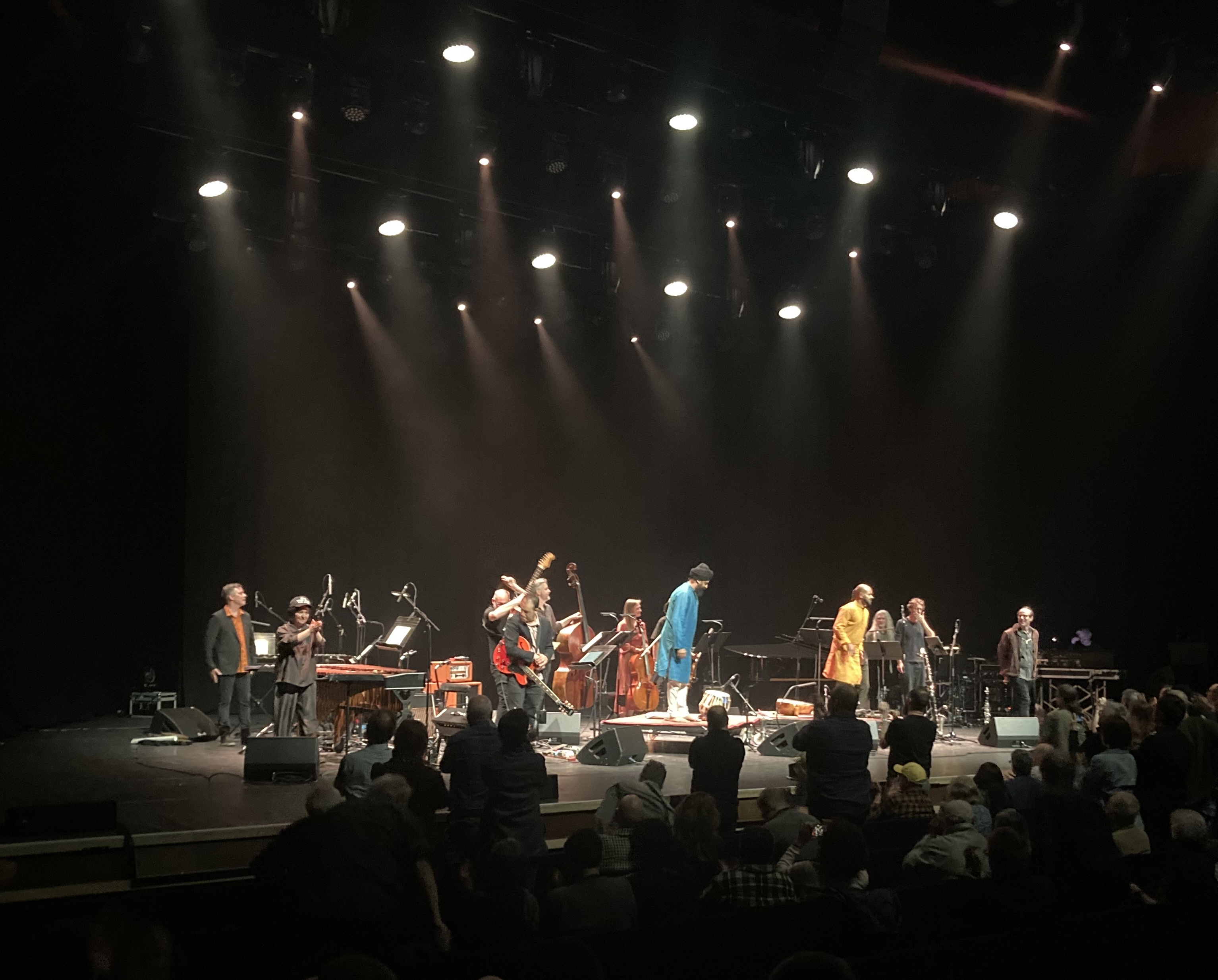
On Thursday night the New York ensemble Bang on a Can All Stars, longtime performers of Riley’s work, arrived at the Barbican to celebrate his birthday by presenting two of his most famous compositions, with the help of several guests. Riley, of course, was 6,000 miles away, but he welcomed the audience warmly with a recorded video message transmitted via large screens.

The evening began with the basic band — keyboard, clarinet/bass clarinet, electric guitar, cello, double bass and drum kit/vibes — performing A Rainbow in Curved Air, such a strong influence when it appeared in 1969 on the likes of Pete Townshend, Brian Eno and others experimenting with early synthesisers, although the original work itself was performed by Riley on organ, electric harpsichord, rocksichord, dumbec and tambourine, via overdubs.

Arranged for the sextet by Gyan Riley, Terry’s son, and slightly stretched from the original 19 minutes to 25, it preserved the sense of genially interlocking patterns, although Riley’s 14-beat measures seemed to have become a distinct 7/4, strongly articulated by the group’s drummer, David Cossin, before he switched to vibes for the later passages. The sudden halts and resumptions were as gently startling as they seemed on the album five and a half decades ago.

In C, first performed in 1964 and recorded in 1968, is the piece that made Riley’s reputation in the world of contemporary classical music. A remarkably versatile composition, open to any number of players and all musical instruments in any combination, its 53 modules — short musical phrases using all 12 tones of the tempered scale except C sharp and E flat — must be played in order but can be repeated according to each performer’s feeling for the piece’s overall collective development. For last night’s 65-minute performance, Bang on a Can were joined by Shabaka on flutes, Valentina Magaletti on marimba, Soumik Datta on sarod, Portishead’s Adrian Utley on guitar, Raven Bush on violin, Gurdain Rayatt on tablas and Jack Wyllie on soprano saxophone. (Pete Townshend was billed to appear but withdrew following a knee operation.)

I found the result entirely true to the original spirit of the composition, preserving the constant momentum and the sense of conversation without the presence of a conductor. The instrumentation produced wonderful fluctuations of density and shifting polyrhythmic layers; there were beautiful isolated moments, like a brief sarod/cello combination and the emergence of a clarinet melody, and the general lightness of tone brought the closing passage close to the texture of baroque music.

It was like lying on your back and watching clouds moving at a variety of altitudes across a busy but unthreatening sky, endlessly mutating and utterly absorbing until it was brought, with an act of intuitive collective decision, to the most graceful close. Happy birthday, Mr Riley.

Kronos at 50

The Kronos Quartet were already well into their second decade when I saw them for the first time, sharing the bill with John Zorn’s Naked City at the Royalty Theatre in London in November 1988. They closed their set with Aarvo Pärt’s “Fratres”, whose hushed, prayer-like cadences were what stuck in my head, and are still there. But they’d become famous for daring to introduce the compositions of Thelonious Monk, Bill Evans and Jimi Hendrix to the format, and for making it clear that they’d be treating those works with the seriousness, rigour and spirit of inquiry that others applied to the standard Beethoven-to-Bartók string quartet repertoire.

Last night at the Barbican, during a year-long tour to mark the 50th anniversary of their creation in San Francisco by the violinist David Harrington, “Purple Haze” was their encore: a shout of joy to celebrate their longevity and the continued relevance of their founding ideal. Harrington and his fellow violinist John Sherba, Hank Dutt on viola and Paul Wiancko, the latest recruit to the cello seat filled so long and so brilliantly by Joan Jeanrenaud, worked their way through a dozen pieces, divided into two sets, coming as close to a career summary as would be possible in two hours for an organisation that, in its lifetime, has commissioned more than a thousand works.

Two guest artists appeared, both on pieces specially written for the quartet: the Indonesian composer Peni Candra Rini to deliver the swooping, chattering vocal lead on her “Maduswara” and the London-born djembe player Yahael Camara Onono to add percussive momentum to Dumisani Maraire’s “Mother Nozipo”. There were reminders of Kronos’s early days in the performance of works by three Americans commonly, if misleadingly, called minimalists: Philip Glass with a piece from the Mishima soundtrack, Steve Reich’s dense and fast-flowing “Triple Quartet”, and Terry Riley with “Lunch in Chinatown”, a light-hearted extract from a new suite featuring the members of the group chatting as if ordering a meal in a restaurant.

For me, the moments of seriousness were the most powerful. The ethereal “God-music” from George Crumb’s Black Angels featured Wiancka coaxing fragile melodies built out of harmonics from his cello while Harrington, Sherba and Dutt each bowed a table full of wine glasses. Dutt took the lead on Jacob Garchik’s arrangement of Antonio Haskell’s “God Shall Wipe All Tears Away”, a setting of a gospel song recorded in 1938 by Mahalia Jackson. This directly followed an excerpt from Zachary James Walker’s Peace Be Still, played against projection of newsreel footage from the Alabama civil rights marches in 1965 and the words of Clarence B. Jones, Martin Luther King Jr’s lawyer and adviser. Jones had helped draft the “I have a dream” speech given at the March on Washington in 1963 — which only took its final form during the speech itself, when Mahalia implored King to break away from his prepared script and tell the crowd of more than 250,000 about his dream.

And then there was their arrangement of Alfred Schnittke’s “Collected Songs Where Every Verse Is Filled With Grief”, which they recorded in 1997, a year before the composer’s death: its skeins of muted melodies and modal harmonic underpinning settled on the hall like a pale but gently glowing mist, much as I remember “Fratres” doing 35 years ago.

Terry Riley in Japan

In the early weeks of 2020, at the outset of a world tour, Terry Riley was in Japan when the Covid-19 epidemic began. The tour was cancelled. He was 85 years old, and his wife — the mother of their three children — had died five years earlier. In his words: “As I had no particular place to go, I decided to stay for a while.” He’s still there.

Before long he was recording in a friend’s studio. That’s not unexpected. What might be surprising is the nature of the resulting album, which consists mostly of solo piano interpretations of Broadway songs with a couple of original pieces, one of them featuring a synthesiser.

Before he became celebrated as the composer of In C, A Rainbow in Curved Air, Cadenza on the Night Plain and Salome Dances for Peace, and as the creator of beguiling extended organ improvisations given titles like Persian Surgery Dervishes and Shri Camel, Riley played the piano in San Francisco bars. When I was writing the book from which this blog takes its name, I talked to him about his experience of visiting the city’s jazz clubs — particularly the Blackhawk — to hear Miles Davis and John Coltrane. Jazz was an important part of his own evolving music. The nature of this new album, he says in the sleeve note, was suggested by friends and family members who had heard him warming up for his solo concerts by improvising on standards.

The album, called STANDARDSAND: Kobuchizawa Sessions #1, begins with “Isn’t It Romantic”, “Blue Room” and “The Best Thing for You (Would Be Me)”. These all very poised and charming mainstream-modern treatments of well known items from the American Songbook. Riley’s touch is sure, his conception that of a somewhat less introspective Bill Evans but his lines nevertheless probing and sometimes surprising. In particular, “Blue Room” is beautifully interpreted. Then comes “Round Midnight”, in which he treats Monk’s great ballad with proper respect and evident fondness while discreetly finding one or two little extensions and decorations that perhaps no one has thought of before among the many thousands of versions of a tune currently celebrating its 80th anniversary.

“Ballad for Sara and Tadashi”, a discursive original, is given in two versions. The first is for solo piano, and follows seamlessly on from the standards. After a six-minute piece for synthesiser titled “Pasha Rag”, which works its way towards a light-hearted reminder that ragtime piano was among Riley’s early accomplishments, “Ballad of Sara and Tadashi” returns with the synth adding an electro shadow-texture to his pensive melodic lines.

There’s a return to Broadway with “Yesterday”, eight minutes of variations on Jerome Kern’s melody swimming in some sort of light electronic reverb against synth backwashes, and Jimmy Van Heusen’s “It Could Happen to You”, the tolling of isolated chords introducing an unadorned treatment somewhere between pensive and sombre, and for me the most satisfying thing here. The album ends with a 43-second miniature in which voices apparently singing some sort of ritual chant fading in and out before they’ve even had time to register properly. A little jeu d’ésprit, maybe, to close one of the more surprising additions to the long and varied discography of one of the most extraordinary musicians of our times.

* Terry Riley’s STANDARDSAND: Kobuchizawa Sessions #1 is released in Japan on Star/Rainbow Records. The uncredited photograph is from the booklet with the album.

Terry Riley’s ‘Sun Rings’

Kronos Sun Rings

Back in 2002 I was fortunate enough to be present when Sun Rings, an extended composition written by Terry Riley for the Kronos Quartet and a 60-voice choir, was given its world premiere in the University of Iowa’s Hancher Auditorium. The partnership between the composer and the quartet celebrates its fortieth anniversary next year; among Riley’s works premiered and recorded by the group have been Sunrise of the Planetary Dream Collector, Cadenza on the Night Plain, Salome Dances for Peace, The Cusp of Magic and Requiem for Adam. But Sun Rings was something different: the musicians and singers were accompanied by sounds harvested from space by the scientists at NASA as their Voyager probes hurtled past Saturn, Uranus and Neptune.

The sound of space — strange chattering, howling and chirruping — was originally captured by Don Gurnett, a research scientist at the university in Iowa City who designed the plasma-wave equipment carried by the probes to record the noises — called “whistlers” — made by electrons whizzing about in the magnetic fields surrounding the planets. Gurnett told me that while their existence had been detected by a German scientist during the First World War, he was the first person to retrieve them from space and to turn the signals into sound.

He had given cassettes of the recordings to Riley, divided under headings like “auroral hiss”, “electron plasma oscillation” and “electron cyclotron harmonic emissions”. The composer chose the ones he liked and made them an integral part of the piece, triggered in real time by the four members of Kronos using fibre-optic wands. The hour-long work, commissioned as part of NASA’s long-standing arts programme, featured lighting and back-projections created by Willie Williams, a Yorkshireman who worked with Deaf School, Stiff Little Fingers and others before joining U2 for the Zoo TV tour and then moving on to collaborate with the Stones and Bowie.

After the Iowa concert, which was quite an experience, the work was given its European premiere at the Barbican. Now an album, recorded in a studio in 2017, makes the piece available to everyone.

Here’s what David Harrington, Kronos’s leader, has to say about Riley in the notes to Sun Rings: “There is no other composer who has added so many new musical words to our vocabulary, words from many corners of the musical world. Terry introduced Kronos to Pandit Pran Nath, Zakir Hussein, Bruce Connor, La Monte Young, Anna Halprin, Hamza El Din, Jon Hassell, Gil Evans… I have never once heard him say an unkind word about another musician. In a crazed world laced with violence and destruction, he has consistently been a force for peace. Through his gentle leadership, a path has emerged. Terry sets the standard for what it means to be a musician in our time.”

All that is apparent in the 10th and final section of Sun Rings, titled “One Earth, One People, One Love”. Those words belong to the writer Alice Walker, and a recording of her voice intoning them is the leitmotif of a piece which begins with a description of the astronaut’s experience of looking at Earth from space by Eugene Cernan, the commander of the Apollo 17 mission. This extraordinarily beautiful nine-minute piece is slow-paced, the strings moving gently through the sounds of space, with Sunny Yang’s lyrical cello prominent as the passing of time is marked by what might be a tuned drum and a damped bell. Bringing us back home, this is music that speaks to everyone.

* Sun Rings is out now on the Nonesuch label. The photograph of the Kronos Quartet performing the piece in Krakow in 2014 is from the accompanying booklet and was taken by Wojciech Wandzel.

‘In C’ at the Barbican

terry-riley-at-80One of the great qualities of Terry Riley’s In C, a foundational work of modern music, is that it can be played by any number of people using any kind of instruments for as long as they choose to make its sequence of 53 motifs last. Since the appearance of the original album in 1968 it has been recorded by a wide variety of ensembles, including the Shanghai Film Orchestra, Acid Mothers Temple, the Salt Lake Electric Ensemble, Adrian Utley’s Guitar Orchestra, and Africa Express with Damon Albarn and Brian Eno. The original album version lasted 42 minutes, but it can be made to go on much longer. (I haven’t heard of an attempt to compress it into the length of a 45rpm single, but I’ll bet someone’s had a go.)

The fact of its remarkable flexibility, however, does not mean that every performance is guaranteed to be successful. Last night the composer himself, looking wonderfully spry for his 81 years, took his place at a prepared piano amid the London Contemporary Orchestra on stage in the Barbican Hall. Just over 70 minutes later the final chord was greeted with an ovation from a full house. I left feeling flat and disappointed.

In its best performances, In C seems to float not just on its famous eighth-note ostinato (suggested to Riley by Steve Reich, and originally the top two Cs of the piano keyboard) but on the moiré patterns created by the combination of instruments, which could be the  brass, reeds and tuned percussion of the original ensemble or the kora, balafon, melodica and calabash of Africa Express. It’s a magical thing — but not an inevitable product of the score.

Last night’s ensemble of 20 musicians, under the direction of Robert Ames, featured bassoon, clarinet, alto saxophone, flute, two guitars (one of them played by Riley’s son, Gyan), flute, violin, viola, cello, viola da gamba, double bass, chamber organ, celeste, and three singers, with a drummer and two percussionists who reproduced the ostinato in a variety of ways, using various implements. This was not far off the 1968 line-up, in which a group of 11 musicians augmented themselves via overdubbing: 10 instruments at the first pass, seven at the second, giving a maximum aggregate of three trumpets, three saxophones, three trombones, three flutes, three oboes, three violas, three vibraphones, two marimbas, two bassoons, two clarinets and piano, a total of 28.

Sheer weight of numbers, then, could not have been the reason I found the Barbican performance so earthbound. For all the panoply of resources, the only element of variety in use seemed to be that of volume. There were soft passages and louder passages, but the rest of it sounded curiously like a big band riffing rather than an ensemble layering and juxtaposing the short motifs provided by the composer. It was all rather prosaic and — despite the composer’s active, if discreet, presence and the ensemble’s evident enthusiasm — hardly true to the spirit of the piece. There was also a rather imprecise attempt at a bravura ending, signalled by the director, which seemed completely inappropriate.

The first half of the evening had consisted of duets by the Rileys, father and son, mostly for piano and electric guitar, although Terry also sang in a deceptively artless voice and played a plaintive-sounding melodica while the nimble-fingered, quick-witted Gyan switched briefly from his Telecaster to an acoustic instrument. Beginning with a loose-limbed piece based on a raga, the set included a song with a strange fantastical lyric which ended with a line about rolling a joint, and which the elder Riley described, to appreciative laughter, as “the national anthem of California”. Cutting through the hippieish mood from time to time were lightning-fast unisons and slashing chordal passages.

At the time Riley conceived In C, in 1964, he was working as a ragtime pianist in the Gold Street Saloon, a waterfront bar in San Francisco, and in his solo passages last night there were frequent echoes and occasional direct hints of blues, stride, boogie-woogie and other vernacular forms. One piece swayed to an elegant habanera rhythm, and contained some lovely filigreed piano/guitar interplay that exposed the substance beneath the charming surface.

The album titled Live that they released a few years ago on Riley’s own Sri Moonshine Music label, featuring duets recorded between 2004 and 2010 in Drogheda, Nantes, Berkeley and Petaluma, is highly recommended. Those interested in looking further into Riley’s vocal music are directed to Atlantis Nath (2002), another self-distributed album, full of fascinating chants and songs with accompaniments including electronics and a string quartet.

* Photo credit: Jean-Pierre Duplan / Light Motiv

Terry Riley at 80

Terry RileyA couple of weeks ago I watched the 10 members of the Richard Alston Dance Company perform a piece called Overdrive, set to Terry Riley’s “Keyboard Studies No 1”. The inventiveness of the choreography and the supple energy of the dancers — notably the remarkable Liam Gillick — made Riley’s steadily shifting patterns, composed in 1964, sound as though they had been minted that morning.

Riley celebrates his 80th birthday today: June 24, 2015. He’s been one of my heroes since I heard the first recording of his composition In C at the end of the ’60s. It’s a pivotal piece in the evolution of modern music: a key element of the evolutionary burst that emanated from the apartment behind a Chinese laundry on West 55th Street in New York City where Gil Evans, George Russell, John Lewis and others gathered to discuss the direction of music in the late ’40s, coming up with new thoughts that were focused through the lens of Miles Davis’s Kind of Blue, whose radical approach to harmonic structure and temporal perception provided the inspiration for everything from James Brown’s “Cold Sweat” through the so-called minimalists — Young, Riley, Glass and Reich — to the Velvet Underground’s “Sister Ray” and much more.

Anyway, that’s an old story now. Riley’s music, however, never gets old. I wouldn’t want to be without the music he created in Paris in 1963 for Ken Dewey’s play The Gift, manipulating a tape of Chet Baker’s quartet, or the sampling exercises “You’re No Good” and “Bird of Paradise”, using the eponymous disco hit by Harvey Averne and a fragment of Jr Walker’s “Shotgun” respectively. Or the endlessly influential A Rainbow in Curved Air, or his collaboration with John Cale on Church of Anthrax, or his lovely 2011 album of live performances with his son, the guitarist Gyan Riley. Or the many solo improvisations with titles like Shri Camel, Poppy Nogood and his Phantom Band, Descending Moonlight Dervishes and Persian Surgery Dervishes. Or every version of In C that I can find, including the one recorded by Africa Express in Mali last year. Or, by no means least, the vinyl bootleg of his wonderful duo performance with Don Cherry, recorded in Cologne in 1975.

And then there are his string quartets, including no fewer than 27 works commissioned by the Kronos Quartet over the past 35 years. In 2002 I travelled to the University of Iowa to hear the world premiere of one of them, and to write a piece for the Guardian (here it is). The piece was called Sun Rings, and it was built around noises recorded by NASA’s Uranus probes as they travelled the galaxy. These sounds — a collection of random chirps and whistles — were controlled by the four members of the quartet, using touch devices. They were augmented by a 60-piece choir, using a key phrase from the writer Alice Walker: “One earth, one people, one love”, against back-projections devised — with the aid of NASA’s library — by the stage designer Willie Williams.

One Earth, One People, One Love is the title given to a celebratory five-CD box of Kronos/Riley collaborations released in the US this week and in the UK on July 10. Four of the discs contain the previously released versions of Salome Dances for Peace (1989), Requiem for Adam (2001) and The Cusp of Magic (2008), but the fifth — also available as a single CD — takes its title from a new recording of the first piece Riley wrote for the quartet, Sunrise of the Planetary Dream Collector (1980), and also includes Cadenza on the Night Plain (1983), plus other bits and pieces.

Among those bits and pieces is the movement from Sun Rings called “One Earth, One People, One Love”, which, taken in isolation, presents itself as one of the most beautiful and moving pieces in Riley’s catalogue. Featuring a prominent cello melody against the whooshes of the electron particles captured by NASA’s sensors and the gentle tolling of what sounds like a prayer bell from a Shinto temple, with the voices of Walker and the astrophysicist Don Gurnett in the background, it’s a piece of extraordinary depth and poignancy. (Here’s a version recorded at a Kronos concert in Germany in 2010.)

It’s the kind of thing, in fact, that makes you think a little harder about the world around you. But even when the content of Riley’s music has been less explicit, it’s always had the knack of doing that. And sometimes, too, it inspires people to dance. So best wishes to him for a happy birthday, and for many more of them.

* The photograph of Terry Riley was taken by Fabio Falcioni and is the cover image of Fabrizio Ottaviucci’s album of his piano pieces, Keyboard Studies 1-2 / Tread on the Trail, released on the Stradivarius label in 2008.