A night at Wigmore Hall
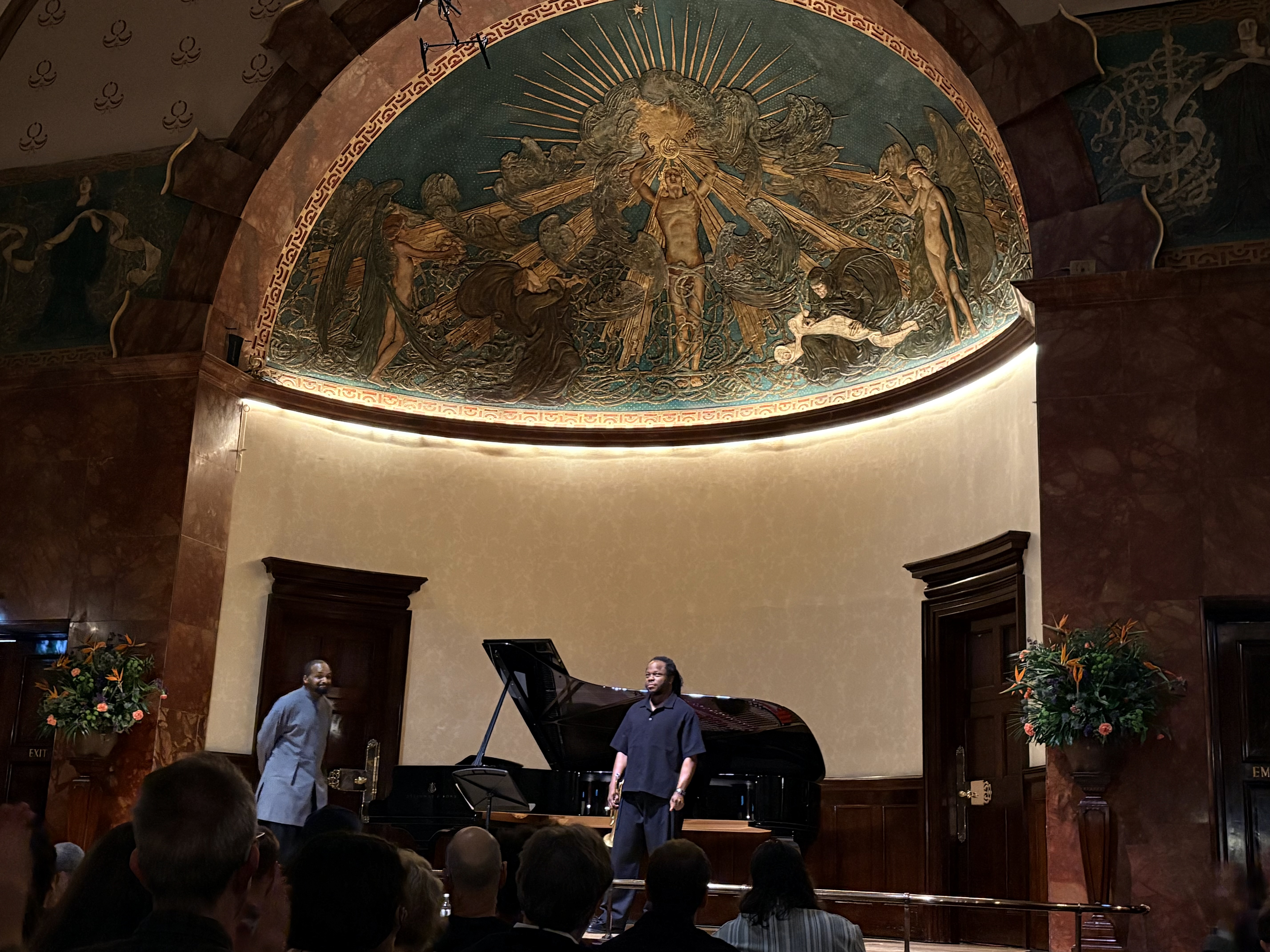
The roots of the trumpet-and-piano duo in jazz go back to the day in December 1928 when Louis Armstrong and Earl Hines recorded a piece titled “Weather Bird”. It became a classic, one of the keystones of jazz history. I was thinking about it when Ambrose Akinmusire and Sullivan Fortner took the stage at the Wigmore Hall last night, so I was thrilled when it turned up in the first section of their 90-minute concert.
They began with variations on two Akinmusire compositions, “Grace” and “Weighted Corners”, before “Weather Bird” made its appearance on the way to “Stablemates”, Benny Golson’s hard-bop favourite. By that time, around 20 minutes in, it was obvious that we were being exposed to something special. The liquid clarity and endless enventiveness of Akinmusire’s trumpet had clearly found a perfect match in Fortner, who was born in New Orleans and displays all the elegance associated with the city’s great pianists as well as his own ability to create strong and deep currents which guide the music’s flow.
A rarely glimpsed peak was reached with the next section, which opened with a Fortner tune called “Aerobatics”, written specially for Akinmusire, leading into an investigation of something that revealed itself to be “All the Things You Are”. That’s a tune I’ve heard played hundreds of times by players of all kinds, including some of the greats, but never like this. It emerged in fragments, twisted and disordered (Fortner’s allusion to the familiar dark-hued intro from the various Charlie Parker versions came several minutes in), but recombined by the two musicians into a constantly shifting mosaic, completely new while somehow seeming to carry the weight of all previous versions. It was like hearing the tune in a hall of mirrors, each set at a different angle, throwing its shapes from different perspectives and trajectories.
The third section of the set was devoted to Akinmusire’s “Owl Song 1”, a ballad whose astonishing tenderness — beautifully enunciated in Fortner’s solo — provided a platform for the trumpeter’s occasional fondness for finding a quickfire motif and repeating it with elaborations and variations of tone until it exhausts itself and is absorbed by the prevailing tide. It’s an example of the sense of dramatic architecture that characterises his work, even at its least superficially emphatic.
For the encore, there was a return to Armstrong with a vigorous reinvention of “West End Blues”, recorded by the Hot Five six months before Louis and Hines got together. Akinmusire and Fortner were showing that musicians who belong to the 21st century can understand how to draw from the past to help create the future. What they did last night — blending joy, humour, lyricism, compassion — represented the highest refinement of the improviser’s art, creating something in the moment that will stay with you forever.

 thebluemoment.com