Artistry in algorithm
This morning’s newspaper headlines included one suggesting that artificial intelligence will play a significant role in the UK’s coming general election. My first response was that, given the mess humans have made of selecting the last four prime ministers, maybe the machines should be given a chance.
Music, though — well, that’s something else. Who, for example, wants the unique voice of Steve Marriott, 30-plus years dead, sliced and diced by AI algorithms and applied to songs he never sang, apparently with the endorsement of his widow?
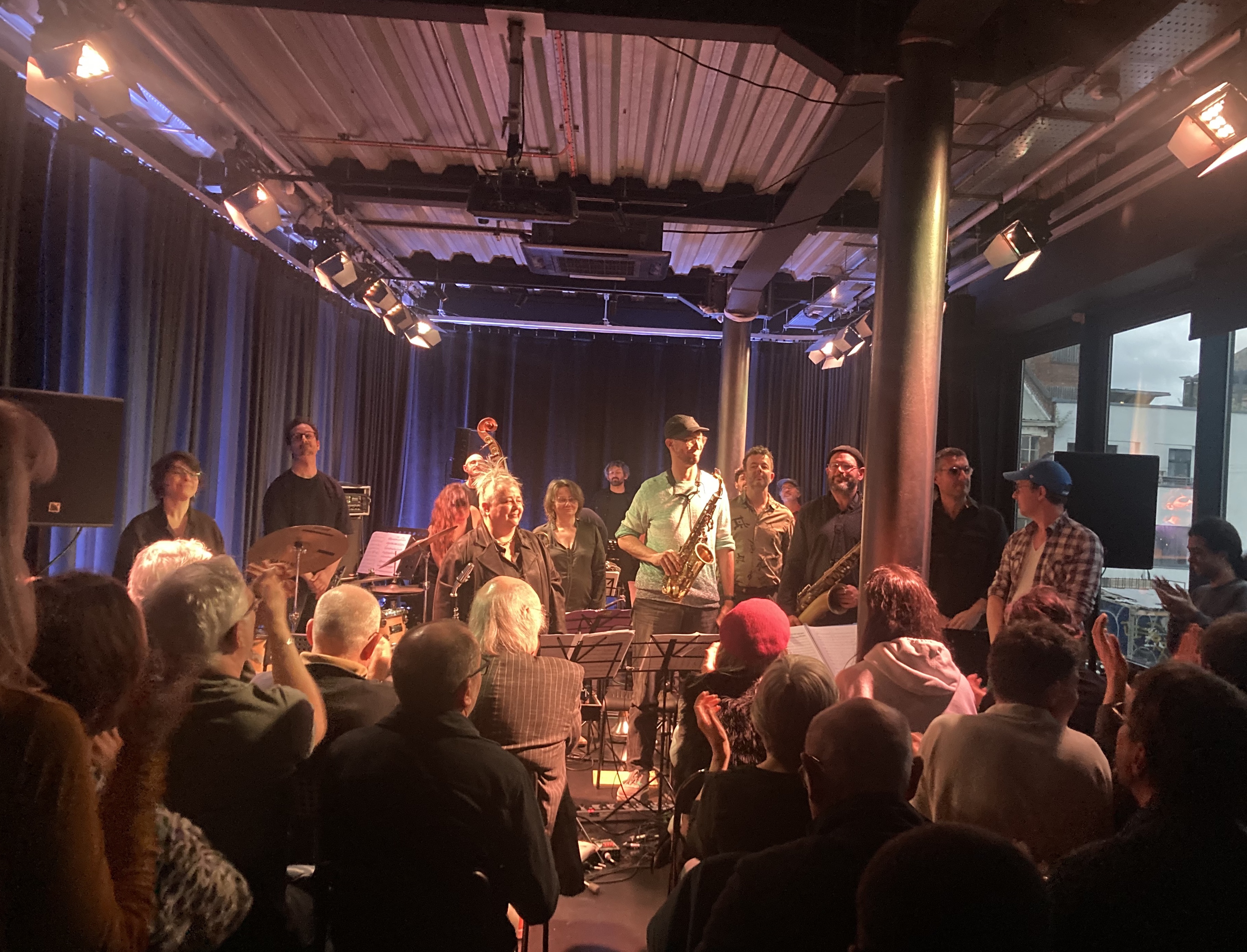
But there are other applications of this slightly terrifying technology that may have a different and more benign outcome. At the Vortex last night, two sold-out houses heard France’s Orchestra National de Jazz play the compositions of Steve Lehman and Frédéric Maurin, specially written to make use of AI software developed by Jérôme Nika, a researcher at the celebrated IRCAM — the Institute for Research and Co-ordination in Acoustics/Music, founded in Paris by Pierre Boulez in 1977, at the request of Georges Pompidou, and now housed in the centre bearing the former president’s name.
The music was recorded last year as a live performance in the Tonstudio Bauer in Ludwigsburg and released as an album titled Ex Machina. It comes with extensive sleeve notes which I’ve read twice without really coming close to an idea of what the software actually does. But I do know that Lehman, who played the alto saxophone parts on the album and in London, and Maurin, the orchestra’s director and conductor, also based their compositions on prolonged study of the movement known as spectral music, in which such post-Messaien composers as Gérard Grisey and Tristan Murail experimented with creating microtonal ambiances.
I found the album interesting but not, on early hearings, as stimulating as Lehman’s work with his great octet or in his multilingual rap group, Sélébéyone. At the Vortex, however, where they were stopping off en route to performing tonight at Southampton University’s AI Arts Festival in Winchester, the music exploded into three dimensions and full colour, retaining all its complexity and subtlety while grabbing the audience and refusing to let them go until the final shimmer of a quarter-tone vibraphone had faded to silence.
Much of this had to do with the vigour of the playing, which ensured that the compositions never sounded dry or academic. Textures vibrated, rhythms were sprung. The shifting syncopations and abrupt stop-time figures had the excitement of James Brown’s band meeting Sun Ra in some distant galaxy.
The individual playing was uniformly brilliant in its response to the material. As well as Lehman’s serpentine, sweet-and-sour alto and the vibraphone of his octet colleague Chris Dingman (the only other American in the band), powerful impressions were left by improvisations from the bass trombone of Christiane Bopp, the tenor saxophone of Julian Soro, the clarinet of Cathérine Delaunay, the flute of Fanny Ménégoz, the baritone saxophone of Fabien Debellefontaine, and the trumpets of Fabien Norbert and Olivier Laisney. But what really fired the orchestra was the rhythm team: the deep power and agility of the double bassist, Sarah Murcia, in collaboration with the magnificent drive and awe-inspiring precision of the drummer, Rafaël Koerner. Thanks to them, the music never flagged.
It made me recall the last time I heard a largeish ensemble playing music that took the composition/improvisation dialogue in such a stimulating new direction. That was in 2016, when I first heard the White Desert Orchestra, led by the French composer/pianist Eve Risser — a graduate of the Orchestre National de Jazz. Obviously not a coincidence.
* Ex Machina by Steve Lehman and the Orchestra National de Jazz is on the Pi Recordings label.


 thebluemoment.com