Skip to content

Posts tagged ‘Shabaka Hutchings’

Farewell to Bra Tebs

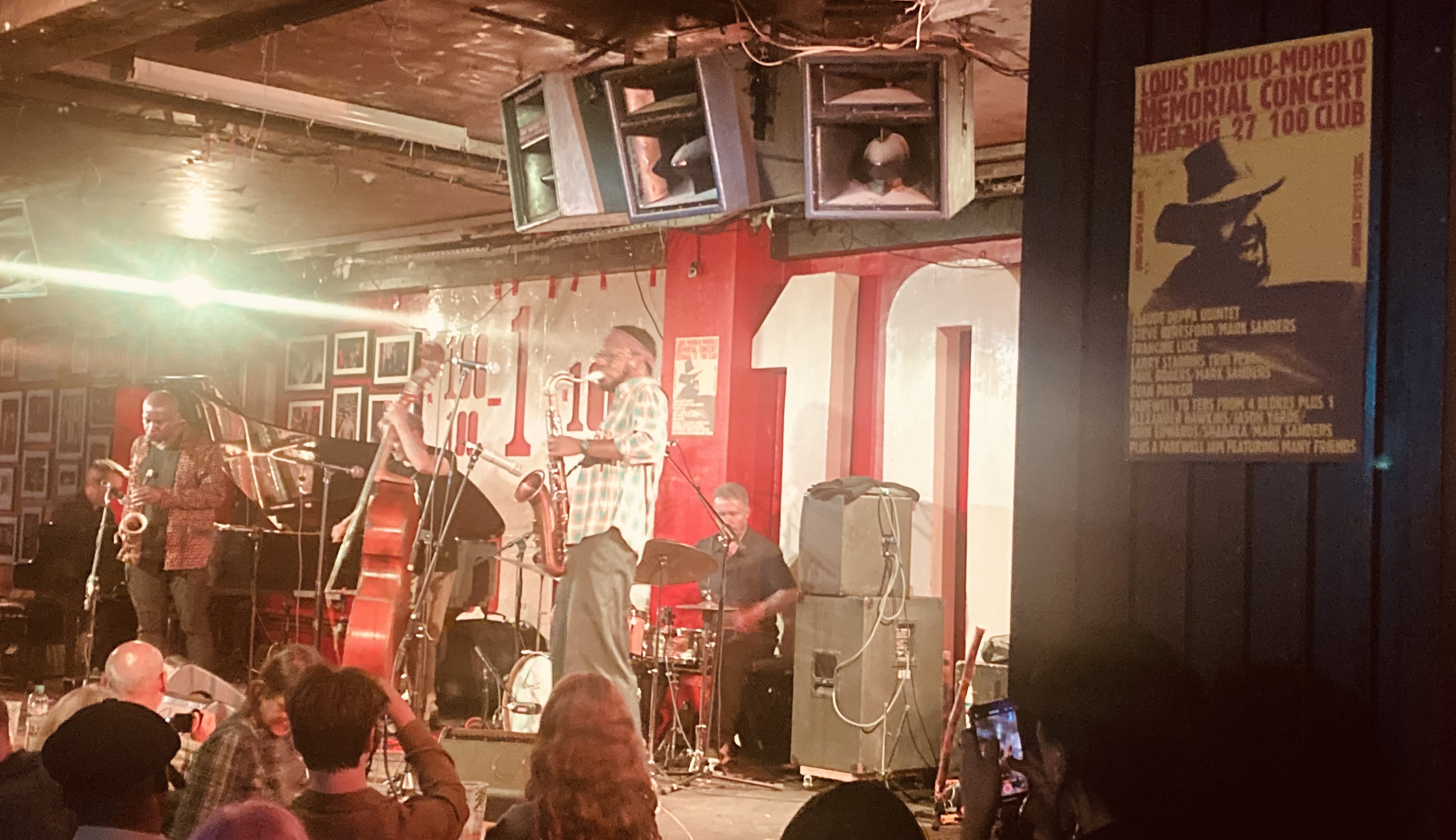
There used to be a civilised convention that normal reviewing practice should be suspended for certain kinds of musical events: those put on for charity, or memorials. Of the celebration of the life of Louis Tebogo Moholo-Moholo at a packed 100 Club last night, it need really only be said that the whole evening was suffused with the indomitable spirit of the great South African drummer, who died in June, aged 85.

The trumpeter Claude Deppa, his friend and frequent bandmate in Viva La Black, started the proceedings at the head of his warm-hearted quartet. Then the pianist Steve Beresford and the drummer Mark Sanders took over for an intricate and absorbing free conversation. Evan Parker brought out his soprano saxophone, removed its mouthpiece, and tapped the keys to produce a quite extraordinary 10-minute percussion solo which managed to be both a shadow commentary on what he might have played with the mouthpiece in place and a unique tribute to his former colleague in the band Foxes Fox. The trio of Larry Stabbins on alto saxophone, Paul Rogers on bass and Sanders again on drums played a set notable for Rogers manoeuvring his bespoke seven-string instrument into the expressive space between a Celtic harp and a cello.

The heart of the celebration of Bra Tebs (as his friends knew him), which was organised by Hazel Miller and Mike Gavin of Ogun Records, came in the set by Four Blokes + 1, his last London-based band. Pictured above, this featured Jason Yarde and Shabaka on saxophones, Alex Hawkins on piano and John Edwards on bass, with the superb Sanders once more on the drum stool, embodying rather than imitating the characteristics of Louis’s playing. They came out roaring, and that’s how they were still sounding as I had to make my departure, with the darkly ecstatic closing cadences of “Dikeledi Tsa Phelo” accompanying me up the stairs and into the night.

Sounds for summer

Tall enough to be unmissable in any environment, and with a truly remarkable fashion sense, Shabaka Hutchings had presence from day one of his career. To me, as an observer, that was the concert at the Royal Festival Hall in June 2009 at which he was one of several UK guests with Charlie Haden’s Liberation Music Orchestra (others included Robert Wyatt, Jason Yarde, John Parricelli and Andy Grappy). He had just one solo but when he stepped forward, the sounds coming from his tenor saxophone commanded everyone’s attention.

Since then, we’ve heard him with Sons of Kemet, The Comet Is Coming, the Ancestors and Louis Moholo-Moholo’s Five Blokes, and in a reinterpretation of Coltrane’s A Love Supreme at the Church of Sound a few weeks ago which I was very sorry to miss. And now he has enough presence to allow him to drop his surname and become just Shabaka.

He’s also dropped the saxophone, which is more of a surprise, in order to study the flute — specifically the Japanese shakuhachi and other iterations, including the Andean quena and the Slavic svirel. His new album — titled Perceive Its Beauty, Acknowledge Its Grace — is evidence of this turn of interest.

It’s a radical departure from anything he’s given us before. A series of sketches deploys varying personnel, including the pianists Nduduzo Makhathini and Jason Moran, the guitarist Dave Okumu, the singer Lianne La Havas, Moses Sumney, Laraaji and ESKA, the harpists Brandee Younger and Charles Overton, the drummers Marcus Gilmore and Nasheet Waits, the speakers Saul Williams, Miguel Atwood-Ferguson and Anum Iyupo, the rapper Elucid, the percussionist Carlos Niño and the bassists Esperanza Spalding and Tom Herbert.

That’s an impressive line-up, but as you listen to the album you’re never really thinking of individuals or their virtuosity. In that sense it’s a quite different experience from that of listening to a “jazz album”. But neither is it a kind of New Age tapestry of sound, slipping by without disturbance, merely a bit of aural decoration.

It has an overall charm and moments of great and singular beauty, too, such as the shakuhachi improvisation against Overton’s harp and the celestial layered voices of Sumney on “Insecurities”, La Havas’s vocal reverie on “Kiss Me Before I Forget”, or Spalding’s springy bass behind Elucid’s rap on “Body to Inhabit”, but it also has depth, and not just in the occasional verbal passages, which are carefully integrated into the quilt of sound. The overall impression is what counts, and somehow that goes beyond words.

The album contains one snatch of tenor saxophone, on a track called “Breathing”, in which Rajni Swaminathan’s mridangam — a Carnatic double-ended hand drum — backs first Shabaka’s treated and looped flutes, then his clarinet, and finally his saxophone, which briefly erupts in a gentle squall with an intonation recalling the great Ethiopian tenorist Getatchew Mekuria.

That little hint of Ethiopian music sent me to a new release in the name of Emahoy Tsege Mariam Gebru, who died this time last year at the age of 99. Born in Addis Ababa, she studied violin in Switzerland as a child, worked as a civil servant and sang for Haile Selassie, was imprisoned by the Italian occupiers during the Second World War, and spent a post-war decade as a nun in a hilltop monastery. The arrival of a new regime forced her to flee to Jerusalem, where she spent the rest of her life in an Ethiopian Orthodox convent and composed music for piano, organ, and various ensembles while running a foundation to encourage music education among children in her native land and elsewhere.

Like Mekuria, she had a volume of the producer Francis Falceto’s Ethiopiques series devoted to her music in 2006, and in the last couple of years there have been more albums on the Mississippi label. The latest is called Souvenirs, a collection of her songs apparently recorded between 1977 and 1985. It’s a primitive recording: the piano sounds like a poorly maintained upright and her voice was probably recorded on the same microphone, in a room that was almost certainly not a recording studio. But that does nothing to diminish the appeal of these songs, with titles such as “Where Is the Highway of Thought?” and “Like the Sun Shines on Meadows”, whose vocal melodies are doubled by the pianist’s right hand against left-hand figurations assembled from scraps of blues and rhumba and gospel tunes.

What’s so appealing, almost mesmerising, about this music? I think it’s the combination of transparent simplicity (and sincerity) with the unexpected guile of the rhythmic undertow, which is always playing appealing tricks on the western ear. There’s something about the distinctive melodic shapes and phrase lengths that is special to this kind of Ethiopian music, springing from some deeper root.

Something else to add pleasure to this summer is After a Pause, the new album of acoustic duo music by two brilliant Welsh musicians, the guitarist Toby Hay and the bassist and cellist Aidan Thorne. I got interested in Hay when he was filming himself outdoors playing ragas during the first Covid-19 lockdown in 2020 and putting the results on YouTube, and wrote a bit more about him when he released some duets recorded in an old chapel with his fellow guitarist David Ian Roberts later that same spring.

I try to avoid talking about what musicians are doing in terms of the work of other musicians, but I suppose a simple — and, I hope, enticing — way of describing the scope of these duets is to imagine what Davy Graham and Danny Thompson might have got up to if they were both in their prime in the 2020s and were able to spend three days together in a studio with no distractions, enhancing their compositions and improvisations with a sparing but highly effective use of overdubbing and electronics.

After living with this album for a few weeks, I’ve come to appreciate not just its surface beauty but the way it reveals more of itself and its spiritual essence the closer you listen. The 12-string arpeggios and bowed bass of the opener are a call to the attention that is never wasted as the music blooms and glows through 10 shortish but unhurried pieces, trajectories shifting and densities varying considerably from bare-bones to near-orchestral (on “Burden” or “Eclipse”) but mood sustained. The brief solo piano coda is a lovely way to finish.

A light shines through these three albums. I’ve a feeling they’re going to be among the summer’s best companions.

* Shabaka’s Perceive Its Beauty, Acknowledge Its Grace is on the Impulse! label. Emahoy Tsege Mariam Gebru’s Souvenirs is on Mississippi Records. Toby Hay and Aidan Thorne’s After a Pause is on Cambrian Records. Links here:

https://spibaig.bandcamp.com/album/perceive-its-beauty-acknowledge-its-grace

https://emahoytsegemariamgebru.bandcamp.com/album/souvenirs

https://cambrianrecords.bandcamp.com/
The sound of London 2020

Guitarist Shirley Tetteh at Church of Sound during the EFG London Jazz Festival

Half an hour into BBC4’s special Jazz 625 programme on Saturday night, the journalist Emma Warren remarked that everybody in London’s new jazz scene has their own role to play. You might be making your contribution as a musician, or taking the money on the door. Or, she suggested, your role might be as the first person on the dance floor that night, leading the way for the rest of the audience to join in. That sense of collective commitment was strong throughout the programme.

Timed to coincide with the 2020 London Jazz Festival, the 90-minute show featured many of the most prominent names of the current scene: the drummer Moses Boyd and his band Exodus, the tenor saxophonist Nubya Garcia’s quartet, the trumpeter Sheila Maurice-Grey’s irresistible Kokoroko, the singer Poppy Ajudah with a searing Black Lives Matter song, the powerful Ezra Collective, the drummer Sarathy Korwar, the clarinetist Shabaka Hutchings with Sons of Kemet, the tuba-player Theon Cross with the rapper Consensus, and others. There were interludes exploring the work of Gary Crosby’s Tomorrow’s Warriors project in mentoring so many of the new generation, and a shift up to Manchester reflected the contributions of the trumpeter Matthew Halsall and the saxophonist Nat Birchall.

Boyd co-hosted the show with Jamz Supernova, and something he said was also striking. Every young black jazz musician, he remarked, knows what it feels like to play to a room full of middle-aged white people. And that’s fine, he added. But sometimes you want to play to people like yourself. A sequence of clips from Steam Down in Deptford, the Fox & Firkin pub in Lewisham, Total Refreshment Centre in Hackney Downs and other London venues in pre-pandemic times showed what he meant.

This music restores a sense of jazz’s old physicality. While strong on a belief in the tradition, it blends in elements of the music absorbed by younger players: hip-hop and its offshoots, reggae, Afro-beat. In that way, too, it recalls jazz’s origins as a musical broth, a bouillabaisse, a gumbo, embracing influences rather than distilling the flavour out of them.

It believes in rhythm and it believes in warmth. Communication is the priority, but without compromise. Lessons from the more abstract directions of contemporary jazz are deployed as extra tools. There are rough edges and signs of what some older listeners might see as naivety. But to watch and listen to the development of these musicians, to hear them stretching their limbs and discovering their own potential, is a thing of wonder and infinite pleasure.

In Saturday’s show the various groups were playing without an audience and in a socially distanced format. The same was true of the livestreams of the festival gigs I was able to watch. What really impressed me was that a movement nourished by the spontaneity and feedback of an intimate live setting proved able to flourish in a completely different environment. If they were being set a test, they passed it en bloc, with distinction.

The BBC4 programme is available now on iPlayer. Some of the livestreams from the festival are also free to watch, like the Charlie Parker centenary tribute from Church of Sound in Hackney, featuring Gary Crosby’s Groundation, with Nathaniel Facey on alto, Shirley Tetteh on guitar, Hamish Moore on bass and Moses Boyd on drums: a quicksilver set of Bird tunes and originals. Facey’s own quartet, completed by two of his fellow members of Empirical, the drummer Shaney Forbes and the bassist Tom Farmer, and the guitarist Dave Preston, were captured at the Green Note in Camden Town, letting air and light into knotty themes by the leader and the guitarist. And at Total Refreshment Centre the impressive young trumpeter/singer Emma-Jean Thackray led her quintet — Lyle Barton on keyboards, Matt Gedrych on bass guitar, Dougal Taylor on drums and Crispin Robinson on percussion — through a wholly absorbing, convincing and thoroughly contemporary investigation of the moods suggested by Bitches Brew 50 years ago.

Tickets were £12.50 to livestream Cassie Kinoshi’s SEED Ensemble and their guests performing an 80th birthday tribute to Pharoah Sanders at the Barbican, and that’s what it’ll cost you to catch up with it via the Barbican’s website. I can only urge everyone do make the investment, since Kinoshi presents an hour of music of the highest quality, carefully devised and packed with all the best qualities of the new London scene.

The core SEED line-up — Kinoshi (alto), Sheila Maurice-Grey and Jack Banjo-Courtney (trumpets), Joe Bristow (trombone), Hannah Mbuya (tuba), Chelsea Carmichael (tenor, flute), Shirley Tetteh (guitar), Rio Kai (bass) and Patrick Boyle (drums) — kicked off with the ever-hypnotic riff of “Upper and Lower Egypt” before being joined by the clarinet of Shabaka Hutchings (on a beautifully flighted “Astral Travelling”), the pianist Ashley Henry (a heartfelt “Greeting to Saud”), the percussionist Yahael Camara-Onono (“Elevation”) and the singer Richie Seivwright (“Love Is Everywhere”). The horn arrangements were perfect, the rhythm section subtle and skilful, each of the soloists offering something of substance.

“Catch you soon, when life is normal again,” Kinoshi told her invisible audience at the end of the set. But if it was sad not to be able to witness this music in person, to share the experience with the players and to make them feel the listeners’ response, it was wonderful to be able to hear it all, staged and played and recorded so beautifully in all the venues.

If you browse the festival’s website, you’ll find other fine performances available: the trumpeter Yazz Ahmed, the guitarist Hedvig Mollestad and the poet Moor Mother with Irreversible Entanglements are some of them. But maybe watch Jazz 625 first, all the way through. At a time when the streets of the city are drained of life, it’s a reminder of what’s waiting around the corner. If it doesn’t fill you with the kind of optimism that’s been in short supply for the past nine months, I’ll be very surprised.

Sounds from the silence

The challenge of putting on a jazz festival in November 2020 would be hard to overestimate. But for four days last week the 57th edition of Jazzfest Berlin presented music to the world with imagination and ingenuity, making the most of the available technology to bring musicians and listeners together in the era of social distancing.

The event’s customary home, the Haus der Berliner Festspiele, is currently being refurbished, so the festival’s director, Nadin Deventer, built a digital bridge between her alternative choice of home venue, Silent Green (a repurposed crematorium in the Wedding district), and the Roulette club in Brooklyn. Bands played in both spaces, alternating sets. Forty separate performances totalled 1,500 minutes of music, all of it broadcast via the ARTE Concerts network (and available to view for the next 12 months).

So, for instance, from Berlin we got to hear two of the expatriate American drummer Jim Black’s groups, a trio and a sextet, and the saxophonist Silke Eberhard’s expanded Potsa Lotsa band playing pieces by Henry Threadgill, who was to have been the festival’s special guest until the pandemic made physical travel from the US impossible. From Brooklyn we heard the intense saxophone/piano duo of Ingrid Laubrock and Kris Davis, the drummer Thomas Fujiwara’s sextet, with Ralph Alessi on trumpet and Mary Halvorson on guitar, the altoist Lakecia Benjamin paying homage to Coltrane, and the pianist Craig Taborn’s new trio, with Halvorson and the drummer Ches Smith. And many others in both locations.

The set that nailed my attention was a 57-minute composition/performance by the British pianist Alexander Hawkins and the Berlin-based Lebanese poet, rapper and visual artist Siska, whose collaboration had to overcome the enforced inability of Hawkins and his two UK-based collaborators, Matt Wright (electronics) and Shabaka Hutchings (clarinet), to travel to Berlin. Instead they recorded their contributions to the piece, with Siska, the trumpeter Lina Allemano and the bassist Nick Dunston located in Silent Green and improvising on the template of Hawkins’s graphic and notated score, with the occasional appearance of film of First and Third World scenes and social rituals on a suspended screen sharing the space with the musicians and a large mirror ball used as a reflective light source.

The recent explosion in Beirut, Siska said, had inspired him to use Arabic lyrics he had written in the Lebanese capital between 2001 and 2008. Allemano contributed strikingly expressive interludes and accompaniments, while Dunston provided sonorous arco playing, a fluid drive when necessary and, to introduce the final section, a memorable solo of his own.

The composition began with plain electronic drones and overtones like something from a La Monte Young installation or a Necks studio album. Slowly unrolling through passages supported by prepared gamelan-like patterns, a clarinet ostinato and the whirring of a 16mm projector, it gradually gained emotional weight until achieving something very like catharsis in its closing passages: imagine, if you can, a fruitful meeting between the Art Ensemble of Chicago and Arthur Jafa, with a global perspective. If the meaning of Siska’s urgently whispered and muttered words was inscrutable to non-Arabic speakers, the accretional impact of the whole work was undeniable, at least in this corner of the digital auditorium. Here it is.

* To see recordings of all the livestreamed performances from Jazzfest Berlin 2020, go to https://www.arte.tv/de/videos/RC-020309/jazzfest-berlin/

Reading music: jazz + prose

IMG_0922doneI’ve always had a soft spot for jazz and poetry: Jack Kerouac with Zoot Sims, Kenneth Patchen with the Chamber Jazz Sextet, Langston Hughes with Charles Mingus, Christopher Logue with Tony Kinsey, LeRoi Jones with the New York Art Quartet. It must be the beatnik in me, or the hopeless optimist, because not much of it has outlived its time. But here’s something new: jazz and prose. Or, to be more precise, jazz both with and without prose, at the same time. The Moss Project’s What Do You See When You Close Your Eyes?, just released on the Babel label, consists of five pieces of music written by the London-based guitarist Moss Freed and a sixth by his colleague Ruth Goller, recorded by his group, and then given to half a dozen writers to produce short stories or poems inspired by what they’ve heard. A handsome hardback book contains the CD and the printed words (which can also be heard, read by the authors, on a download from the artist’s website).

The writers who responded to Freed’s invitation are Naomi Alderman, Colum McCann, James Miller, Lawrence Norfolk,  Joe Dunthorne and Hanan al-Shaykh. The musicians, apart from Freed, are the members of his quartet (pictured above) — Ruth Goller on bass guitar and double bass, the drummer Marek Dorcik and the singer and violinist Alice Zawadzki — plus a guest, the near-ubiquitous Shabaka Hutchings, on tenor saxophone and bass clarinet. The six pieces are bookended by an brief instrumental prelude and a song for voices and instruments with words and music by Freed.

On a purely musical level, the CD gets better as it goes along: after a somewhat self-conscious beginning with “The Bubble”, the first full-length piece, and the gentle pastorale of “Anniversary”, to which Goller’s double bass makes an outstanding contribution, the blood starts flowing and the playing seems to loosen up. (This may have nothing to do with reality, in the sense of bearing a relationship to the order in which the pieces were recorded, but it happens to be this listener’s experience.) The fourth and sixth pieces, the intricate title track and an adventurous slow invention called “The Angel”, on which Freed explores various instrumental effects, are the picks for me. These are carefully constructed compositions that sound entirely contemporary while generally avoiding the tricksiness — usually expressed as a perversely wilful angularity — that can afflict the current generation of young, conservatory-trained jazz musicians (Freed studied at Edinburgh and Berklee). The blend of the leader’s guitar and Zawadzki’s violin is an extremely happy one, subtly enhanced by the addition of bass clarinet on “Caravans”, while Goller and Dorcik keep the music’s sinews taut (their handling of irregular metres on “What Do You See…” is as calm and frictionless as their switching between time to no-time in “Postscript: Lose Ourselves”).

And the written words? Freed suggests they can be read at the same time as the music is playing, or before, or after, or just listened to in the writers’ recitations (find them at http://www.mossfreed.com). I can’t honestly say that reading them greatly affected my response to the music, but I enjoyed McCann’s meditation on a woman’s visit to an old church (“Anniversary”), which really does fit with its music, and Norfolk’s miniature account of two characters on a slightly tense road trip (“Caravans”). A worthwhile experiment, attractively presented.

* The photograph above is by Barbara Bartz. Left to right: Ruth Goller, Marek Dorcik, Moss Freed and Alice Zawadzki.