Skip to content

Posts tagged ‘Russ Titelman’

RIP Margaret Ross

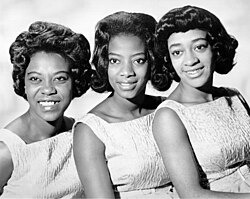
The Cookies: Earl-Jean McRea, Dorothy Jones and Margaret Ross

Margaret Ross was still in high school when she joined her cousin Dorothy Jones and their friend Earl-Jean McRea in the Cookies, a vocal group from Coney Island who became the favourites of the hit-making songwriters in Aldon Music’s Brill Building offices in the early ’60s. They sang on countless demos and provided backup on many hits by other artists.

On their own records, such as “Chains”, “Don’t Say Nothing Bad About My Baby” and “Girls Grow Up (Faster Than Boys)”, they shared the lead vocals between them. But in 1964 it was Margaret who sang lead on the sublime “I Never Dreamed”, a song written by Gerry Goffin and Russ Titelman, one of my three all-time favourite records in the beloved girl-group genre. Arranged by Carole King, it was produced by Goffin, King’s then-husband, and Titelman.

I saw the news of her death at the age of 83 today on Titelman’s Facebook page, which shows how long some old loyalties last. In the same year as “I Never Dreamed”, Margaret also sang lead on two almost equally fine records released under the fictitious name of the Cinderellas: “Baby Baby (I Still Love You)” and “Please Don’t Wake Me”, both written by Titelman with Cynthia Weil, and produced by Titelman with Barry Mann, Weil’s husband and usual writing partner.

Who were the greatest of all the girl-group lead singers? For me it’s Shirley Owens of the Shirelles and Judy Craig of the Chiffons. But Margaret Ross had something special: she could capture the innocence that people like Goffin, Weil and Ellie Greenwich wrote into their stories of young love. She, above all, sounds like a teenager singing on behalf of other teenagers — but with a fine vocal technique that, when matched with the other members of the group, explained their popularity with the writers. “Their ears were so good,” said Neil Sedaka, for whom they sang the background to “Breaking Up Is Hard to Do”.

That day Sedaka took them from Coney Island to the session at RCA studios on East 24th Street in a taxicab. As Ross told Laura Flam and Emily Sieu Liebowitz, the authors of But Will You Love Me Tomorrow?, an oral history of the girl groups: “We learned the song in the taxi. Only took a few minutes to put it together, and once we got in the studio, naturally that’s how it came out.”

It was the Beatles who called time on the girl-group era — ironically, because Lennon and McCartney had been inspired and influenced by those very records, and they covered “Chains”, along with the Shirelles’ “Baby It’s You”, on their first album. Ross was not pleased. “We were furious. Oh, we were mad. I mean, they came over here and they just took over and they pushed us out. And that’s when everything slowed down. They just knocked all of us out.”

She left the music business, got married, had two children, and went to work for the New York City Health Department until her retirement in 1998. In her later years she performed sometimes with a new group of Cookies and sometimes with Louise Murray of the Jaynetts, Lillian Walker-Moss from the Exciters, Beverly Warren from the Raindrops and Nanette Licari from Reparata and the Delrons.

“I love to sing,” Margaret told Flam and Liebowitz. But the schoolgirl could not have imagined, as “I Never Dreamed” went on to the tape in 1964, that she was singing her way into a kind of immortality.

* But Will You Love Me Tomorrow? was published in 2023 by Hachette Books. The Cookies: Chains / The Dimension Links 1962-64 was issued in 2009 on RPM Records and contains their important recordings, under the group name and those of the Cinderellas, Earl-Jean, the Palisades, Darlene McRea and the Honey Bees.

The bending of headlights

“We have a new very quiet album out,” Rickie Lee Jones said as she greeted a packed Jazz Café in London last night. I bought Pieces of Treasure, the album in question, a few weeks ago, played it three times, and filed it next to the rest of the evidence of her long and remarkable life in music. It was certainly nice to see her reunited with Russ Titelman, the co-producer of her unforgettable debut album back in 1979 and a careful curator of this new collection of standard songs, but it didn’t make a huge initial impression. Last night she brought it to life.

She’s travelling with a three-piece band: Ben Rosenblum on electric piano doubling accordion, Paul Nowinski on string bass and Vilray Bolles on electric guitar. For the first half of the 75-minute set she just sang a selection of standards, starting with a pin-drop “The Second Time Around”, which she recorded on Pop Pop in 1991, and continuing with “Just in Time”, “One for My Baby” and “September Song”, which are on the new one, then “Up a Lazy River” from 2000’s It’s Like This, “Hi-lili, Hi-lo” from Pop Pop (with the accordionist not just exquisitely replicating but actually improving on Dino Saluzzi’s bandoneon part on the original recording), and “Nature Boy” from the new one.

It didn’t take long to appreciate not just how well she was singing but how beautifully her musicians were creating a matrix for the way she was so thoroughly inhabiting the songs. You might have heard “September Song” a million times, interpreted by some of the greatest singers in the history of popular music, but by bringing herself so close to the song, by eliminating the distance between song and singer, she made you think, as if for the first time, about what it meant.

Later on she did the same with another song worn threadbare by repetition. “There will be other lips that I may kiss / How could they thrill me like yours used to do? / Oh, I may dream a million dreams / But how will they come true? / For there will never be another you.” It was as though she’d just written it.

The groove changed with Steely Dan’s “Show Biz Kids”, which she recorded on It’s Like This. The slinky funk-lite keyboard riff summoned a whole universe of laid-back rock and roll hipness, and the audience enjoyed singing along: “Show business kids makin’ movies of themselves / You know they don’t give a fuck about anybody else.” (And how prophetic was that, written by Walter Becker and Donald Fagen 50 years ago?) She did her father’s song, the lullaby-ballad “The Moon is Made of Gold”, and her own much loved “Weasel and the White Boys Cool”, and finished by returning to the new album for “On the Sunny Side of the Street”, a song her dad taught her in the summer of 1963 (“a big year for me” — she would have been eight years old, and he also taught her “My Funny Valentine” and “Bye Bye Blackbird”). She left to an ovation, on a wave of profound affection.

But earlier, after about an hour, when she had strapped on a guitar, there had been “The Last Chance Texaco”. Those two gentle chords, instantly recognisable, then: “A long stretch of headlights / Bends into I-9…” It’s a movie. It’s a poem. It’s a confessional. It’s a communion. It’s the song that defines her. The one that most fully draws us into her world. “(It) wasn’t like anything I’d ever written,” she remembered in her wonderful 2021 autobiography. “It wasn’t like anything I’d ever heard.” As she sang it, once again the space between then and now collapsed. And when the sound of the car on the highway faded to silence, I might not have been alone in discovering that my cheeks were suddenly damp.

* The photo of Rickie Lee Jones at the Jazz Café is by me. Pieces of Treasure is on BMG/Modern. Her autobiography, Last Chance Texaco, is published in paperback by Grove Press. Thanks to Allan Chase (see Comments) for identifying the musicians.

Glen Campbell 1936-2017

Quite rightly, the majority of the eulogies for Glen Campbell — like this excellent one from Michael Hann in today’s Guardian — concentrate on the great trilogy of place-name songs written by Jimmy Webb: “By the Time I Get to Phoenix”, “Wichita Lineman” and “Galveston”. The record I’ll remember him for came from the time before he started his run of hits: a song called “Guess I’m Dumb”, written by Brian Wilson and Russ Titelman and produced by Wilson in 1965.

Recorded at the same time as the Beach Boys Today album, it’s a prototype of what we were going to hear on Pet Sounds the following year: a carefully wrought song of tortured self-examination set to an imaginative adaptation of the techniques originated by Phil Spector, sung on this occasion by a member of the Wrecking Crew who, while trying to kick-start his own solo career, had stepped forward to take Brian’s place in the Beach Boys for a few weeks of live shows at the end of 1964.

“Guess I’m Dumb” opens with flat-toned tom-toms, a conga, a bass guitar and several strummed acoustic guitars layering the baion rhythm. And then: “The way I act don’t seem like me / I’m not on top like I used to be / I’ll give in when I know I should be strong / I’ll still give in even though I know it’s wrong / I guess I’m dumb, but I don’t care…” Campbell sings the beautiful ascending melody with perfect clarity, like an older Wilson brother might do, as the arrangement builds up: anxious bowed cellos and double basses, a thick brass-and-reeds chorale, humming male voices, sweeping violins answered by staccato trumpets in the instrumental interlude, sleighbells doubling the eighth-note rhythm, and female singers chanting the chorus against a trademark Hal Blaine drum fusillade on the fade.

The mono mix is a masterpiece. I’ve described the individual elements separately, but you’re supposed to hear them as a one giant instrument, as if recorded by a single microphone. It doesn’t have the steamroller impact of a vintage Spector 45, but Wilson and his friend Titelman were after a subtler and more complex portrayal of teenage uncertainties, and the result belongs up there with “Caroline, No”, “I Know There’s an Answer” and “I Wasn’t Made For These Times”. I’m still amazed that, in the greatest of all years for pure pop music, it wasn’t even a tiny hit.

* You can find “Guess I’m Dumb” on Ace Records’ Pet Projects, a 23-track compilation of Brian Wilson productions released in 2003.

Far from dumb

Russ TitelmanGerry Goffin, whose death was announced yesterday, didn’t just write songs with Carole King. Even during their most successful and prolific time together in the mid-’60s he was collaborating with other writers, as I point out here, in my tribute to his lyric-writing genius for the Guardian’s music blog. The one that comes most readily to my mind is Russ Titelman (pictured above), later a staff producer for Warner Brothers and now best known for his work in the studio with Little Feat, Ry Cooder, Randy Newman, Rickie Lee Jones, Eric Clapton, George Harrison, Steve Winwood and others.

Goffin and Titelman wrote two wonderful songs together. First, in 1964, came “I Never Dreamed” for the Cookies, a fabulous girl-group record which they produced together, with King providing the arrangement. Goodness knows how it didn’t follow the group’s other songs into the charts. A year later they wrote “What Am I Gonna Do With You (Hey Baby)“, recorded by the Chiffons, Skeeter Davis, Lesley Gore and finally, in 1967, by the Inspirations on the obscure Black Pearl label. Each of these versions has its fans, but mine is the last of them, in which the echo-heavy production and the lead singer’s delivery mirror the plaintive mood of Goffin’s lyric.

Titelman was born in Los Angeles in 1944. I’m indebted to an interview in Harvey Kubernik’s Turn Up the Radio! for the information that his older sister, Susan (later to marry Cooder), was the girlfriend of Marshall Lieb, a member of the Teddy Bears, who rehearsed in the Titelmans’ lounge on their way to stardom. Phil Spector, their leader, was going out with Susan’s best friend, and young Russ fell under his spell: “He was so smart, and so funny, and so charming, and so incredibly charismatic, and so you were sort of charmed by it all. Then there was the other side of him, which was this dark, murky, scary person, you know, who made shit up.”

He went to work as a songwriter for Lou Adler and Don Kirshner at Screen Gems-Columbia Music, in whose LA offices he met Brian Wilson. Together they wrote “Guess I’m Dumb”, which would have made a great track for Pet Sounds but was instead recorded by Glen Campbell, a future Beach Boy. Wilson is credited as the arranger, conductor and producer of what remains one of his very finest efforts.

Titelman’s early adventures in the LA pop business also included collaborations with the young David Gates (later the founder of Bread), who produced Margaret Mandolph’s utterly sublime version of a Titelman co-composition (with Cynthia Weil) called “I Wanna Make You Happy”. The Titelman/Gates partnership was also responsible for Suzy Wallis’s delightful “Little Things Like That”

On all these records, Titelman’s involvement seemed to guarantee that they would somehow capture the very essence of teenage pop music. They have great hooks and an understanding of how a simple chord change can sell a song. Eventually, of course, he had to grow up, as did his friends and accomplices, including Goffin and Gates. But the stuff they left us from that time continues to give undiminished pleasure decades after its supposed expiry date.