Skip to content

Posts tagged ‘Robert Stillman’

Tom Skinner at the QEH

The trouble with the EFG London Jazz Festival is that it’s all too much. Given 300 gigs in 10 days, there’s always going to be something you regret missing. Last night I badly wanted to hear the Weather Station — the marvellous Canadian singer-songwriter Tamara Lindeman — with a string quartet at EartH in Dalston. But I also wanted to hear the drummer-composer Tom Skinner and his band perform their new album, Kaleidoscopic Visions, at the Queen Elizabeth Hall. I’d seen the Weather Station in Islington at the start of this year. I hadn’t seen Skinner since 2022. So that’s how my decision was made.

In the end, any regrets were overwhelmed by events. Skinner and his six colleagues — Chelsea Carmichael (flute and tenor saxophone), Robert Stillman (soprano and tenor saxophones), Yaffra (keyboards, voice and percussion), Adrian Utley (guitar), Kareem Dayes (cello) and Caius Williams (bass) — started the concert with watchful discretion. But over the course of 90 minutes they built the music until it had become a living, pulsing thing, full of narratives, individual and collective.

Skinner writes deceptively simple, sometimes folk-like melodies that exist in essential dialogue with the riffs and other figures devised to help form a unified matrix. The textures are airy, with room for light and shade. (That’s a reflection of his superbly flexible drumming, in which power is used with restraint.) There are solos on top of prepared accompaniment — those from Utley and Carmichael, cutting loose on tenor, were quite remarkable — but often the improvising is done in small groupings.

A string trio of Williams’s bowed bass, Dayes’ pizzicato cello and the guitar of Utley, making use of sustain and the volume pedal to eliminate attack, was beautifully realised, as was an unaccompanied tenor saxophone duet by Stillman and Carmichael. I’d been listening to their spontaneous interlocking pointilliste figures for a couple of minutes before I realised that the dialogue sounded like a solo tenor improvisation by Evan Parker, its components broken down and distributed between the two players to create an actual version of the conversation that Parker’s playing often resembles. And there was also a real conversation between Skinner and Yaffra, who moved from his keyboards to play a pair of tom-toms with tympani beaters, the two of them sending a gentle thunder rolling around the hall.

I wrote with some enthusiasm about the album a few weeks ago, but the concert did what concerts should do: it warmed the blood in the music’s veins, allowing it to grow. I’d have been very sad to miss it. Now I hope Skinner follows the practice he established with his earlier project, Voices of Bishara, and releases the live version of Kaleidoscopic Visions. Last night’s, if possible.
Tom Skinner at Church of Sound

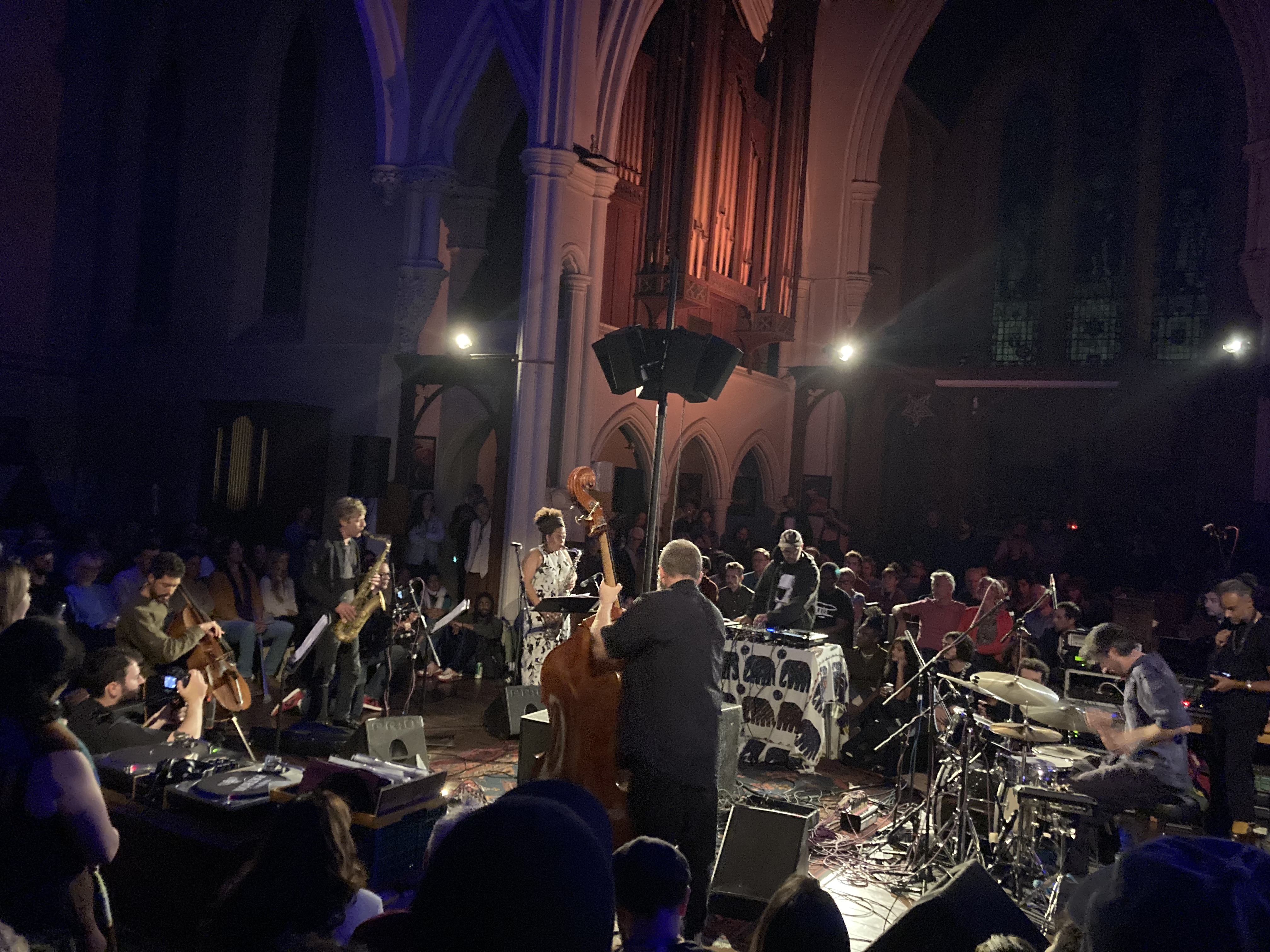
Long before hearing of Abdul Wadud’s death in August at the age of 75, Tom Skinner had been preparing his homage to the great cellist. Last night’s Church of Sound concert at St James the Great in Lower Clapton was a wonderful tribute from one musician to another, transmuting elements of Wadud’s solo album, By Myself, into a framework for a six-piece band called Voices of Bishara.

Taking their name from that chosen by Wadud for the label on which his album was released in 1977, the musicians were Chelsea Carmichael (tenor saxophone and flute), Robert Stillman (tenor saxophone and bass clarinet), Kareem Dayes (cello), Tom Herbert (bass), Paul Camo (samples) and Skinner himself (drums). Church of Sound is a terrific gig: the place was packed for the debut of a project led by a man known from his work with Sons of Kemet and more recently with Thom Yorke and Jonny Greenwood. Not many among the audience would have known of Wadud before last night, although there were a few whoops when Skinner mentioned the name of Julius Hemphill, with whom the cellist worked so memorably in the 1970s and ’80s, but they certainly responded to the music created in his honour.

Even at its most sophisticated there was something elemental about Wadud’s playing, something steeped in African ancestry, to which the name Bishara — ”gospel” or “good news” in a variety of languages, including Arabic and Swahili — made reference. Skinner’s arrangements enhanced this core sensibility, using the two stringed instruments and Camo’s samples to create a kind of desert blues atmosphere, floating on the drummer’s own loose-jointed propulsion and providing the setting for the two horn soloists. (At times it recalled the use of Ahmed Abdul-Malik’s oud and the basses of Jimmy Garrison and Reggie Workman on Coltrane’s 1961 Village Vanguard recordings). Dayes made fine contributions with his scrabbled pizzicato figures and keening arco, while Herbert raised the temperature in the second half with a majestic solo, setting up a two-tenor juxtaposition of Stillman’s asymmetrical agility and Carmichael’s confident power.

At St James the Great the musicians play in the round, and the church’s architecture means that the quality of the sound depends on where you’re sitting or standing. I moved after the interval and found that what had previously been swimming in echo now came into proper focus. The activities of two camera operators, filming the musicians at close quarters, was unhelpful and at times a distraction, but there’s an album of this music out soon, and on the evidence of the concert I’m looking forward to it very much. Rather than just settle for saluting the source of his inspiration, Skinner has found a way of going beyond it to discover something of his own.

* Here’s my Guardian obit of Abdul Wadud. As Tom Skinner told the audience, Wadud’s By Myself can now be found on YouTube: https://www.youtube.com/watch?v=Mff74JJKD40&ab_channel=HeathZiebell. The Voices of Bishara album is out in November.