Almost a year ago I wrote warmly about the debut of the bassist and composer Olie Brice’s new quartet at Cafe Oto, noting that they’d be going into a studio the following day to record an album. That album — titled All It Was — is now out, its release celebrated at the Vortex last night with an evening of powerfully emotional music.
The tenor saxophonist Rachel Musson, the pianist Alexander Hawkins and the drummer Will Glaser are Brice’s accomplices in a project that takes all the lessons the four of them have ever learnt about how to play this music and puts the result at the service of a set of distinctive and memorable compositions.
Brice tends to lead off in the way Charles Mingus used to, with solo bass statements of attention-grabbing clarity and strength before the others dive into the structures of pieces such as “Listening Interntly to Raptors” (which began the set with a Monkish prowl), the soaring, hard-swinging “Happy Song for Joni”, the hypnotic “And We Dance on Firm Earth”, and the pointilliste “After a Break”.
A couple of of the pieces referred to recent losses. “Morning Mourning” was an elegy for Brice’s father, while Don Cherry’s “Awake Nu” was included as a tribute to Louis Moholo-Moholo, who died in South Africa last month. Fittingly, Glaser’s playing throughout the evening was lit by Louis’s fire: dense but never oppressive, building to ecstatic climaxes, particularly in several duet passages with Hawkins, who occasionally infiltrated almost subliminal elements of barrelhouse and boogie-woogie into his strongly percussive inventions.
Once again Musson impressed as one of the most creative saxophonists on the UK scene, employing a striking variety of tone and trajectory, from jagged outbursts at full throttle to the delicate altissimo phrases with which she brought one piece to its final rest.
That combination of grace and strength typified the assimilation of individual assets into the work of a truly extraordinary quartet. All It Was will be one of the records of the year, and this was a gig to match its excellence.
* The Olie Brice Quartet’s All It Was is on West Hill Records and available via Bandcamp: https://westhill.bandcamp.com/
Olie Brice’s new quartet made a very promising debut at Café Oto last night, and one the reasons was Rachel Musson, whose tenor saxophone traced and explored the contours of the bassist’s characteristically intriguing themes (and Don Cherry’s perky “Awake Nu”) with alert and graceful lyricism. The piano of Alexander Hawkins and the drums of Will Glaser rounded out a group that was heading into a studio the next day to record what will surely be a most interesting album.
A fellow listener observed that Musson’s playing in this context made quite a contrast with her work in her more familiar setting of free improvisation, where multiphonics and other techniques come into play. Last night her fibrous tone and mobile phrasing suggested that she’d located a very fruitful spot within an area defined by Sam Rivers and Pharoah Sanders (at his most songlike). I was reminded, too, that one of her early inspirations was Lee Konitz.
At the merch table during the interval I bought her new CD, titled Ashes and Dust, Earth and Sky in English and Lludw a Llwch, Daear a Nef in Welsh. To be honest, I bought it not just because I’d been enjoying her playing in the first half, or because of the Welsh element, but because I liked the look and feel of the packaging. Sometimes a sleeve design really can tell you about what’s inside.
Inspired during lockdown by researches into her family’s history in Pembrokeshire/Sir Benfro during lockdown, the album was recorded and mixed in 2021. It combines field recordings in West Wales with her saxophones, flute, piccolo, wind chimes, singing bowl and tro (a Cambodian spike fiddle).
Birdsong, wind, church bells — these form the material into which Musson weaves her own contributions, shaping a 40-minute tapestry beyond definition. Birds are the first thing you hear, chirping and cawing, and soon a song is being mimicked by her flute, which reminded me of something Eric Dolphy, another flautist, said long ago: “At home I used to play, and the birds always used to whistle with me. I’d stop what I was working on and play with the birds.” A piccolo joins in, while a singing bowl and the patter of saxophone pads add to the mix before a brief passage of restrained free-style tenor ends the piece.
The music creates and sustains its own space, with frequent individual highlights. The second and fifth of the six tracks, “Bethink and Lay to Heart” and “Windblown”, contain lovely saxophone chorales emerging out of the ambiance and speaking to it, while the finale, the 10-minute title track, opens with a pair of piccolos conversing like blackbirds, introducing the altered sound of bells and other distorted samples which loom and linger until they recede into the silence, having made their quiet but lasting impression.
Jean-Luc Godard once compared watching the great Hungarian football team of the 1950s to listening to free jazz. A few hours after the announcement of the great director’s death, it was possible to reflect on the meaning of his comparison during a performance at the Café Oto by the trio and octet of Olie Brice, launching the bassist’s new double album, Fire Hills.
Nowadays when we use the term free jazz we tend to mean music created from scratch, on the spot, with no prepared material. Back in the early ’60s, it tended to mean the use of composition to inspire improvisers to stretch the traditional boundaries, using the material as a launch-pad rather than a template while freeing soloists and accompanists to exchange roles. All that could be heard in the music made by Brice’s groups, both of them benefitting from his ability to use his role as a composer to guide rather than prescribe.
The first half featured the trio, completed by the tenor saxophonist Tom Challenger and the drummer Will Glaser, moving with great empathy through compositions dedicated to Johnny Dyani, Eric Dolphy and Andrew Hill. Linking two of the pieces, Glaser delivered a extraordinary solo that began with mallets rolling fast around his snare drum and two tom-toms, using the three pitches to produce something that had the quality of a song, before reversing one of the mallets to introduce a kind of counter-line. Drum solos are seldom poetic, but this was.
Between the two sets, the Oto sound system quietly played selections from the soundtracks of Godard’s movies, including Georges Delerue’s gorgeous orchestral compositions for Le Mépris: a nice touch on a day when a key figure of contemporary culture left the scene.
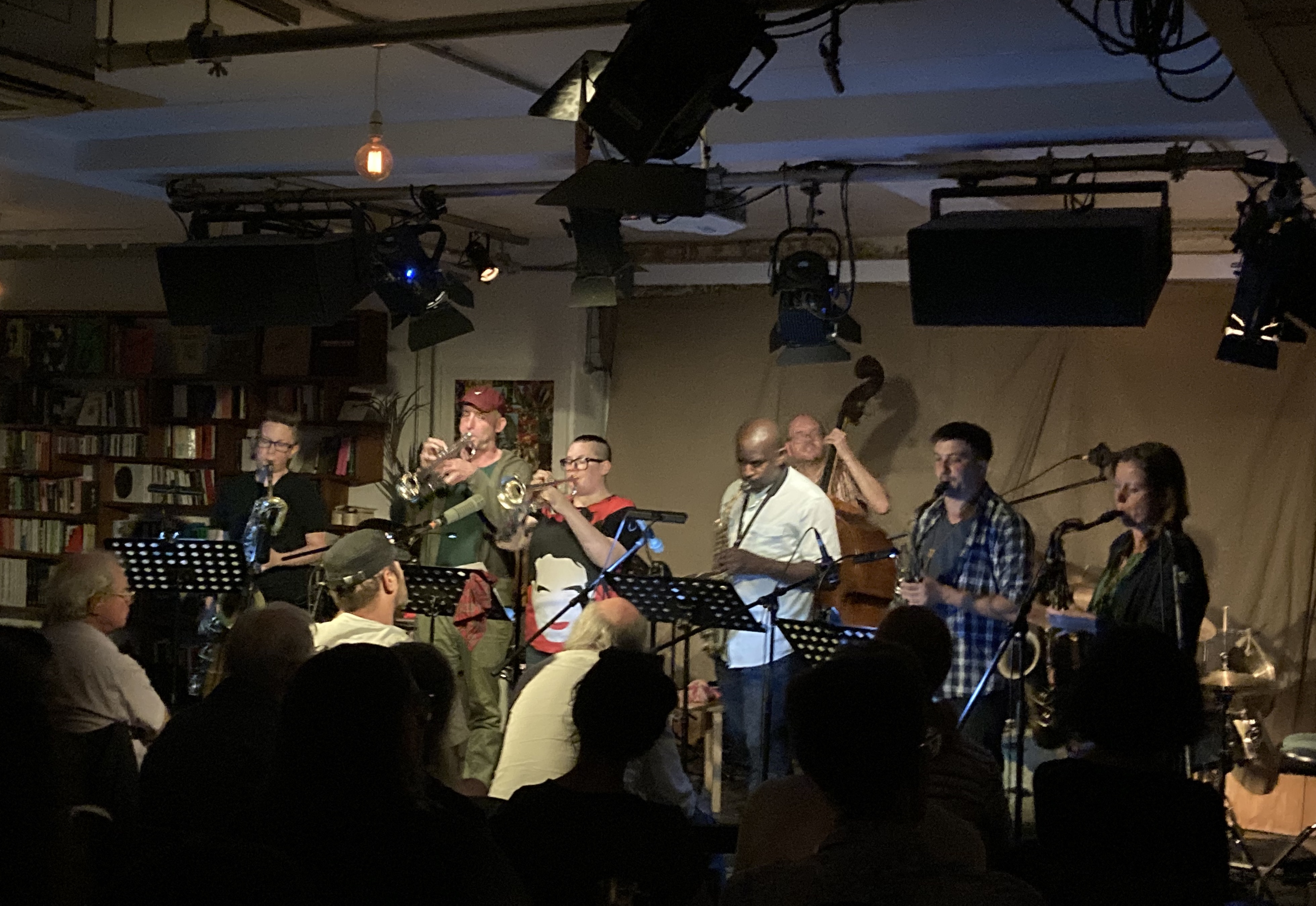
The six horns of Brice’s octet were assembled in a single line, but it soon became apparent that he would be using them as two units: a pair of trumpets (Kim Macari and Alex Bonney) and a baritone saxophone (Cath Roberts) to the left, an alto saxophone (Jason Yarde) and two tenors (George Crowley and Rachel Musson) to the right, with the drummer Johnny Hunter joining Brice in the rhythm section.
The short ensemble passages — sometimes just punctuations between the improvisations — had the kind of loose-woven, slightly ragged ebullience that could remind you of Mingus’s bands or Charlie Haden’s Liberation Music Orchestra, without borrowing moves from either. That made sense, since Mingus and Haden also figure strongly as inspirations for Brice’s own playing, in which virtuosity and passion are equally mixed.
The first two solos, by Macari and Musson, were the kind you want to wrap up and take home: on-the-nose power from the trumpet, beautifully controlled tonal distortion from the tenor. There were many duets, notably one between the soaring Yarde and the agile Bonney. One or two of the solos outstayed their momentum, but with this music that’s a risk worth taking. And what the evening showed was that Brice has his own way of applying organisation to music, shaping it in interesting ways without compromising the crucial spontaneity of expression and interaction.
Alexander Hawkins and Evan Parker (photo: Dawid Laskowski)
Organising free improvisers might seem like a fool’s task. Why would the special breed of players who spend their lives resolutely creating music from scratch suddenly want to submit to the will of a composer? Nevertheless, history proves that sometimes it works: notable successes were recorded by Michael Mantler with the original Jazz Composer’s Orchestra, Alexander von Schlippenbach with his Globe Unity Orchestra and Barry Guy with the London Jazz Composers’ Orchestra. Each project depended to some extent on the leader/composer’s familiarity with the techniques of contemporary European straight music, but the idea was given new impetus with the introduction of the looser and perhaps more organic-to-the-idiom technique of “conduction”, pioneered by the late Butch Morris and pursued by George Lewis and Tyshawn Sorey, among others. Slightly to one side were the adventures of the British duo Ashley Wales and John Coxon, known as Spring Heel Jack, who created stimulating modern environments for many individual improvisers, including Wadada Leo Smith and John Tchicai.
The first sound heard on Togetherness Music: For Sixteen Musicians, Alexander Hawkins’ new album, is that of Evan Parker’s soprano saxophone, unwinding its always surprising coils of sound, the seemingly unbroken skeins of notes punctuated by split-second darts and lurches into other registers. As usual, it’s exhilarating and mesmerising, particularly when the sound of the isolated soprano blooms with reverberation, which may or may not be the natural property of Challow Park Studios in Oxfordshire, where the set was recorded. But then Hawkins introduces his other resources: the five string players of the Riot Ensemble and nine other musicians, including the trumpeter Percy Pursglove, the saxophonist and flautist Rachel Musson, the cellist Hannah Marshall, the bassist Neil Charles, the drummer Mark Sanders, and Matthew Wright on electronics, all conducted by Aaron Hollway-Nahum. Gradually they add sombre pedal-points, heightening the atmosphere before Parker drops out and the strings begin to slip and slide until the piece ends, after almost 10 minutes, with several of them holding a tentative D natural.
Sanders and Pursglove are the next to get the concerto grosso for improvisers treatment, a layer of restless percussion under the silvery trumpet continuing into a dialogue with written lines for flute/bass clarinet and viola/cello. On the third piece Parker returns for a pointilliste conversation with Hawkins’ scrambling piano in which the Riot Ensemble make their full presence known, soaring and churning as the music holds itself together through some mysterious centripetal force.
Hawkins, the 16th musician, is featured on the fourth piece, against a walking line played by two basses (Charles and Marianne Schofield) and possibly one of the two cellos, too. Showing the pianist at his most inventive and hyper-alert, it has the loping gait and harmonically ambiguous flavour of the music created by young Cecil Taylor and the bassist with his early groups, Buell Neidlinger, before Parker pipes up with a reminder of another early Taylor collaborator, Steve Lacy, in a passage of ensemble agitation that resolves into an elegant, ruminative diminuendo.
The strings dominate the fifth piece, a collective statement in which the individual instruments glide around each other as if in mismatched orbits, the fine details of tone and timbre revealed within an aural space that feels busy yet uncluttered. The sixth and final composition opens with a trio of Charles, Sanders and Wright, bass and drums working around light electronic taps, thuds and crackles. Pursglove and Hawkins emerge with staccato trumpet figures and a purposefully wandering single-note piano line, continuing as Sanders briefly dominates with thrashing brushwork before the other musicians reappear in a crescendo of exultant sound. A graceful withdrawal gives the last word to Parker and Hawkins, two improvisers who share a near-infallible instinct for an ending.
The six pieces are titled, in order, “Indistinguishable from Magic”, “Sea No Shore”, “Ensemble Equals Together”, “Leaving the Classroom of a Beloved Teacher”, “Ecstatic Baobabs” and “Optimism of the Will”. I’ve described them in such details because the more you listen, the more distinctive they become: each one a living organism with its own cellular structure, texture and micro-climate. I’ve said before that Hawkins has a rare understanding of how to combine composition and improvisation, and here, in this very special recording, we have a perfect example of his gift.
Perhaps I’ve found Togetherness Music particularly valuable because I’ve missed attending live performances of free improvisation very much over the past year. Recordings of small groups, however excellent, aren’t the same thing as hearing and seeing this music conjured in front of you. But by framing improvisation so creatively, Hawkins brings it to life in a different way.
* Alexander Hawkins’ Togetherness Music is out now on the Intakt label (www.intaktrec.ch)




 thebluemoment.com