Skip to content

Posts tagged ‘Pat Metheny’

Everybody Loves a Train

About twenty years ago, my friend Charlie Gillett was compiling a series of themed CDs for a Polygram label called Debutante, under the aegis of the former Island A&R head Nick Stewart. Charlie asked me if I’d like to put one together, and if so, what the theme might be. “Trains,” I said, after about ten seconds’ thought, and then I went away to assemble a running order. It took a while, because I enjoyed the process so much.

Sadly, the series came to a sudden end before my contribution could see the light of day. But I’d edited together a disc of how I wanted it to go. I called it Everybody Loves a Train, after the song by Los Lobos. It has all sorts of songs, some of which speak to each other in ways that are obvious and not. I avoided the most obvious candidates, even when they perfectly expressed the feeling I was after (James Brown’s “Night Train” and Gladys Knight’s “Midnight Train to Georgia”) and instrumentals, too (see the footnote).

Every now and then I take it out and play it, as I did this week, with a sense of regret that it never reached fulfilment. Here it is, with a gentle warning: not all these trains are bound for glory. Remember, as Paul Simon observes, “Everybody loves the sound of a train in the distance / Everybody thinks it’s true.”

  1. Unknown: “Calling Trains” (From Railroad Songs and Ballads, Rounder 1997) Forty-odd seconds of an unidentified former New Orleans station announcer, recorded at Parchman Farm, the Mississippi state penitentiary, in 1936, calling from memory the itinerary of the Illinois Central’s “Panama Limited” from New Orleans to Chicago: “…Ponchatoula, Hammond, Amite, Independence… Sardis, Memphis, Dyersburg, Fulton, Cairo, Carbondale…” American poetry.
  2. Rufus Thomas: “The Memphis Train” (Stax single, 1968) Co-written by Rufus with Mack Rice and Willie Sparks. Produced by Steve Cropper. Firebox stoked by Al Jackson Jr.
  3. Los Lobos: “Everybody Loves a Train” (from Colossal Head, 1996) “Steel whistle blowin’ a crazy sound / Jump on a car when she comes around.” Steve Berlin on baritone saxophone.
  4. Bob Dylan: “It Takes a Lot to Laugh, It Takes a Train to Cry” (from Highway 61 Revisited, 1965) “Don’t the brakeman look good, mama, flaggin’ down the Double E?”
  5. Joe Ely: “Boxcars” (from Honky Tonk Masquerade, 1978) A Butch Hancock song. Ponty Bone on accordion, Lloyd Maines on steel guitar.
  6. Counting Crows: “Ghost Train” (from August and Everything After, 1993) “She buys a ticket ’cause it’s cold where she comes from / She climbs aboard because she’s scared of getting older in the snow…”
  7. Rickie Lee Jones: “Night Train” (from Rickie Lee Jones, 1979) It was a plane she took from Chicago to LA to begin her new life in 1969, and an old yellow Chevy Vega she was driving before she cashed the 50K advance from Warner Bros ten years later. But, you know, trains.
  8. The Count Bishops: “Train, Train” (Chiswick 45, 1976) London rockabilly/pub rock/proto-punk. Written by guitarist/singer Xenon De Fleur, who died a couple of years later in a car crash, aged 28, on his way home from a gig at the Nashville Rooms. Note that comma. I like a punctuated title.
  9. Julien Clerc: “Le prochain train” (from Julien, 1997) My favourite modern chansonnier. Lyric by Laurent Chalumeau.
  10. Blind Willie McTell: “Broke Down Engine Blues” (Vocalion 78, 1931) Born blind in one eye, lost the sight in the other in childhood. Maybe he saw trains in time to carry their image with him as he travelled around Georgia with his 12-string guitar.
  11. Laura Nyro: “Been on a Train” (from Christmas and the Beads of Sweat, 1970) One song she didn’t do live, as far as I can tell. Too raw, probably.
  12. Chuck Berry: “The Downbound Train” (Chess B-side, 1956) When George Thorogood covered this song, he renamed it “Hellbound Train”. He didn’t need to do that. Chuck had already got there.
  13. Bruce Springsteen: “Downbound Train” (from Born in the USA, 1984) “The room was dark, the bed was empty / Then I heard that long whistle whine…”
  14. Dillard & Clark: “Train Leaves Here This Morning” (from The Fantastic Expedition of Dillard & Clark, 1968) Written by Gene Clark and Bernie Leadon: “1320 North Columbus was the address that I’d written on my sleeve / I don’t know just what she wanted, might have been that it was getting time to leave…”
  15. Little Feat: “Two Trains” (from Dixie Chicken, 1973) In which Lowell George extends the metaphor of Muddy Waters’ “Still a Fool (Two Trains Running)”: “Two trains runnin’ on that line / One train’s for me and the other’s a friend of mine…”
  16. B. B. King: “Hold That Train” (45, 1961) “Oh don’t stop this train, conductor, ’til Mississippi is out of sight / Well, I’m going to California, where I know my baby will treat me right”
  17. Paul Simon: “Train in the Distance” (from Hearts and Bones, 1983) Richard Tee on Fender Rhodes. “What is the point of this story? / What information pertains? / The thought that life could be better / Is woven indelibly into our hearts and our brains.”
  18. Vince Gill: “Jenny Dreams of Trains” (from High Lonesome Sound, 1996) Written by Gill with Guy Clark. Fiddle solo by Jeff Guernsey. Find me something more beautiful than this, if you can.
  19. Muddy Waters: “All Aboard” (Chess B-side, 1956) Duelling harmonicas: James Cotton on train whistle effects, Little Walter on chromatic.
  20. Darden Smith: “Midnight Train” (from Trouble No More, 1990) “And the years go by like the smoke and cinders, disappear from where they came…”
  21. The Blue Nile: “From a Late Night Train” (from Hats, 1989) For Paul Buchanan, the compartment becomes a confessional.
  22. Tom Waits: “Downtown Train” (from Rain Dogs, 1985) “All my dreams, they fall like rain / Oh baby, on a downtown train.” A New York song.

Closing music: Pat Metheny’s “Last Train Home” (from Still Life (Talking), 1987) to accompany the photo of the Birmingham Special crossing Bridge No 201 near Radford, Virginia in 1957 — taken, of course, by the great O. Winston Link. Other appropriate instrumentals: Booker T & the MGs’ “Big Train” (from Soul Dressing, 1962, a barely rewritten “My Babe”) and Big John Patton’s “The Silver Meter Pts 1 & 2” (Blue Note 45, 1963, a tune by the drummer Ben Dixon whose title is a misspelling of the Silver Meteor, a sleeper service running from New York to Miami).
The state of things

Robert Cray etc 2

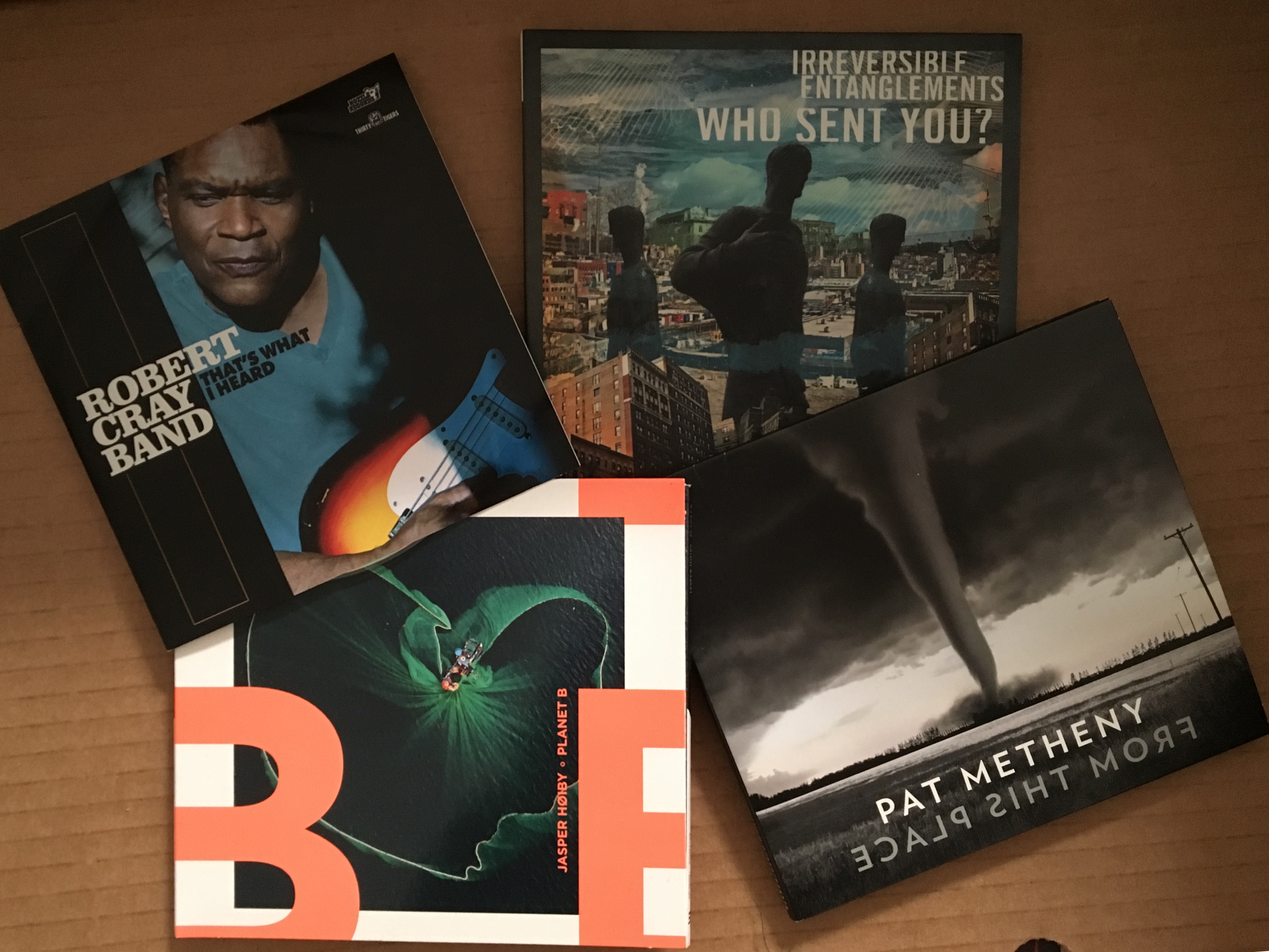
One characteristic of despotic governments is an urge to suppress or deride art that does not serve their own purpose; hence Hitler’s persecution of “degenerate art” and Stalin’s enthusiasm for socialist realism. We haven’t quite reached that stage, but the political role of artists of all kinds grows more important in times such as these. Here are four new recordings with something to say.

1 Robert Cray Band: “This Man”

In his excellent new album, That’s What I Heard, Cray and his producer, Steve Jordan, explore a variety of approaches with great success (for example, there’s a gorgeous version of “You’ll Want Me Back”, which Curtis Mayfield wrote for Major Lance in 1966). But one track really stands out. On “This Man” he takes a standard blues trope — a stranger arrives in the singer’s home and tries to steal his woman — and turns it to a different use. The groove is down and funky, the mood ominous. “Who is this man in our house? / Who is this man? Better get him out! / We’ve got a problem, he’s gotta go / If he don’t leave, we can’t live here no more / If we want to save our home, better get him out.” Next verse: “When I come home from work, there he is again / Talkin’ loud, talkin’ trash, and it’s always something about him…” I don’t think it’s hard to identify the connection we’re being invited to make. The refrain goes “Get him out! Get him out! Get him out!” If songs could win elections…

2 Irreversible Entanglements: Who Sent You?

As well as being probably the finest solution yet devised to the eternal problem of how to blend jazz and poetry in a way that satisfies the requirement of both, Chicago’s Irreversible Entanglements are also a great protest band. Camae Ayewa — sometimes known as Moor Mother — rivals Matana Roberts as an eloquent writer and spellbinding declaimer of poetic texts. The musicians — Aquiles Navarro (trumpet), Keir Neuringer (alto saxophone), Luke Stewart (bass) and Tcheser Holmes (drums) — bring the open lines and flexible interplay of Ornette Coleman’s classic quartet and the explicit cultural grounding of Eddie Gale’s Ghetto Music into the 21st century. Who Sent You?, the collective’s second album, presents the coolly controlled sound of an angry and insurrectionary America that will not be silenced.

3 Pat Metheny: From This Place

With “This Is Not America”, co-written with Lyle Mays and David Bowie in 1985 for the movie The Falcon and the Snowman, Pat Metheny created a piece whose resonance has grown over the intervening three and a half decades, whether you’re listening to the original or to the version by Charlie Haden’s Liberation Music Orchestra on the album Not in My Name. The undertone of his latest album, even in its most lyrical moments, is one of disquiet. The oncoming twister pictured on the cover looms as the music begins with a long, complex, multi-sectioned piece called “America Undefined”. There is wonderful playing throughout by the pianist Gwilym Simcock, the drummer Antonio Sànchez and — particularly — the marvellous bassist Linda May Han Oh, against discreet and effective orchestral arrangements on some pieces. Grégoire Maret adds lovely harmonica, and the title track features Meshell Ndegeocello singing Alison Riley’s lyric: “From this place I cannot see / Heart is dark / Beneath rising seas…”

4 Jasper Høiby: Planet B

The Danish bassist and composer probably best known for his work with Phronesis assembles a different multinational trio to tackle climate change and related social issues. The British saxophonist Josh Arcoleo and the French drummer Marc Michel are more than ready for the challenge of the exposed format, helped by the inventiveness of Høiby’s compositions and his subtle use of electronics — and by the sparing inclusion of words spoken by thinkers including Ram Dass, Grace Lee Boggs, Charles Eisenstein and Jiddu Krishnamurti. Their speech is incorporated with the lightest of touches, providing a framework within which the music speaks in its own language. “If we could truly collaborate with our fellow man,” Ram Dass says, “there would be enough to go around for the world.” Music that relies on unselfish collaboration has much to teach tyrants, actual and would-be.

* The Robert Cray Band’s That’s What I Heard is on the Thirty Tigers label. They tour the UK from April 30 to May 16, starting in Bexhill-on-Sea. Irreversible Entanglements’ Who Sent You? is on IARC/Don Giovanni. They play the Corsica Studios, London on March 10. Pat Metheny’s From This Place is on Nonesuch. Jasper Høiby’s Planet B is on Edition Records.

Lyle Mays, soundpainter

As Falls Wichita

This September it will be 40 years since Lyle Mays and Pat Metheny went into a studio with the producer Manfred Eicher to piece together the 20-minute work that gave its name to an album: “As Falls Wichita, So Falls Wichita Falls”. A sidebar to their work together as members of the Pat Metheny Group, it soon became recognised as a remarkable free-standing piece of work.

Crudely put, it functions as the soundtrack to an imaginary film: starting with the babble of voices — a sports crowd? a street market? a political demonstration? — and the thrumming of a bass guitar, evolving into gorgeous tunes built sometimes simply of chords, sometimes of melodies whistled or played on a berimbau (a heartbreaking twang). All sorts of soundscapes are evoked, and all sorts of weather, through textures that are constantly shifting and blending. The sound of Metheny’s various guitars and Mays’s keyboards and synths is of its time, but timeless, too. The berimbau is played by Nana Vasconcelos, who also contributes percussion and is the only other musician present.

It’s a beautiful American tone poem, epic in its sweep but also intimate in its approach to the listener. Later in the decade Metheny’s group would record the great “Last Train Home”, which felt then, and still feels, like a coda to the longer piece.

Lyle Mays died on February 10, aged 66, after a long illness. “As Falls Wichita, So Falls Wichita Falls” is likely to live as long as people are still listening to the recorded music of the twentieth century.

* The album As Falls Wichita, So Falls Wichita Falls was released in 1981 on the ECM label. The photograph, taken by Klaus Frahm (father of Nils), is from the cover.