Sylvie Courvoisier x 2
One way and another, Sylvie Courvoiser’s new album, Chimaera, contains the most sheerly beautiful music I’ve heard this year. Inspired by the paintings and drawings of Odilon Redon (1840-1916), these pieces recall the words of the French artist about his own work: “They place us, as does music, in the ambiguous realm of the undetermined.” Without getting remotely literal about it, Courvoisier finds ways of creating a music parallel to such works as “Partout des prunelles flamboient (Everywhere eyeballs are ablaze)” and “Le pavout rouge (The red poppy)”, summoning dream-like textures that swirl and mingle, float and evaporate, creating pictures of their own.
Courvoisier, the Swiss-born pianist and composer, has lived in Brooklyn for the past 25 years, becoming an important figure in the New York downtown scene. Her band for the new album unites her partners in her regular trio, the bassist Drew Gress and the drummer and vibraphone-player Kenny Wollesen, with the trumpeters Wadada Leo Smith and Nate Wooley and the Austrian guitarist Christian Fennesz, who brings along his array of electronic tools. The broad palette of instrumental colours is used with immense care and subtlety, and with a sense of spatial resolution that invites the listener’s engagement.
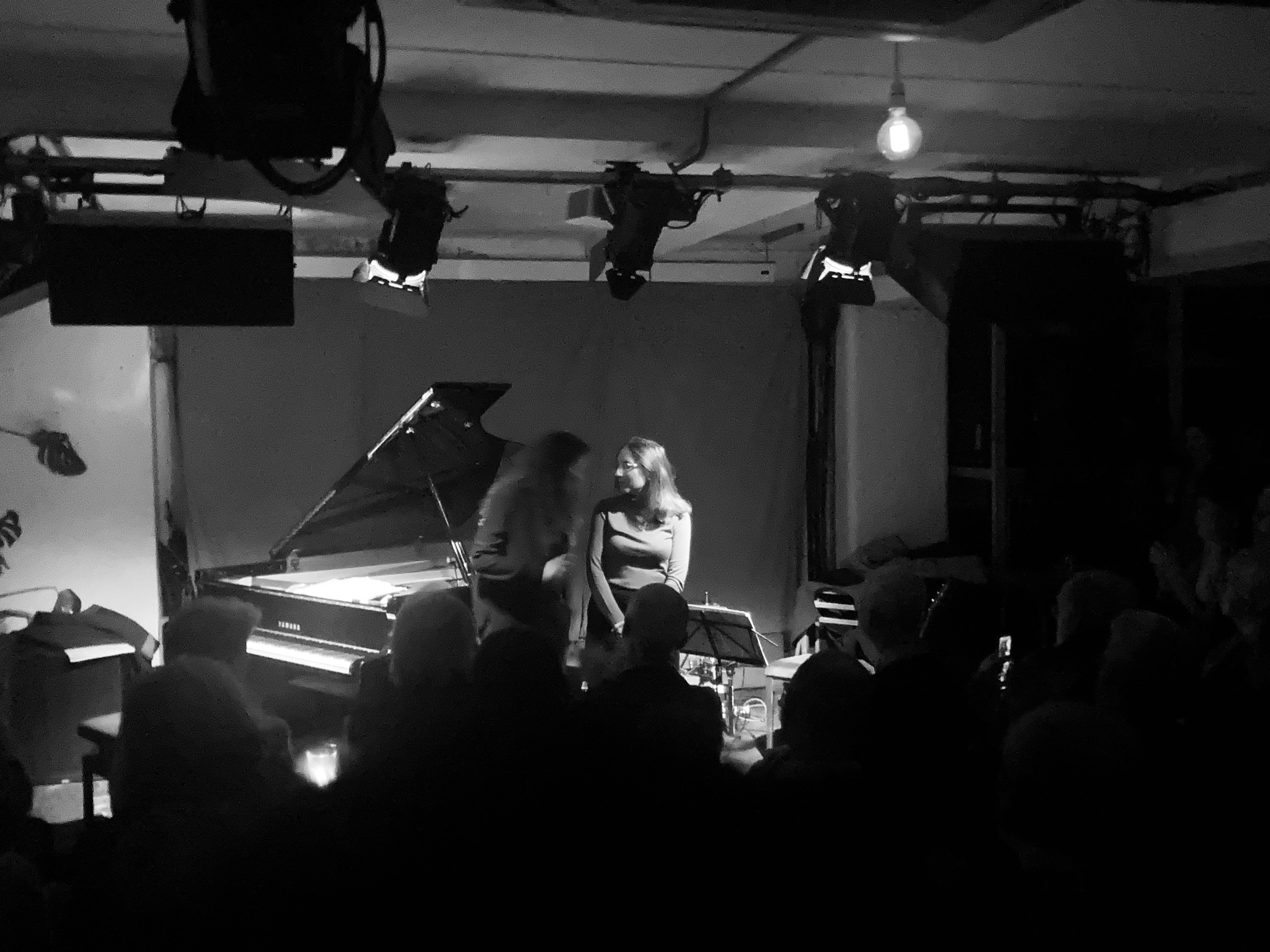
She was at Café Oto in London last night with another regular partner, the guitarist Mary Halvorson, to present music based on their most recent album together, Searching for the Disappeared Hour. As piano-guitar duos go, this was neither Bill Evans with Jim Hall nor Cecil Taylor with Derek Bailey, although it contained elements of both those rare partnerships: the elegance of detail of the first and the fearless extended vocabularies of the second. This was music characterised by exactitude and generosity, making its own unique world, in which dizzyingly rapid written passages, never gratuitous, opened out into spellbinding improvised solo passages.
* Sylvie Courvoisier’s Chimaera is on the Intakt label. Couvoisier and Mary Halvorson’s Searching for the Disappeared Hour is on Pyroclastic Records.
 Matana Roberts was reminiscing about the first time she played with the great bassist Henry Grimes. It was during the New York blackout of 2004, when she was scheduled to appear at the Jazz Gallery with a group including Grimes and the pianist Vijay Iyer. She had been travelling on the L train from her home in Queens, and it had just emerged from the tunnel under the East River when all power vanished across the length and breadth of the city.
 thebluemoment.com