Skip to content

Posts tagged ‘Muddy Waters’

Everybody Loves a Train

About twenty years ago, my friend Charlie Gillett was compiling a series of themed CDs for a Polygram label called Debutante, under the aegis of the former Island A&R head Nick Stewart. Charlie asked me if I’d like to put one together, and if so, what the theme might be. “Trains,” I said, after about ten seconds’ thought, and then I went away to assemble a running order. It took a while, because I enjoyed the process so much.

Sadly, the series came to a sudden end before my contribution could see the light of day. But I’d edited together a disc of how I wanted it to go. I called it Everybody Loves a Train, after the song by Los Lobos. It has all sorts of songs, some of which speak to each other in ways that are obvious and not. I avoided the most obvious candidates, even when they perfectly expressed the feeling I was after (James Brown’s “Night Train” and Gladys Knight’s “Midnight Train to Georgia”) and instrumentals, too (see the footnote).

Every now and then I take it out and play it, as I did this week, with a sense of regret that it never reached fulfilment. Here it is, with a gentle warning: not all these trains are bound for glory. Remember, as Paul Simon observes, “Everybody loves the sound of a train in the distance / Everybody thinks it’s true.”

  1. Unknown: “Calling Trains” (From Railroad Songs and Ballads, Rounder 1997) Forty-odd seconds of an unidentified former New Orleans station announcer, recorded at Parchman Farm, the Mississippi state penitentiary, in 1936, calling from memory the itinerary of the Illinois Central’s “Panama Limited” from New Orleans to Chicago: “…Ponchatoula, Hammond, Amite, Independence… Sardis, Memphis, Dyersburg, Fulton, Cairo, Carbondale…” American poetry.
  2. Rufus Thomas: “The Memphis Train” (Stax single, 1968) Co-written by Rufus with Mack Rice and Willie Sparks. Produced by Steve Cropper. Firebox stoked by Al Jackson Jr.
  3. Los Lobos: “Everybody Loves a Train” (from Colossal Head, 1996) “Steel whistle blowin’ a crazy sound / Jump on a car when she comes around.” Steve Berlin on baritone saxophone.
  4. Bob Dylan: “It Takes a Lot to Laugh, It Takes a Train to Cry” (from Highway 61 Revisited, 1965) “Don’t the brakeman look good, mama, flaggin’ down the Double E?”
  5. Joe Ely: “Boxcars” (from Honky Tonk Masquerade, 1978) A Butch Hancock song. Ponty Bone on accordion, Lloyd Maines on steel guitar.
  6. Counting Crows: “Ghost Train” (from August and Everything After, 1993) “She buys a ticket ’cause it’s cold where she comes from / She climbs aboard because she’s scared of getting older in the snow…”
  7. Rickie Lee Jones: “Night Train” (from Rickie Lee Jones, 1979) It was a plane she took from Chicago to LA to begin her new life in 1969, and an old yellow Chevy Vega she was driving before she cashed the 50K advance from Warner Bros ten years later. But, you know, trains.
  8. The Count Bishops: “Train, Train” (Chiswick 45, 1976) London rockabilly/pub rock/proto-punk. Written by guitarist/singer Xenon De Fleur, who died a couple of years later in a car crash, aged 28, on his way home from a gig at the Nashville Rooms. Note that comma. I like a punctuated title.
  9. Julien Clerc: “Le prochain train” (from Julien, 1997) My favourite modern chansonnier. Lyric by Laurent Chalumeau.
  10. Blind Willie McTell: “Broke Down Engine Blues” (Vocalion 78, 1931) Born blind in one eye, lost the sight in the other in childhood. Maybe he saw trains in time to carry their image with him as he travelled around Georgia with his 12-string guitar.
  11. Laura Nyro: “Been on a Train” (from Christmas and the Beads of Sweat, 1970) One song she didn’t do live, as far as I can tell. Too raw, probably.
  12. Chuck Berry: “The Downbound Train” (Chess B-side, 1956) When George Thorogood covered this song, he renamed it “Hellbound Train”. He didn’t need to do that. Chuck had already got there.
  13. Bruce Springsteen: “Downbound Train” (from Born in the USA, 1984) “The room was dark, the bed was empty / Then I heard that long whistle whine…”
  14. Dillard & Clark: “Train Leaves Here This Morning” (from The Fantastic Expedition of Dillard & Clark, 1968) Written by Gene Clark and Bernie Leadon: “1320 North Columbus was the address that I’d written on my sleeve / I don’t know just what she wanted, might have been that it was getting time to leave…”
  15. Little Feat: “Two Trains” (from Dixie Chicken, 1973) In which Lowell George extends the metaphor of Muddy Waters’ “Still a Fool (Two Trains Running)”: “Two trains runnin’ on that line / One train’s for me and the other’s a friend of mine…”
  16. B. B. King: “Hold That Train” (45, 1961) “Oh don’t stop this train, conductor, ’til Mississippi is out of sight / Well, I’m going to California, where I know my baby will treat me right”
  17. Paul Simon: “Train in the Distance” (from Hearts and Bones, 1983) Richard Tee on Fender Rhodes. “What is the point of this story? / What information pertains? / The thought that life could be better / Is woven indelibly into our hearts and our brains.”
  18. Vince Gill: “Jenny Dreams of Trains” (from High Lonesome Sound, 1996) Written by Gill with Guy Clark. Fiddle solo by Jeff Guernsey. Find me something more beautiful than this, if you can.
  19. Muddy Waters: “All Aboard” (Chess B-side, 1956) Duelling harmonicas: James Cotton on train whistle effects, Little Walter on chromatic.
  20. Darden Smith: “Midnight Train” (from Trouble No More, 1990) “And the years go by like the smoke and cinders, disappear from where they came…”
  21. The Blue Nile: “From a Late Night Train” (from Hats, 1989) For Paul Buchanan, the compartment becomes a confessional.
  22. Tom Waits: “Downtown Train” (from Rain Dogs, 1985) “All my dreams, they fall like rain / Oh baby, on a downtown train.” A New York song.

Closing music: Pat Metheny’s “Last Train Home” (from Still Life (Talking), 1987) to accompany the photo of the Birmingham Special crossing Bridge No 201 near Radford, Virginia in 1957 — taken, of course, by the great O. Winston Link. Other appropriate instrumentals: Booker T & the MGs’ “Big Train” (from Soul Dressing, 1962, a barely rewritten “My Babe”) and Big John Patton’s “The Silver Meter Pts 1 & 2” (Blue Note 45, 1963, a tune by the drummer Ben Dixon whose title is a misspelling of the Silver Meteor, a sleeper service running from New York to Miami).
Chris Barber turns 90

5d654f0341869b004e096c6a_Chris-Barber-and-Muddy-Waters-et-al_news

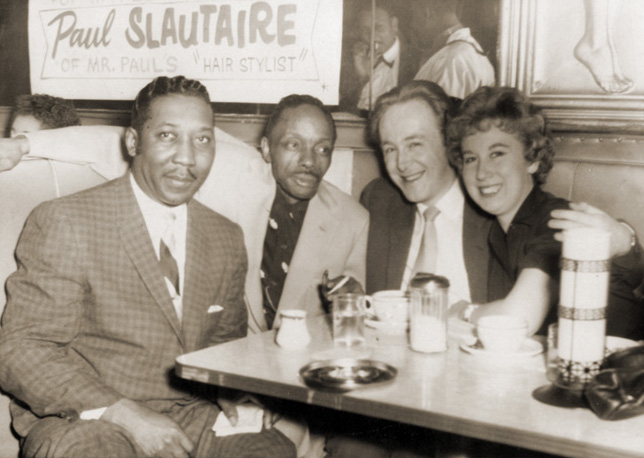
Chicago, 1959: Muddy Waters, St Louis Jimmy Oden, Chris Barber and Ottilie Patterson

Chris Barber is 90 today. Few people have had a more profound impact on the course of my generation’s musical tastes in the six and a half decades since he encouraged his banjoist/guitarist, Lonnie Donegan, to continue the habit — started when they were both members of Ken Colyer’s Jazzmen — of breaking up an evening of New Orleans music with a skiffle turn in the intervals, thus leading directly to “Rock Island Line” and all else that followed.

That was no fluke. Barber had broad taste and was a lifelong proselytiser for great music and great musicians. He loved the blues, and in the late ’50s he brought Sister Rosetta Tharpe and Muddy Waters to Britain. The legend goes that purists turned up to hear Muddy sing the “authentic” Delta blues on an acoustic guitar and were scandalised when he plugged in his Telecaster and let rip with the electrified Chicago version. Luckily, at least as far as history goes, the purists were in the minority. Barber also brought over Big Bill Broonzy and Sonny Terry and Brownie McGhee, thus helping to shape the tastes of a generation who would soon become Rolling Stones, Yardbirds, Blues Breakers and thousands more.

Barber’s own ensembles veered gently away from the strict New Orleans format, adding an electric guitarist and extra horns (including saxophones, anathema to traddies). Later Paul Jones was often the featured singer with the Big Chris Barber Band, which I last saw playing in the park in central Baden-Baden on a sunny summer afternoon during the 2006 World Cup. On that occasion the bandshell was only 100 yards or so from the five-star hotel where the wives and girlfriends of the England team were staying, staked out by Fleet Street’s paparazzi, but I don’t recall any of them leaving their poolside loungers to listen.

Last year Chris announced his retirement. On his 90th birthday, I’d like to thank him for all he did, directly and indirectly, to guide so many of us towards the music that changed our lives. And, of course, to wish him many happy returns.

Muddy Waters: Behind the sun

Muddy Waters

A new compilation of Muddy Waters’ recordings for the Chess label got me listening obsessively this week to “Louisiana Blues”, one of my favourite pieces of American music. The pleasure was enhanced by the fact that the mastering of Can’t Be Satisfied: The Very Best of Muddy Waters 1947-1975 gives the music, recorded on primitive equipment at the Chess Studio in Chicago almost 70 years ago, a new clarity without compromising its grainy warmth.

Recorded on October 23, 1950 with Little Walter Jacobs on harmonica, Ernest “Big” Crawford on string bass, the drummer Elgin Evans tapping something (possibly a washboard) almost subliminally, and an unknown second guitarist, “Louisiana Blues” has the subtlety and intricacy of chamber music. Opened by Muddy’s quivering unaccompanied bottleneck guitar, it eases quickly into a graceful pattern that switches between a light-footed stride and a funkier half-time rhythm as the instrumental lines wind around each other.

The time is hard to follow: there’s a basic 4/4, but Muddy throws in individual bars of 2/4 and 3/4. Unlike John Lee Hooker, however, he doesn’t do it because the symmetry of the conventional 12-bar blues is of no consequence to him. He does it because that’s what the natural cadence of the song, whose melody line echoes the bottleneck phrases, is demanding. You know that nothing was ever written down on a piece of manuscript paper that day in 1950, but this is nevertheless a fully composed piece.

If you’re trying to count the bars, it’s hard to follow — for me, anyway. And that’s what gives the record its everlasting mystery. It won’t stand still for you. It keeps moving to its own multi-layered momentum, seeming to slide out of your grasp while simultaneously pulling you forward with it.

Muddy wrote it, and I have a particular fondness for the first verse: “I’m going down in Louisiana / Baby, behind the sun / Well I just found out / My troubles just begun…” Behind the sun? That’s the poetry of the blues right there, in an image that leaps beyond literal meaning into the realm of the imagination. And the firm but gentle way he bends those words, laying them against the warping harmonica and bottleneck phrases, shows a supreme musicality at work.

(Another bluesman, Louisiana Red, used the phrase to introduce himself a dozen years on his first album, The Lowdown Back Porch Blues: “I am Louisiana Red / And I come from behind the sun…” Were they Muddy’s original words, or had he already borrowed them from someone else? I have no idea. But he makes them belong to him.)

Anyway, this three-minute act of perfection, characterised by a wonderfully delicate balance of interplay which we white boys of the 1960s could hope to do no more than crudely approximate, gave Muddy his first Top 10 hit in the R&B chart in February 1951, which says something about the good taste of his public. Now it’s hard to imagine a time when people all over the world won’t still be listening to it.

* Can’t Be Satisfied is a 2CD set, released on Universal’s Spectrum imprint. Its 40 tracks, selected by Russell Beecher, include material from many of Muddy’s single and album releases during his time with Chess, including selections from his 1960 Newport live album, Muddy Waters: Folk Singer, Folk Festival of the Blues, Electric Mud, Live at Mr Kelly’s and The London Muddy Waters Sessions. Listening to it sent me back to Robert Gordon’s Waters biography, also called Can’t Be Satisfied, published by Jonathan Cape in the UK in 2002 and still highly recommended.

The real rhythm and blues

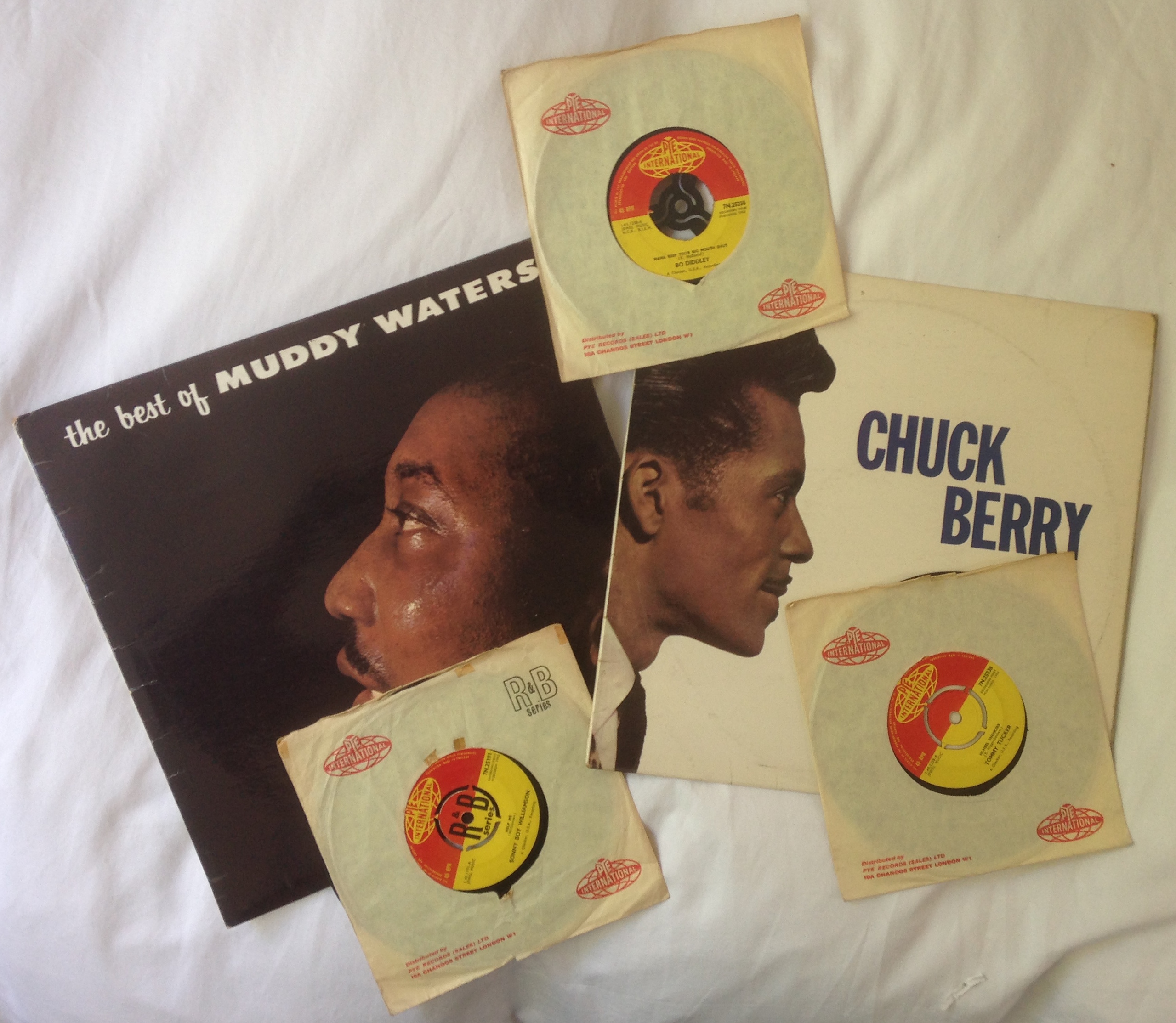
ChessWilko Johnson’s new autobiography, Don’t You Leave Me Here, received an eloquent recommendation from Mark Ellen in the Sunday Times at the weekend. To coincide with its publication, Universal’s Spectrum imprint is issuing a 40-track double CD set compiled by the former Dr Feelgood guitarist called The First Time I Met the Blues: Essential Chess Masters. Its appearance prompted me to dig out the records you see above: three 45s from my all-time Top 100 box, plus two magnificent albums, all licensed for release in the UK on the Pye International label in the early ’60s.

That red and yellow label still triggers an emotional response, particularly when the centre and the paper sleeve carry the “R&B Series” logo, as the copy of Sonny Boy Williamson’s “Help Me” pictured above does. Why it didn’t also appear on records like Tommy Tucker’s “Hi-Heel Sneakers” and Bo Diddley’s “Mama Keep Your Big Mouth Shut” is a question that someone out there might be able to answer.

It’s a good compilation, equally valuable to those who no longer have their original copies and to newcomers who would like a compact introduction to a golden age of Chicago rhythm and blues. There are masterpieces here: Muddy Waters’s “Hoochie Coochie Man”, Little Walter’s “My Babe”, Howlin’ Wolf’s “Smokestack Lightnin'” and “Goin’ Down Slow”, Sonny Boy’s “Don’t Start Me to Talkin'”, John Lee Hooker’s “I’m in the Mood”, Chuck Berry’s “Memphis, Tennessee” — the songs that those of us who were in British R&B groups in 1963-65 were required to know.

Muddy’s “I Can’t Be Satisfied” — recorded in 1948 with Ernest “Big” Crawford’s stand-up bass accompanying the singer’s bottleneck guitar, the two of them sounding like the whole band Waters was soon to assemble — remains one of the great moments in American popular music: magical and mysterious, a perfect integration of voice and instruments, an endlessly fascinating essay in rhythmic subtlety. “Louisiana Blues”, from a band session two years later, runs it close in that respect. It’s interesting to think about the way these particular tracks sounded before a drummer came in to tie down the beat: they float so loose and free (Elgin Evans is credited on “Louisiana Blues”, but his contribution is practically subliminal).

In some ways, however, my favourite among the 40 tracks has to be “Hi-Heel Sneakers”: a record that, in the early weeks of 1964, any young person with the slightest pretension to coolness simply had to own. It amazes me now that this modest little 12-bar blues could become not just a mod classic in the UK but such a big hit on the pop charts: No 11 in the US (Billboard), where it had the benefit of a huge number of black record-buyers, and No 23 in Britain (Record Retailer), where it didn’t.

Tucker (born Robert Higginbotham in Springfield, Ohio) sang and played organ on his own song. That exquisite and unforgettable guitar intro seems to have been played by Dean Young from Ripley, Tennessee — a member, along with bassist Brenda Jones and drummer Bo Tolliver, of Tucker’s regular band, who negotiated a then-fashionable chord pattern that echoed Jimmy Reed’s “Shame Shame Shame” and Marvin Gaye’s “Can I Get a Witness”. The producer, Herb Abramson (an original co-founder of Atlantic Records with Ahmet Ertegun), wisely left them to get on with it. They cannot have dreamed for a single instant that it would still be listened to and loved more than half a century later.

* This post originally credited the new compilation to the Ace label. Once the error was pointed out, I corrected it. The relevant label is Spectrum.