Skip to content

Posts tagged ‘Mike Westbrook’

Mike Westbrook at the piano
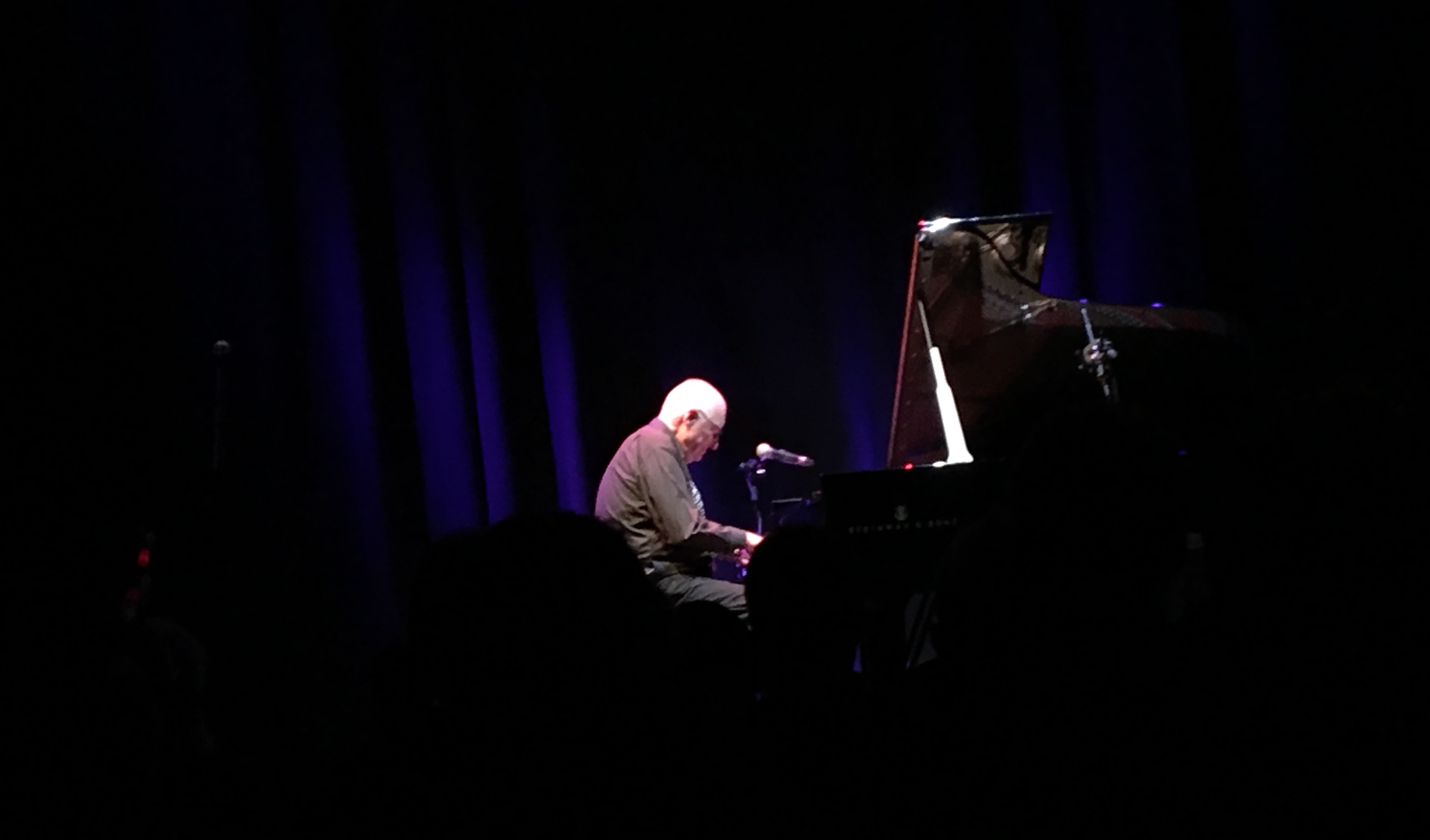
mike-westbrook-kp2In the days leading up to Mike Westbrook’s solo recital at Kings Place on Saturday afternoon, part of the EFG London Jazz Festival, I’d attended a run of performances by several younger pianists — Kit Downes, Michael Wollny, Giovanni Guidi and Jason Moran — of great reputation and achievement. Spending just over an hour listening to Westbrook as he stitched together songs that have meant much to him over the years provided a useful reminder of what age can bring.

Westbrook turned 80 this year. Afterwards, in conversation with Philip Clark, he spoke of the way a prolonged examination can change the material: “a deep process”, he called it, and one which he applied with equal success to songs by Duke Ellington (“Sophisticated Lady”) and Thom Bell (“You Make Me Feel Brand New”) and to pieces from his own pen, including some from his works inspired by Blake, Goethe and Lawrence.

“You don’t have too much respect for the material,” he observed. “You use it. You find harmonies that interest you more than the original. You layer one chord on top of another to make it more magical, or more beautiful, or even to throw a spanner in the works. But it’s not random. It’s logical.” The reharmonisation of some of these pieces was striking. “It’s no secret,” Westbrook said, “that when you’re writing arrangements at the piano, you become a master at holding down chords while you reach for a pen to write them down. I’ve developed a piano style almost out of that.”

It’s his version of what used to be called “arranger’s piano”, the spare approach associated with Tadd Dameron and Gil Evans, among others. And you could hear very specifically what he meant when he struck thick, dark chords and allowed them to resonate and bounce off the lid of the 7ft Steinway Model B in the silence between “You Make Me Feel Brand New” and “A Nightingale Sang in Berkeley Square”.

The mood was reflective, sometimes elegiac, particularly when he included a First World War poem in the first of the long, loosely themed sequences into which the recital was divided. Throughout the hour I loved the sense of a man playing these pieces for the thousandth time but still searching for new angles, new shapes, and new combinations of notes with which to deepen his investigation of their wordless essence. There was not a wasted note, not a superfluous gesture, not the tiniest hint of display for its own sake.

Much of the programme reflected the structure of his new solo album, which is titled Paris and was recorded earlier this year in an art gallery and performance space near the Porte d’Orléans. In his online notes to the album (to be found at http://www.westbrookjazz.co.uk), he says this while introducing the sequence of pieces grouped under the heading of Bar Room Music: “I often enjoy playing the piano in a crowded room where people are talking. Though almost no one is paying any attention to the music, it nevertheless affects the general atmosphere.”

Those words reinforce his strong sense of the social function of music, made explicit in the past in the work he and his wife Kate have done with street theatre groups and with their brass band. But the Kings Hall recital was at the opposite end of the spectrum: a carefully focused performance in an optimum listening environment, in front of a rapt full house. As always with Westbrook, a massive authority was lightly worn– but its presence was never in doubt, and the result was unforgettable.

* Paris is out now on the ASC label.
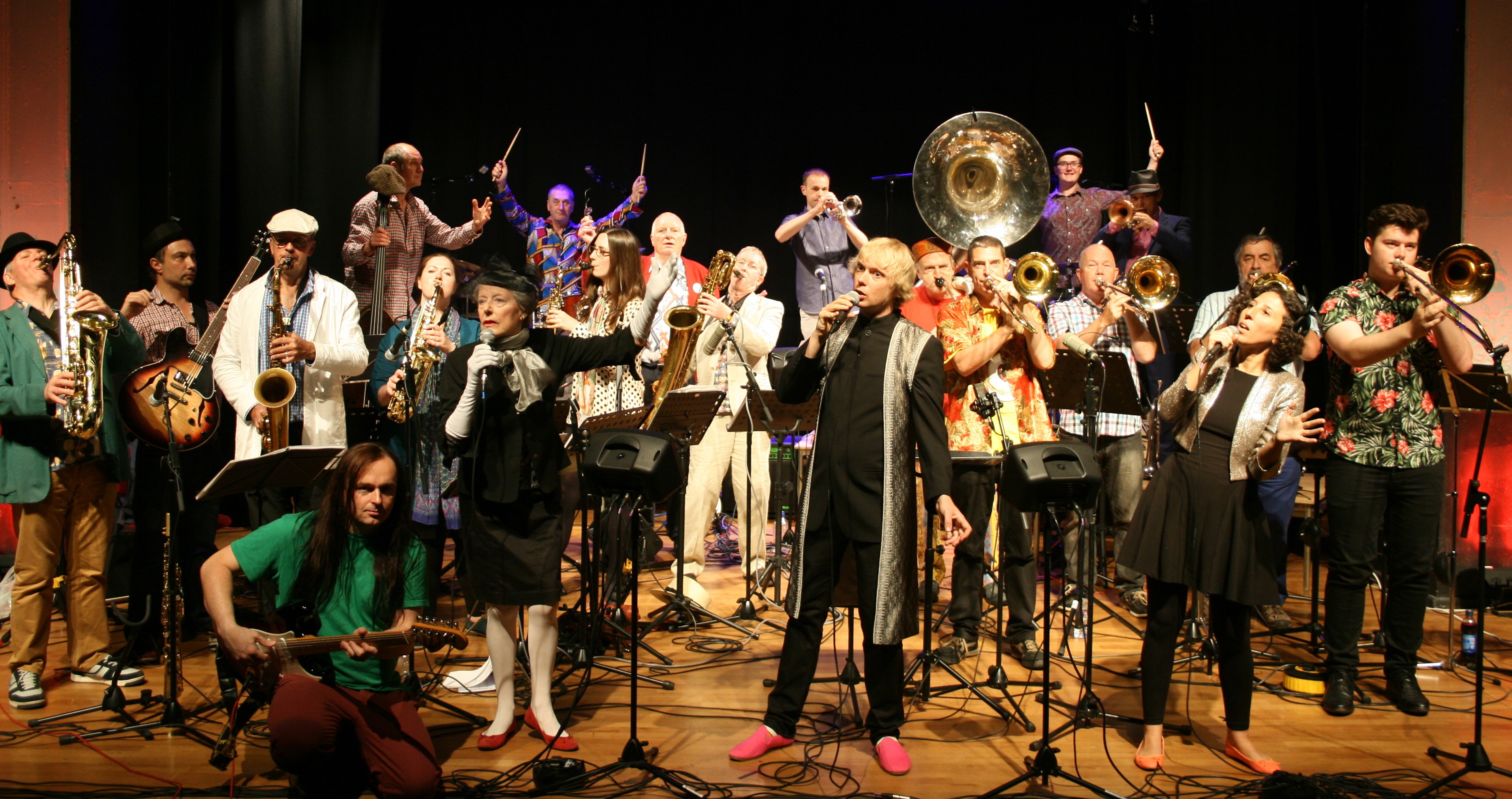
Mike Westbrook’s Bigger Show

The Uncommon Orchestra image 1The great English jazz composer and bandleader Mike Westbrook turns 80 next month — on March 21, to be exact. His long career is studded with extended works of great ambition and achievement: Marching Song, Metropolis, Citadel/Room 315, The Westbrook BlakeThe Cortège (his masterpiece, for my money), On Duke’s Birthday, London Bridge Is Broken Down, Mama Chicago, and others. What began in the late 1960s as a distinctively Westbrookian conception of jazz — with undertones of the approach Ellington and Mingus took to blending composition and improvisation — was broadened by an engagement with street theatre and brass bands, and by a collaboration with his wife, the singer and librettist Kate Westbrook, on pieces that reflected the influence of Berlin theatre song and British music hall.
And now there’s another magnum opus to celebrate. A Bigger Show is a piece in eight sections, lasting almost two hours, performed by Westbrook’s latest large ensemble, the Uncommon Orchestra, a 21-piece unit based around his home in Devon. Due to its size, it doesn’t often show its face. But last summer a recording of the piece was made at Exeter’s Barnfield Theatre, and the results — produced by Jon Hiseman — are out now on a 2CD set.

The suite was inspired by the old St Bartholomew’s Day fair, which took place in Smithfield, in the City of London, continuously between the 12th and 19th centuries until it was closed down in 1855 on the grounds of excessive rowdiness and debauchery. Back in 1975 Westbrook’s Brass Band took part in a production of Ben Jonson’s play Bartholomew Fair, and the idea grew into its present incarnation.

Once again the Westbrooks’ vision of modern life finds powerful expression in a work featuring rousing and often turbulent ensemble work with instrumental solos of real substance from such familiar figures as Alan Wakeman on soprano and tenor saxophones and Dave Holdsworth on pocket trumpet and Sousaphone, and newer names like the altoist Roz Harding, the trumpeter Sam Massey and the tenorist Gary Bayley. As has been the case with Mike Westbrook since the beginning of his career, the improvisations emerge from the arrangements in an organic and dramatically satisfying way — the work of composer who has paid close (but never imitative) attention to the lessons handed out by Ellington, Mingus and Gil Evans.

The tone is variously raucous and tender, celebratory and scathing. Kate Westbrook’s lyrics, sung by herself, Martine Waltier and Billy Bottle, are etched in acid (particularly in a song satirising the social media). Human nature and human behaviour, they suggest, are little altered since the days of Blake and Hogarth: in an era when the gap between affluence and poverty is widening rapidly, only the superficial symptoms of excess and deprivation differ.

All this is achieved with a courage, a vigour and a generosity of spirit always characteristic of Mike Westbrook’s work. A Bigger Show is ambitious, thought-provoking, and exhilarating; when it ends, you feel as though you’ve been on a journey. Perhaps one day his extended pieces will be acclaimed as belonging among the most acutely relevant cultural artefacts of our time. Until then, here’s a new one to treasure.

* A Bigger Show is released on ASC Records. Westbrook and the Uncommon Orchestra will perform the piece at the Brewhouse Theatre in Taunton on April 1, Kings Place in London on May 20, and the Plough Arts Centre in Torrington on June 10.

Westbrook’s Blake

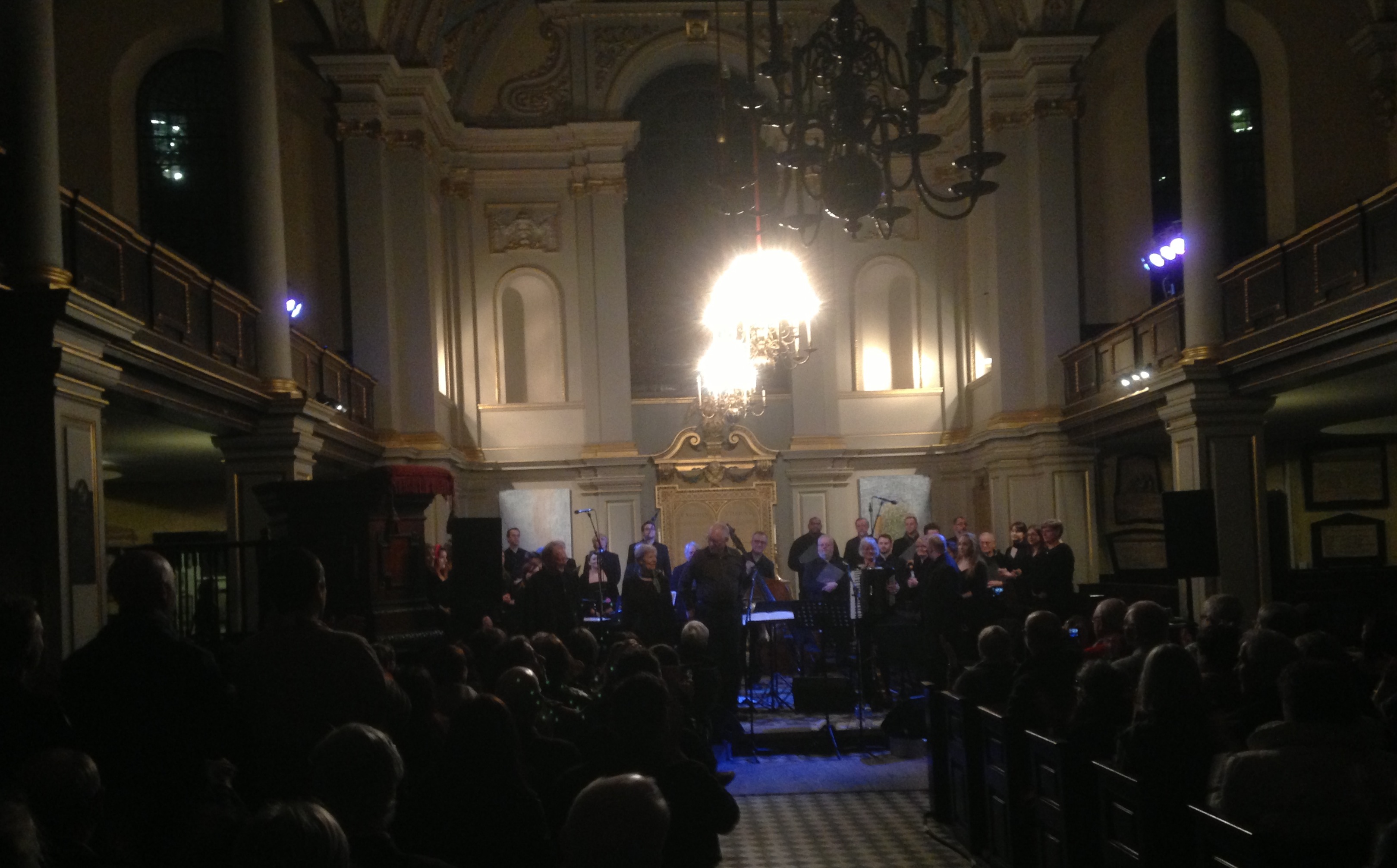
Mike Westbrook 3The parish church of St Giles-in-the-Fields turned out to be the perfect place for last night’s performance of Glad Day, Mike Westbrook’s settings of William Blake’s poetry. Situated close to the modern junction of Charing Cross Road, Oxford Street, Tottenham Court Road and New Oxford Street, and known as the Poets’ Church, the present building was completed in 1733 on the site where first a monastery and chapel and then earlier churches had ministered to lepers (St Giles is their patron saint) since the 12th century. The first victims of the Great Plague of 1665 were buried in its garden.

Blake was born in nearby Soho and in his time the church stood next to the warren of dwellings known as the Rookery, London’s most notorious haunt of thieves and prostitutes, immortalised in Hogarth’s Gin Lane drawings and Dickens’s Sketches by Boz. It’s a gentler place now, although had Blake, Hogarth and Dickens been living today they might have been interested to leave the church, turn left down Denmark Street, cross Charing Cross Road and witness the sights of 21st century Soho on a Saturday night.

The concert was in aid of the Simon Community, which recently celebrated the 50th anniversary of its work with London’s homeless population. In the church’s soft yellow light Westbrook was joined by two solo singers — his wife, Kate, and Phil Minton — and the 30-voice Queldryk Choral Ensemble, conducted by Paul Ayres, plus the violinist Billy Thompson, the accordionist Karen Street and the double bassist Steve Berry.

They began, appropriately enough, with the searing images of “London”, sung by Kate, before Minton delivered “Let the Slave” and Mike Westbrook himself recited “The Price of Experience” above a lulling choral vamp: “It is an easy thing to triumph in the summer’s sun / And in the vintage and to sing on the wagon loaded with corn. / It is an easy thing to talk of patience to the afflicted, / To speak of the laws of prudence to the houseless wanderer…”

“Holy Thursday”, “The Tyger and the Lamb” and “Long John Brown and Little Mary Bell” were among the texts, most of them arranged by the late Adrian Mitchell and the others by Kate Westbrook. The audience remained silent between the individual pieces, reluctant to disturb the mood, but the dramatic conclusion of “The Poison Tree”, on which tango rhythms propelled Kate’s bitter vocal and Thompson’s dazzling fiddle solo, provoked spontaneous cheering.

The musicians were given plenty of space for unaccompanied solos, each one relevant to Westbrook’s overall structure while ensuring a constant variety of texture. They all shone, with Berry’s dark-toned bass outstanding throughout, and particularly when he launched “The Human Abstract” with an improvisation located somewhere between Charles Mingus and Charlie Haden, which is not a bad place to be. But nothing was more quietly electrifying than the transition from Minton’s open-hearted vocal to Thompson’s spirit-possessed violin which led from “The Fields” to the concluding “I See Thy Form”.

Westbrook has been working on this material for many years, and it is among his several masterpieces. Like his fellow pianist/composer Keith Tippett and his old associate John Surman, he came out of the jazz ferment of the 1960s and found his way to a music in which he can employ everything he has learnt while making profound use of his indigenous heritage. For his admirers who couldn’t make it to last night’s concert, there’s a new DVD and CD, called Glad Day Live, of a performance by the same singers and musicians, filmed at Toynbee Hall in Whitechapel five years ago. Highly recommended, of course.

Blake’s London

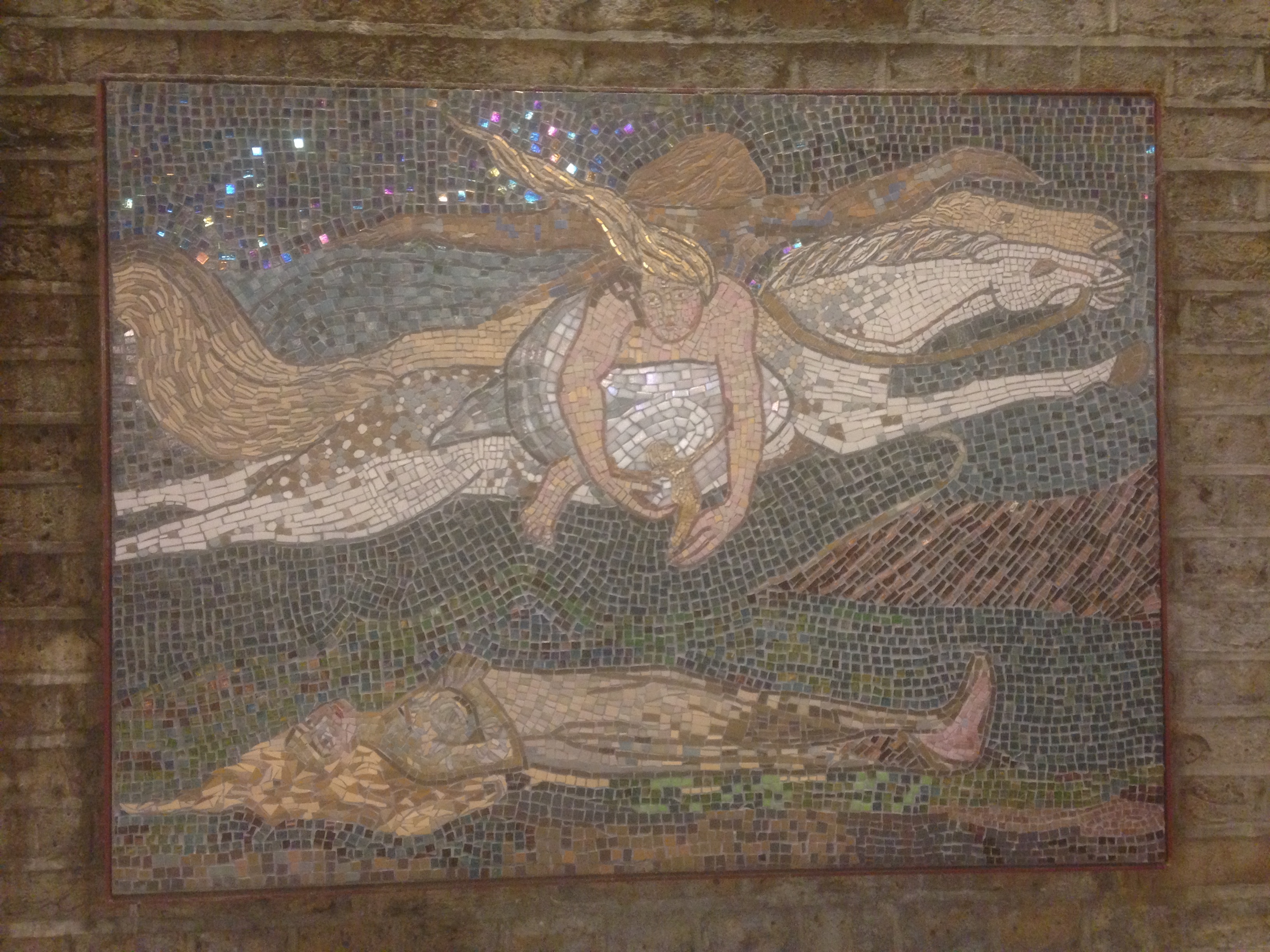
Blake 1In a pair of parallel alleyways under the railway line that runs through Lambeth from Waterloo station, parallel with the river, you will find two dozen panels like the one above, created by Southbank Mosaics, a non-profit community enterprise, to commemorate the work of the great English visionary William Blake. A few yards away is the housing estate that occupies the site on which stood the house where Blake and his wife lived between 1790 and 1800, and in which he composed and printed his Songs of Experience. One of those poems is called “London”, and this is how begins: “I wander thro’ each charter’d street / Near where the charter’d Thames does flow / And mark in every face I meet / Marks of weakness, marks of woe…” In the late 18th century, it needs to be said, the term “charter’d” could be taken to mean “in private ownership”. It’s a shattering poem, born of the conditions to which Blake bore witness every day of his life amid the teeming riverine streets, and it doesn’t seem to have lost any of its force or relevance.

Hercules Road, on which Blake’s house stood until it was demolished in 1912, is not a place to attract tourists in search of his traces. The anonymous postwar council estate — which bears the poet’s name and an appropriate plaque — occupies one side; the railway arches line the other. It takes some imagination to link it to the music composed by John Zorn for In Lambeth, an album inspired by the time Blake spent there.

This is Zorn’s second attempt to capture the poet’s spirit. The first, released in 2012 (also on the composer’s Tzadik label), was called Vision in Blakelight and was written for a sextet of keyboards, harp, vibes, bass, drums and percussion; its 10 sprightly, occasionally almost ecstatic pieces featured particularly fine playing by John Medeski on organ and Trevor Dunn on double bass.

In Lambeth, subtitled “Visions from the Walled Garden of William Blake”, filters that mood through a finer mesh. The group here is Zorn’s Gnostic Trio, in which two members of the Blakelight group, the harpist Carol Emanuel and Kenny Wolleson on vibes and bells, are joined by the guitar of Bill Frisell. The music is no less lively and active, often based on arpeggiated figurations reminiscent of the ostinatos of Terry Riley and Steve Reich, but its glistening instrumental timbres and the intimacy of the interplay between these brilliant musicians give it a character of its own. Here’s a track called “The Night of Enitharmon’s Joy”, referring to a female figure used by Blake to signify beauty and poetry (and possibly inspired by his wife, Catherine).

It’s as distinctive, in its own way, as the Jimmy Giuffre Trio of “The Train and the River”, as close as that to jazz — in fact impossible without it — yet breathing quite different air. Beyond category, and highly seductive.

In related Blake-and-jazz news: on Saturday, February 8, at the church of St Giles-in-the-Fields at the end of Denmark Street (once London’s Tin Pan Alley), Mike Westbrook and his musicians, including the Queldryk Choral Ensemble, will perform Glad Day, his celebrated settings of Blake’s poems, to promote the release of the music on a CD recorded live at the Toynbee Hall in London five years ago. This latest concert is dedicated to the memory of the poet Adrian Mitchell, with whom Westbrook worked on Tyger, the Blake-inspired musical performed at the National Theatre in 1971. Not to be missed, I’d say.