‘Won’t last for ever…’

There’s a moment in Love and Mercy, the 2014 Brian Wilson biopic, when Paul Dano, as the young Brian, sits at the piano to play a song he’s just written. When his hands form the opening chords of “God Only Knows”, we’re overwhelmed by a sense of sheer wonder. You can’t watch it and not think that Derek Taylor, the English publicist who went to Los Angeles in 1966 and took on the Beach Boys as his clients, was absolutely right to propagate the idea that the oldest of the three Wilson brothers was a genius. I mean, where did that stuff — those voicings, that progression — come from?
I thought about that, and a lot else, when I read with great sadness earlier this month that, as a result of Brian’s advancing dementia, and only a few weeks after the death of his second wife, Melinda, he had been put into a formal conservatorship. “Won’t last for ever,” the 22-year-old sang with great prescience on a magnificent single in 1964. Sixty years later, a court in LA has ruled that his personal, medical and financial affairs will now be in the control of his family and associates.
In the car that day, I listened to some favourites, from “Surfer Girl” to “Surf’s Up” and beyond. “Please Let Me Wonder”. “Wendy”. “Girls on the Beach”. “Caroline, No”. “When I Grow Up (To Be a Man)”. “Let Him Run Wild”. “The Little Girl I Once Knew”. “She Knows Me Too Well”. “The Warmth of the Sun”. “Kiss Me Baby”. And, of course, “Don’t Worry Baby”, which probably encapsulates more of the essence in a single track than any of them: the sun-kissed harmonies, the cars, the girls, the youthful rapture and the underlying sadness. And the way Brian was starting to make a standard guitar-keys-bass-drums line-up sound like a new kind of orchestra.
And then I watched The Beach Boys, a new 112-minute authorised documentary directed by Frank Russell and Thom Zimny, which tells the group’s story from its creation in the Wilson family garage in Hawthorne, California in 1961 to the comeback in the early 1980s. That’s a sensible limitation, although it means omitting Brian’s triumphant 21st century renaissance with the Pet Sounds concerts and the SMiLE recreation. But the saga is so vast that many of its salient features are necessarily overlooked.
It’s the survivors’ tale, in a way, which means that Mike Love gets another chance to tell his side of the story, although not to an unbearable extent, at least until “Kokomo” is chosen to play over the final credits — and he does thoughtfully identify Brian’s “melancholy” as being a vital ingredient in their music. Archive interviews with Carl and Dennis Wilson are included, and we’re reminded of how their long-hidden talents emerged during the period covered by the film. Al Jardine and David Marks provide interesting insights (Jardine describes “Don’t Worry Baby” as “definitely a turning point for us, and for Brian”), as does Marilyn Rovell, Brian’s first wife.
Interviews with some of the LA studio musicians who played on the great records, including the pianist Don Randi, the bass guitarist Carol Kaye and the drummer Hal Blaine, paint an interesting picture of Brian’s relationship with these highly professional, mostly jazz-trained players. From very early on, he was pursuing an approach very different from most of those who enlisted their help in search of hit records, earning their respect through his seriousness of purpose and originality of thought. There’s a tiny but very telling clip in which he’s explaining to Blaine the rhythmic emphasis he wants on the out-of-tempo introduction to “California Girls”, itself a small miracle of creative imagination. Blaine has heard it all before, but not this.
There have been many Beach Boys-themed films, but this one is still worth watching for its wealth of archive footage, on and off stage. Their difficulties in coming to terms with change could hardly be better illustrated than by a truly teeth-grinding sequence from a 1969 TV show called Kraft Music Hall, in which they attempt to hold the counter-culture at bay by miming to “California Girls” surrounded by bikini-wearing girls, with Love wearing a yacht skipper’s cap and blazer. Some of the scabs are picked at — mostly to do with the behaviour of Murry Wilson, who gave his sons his genes but also a lot of unhappiness, and whose legacy of poor management eventually caused a permanent rupture.
But there’s enough remembered joy here — capped by a silent reunion of the four survivors at Paradise Cove, where the famous early photo of the group with a surfboard was shot — to make it a good way to start the summer, with immeasurable gratitude to Brian for all he gave us.
* The Beach Boys is streaming on Disney+.
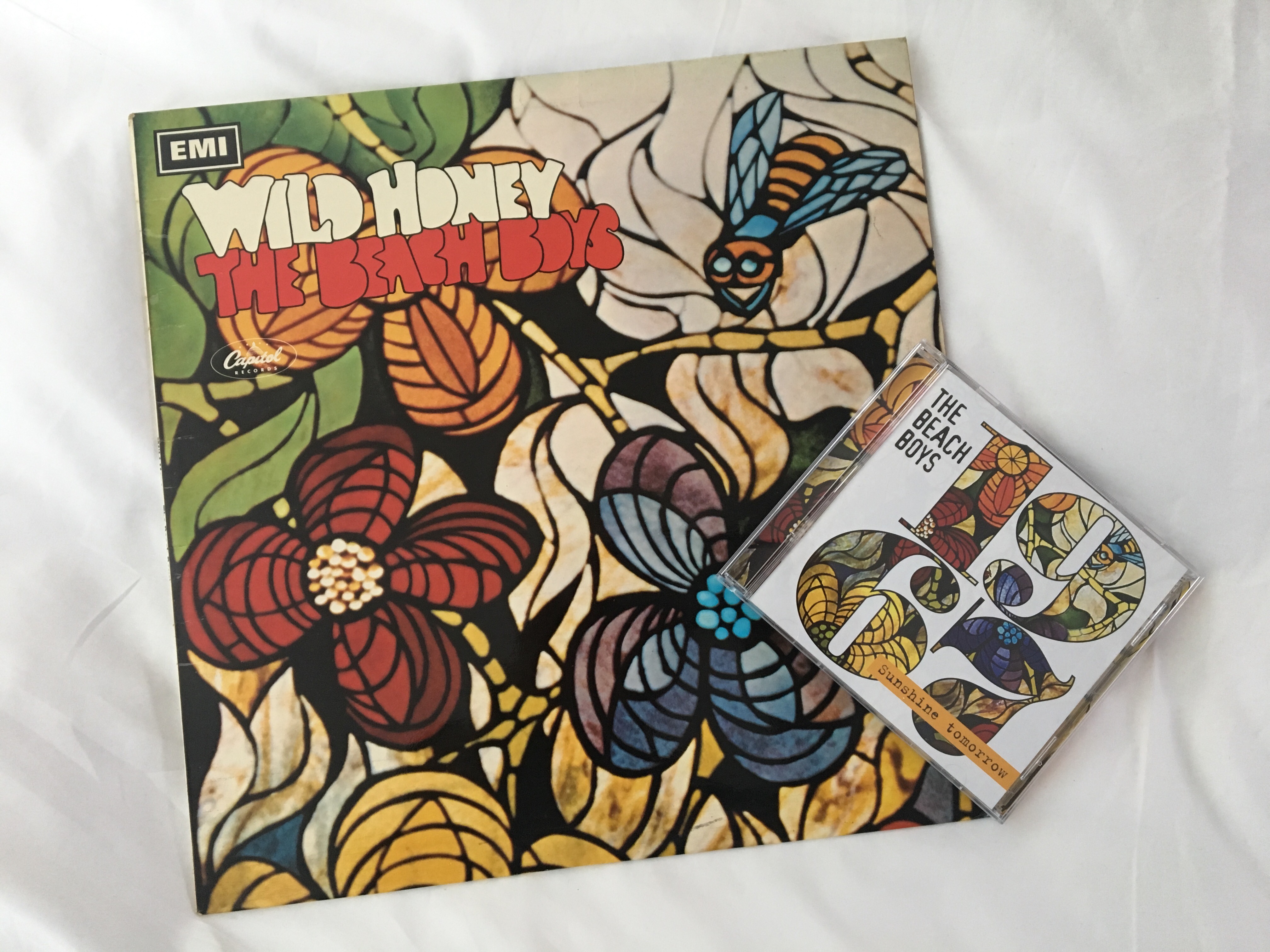 If you wanted to isolate an individual moment that summed up the curious position of the Beach Boys vis à vis the changing modes of youth culture in 1967, you might come up with the one in “Darlin'”, a single released in that pivotal year, when Carl Wilson sings a phrase written by Mike Love which lands precisely in the space between a letterman’s sweater and a paisley kaftan, between the disappearing culture and the emerging one: “You’re so doggone outtasight…”
 thebluemoment.com