Bill Frisell in Bristol, Brussels, Orvieto…

At the end of Bill Frisell’s concert in Bristol last night, my son (who had bought the tickets as a belated birthday present) asked me which of all the times I’d seen him live was my favourite. That took some thinking, but eventually I told him that it was probably a solo concert at Cadogan Hall in London half a dozen years ago. Although perhaps not the most spectacular, it seemed to capture so much of the essence of an extraordinary musician.
But Frisell is one of those players who put his essence into every note, whatever the context and the demands it makes. At last night’s gig in the beautiful St George’s, a repurposed 200-year-old neoclassical church, he was joined by the bassist Thomas Morgan and the drummer Rudy Royston, long-time partners with whom he has a rapport that may be well grooved but never precludes the element of quiet surprise.
Their two unbroken 45-minute sets were intimate conversations that flowed from theme to theme with a beautiful sense of dovetailing, full of subtle allusions that looked both backwards and forwards, maintaining a gentle but persuasive continuity.
Some of the themes I recognised were Frisell favourites: a gorgeous “Lush Life” (including the prefatory verse); the loping “Lookout for Hope”, with its light reggae inflection; the staccato flourishes of Thelonious Monk’s “Evidence”; Bacharach and David’s “What the World Needs Now Is Love”, with a lovely moment in which Frisell simply stroked out the chords; and, as an encore and parting benediction, a quietly glowing “When You Wish Upon a Star”, written for the 1940 Disney film Pinocchio, a song that he once said “has been in my bloodstream for as long as I can remember.”
The trio is also present throughout his new album, Orchestras, which combines one disc recorded live at two halls in Belgium with the Brussels Philharmonic and another captured at a theatre in Orvieto with the Umbria Jazz Orchestra. Both ensembles are arranged by the great Michael Gibbs, now 86 years years old, who pours all his decades of knowledge and wisdom into providing inspiring settings for the guitarist.
If Nelson Riddle had been a jazz arranger on the level of a Gil Evans, he might have come up with the subtly shaded orchestrations Gibbs delivers for the full symphony outfit on his own “Nocturne Vulgaire” and “Sweet Rain”, Ron Carter’s “Doom” and several of the guitarist’s own compositions, including “Electricity”, “Throughout” and “Richter 858 No 7”, from his album of pieces inspired by the German artist. Strings, brass and woodwind are everywhere deployed with subtle grace.
On the second disc, Gibbs uses the 11-piece Umbria ensemble — six brass, four reeds and a lone cellist — to bring out the shades in Frisell’s music that evoke an America of bayous, of prairies, of woodsmoke rising from remote farmsteads. It’s much more of a jazz sound, like an expanded version of the three-horn sextet with which the guitarist made the gorgeous Blues Dream album — a particular favourite of mine — in 2001.
Thanks to Gibbs, everything on both discs has combines an almost weightless elegance with deep soulfulness, something the arranger absorbed from his reverence for Gil Evans. You can hear it perfectly on “Strange Meeting”, with echoes of Evans’s fondness for the Spanish tinge in its luscious sway and Moorish blues tonality, drawing the very best from Frisell, to whose vast discography this is a recommended addition.
* Bill Frisell’s Orchestras is out now on the Blue Note label, as two CDs or three LPs.
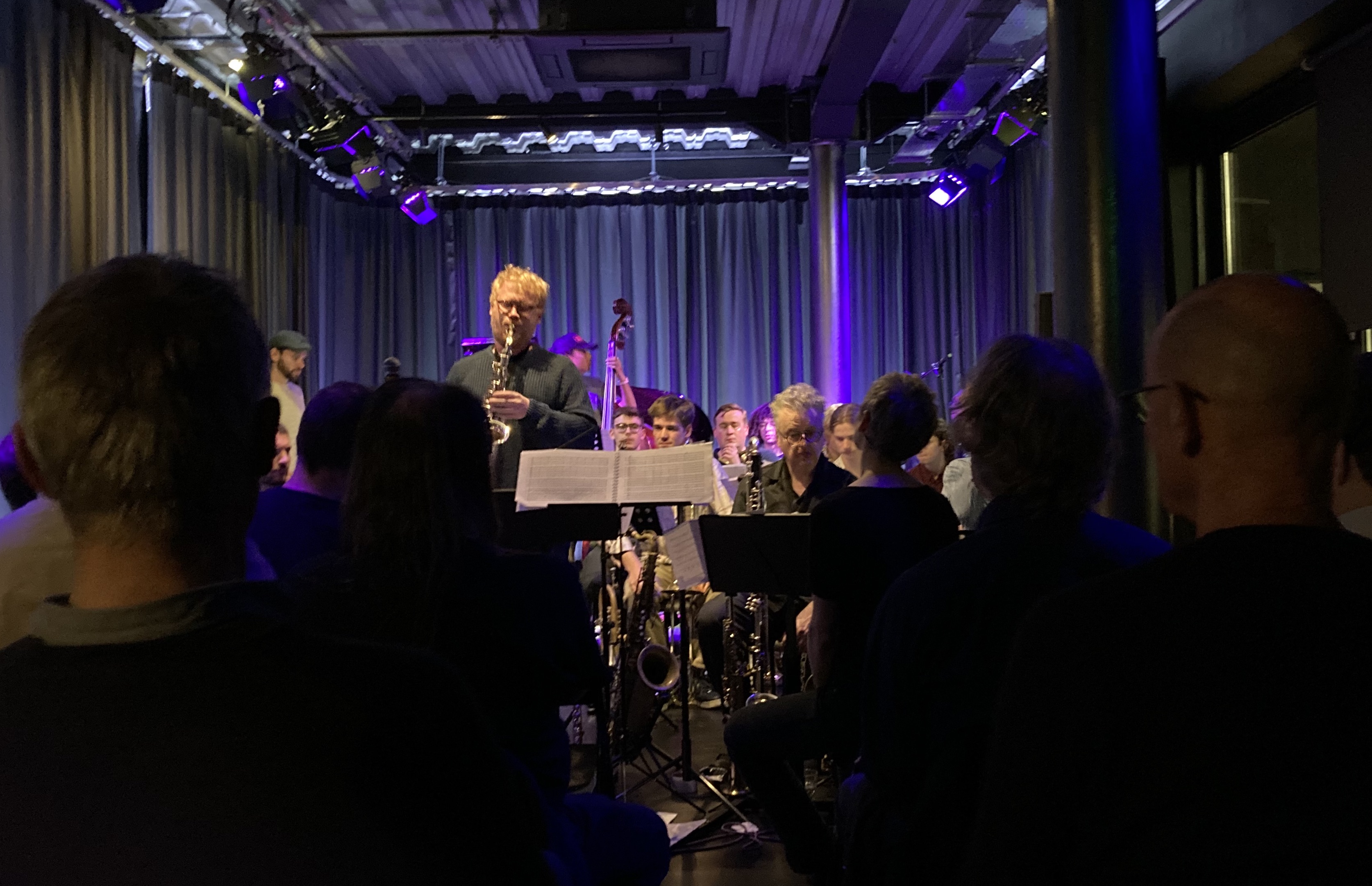
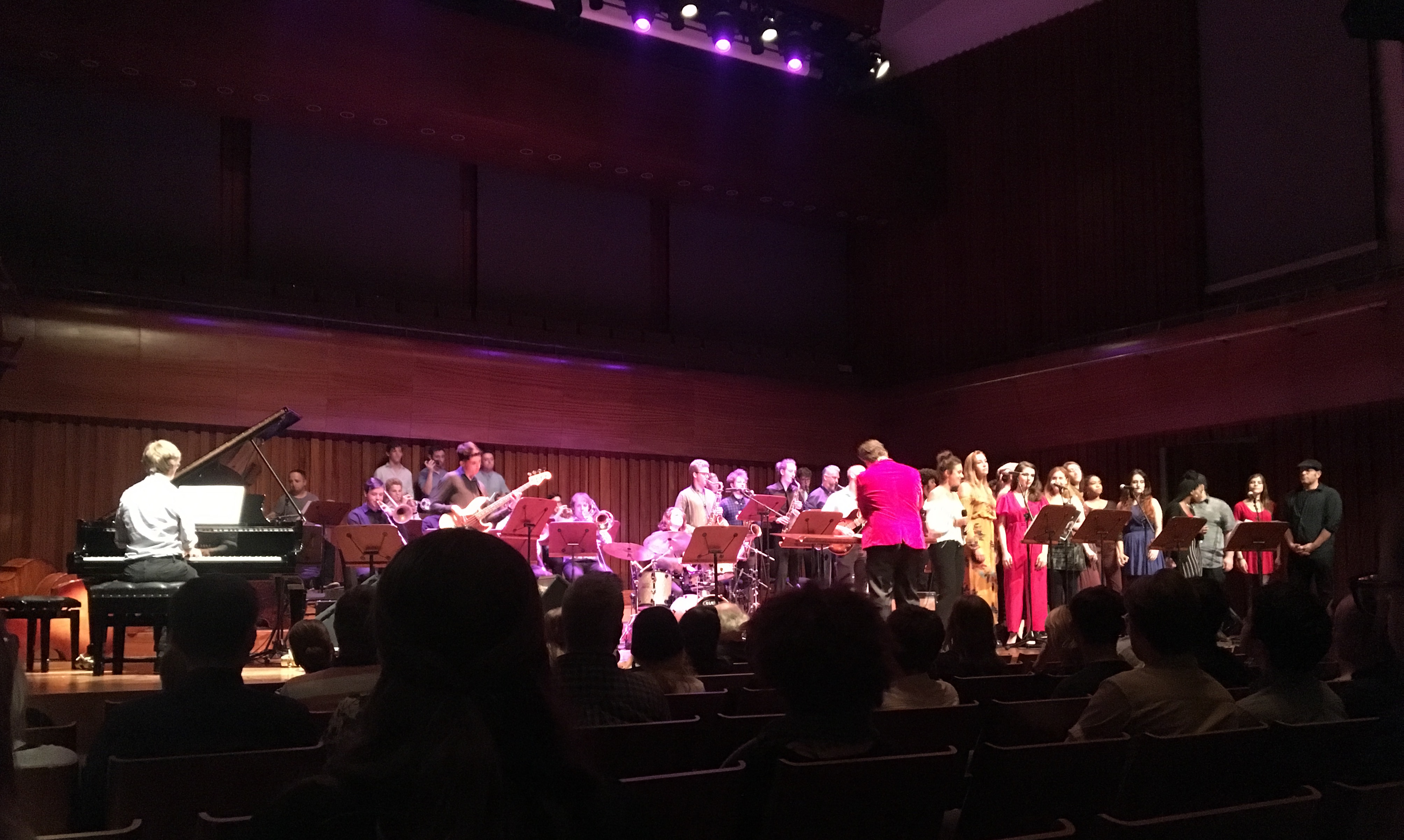 Even though it meant missing the first set of Michael Gibbs’ 80th birthday concert at the Vortex, the idea of hearing Donald Fagen’s first solo album played by the new intake of students on the jazz course at the Guildhall School on Monday night was impossible to resist. The Nightfly is a wonderful album, made by a man in early middle aged in the era of Reagan looking back at how things felt as the era of Eisenhower shaded into that of Kennedy, in that brief period of illusory optimism when prosperity and progress seemed to be the prevailing forces, before the Cuban missile crisis, the civil rights marches and the Vietnam protests took over. I thought it might be interesting to see how it sounded in the era of a president whose name I don’t even want to type out on this blog.

 thebluemoment.com