Skip to content

Posts tagged ‘Max Roach’

‘Soundtrack to a Coup d’état’

Sixty years ago Archie Shepp wrote a provocative column for Down Beat magazine in which, if memory serves, he compared his tenor saxophone to a machine gun in the hands of a Vietcong guerrilla. In the early ’60s it seemed that jazz’s New Thing, or whatever you wanted to call it, possessed a powerful political dimension, exemplified by Max Roach and Abbey Lincoln’s Freedom Now Suite, John Coltrane’s “Alabama”, and Shepp’s own “Malcolm, Malcolm — Semper Malcolm”. Even the music that had no explicit political content, such as Ornette Coleman’s “Free Jazz”, somehow seemed to express revolutionary feelings.

It’s with great brilliance that the Belgian film director Johan Grimonprez makes that music (and indeed those very pieces, plus others) into an integral component of his award-winning documentary Soundtrack to a Coup d’état. The two-and-a-half-hour film’s subject is the murder in 1961 of the activist and politician Patrice Lumumba, whose tenure as the first prime minister of the newly independent Republic of Congo — formerly the Belgian Congo — was ended after only three months by a military coup fomented by those with interests in the country’s rich deposits of rare minerals, notably Belgium, the withdrawing colonial power, the United States government of President Eisenhower, and the British government of Harold Macmillan.

Lumumba was a symbol not just of the independence of former colonies but of pan-Africanism. Given the activities of the CIA and the British and Belgian intelligence services, it was no surprise that he welcomed support from Castro’s Cuba and Khrushchev’s Soviet Union, or that he should pay the ultimate price for it, his body hacked to pieces and dissolved in acid by the mercenaries who killed him. Names familiar to those of my generation — Moïse Tshombe, Joseph-Désiré Mobutu, Joseph Kasa-Vubu, Dag Hammarskjöld — stud the narrative, while Grimonprez deploys archive interviews of varying degrees of blatant or sly self-incrimination with participants including Larry Devlin, the CIA station chief, and the MI6 officer Daphne Park.

What makes this film different is the use of music. Grimonprez has spotted the US government’s soft-power deployment of jazz during the Cold War through State Department-sponsored international tours. In 1956 Dizzy Gillespie and an 18-piece band spent 10 weeks touring Europe, Asia and South America. A year earlier Louis Armstrong had pulled out of what would have been the inaugural tour in protest against racial segregation in schools in the Southern states, but in 1960 he travelled to Congo, where he played to an audience of 100,000 people in Léopoldville (as Kinshasa was then known) in the middle of the political disturbances, before returning to Africa in 1961 to perform in Senegal, Mali, Sierra Leone, Liberia, Sudan and the United Arab Republic.

We see Armstrong in Africa in the film, but more novel and powerful is the juxtaposition of the avant-garde jazz of the time with footage of the political events: not so much a soundtrack as an active commentary. So we hear Abbey Lincoln’s anguished screaming, Max Roach firing off snare-drum fusillades, the contorted sounds of Eric Dolphy’s bass clarinet (with Charles Mingus’s group, shortly before his death), Nina Simone simmering through Bob Dylan’s “Ballad of Hollis Brown”, and Coltrane, on fire in “My Favourite Things” and intoning the sorrow of “Alabama”. Fast cutting is usually the enemy of understanding, but Rik Chaubet’s shrewdly paced editing creates a non-stop tapestry of emotions, making the rhythms and the cry of the music mirror the events being depicted.

Direct action also played a part, and if you see this extraordinarily compelling film, you won’t forget the spectacle of Lincoln, Roach and dozens of others courageously disrupting a session of the UN Security Council in New York to protest against the assassination of the figure Malcolm X called “the greatest black man who ever walked the African continent.”

Lumumba’s death was a crime and a tragedy of enormous significance. Grimonprez alludes to its enduring importance through reminding us that the Democratic Republic of Congo, whose mines produced the uranium for the atom bombs that fell on Hiroshima and Nagasaki, remains the world’s major source of coltan, the rare and precious commodity that powers our iPhones. In other words, a country of 100 million people, whose mineral deposits are said to be worth $24 trillion, but where two million children are at risk of starvation, and which currently ranks 179th out of 191 countries in the UN’s Human Development Index, is safe for civilisation.

* Soundtrack to a Coup d’etat is being screened at various independent cinemas.

Semper Max

Max Roach, a vital link in the chain of jazz drummers that stretches from Baby Dodds to Tyshawn Sorey, was born in North Carolina a hundred years ago today, on January 10, 1924. After moving with his family to New York at the age of four, he played the bugle and the drums in gospel ensembles in Brooklyn. He was still a teenager when he depped for Sonny Greer in the Duke Ellington Orchestra. At 21 he played on the Charlie Parker session that produced the eternally breathtaking “Ko Ko”. After that he was on many of Parker’s celebrated recordings, including “Parker’s Mood” in 1948 and the Massey Hall concert in 1953.

Roach was the one who took Kenny Clarke’s proto-bebop drumming to the next stage, freeing the left hand and the right foot from the obligation of symmetry, enabling them to respond to what a soloist was doing in the moment: enhancing, encouraging, propelling, providing a spontaneous commentary. Just what Parker needed.

All that was in my head — along with his presence in Miles Davis’s historic nonet at the Royal Roost in 1948, his subsequent quintets with the trumpeters Clifford Brown and Booker Little in the ’50s, and the sequence of albums including We Insist: Freedom Now Suite and Percussion Bitter Sweet that he recorded during the civil rights era in the ’60s — when I went to interview him in his hotel during the 1971 Montreux Jazz Festival.

By then he was an elder, and that was how he seemed to me: a man of wisdom, elegance and sophistication, with something reserved and almost austere about him, someone who had been through the fires of the creative life and come out having cast aside all non-essentials, with his humanity intact. He talked freely and eloquently, and said many interesting things. But I what I remember chiefly is just the feeling of being in his presence, in a room with the embodiment of so much history.

At Montreux he was playing with a student orchestra, so I asked him about his history with big bands. “The first big band I played with was Dizzy Gillespie’s,” he said, “which had Charlie Parker, Fats Navarro and Miles Davis, who were very young, Freddie Webster, Kenny Dorham — fantastic trumpet section — Dexter Gordon, Gene Ammons, Leo Parker, Bud Powell…”

Then he corrected himself. “No, the first big band I played with was Duke’s. I remember now. That was at the Paramount Theatre in New York. I was still in school and I played with them for four or five days because Sonny Greer got sick. It was during the war and the reason I played with them was Billie Holiday’s brother-in-law, Jimmy Monroe’s brother Clark, whose protégé I was — he made sure I got in the union and he knew all these people, so when he found that Duke Ellington needed a drummer, he called me for it.”

Clark Monroe’s Uptown House, on West 134th Street in Harlem, was one of the cradles of the bop revolution. By 1942, Roach was the house drummer. Parker played there that year, so perhaps it was where they first met. I wish I’d asked him. I wish I’d asked him a whole lot of things.

I did get him to talk about Clifford Brown. “In my music I’m inspired by human values,” he said, “because I believe that human beings are supposed to live together. As artists, we feed on the past. All the things that we hear today are really extensions of things that were laid down by people who came before — and of course I’ve been fortunate enough to have been associated with many, many great musicians. One that was a turning point in my own career was Clifford.

“The association was one that was full not only of friendship and love for each other as human beings but as musicians we both spent as much time as we could involved in music as a craft. I noticed particularly that Clifford was a human being, number one, which I guess was the reason he could get so much beauty out of playing the way he did at such an early age. To sound so mature before he was 25…

“I can say this: during our whole relationship he was a very dedicated musician and an extremely responsible person as a leader, as young as he was. He was almost 24 hours immersed in music, every aspect of it, from the piano to the drums to his trumpet, and the thing we can all learn from that is that the more time you put in sincerely, the more that you will get out of it in a shorter space of time.”

Luckily, Max was granted a longer span. I was fortunate enough to see him play on a handful occasions, notably in New York in 1972 with M’Boom, his percussion ensemble, and at the Bracknell Jazz Festival about 10 years later with his regular quartet. What was striking was how he played with his back straight and shoulders still, most of the work done by his wrists. He was as crisp and precise as any jazz drummer I’ve ever seen, but without forfeiting a sense of surprise or the inner relaxation vital to swing. Carrying the joy and the responsibility of the music’s history, he was everything you’d imagined him to be.

* The image above is grabbed from a BBC recording of the Max Roach quartet with Abbey Lincoln in London in 1964, performing “Triptych: Prayer/Protest/Peace” from We Insist! The Freedom Now Suite. It’s on YouTube.

Just like Elvin, Art, Max…

All the way through the ’60s, starting at the age of 13, I’d buy a copy of Down Beat every fortnight from a newsagent that stocked foreign publications. Thirty five cents in the US, it cost half a crown in the UK — a lot of money when I was still at school. Of course I wanted to read interviews with people like John Coltrane and Ornette Coleman, and to absorb the wisdom of critics and columnists such as Pete Welding, Don DeMichael, John A. Tynan and LeRoi Jones. But I also wanted to gaze at the full-page ads for Gretsch drums.

Other manufacturers also used famous players as their pitchmen: Shelly Manne used Leedy drums, we were told, while Buddy Rich played Rogers, Rufus Jones played Slingerland, and Joe Morello had a Ludwig kit. But the Fred Gretsch Manufacturing Co. of Brooklyn, NY… well, as you can see above, they had Elvin Jones, Art Blakey, Max Roach, Philly Joe Jones and the teenaged prodigy Tony Williams, all of them drummers I worshipped, and most issues of Down Beat included an ad showing one of them with the kit he favoured. That was enough to give me a lifelong yearning to own a set of Gretsch drums: a jazz kit with an 18-inch bass drum and 12- and 14-inch toms, all in that nice black finish that Tony used with Miles, and a five-inch chrome-shelled snare drum. Since you’re asking.

I know it’s stupid to fetishise makers of percussion instruments; after all, one of the most effective drum kits in music history — the one in Motown’s main studio throughout the ’60s, played by Benny Benjamin, Richard “Pistol” Allen and Uriel Jones on countless classic hits — was a hotch-potch bearing the logos of Ludwig, Slingerland, Rogers and Gretsch. And how great did that sound?

Still, we can dream, and my particular yearning was partially satisfied a few years ago when I was asked what I wanted for Christmas and the only thing I could think of, within sensible limits, was a Gretsch snare drum. So now I have one, just to keep my wrists in shape, although a fear of annoying the neighbours leads me to muffle it with a thick duster, which removes a fair amount of the fun. (The kid across the street who started playing a full kit from scratch a year ago has no such compunction, but at least he’s got a future and I can hear him improving by the month.)

And the point of this, you’re asking? It’s that next month there’s an online auction of equipment from the Gretsch factory, with the proceeds apparently going to the company’s charitable foundation, whose activities include organising drum circles for child refugees from Africa and the Middle East. Here’s a link. You’ll see that among the offerings are not just drums and some of the guitars for which the company also became famous — including the Chet Atkins and Duane Eddy models — but an intriguing miscellany of items including “vintage guitar neck patterns, a rolling rack with ten drawers of saw blades, metal clamps with a large wooden hand drill, an antique cabinet, body forms, wrenches, a sanding table, vintage four-wheel open carts and more…”

I won’t be bidding. I’ve got my drum with a Gretsch badge on it. Just like Elvin, Art, Max, Philly Joe and Tony, right?

The precious legacy of Booker Little

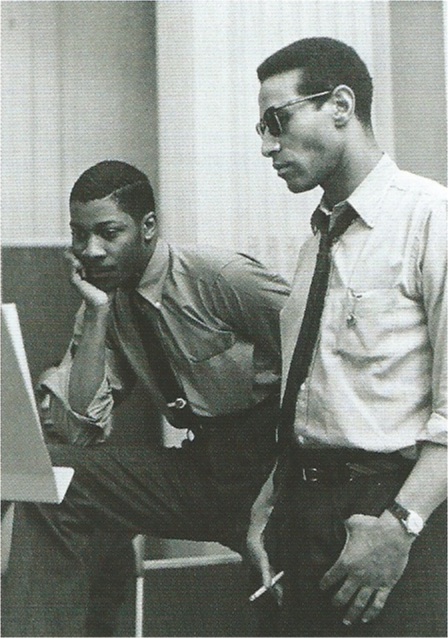
Booker Little:Max Roach

The four studio albums recorded under the Memphis-born trumpeter Booker Little’s name between 1958 and 1961 were issued by four different labels. It’s always been my feeling that if he had signed a contract with Blue Note Records early in his career, his reputation today would more than match that of Lee Morgan, Freddie Hubbard or Donald Byrd. But they did and he didn’t, and after his untimely death from uraemia, a kidney disease, at the age of 23, the piecemeal nature of his recorded output somehow prevented him from acquiring the stature he deserved.

For many years those four albums were hard to find and expensive to acquire. You might have gone without a few meals to buy one. Now, thanks to European copyright laws, all four are available in a single 2CD package for which I paid £12 the other day. Those copyright laws are problematic in some respects, but when they make it possible for independent companies to reissue music like this, in which the corporate successors to the original labels have seldom shown any constructive interest, it’s very hard to argue against them, so I won’t. The original albums in question were called Booker Little 4 & Max Roach (United Artists, recorded 1958), Booker Little (Time, 1960), Out Front (Candid, 1961), and Booker Little and Friend (Bethlehem, 1961). The package in which they are assembled, titled Complete Recordings: Master Takes and issued on the American Jazz Classics label, has been put together with evident care, reproducing the original sleeves and notes, with full recording details and extra pictures.

The first of them reminds us that Little came to prominence as a member of the Max Roach Quintet, whom he joined just after his 20th birthday, following studies at the Chicago Conservatory. He made several albums with that band, and his qualities as a soloist were obvious from the start: his clean articulation, bright, burnished tone, rhythmic agility and harmonic acuity made him the obvious successor to Clifford Brown. And at a time when skilled hard-bop trumpeters were not exactly thin on the ground, his playing was immediately identifiable.

The Time album is by a quartet, with Wynton Kelly or Tommy Flanagan on piano, Scott LaFaro on bass and Roy Haynes on drums, and it still sounds pristine. But the remaining albums are the real jewels, since they place his improvisations in the context of a developing compositional gift. They feature sextets, both including the trombonist Julian Priester and the pianist Don Friedman, with Out Front also including Eric Dolphy and Max Roach while Booker Little and Friend (a coy reference to his trumpet) features George Coleman and another great drummer, Pete LaRoca. Little’s 14 tunes on these albums are distinguished by a gift for lyricism that was not always to be found in the composers of the post-bop era; perhaps the nearest equivalent would be the great Benny Golson, who also achieved a song-like quality in his themes for hard-driving horns-and-rhythm combos. Little, though, was a more sophisticated thinker than Golson. In pieces as breathtakingly gorgeous and structurally fascinating as “Forward Flight”, “Strength and Sanity” and “Moods in Free Time”, written in his very early twenties, there are unmissable signs of boundless potential.

His partnership with Dolphy would no doubt have borne further fruit. They were ideal partners, utterly dissimilar in instrumental style but clearly on the same musical and intellectual wavelength, as can be heard on Dolphy’s Far Cry, recorded for Prestige in December 1960, and in the three volumes of live recordings by their quintet, taped in July 1961, just three months before his death, and released as Eric Dolphy at the Five Spot (now also available in a complete edition, from Essential Jazz Classics). Among the last things he played on, as a sideman, were John Coltrane’s Africa/Brass and Max Roach’s Percussion: Bitter Sweet. Wherever jazz was heading in that turbulent and exhilarating era, he was going to be part of it.

We’ll never know what he might have achieved in the years that a fatal illness denied him, but the four albums under his own name — brimming with the amazing clarity of his playing and a talent for exploiting the resources of a small group — are evidence of a remarkable artist at work. It’s a legacy that all jazz fans should know about.

* The uncredited photograph of Booker Little (left) and Max Roach is taken from the booklet accompanying the American Jazz Classics package.