Skip to content

Posts tagged ‘Matana Roberts’

Matana Roberts at the Roundhouse

Note: After this piece was first posted, Matana pointed out to me that her pronouns are “they/them”. I’ve rewritten it to take account of that preference.

Matana Roberts did a lot of talking at the Roundhouse last night. A lot more talking than playing, in fact. Alone on the stage, opening the show for Lonnie Holley with an hour-long set, they restricted the saxophone — a soprano, rather than her usual alto — to the occasional short phrase or two, often prefaced with the words “This is an improvisation.” We heard a handsome tone on the straight horn, and an ardent delivery, but nothing was allowed to build or cohere into a greater scheme.

Instead we were addressed with verbal riffs on a variety of topics, from the general reaction to the artist’s wild new hair to what a border control officer said about their tattoos. They spoke of a photo of a recent protest in which students had barricaded their doors and windows in the manner taught in “active shooter” drills. “I’m from the Mid-West,” Matana said. “We only had tornado drills.”

That provoked their observations on protest songs, during which we were encouraged to hum a single tonic note in accompaniment as they sang “Wade in the Water” in a pleasant, unemphatic voice. Eventually we were persuaded to join in “I Shall Not Be Moved”.

There was also a story to tell about being invited to play at the Whitney Museum on the day in 2015 when Michelle Obama, a fellow Chicagoan, was opening a new wing. Matana was invited to perform on the roof while the First Lady was doing the ribbon-cutting thing, so that the music would cascade down. The surprise discovery up there was the presence of a detachment of snipers.

“They were surrounding me,” Matana remembered. “Three of them. And they were kind of happy-go-lucky. They wanted to show me their guns. ‘I don’t want to see your guns!'” The ceremony over, Michelle Obama was taken away in an armoured vehicle.

“That was really a symbol of America today,” Matana observed, before returning to the business of singing and playing and musing, trying to summon the better spirits of our troubled world.

The great-grandmother’s tale

The series of audio collages that Matana Roberts calls Coin Coin, now reaching its fifth chapter (of a projected 12) with the release of In the Garden, may one day come to be seen as a kind of Bayeux Tapestry of Black American life: an extended narrative portrayal of the struggles, the pain, the joy, the successes and reverses of the successive generations which Roberts, through her own family’s post-emancipation history, can touch and bring back to imagined life.

Each chapter has a theme and here is how, in her sleeve note, she introduces the latest:

There is something quite rancid going on in America right now, more so than any time I have seen… a growing cohort of ghoul-like humans who seem to think that your body does not belong to you. We have seen some of this before, and we eradicated some of the issues. It wasn’t perfect how we did it, but we did it. And yet, like a never-ending train wreck, here we are again.

She is referring to last year’s decision of the US Supreme Court, stacked with conservatives during the Trump administration, to reverse the decision in the case of Roe vs Wade, made in 1973 and guaranteeing every woman’s constitutional right to an abortion. That was a landmark case, won after a long campaign, and its reversal was equally significant in what it said about the prevailing social tides.

She continues: “The lack of access to safe and legal abortion services disproportionately affects marginalised and low-income communities, who often lack the resources and support to obtain safe reproductive health care. Reproductive health care includes abortion. The issue specifically of black folks’ mortality concerning abortion is a complex and sensitive one.” They are, she says, three or four times more likely to die from pregnancy-related causes than their white counterparts.

As usual, Roberts tell stories of women, apparently drawn from her family’s history, affected by those tides: stories of survival in response to oppression, sometimes tragic. This one is based on the story of an ancestor, three generations back, who “perished at a young age, leaving her growing children motherless”. She did not have to die, Roberts says, but “the negative consequences of her death have reverberated down through generations in my family line, in the same way that a similar resounding might happen to someone else’s ancestral line generations from today.”

Her brilliance as a musician is to find the tones and blends that underscore, reflect and amplify these stories, carrying the sounds of both the past and the present in their combinations of reeds, fiddle, tin whistles, percussion, electronics and voices. The turbulent, swirling horns of the mid-’60s “fire music” (including the composer’s own eloquent alto saxophone), the tintinnabulating “little instruments” of the Art Ensemble of Chicago and Corey Smythe’s piano are blended with a simulacrum of the fife-and-drum bands of the 19th century to create an orchestral language that functions as a backdrop to her recitations while richly endowed with the capacity to move to the forefront when required.

Roberts inhabits her ancestor’s story, her voice and the music a palimpsest through which the outlines of history emerge. She is a superb narrator, wry and vigorous, and her alto saxophone solos are a match for her recitations in emotional impact. “At least I know through the eyes of my great-granddaughter [that] I am seen and I have been heard,” she concludes, channeling proudly, and suddenly, in Eliot’s phrase, “all time is eternally present.”

* Matana Roberts’s Coin Coin Chapter Five: In the Garden is released on the Constellation label, available along with its predecessors at https://matana-roberts.bandcamp.com/album/coin-coin-chapter-five-in-the-garden

Ancestral voices

Coin Coin 4


Run, baby, run — run like the wind.

That phrase is a recurring motif of Coin Coin Chapter Four: Memphis, the latest instalment of Matana Roberts’ meditation on personal history and cultural memory. The words are those of “Daddy”, and they appear in various contexts, from schoolyard races to a sighting of men in strange robes and hoods.

The emotional loading of that phrase and the image of a black child running, whether out of pleasure or terror, is at the centre of Roberts’s latest piece of “panoramic sound quilting.” Each chapter so far (she plans an eventual total of 12) has had a different trajectory and texture, and this is no exception.

The narrative core is drawn from the story, told to Roberts by her maternal grandmother, of a Memphis woman named Liddie  — “who for moment of a long lifetime ago, lived in a Tennessee wood, alone, a small person yet ungrown/unknown… her father murdered by weak men in white hoods, her mother dying somewhere unknown… alone…”

Roberts is a beautiful reader and narrator, as anyone who has attended her solo concerts will know. Her strong, alert voice rises naturally out of the music and can render sombre material powerful but never portentous or hectoring. Here she devises settings that fall somewhere between the black country brass and string bands of the early 20th century — braying trombone, rollicking fiddle, wheezing accordion, twanging jaw harp — and the free jazz of the 1960s. There’s an Aylerish exultation to the use of traditional cadences, most obviously in the flights of Roberts’ own alto playing and the scrabbling, plicketing electric guitars of Hannah Marcus and Sam Shalabi. (The bassist Nicolas Caloia and the drummer/vibraphonist Ryan Sawyer are the other members of the core group.)

Snatches of folk songs and gospel hymns slip in and out of this sound-quilt, alongside hints of “St Louis Blues”, “This Little Light of Mine” and “Tennessee Waltz”. They are the ghosts of an unquiet past in a restless, troubled present, brilliantly evoked in the latest episode of this monumental work.

* The photograph is of Matana Roberts’s grandmother and is from the front cover of Coin Coin Chapter Four: Memphis. The album is out now on the Constellation label. I’ve made a couple of factual corrections to this piece in response to Matana Roberts’s comment.

Matana Roberts in Alphabet City

The StoneMatana Roberts was reminiscing about the first time she played with the great bassist Henry Grimes. It was during the New York blackout of 2004, when she was scheduled to appear at the Jazz Gallery with a group including Grimes and the pianist Vijay Iyer. She had been travelling on the L train from her home in Queens, and it had  just emerged from the tunnel under the East River when all power vanished across the length and breadth of the city.
The passengers were allowed to get out and clamber up to the surface, and she set off to cross Manhattan to the club, which in those days had its home on the west side. She got there to discover that she and Grimes were the only members of the band who had made it to Hudson Street. In response to the situation, they played duets for stranded workers. Afterwards she walked all the way back to Queens. “I would never wear heels again,” she said. “You never know when you might have to walk home.”

She told the story on Sunday, the last night of the season she was curating at the Stone, John Zorn’s bare-bones performance space in Alphabet City, on the corner of Avenue C and 2nd Street (seen in the photograph above). Twice nightly for six days, with a different line-up for each show, she invited groups varying in size from three to six members to improvise together for an hour or so. I made it to four of the shows, and some of the musicians I missed included the pianists Myra Melford and Jason Moran, the flautist Nicole Mitchell, the cellist Tomeka Reid, the trumpeter Peter Evans and the guitarist Liberty Ellman.

The first show I caught featured Roberts with Iyer and the koto player Miya Masaoka, creating three-part inventions of great delicacy and intricacy, the set culminating in a short piece in which they discovered a swelling, hymn-like lyricism. The following night I was impressed by the contributions of the trumpeters Nate Wooley, in the first set, and Forbes Graham, in the second.

Roberts was at pains to explain how important this season, first proposed two years ago, was to her. I suspect that the penultimate set, the one that featured a quartet including Grimes, the guitarist Kyp Malone and the drummer Mike Pride, offered particular satisfaction. Malone, she said, was one of the first people she played with after she arrived in New York. Pride had pointed her towards the paid work that kept her going. “And Mr Grimes,” she added, “has been an inspiration for ever.”

With Pride using bells and gongs as well as his regular kit and Malone flicking out fast-moving note clusters while Roberts deployed her throaty tone in a series of powerful incantations, the blend of textures and the rapt mood of the opening passages reminded me that Grimes had been a participant on Pharaoh Sanders’ Tauhid, a favourite (and nowadays somewhat under appreciated) album from 1966. But then the players stepped up their intensity, Roberts responding with passionate cries recalling Albert Ayler. It was a wonderful performance, full of wisdom and empathy, with Grimes — who turned 80 in November — a marvel throughout.

Regular readers of this blog will know that I think very highly of Matana Roberts (I wrote about her last year here and here). At the Stone she led off every performance that I saw with great energy, and listened to her colleagues with the same intensity with which she played. She could be proud of the whole mini-season, but of that hour on Sunday in particular.

Matana Roberts in Hackney

Matana Roberts Oslo 2Matana Roberts asked for “comments, questions and critiques” at the end of her remarkable performance at Oslo in Hackney last night (“Well, maybe not the critiques,” she added). That doesn’t happen at every gig. There were many questions from an enthusiastic audience, and she answered them all — whether on David Cameron’s attitude to reparations for slavery or the influence of early ’60s free jazz on her music — with conviction, insight and wit.

A genuinely extraordinary artist of our time, she pursues a vision that places her beyond category. Last night she gave us a version of her latest record, the third chapter of the Coin Coin series, in which she is exploring various aspects of American history. On Oslo’s low stage she sat in front of a screen showing a loop of film she created with the use of family ephemera and other images, and divided her time between cueing and modifying the sound bed created from all sorts of audio sources (the “panoramic sound quilting” of which she speaks) and playing brief alto saxophone passages with her fibrous tone and hymn-like delivery, singing snatches of seemingly half-remembered songs, and reading from an old, scuffed, pocket-sized Bible into which she had pasted the various texts used in Chapter Three: River Run Thee.

She is a natural actor, with a powerful presence even in repose. She can draw us in with the warmest of smiles but suddenly switch and flash her eyes with a Simone-like disdain. Her powerful voice sometimes dissolves into strange mumblings and twitterings.

Some thematic fragments recurred. “Come away with me,” she crooned. “Black lives matter / All lives matter.” “I pledge allegiance to… I pledge allegiance to… I pledge allegiance… to a flag with liberty and justice for some.” And, frequently repeated, “I like to tell stories…” That, most of all, was how it felt. In her voluminous skirt, grey shawl, face paint and wild locks, patiently thumbing through her defaced Bible, fiddling with her laptop and electronics, taking her time as the story unwound, she had brought the meaning and textures of the lives of her ancestors into her own existence — and, quite unforgettably, into ours.

Taking the long view

Coin Con Chapter ThreeMatana Roberts thinks big, encouraging us to do the same. After emerging a few years ago as an uncommonly talented young alto saxophonist, composer and bandleader, at a time when she was a member of Chicago’s Association for the Advancement of Creative Musicians, she is now a quarter of the way through a sequence of 12 albums under the series title Coin Coin (the nickname of Marie Thérèse Metoyer, a freed slave who founded a colony in 18th century Louisiana).

The first volume, Chapter One: Gens de Couleur Libres, appeared in 2011; the second, Chapter Two: Mississippi Moonchile, in 2013; the third, Chapter Three: River Run Thee, is just out. At her present rate of production, if my arithmetic is correct, she will complete the cycle in 2033, at which point those who are still around will be able to enjoy a vast, impressionistic and many-dimensioned view of the history of African Americans, seen through one artist’s eyes.

Roberts calls what she does “panoramic soundquilting”: a particularly appropriate description given the development of quilt-making into an American folk art, beginning with the earliest settlers. What her use of the term conveys is a willingness to use techniques of collage and superimposition to create layers of texture and meaning.

Although Roberts is now based in New York, all three albums were recorded at the Hotel2Tango studio in Montreal. Each takes a quite distinct approach. Gens de Couleurs Libre juxtaposed her arrangements for a 16-piece ensemble with songs and readings from diverse sources, with an extended and disturbingly nonchalant depiction of a slave auction as its centrepiece. Mississippi Moonchile found the instrumental resources pared down to a conventional post-Coleman quintet, featuring Roberts’ alto and the trumpet of the excellent Jason Palmer — with the occasional intrusion of Jeremiah Abiah’s operatic tenor providing a provocative contrast.

River Run Thee continues the process of reduction, and is a more demanding experience. Unlike its predecessors, it cannot be listened to as an album of relatively straightforward contemporary jazz, with horns and rhythm sections and riffs and improvisations based on the thematic material. Essentially a solo album featuring Roberts’s voice, alto, synthesiser and piano, it resembles not so much a quilt as one of Gerhard Richter’s abstract works, in which the painter partially scrapes through his own layers of paint to reveal disarticulated fragments of colour and pattern. The 12 movements of this chapter of Roberts’s giant work are indistinctly defined: whooshes and surges of electronic noise part to expose found sounds and voices recorded during a recent trip to the South, shards of free-floating saxophone improvisation and fragments of “The Star Spangled Banner”, “Lift Ev’ry Voice and Sing”, “All the Pretty Horses” and other pieces from America’s collective memory.

As a child, Roberts’s imagination was fired when her grandfather, a Louisiana man, told her about Marie Thérèse Metoyer; now the South, and particularly the experience of slavery, forms the primed canvas for the whole work to date. Literal meaning, however, is not on offer. She seems to be excavating America’s memory in search of the elements, some of them far distant in time, that shaped her own life, using notes and words but intending to convey something beyond them, something they cannot express. The richness of her gathered material is what makes Coin Coin such a fascinating project, one whose future chapters and ultimate resolution are likely to be awaited with great anticipation for many years to come.

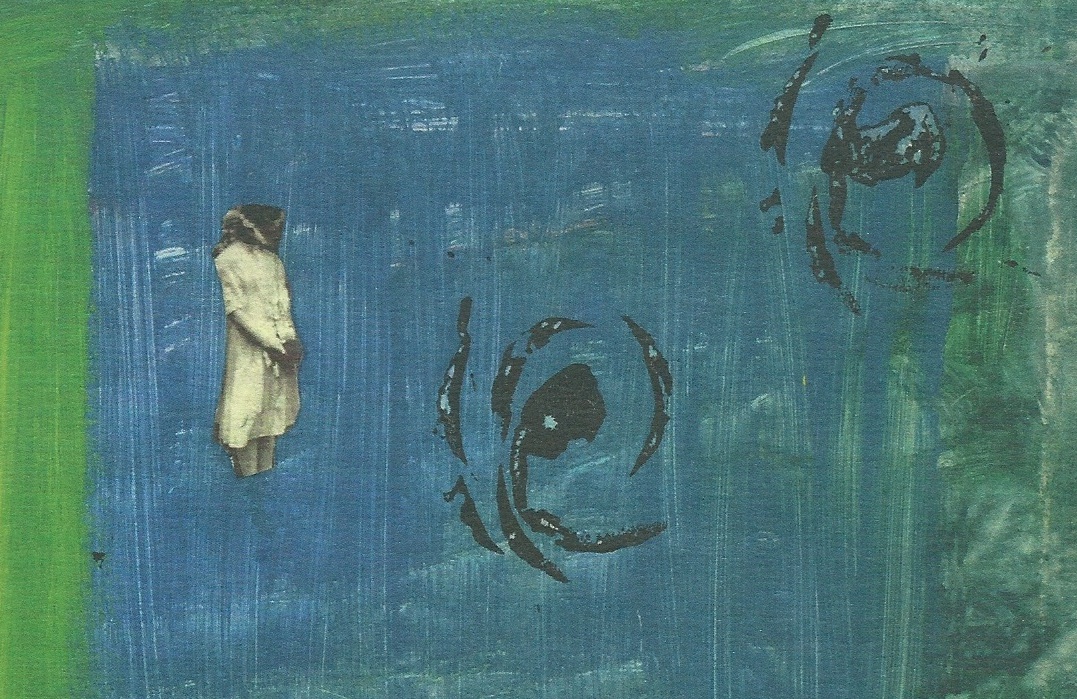
* The painting/collage is by Matana Roberts and forms a part of the cover of Coin Coin Chapter Three: River Run Thee, released by the Constellation label.