Skip to content

Posts tagged ‘Marvin Sewell’

Silence and slow time

“Silence and slow time…” John Keats’s beautiful phrase finds an echo in some of the music I love, the kind that emerges from a stillness to which it eventually returns, taking its time and not raising its voice to attract attention. Here are five brand-new examples of music with healing qualities, all highly recommended.

1 The Necks: Disquiet (Northern Spy)

Three hours of glorious studio-recorded collective interplay on three CDs. “Rapid Eye Movement” is a 57-minute exploration of densities, starting with Chris Abrahams’ Rhodes piano, punctuated by Lloyd Swanton’s abrupt double bass figures. It changes slowly, like the weather, eventually reaching a passage of single-note cascades from the acoustic piano over Tony Buck’s rumbling tom-toms, leading to an exquisitely tapered ending. “Ghost Net” is 74 minutes of lurching, clattering, gradually darkening polyrhythmic layering, with each musician apparently playing in 12/8, but in three different 12/8s. Using what sounds like a Farfisa organ, it’s as though they’ve suddenly found the sweet spot between Thelonious Monk and ? and the Mysterians. The other two tracks divide an hour between them. “Causeway” opens with echoing guitar and celestial organ and contains a completely intoxicating E minor/B minor/A minor vamp — the Necks’ own three-chord trick — with piano above guitar and organ before a sudden gearchange, involving the addition of thrashing drums, turns a reverie into something soaringly urgent. “Warm Running Sunlight” is an essay in textures and the contemplative space between them: string bass going from plucked to bowed and back, splashing cymbals, Rhodes heavy on the reverb. A lot to take in, but among their very best, I’d say.

2 Tom Skinner: Kaleidoscopic Visions (Brownswood)

The drummer and composer whose Voices of Bishara project I liked so much, in both its studio and live incarnations, takes a slightly different tack here. The music is built around his regular bandmates — the saxophonists Chelsea Carmichael and Robert Stillman, the bassist Tom Herbert and the cellist Kareen Dayes — but with a handful of guests: Meshell Ndegeocello layering her voices on one track, Portishead’s Adrian Utley adding his guitar to a couple more, the singer Contour (Khari Lucas) from South Carolina gently intoning the poetic lyric of “Logue”, and Yaffra (London-born, Berlin-residing Jonathan Geyevu) reciting the poem “See How They Run” over his own piano and Skinner’s overdubbed keyboards, vibes, bass, guitar and percussion. Music without boundaries, full of human feelings, ancient to the future.

3 Jan Bang / Arve Henriksen: After the Wildfire (Punkt Editions)

The two Norwegians devise eight pieces featuring Henriksen’s distinctive trumpet with Bang’s samples, Eivind Aarset’s guitar, Ingar Zach’s percussion, three singers, the Fames Institute Orchestra, a cellist, two Balkan instruments — the tapan (a double-headed drum) and the kaval (an end-blown flute) — and the zurla, a Turkish double-reed instrument. Ravishing from beginning to end, starting with “Seeing (Eyes Closed)”, which made me think that Miles Davis and Gil Evans had been reincarnated as graduates of the contemporary Norwegian jazz scene, to “Abandoned Cathedral II”, a continuation of Henriksen’s classic 2013 album, Places of Worship.

4 Rolf Lislevand: Libro Primo (ECM New Series)

Another Norwegian, this time an exponent of the archlute and the chitarrone, examining the works written for the lute and its variants by the 16th and 17th century composers Johann Hieronymus Kapsberger, Giovanni Paolo Foscarini, Bernardo Gianoncelli and Diego Ortiz. Lislevand’s sleeve essay explains the revolution in which these composers were involved, and he brings them into the present day with free, fluid interpretations that make this music ageless. His own riveting “Passacaglia al Modo Mio” is both a salute and a declaration of possibilities. Anyone with a fondness for Davy Graham or Sandy Bull will enjoy this enormously.

5 Charles Lloyd: Figures in Blue (Blue Note)

For the latest in his series of drummerless chamber trios, the great saxophonist is joined by an old colleague, the pianist Jason Moran, and a newer one, the guitarist Marvin Sewell. This two-CD set begins with what is surely the first version of “Abide with Me” to appear on a jazz album Monk’s Music in 1957 and ends with a exquisite rumination on the standard “My One and Only Love”. In between Lloyd invokes the spirits of Duke Ellington, Billie Holiday, Langston Hughes and Zakir Hussain. On two tracks he also makes fine use of Sewell’s command of bottleneck techniques, leading one to wish that more modern jazz musicians would explore the blues in the way Gil Evans did with “Spoonful” and Julius Hemphill with “The Hard Blues”.

Sounds from silence

Gerald Clayton, Charles Lloyd and Marvin Sewell at the Barbican 17/11/23

Charles Lloyd’s set with his Ocean Trio at the Barbican on Friday felt like a voyage into the core of jazz. Together they created music full of warmth, humanity, experience and spontaneity, ranging from the gently probing lyricism of Lloyd’s tenor saxophone, flute and tarogato through Marvin Sewell’s stunning essay in Delta blues bottleneck guitar to the brilliant pianist Gerald Clayton’s ability to reinvigorate familiar gospel and Broadway material, enriching it with his own personality.

Lloyd is 85 now, and he wears those years with a hard-won but lightly born combination of wisdom and innocence. This is a man born in Memphis, Tennessee, of African, Cherokee, Mongolian and Irish ancestry, whose employers, friends, collaborators and sidemen have included B. B. King, Howlin’ Wolf, Booker Little, Eric Dolphy, Chico Hamilton, Cannonball Adderley, Keith Jarrett, the Beach Boys, Brad Mehldau, Billy Higgins, Jason Moran, Bill Frisell and Lucinda Williams. Even now, his sense of creative adventure remains undimmed. And what you still feel at one of his concerts, even after he has delivered the benediction concluding with “Om shanti shanti shanti”, is that he can’t bear to stop now.

In one way or another, all music emerges from silence. As part of the 2023 EFG London Jazz Festival, Lloyd’s group was preceded on to the Barbican stage by another trio, that of the tenor saxophonist and composer Mette Henriette Martedatter Rølvåg, whose first album appeared on the ECM label in 2015. On Friday she, the pianist Johan Lindvall and the cellist Judith Hamann played pieces from its follow-up, Drifting, released last year. Maybe none of the company’s releases comes closer than Mette Henriette’s music to the ideal expressed in ECM’s famous early slogan: “The most beautiful sound next to silence.”

This was quiet, patient music constructed from slow lines and careful tonal combinations, but none the less intense for an absence of overt drama. Early in her career, Mette Henriette was being told that she sounded like various prominent free-jazz saxophonists before she had even heard of them, although really she sounds like no one but herself. This was the second time I’ve seen her in concert, and on both occasions she demonstrated through her music as well as her poised presence a marked ability to cast a spell over an audience who may not have known much, if anything, about her in advance.

There was no shortage of drama in the short duo set played by the pianist Pat Thomas and the drummer Tyshawn Sorey at Café Oto on Saturday night: half an hour of relentless dynamic and textural contrasts followed by a spirited encore of “A Night in Tunisia” that lasted barely a minute, so short that it didn’t even reach the middle eight. The intensity with which ideas were investigated and compressed made it seem quite enough to satisfy any listener.

Thomas belongs to the school of jazz pianism that proceeds from Ellington through Monk, Elmo Hope, Herbie Nichols and Andrew Hill, splintering off via Cecil Taylor to Alex von Schlippenbach, Misha Mengelberg and Alexander Hawkins. He’s a player of great intellectual weight but also of emotional power, and his partnership with the extraordinary Sorey produced great dividends.

I once heard Sorey hit a very large gong with unimaginable force and precision, producing a sound of such volume that I feared it was going to bring down the walls of the Haus der Berliner Festspiele. Although some of the climaxes he devised with Thomas were quite ferocious, there was no such threat to the fabric of Café Oto. His command of the dynamic spectrum is such that at one moment, when the dialogue was at its most refined, almost transparent, he spent several seconds waving his wire brushes above his drums and cymbals, striking nothing at all. In the silence, I’ll swear you could hear him playing the air.

London Jazz Festival 2: Cécile McLorin Salvant

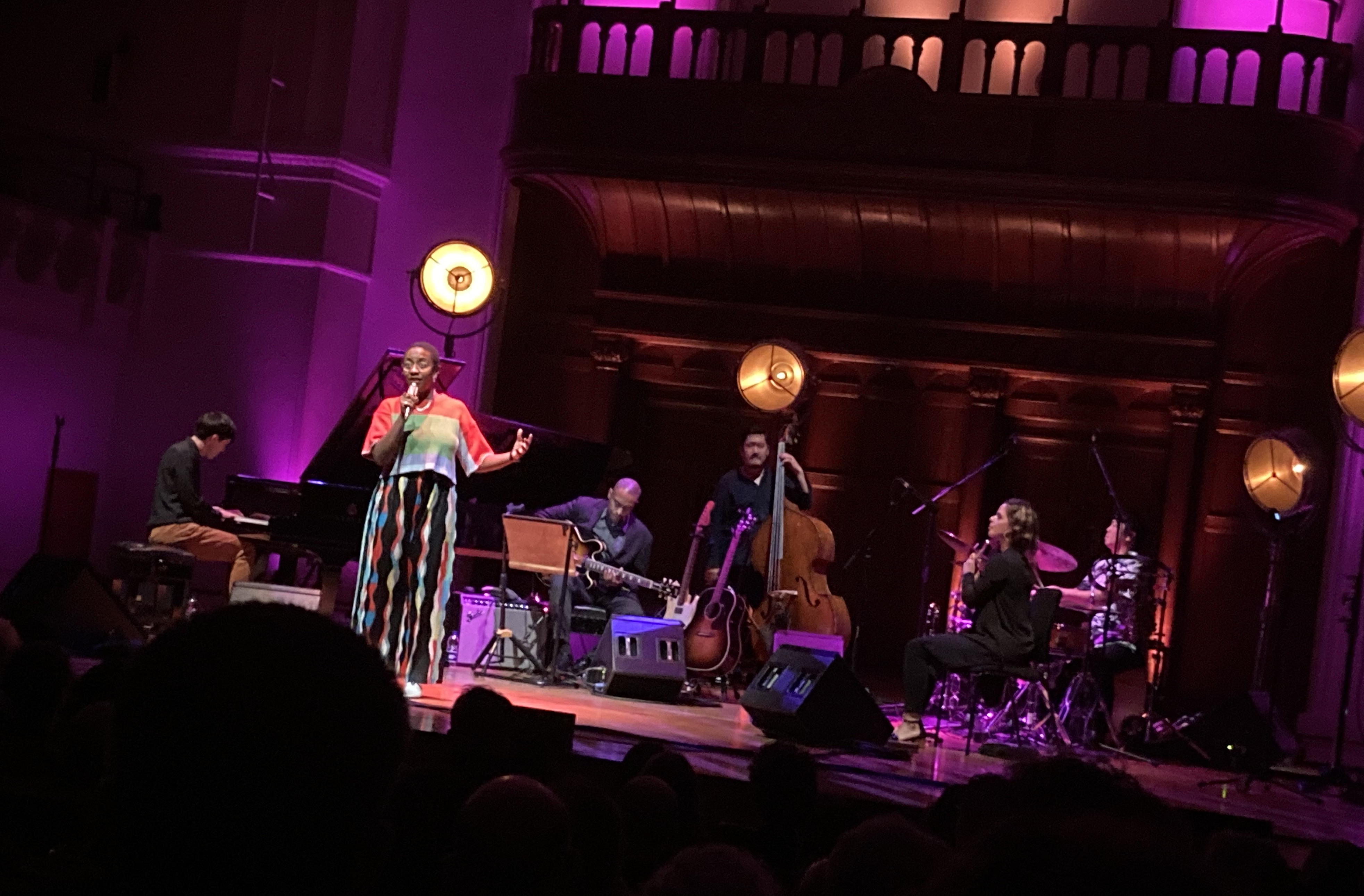
With Grammy awards on her mantelpiece for each of her last three albums, Cécile McLorin Salvant could be cruising. Instead she’s challenging herself and her audience. Listening to her at Cadogan Hall on Tuesday, I was reminded of Rhiannon Giddens: these are women with powerful voices, vast musicality, great curiosity, and a disinclination to opt for the comfortable life that could be the reward for the acclaim both have received in recent years.

For the tour preceding the arrival of her next album, Ghost Song, early next year, McLorin Salvant has jettisoned the familiar support of a jazz piano trio in favour of a kind of chamber quintet featuring flute (Alexa Tarantino), guitar (Marvin Sewell), piano (Glenn Zaleski), bass (Yasushi Nakamura) and percussion (Keito Ogawa). Carefully deployed, the ensemble is flexible enough to cover all the territory she now explores as she expands her range from the basic repertoire of ballads and blues.

Her own songs at this concert included “Fog”, from the 2015 album For One to Love, the new “Thunderclouds”, inspired by Les Enfants du Paradis and finished with a couple of lines from Colette, “Obsession”, from 2018’s The Window, and the haunting “Ghost Song” itself, her voice on its final chorus plaintively joined by that of Tarantino. In these compositions, Broadway theatre music meets art song and the virtuosic inventiveness of Betty Carter meets the emotional focus of Nina Simone.

Her choice of cover versions was intriguing. “I Want to Know” was an ’50s-style R&B song, a 12-bar blues with a bridge, showcasing Sewell’s fine bottleneck playing. Brecht and Weill’s “Pirate Jenny” came from Simone’s repertoire, sung with a teasing lightness. Sting’s “Until…”, from the soundtrack to the 2001 film Kate & Leopold, was interestingly rearranged to culminate in a Latin section featuring fine flute and piano solos. But the biggest surprise came with “Wuthering Heights”, a song I cordially detest in its original version, here slowed and spun into something mesmerisingly beautiful, its gimmicks completely removed in order to facilitate this remarkable transfiguration.

She’s on a journey, just as Cassandra Wilson, a member of a previous generation, was when she moved from the supper-club safety of Blue Skies in 1988 to the uncharted waters of Blue Light ‘Til Dawn five years later, using different instrumentations to tackle Robert Johnson, Joni Mitchell and the Monkees. Even McLorin Salvant herself may not know where her well-stocked mind and innately inquisitive spirit will take her in the coming years, but from the sound of Tuesday’s ovation she will not be alone on the trip.