Skip to content

Posts tagged ‘Mark O'Connor’

Croeso y Cafe Oto

Cafe Oto, 8/6/24. From left: Melvin Gibbs, Eadyth Crawford, Mark O’Connor, Tomos Williams, Mared Williams and Nguyen Le

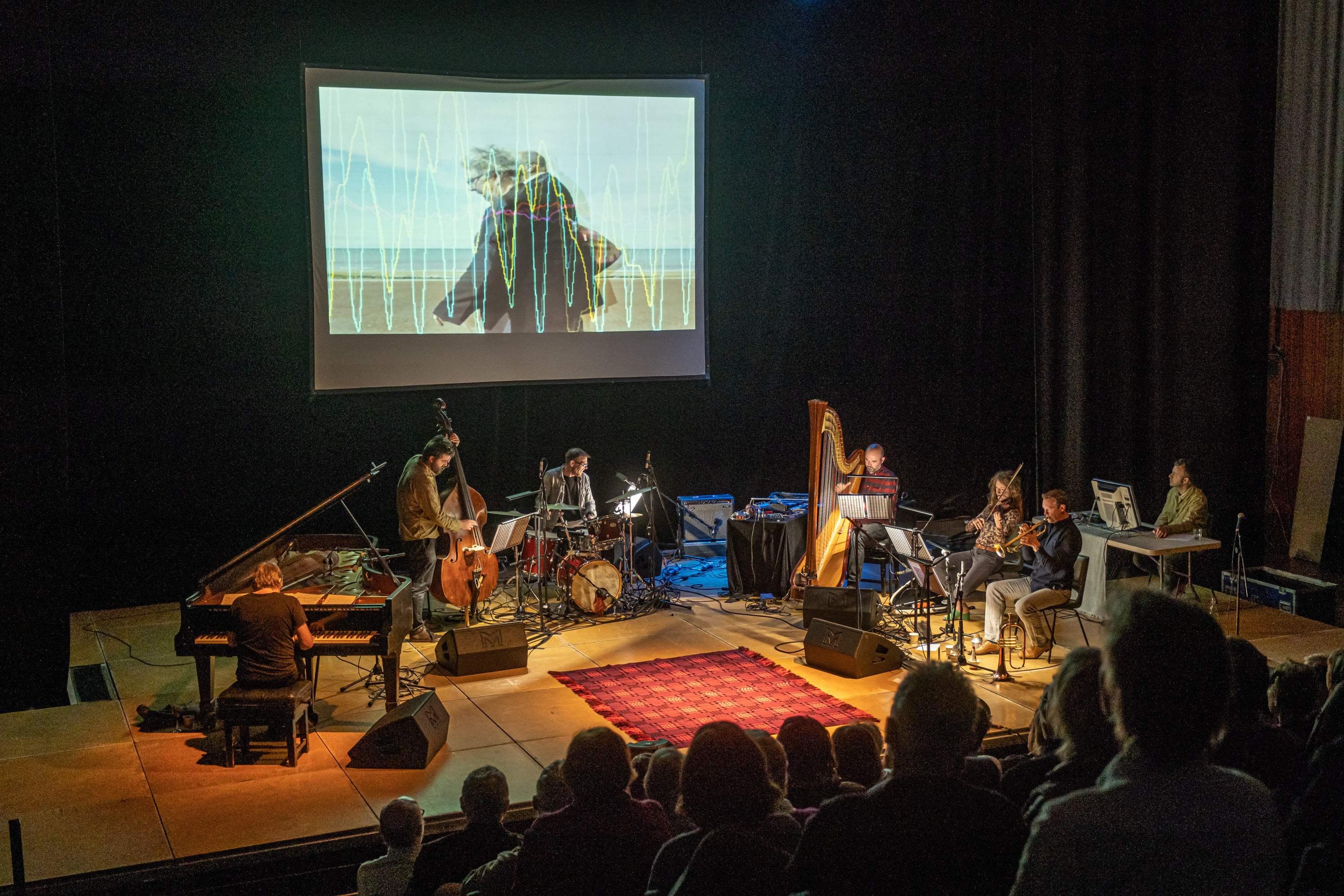
A welcome in Welsh from the trumpeter, composer and bandleader Tomos Williams prefaced the performance in Dalston of the third part of his Cwmwl Tystion series: Empathy, to follow the live recordings of Witness (released in 2021) and Riot! (2023) made during earlier tours. In all three, Williams blends the language of contemporary jazz with stories from the last 200 years of Welsh history.

For each part, he deployed different resources: the harp of Rhodri Davies and the voice of Francesca Simmons on Witness, the saxophone of Soweto Kinch and the vibes of Orphy Robinson on Riot!. For Empathy, he retained the voice of Eadyth Crawford and the drums of Mark O’Connor and added the Vietnamese guitarist Nguyen Le, the American bass guitarist Melvin Gibbs and a second voice, that of Mared Williams.

The two non-Welsh guests, both virtuosos of effects-enhanced stringed instruments, played powerful roles in setting the tone and trajectory of the music chosen and written to accompany pieces inspired by Paul Robeson’s recital to the mining families of Aberpennar (Mountain Ash) in 1938, the eviction of the villagers of Mynydd Epynt in Powys by the Ministry of Defence in 1940, the Aberfan disaster of 1966 and the miners’ strike of 1984. All these were accompanied by Simon Proffitt’s back-projected visuals.

Gibbs, once a member of Defunkt, has few equals in turning a five-string bass guitarist into an electronic orchestra. Le is one of the most adept of post-Hendrix guitarists. They found a willing accomplice in the powerful and dextrous O’Connor. At times I was reminded of Miles Davis’s Tutu period, of Jon Hassell’s Fourth World Music, and of Terje Rypdal at his wildest. One late passage raised the volume to death-metal levels.

That made the use of the two voices, sometimes combined in folk-like materials, even more valuable as a contrast, along with the sudden and very moving insertion, during the Aberfan passage, of the pre-recorded sound of a pipe organ and a chapel choir, and Williams’s use of Donald Byrd’s “Cristo Redentor” as a healing balm towards the conclusion. Earlier, the trumpeter had excelled in a tightly muted solo over a lovely habanera rhythm.

After six concerts at various venues around Wales in the preceding days, this visit to Llundain represented the tour’s finale: the final performance of this particular work by this particular band. As they laid down their instruments and stepped back from microphones, the sense of exhilaration had a special resonance.

* Parts one and two of Cwmwl Tystion are available on the Ty Cerdd label.
Bearing witness

It was by concidence, or so I imagine, that a CD titled Cwmwl Tystion dropped through my letterbox on St David’s Day, which falls on March 1. Cwmwl Tystion — whose English title is Witness — happens to be an album of new jazz by Welsh musicians, devoted to themes of Welsh culture and nationhood.

The literal translation of “cwmwl tystion” is “cloud of witnesses”, a phrase taken from a translation (by Rowan Williams, the former Archbishop of Canterbury) of a poem called “What is Man?” by Waldo Williams (1904-1971), a celebrated Welsh poet, nationalist and peace activist:

What is it to be a people? A gift
lodged in the heart’s deep folds.
What is love of country? Keeping house
among a cloud of witnesses.

Six of the seven pieces on the album were written by the trumpeter Tomos Williams (the exception is the traditional “Glyn Tawe”) and performed by him with Francesca Simmons (violin and saw), Rhodri Davies (harp and electronics), Huw Warren (piano), Huw V. Williams (bass), and Mark O’Connor (drums). The titles make reference to Paul Robeson’s historic performance at the miners’ eisteddfod in Porthcawl in 1957; to the Blue Books of 1847, in which the teaching of the Welsh language was officially discouraged; and to the infamous obliteration of an entire North Wales village in 1965 in order to create a reservoir to provide water for the people of Liverpool.

This would be all very well and good, but perhaps pleasing primarily to Welsh hearts, were it not that the music produced by Tomos Williams and his colleagues is of the very highest class. Supported by Ty Cerdd (Music Centre Wales), on whose label the CD was released this month, The Cwmwl Tystion Suite was given five concert performances — with live visuals by Simon Proffitt — in 2019, from which these recordings were taken.

What Tomos Williams has done is subtly infiltrate contemporary jazz practices with textures drawn from the music of his native land, but in a very non-literal way. So while the sound of Rhodri Davies’ harp is a reminder of traditional Welsh music, it also carries an echo of Alice Coltrane: the spirituality shared by both infuses the music without dominating it. Davies’s use of electronics adds different colours and dimensions to the music, as an equal voice with the acoustic instruments or as a soundwash. The unusual instrumentation is thoughtfully deployed — as in the trumpet/violin statement of the opening “Mynyddoedd Cymru (Mountains of Wales)” — and shrewdly rotated to maximise its possibilities and its freshness.

All the soloists bring character to their improvisations. Tomos Williams plays as Wadada Leo Smith might do, had he been born in Aberystwyth: a different kind of blues. Francesca Simmons finds interesting ways of applying lyricism to these often astringent textures, and her rich tone is spotlit on “Glyn Tawe”. Huw V. Williams is a powerful force on bass, taking the spotlight on the tribute to Robeson, and Huw Warren’s glistening solo on the closing track, “What is Man?”, mines the creative space between Bill Evans and Herbie Hancock. Mark O’Connor’s drumming is beautifully sensitive and exquisitely detailed, radiating light and swing.

Jazz is an African American music generous enough to allow others to inhabit its spirit and to shape it to their own ends. Django Reinhardt proved that, as have Tomasz Stanko, Dudu Pukwana, Han Bennink, Don Drummond, Giorgio Gaslini, John Surman, Masabumi Kikuchi, Gato Barbieri, and many others. If the music can “belong” to Sinti, Poles, South Africans, Dutch, Jamaicans, Italians, English, Japanese and Argentinians, then it can belong to the Welsh, too.

Small country, big heart — a heart that beats firmly throughout this excellent album, a showcase for skill, imagination, soul and originality. Even without a spasm of hiraeth — the Welsh yearning for the homeland — I’d be disposed to recommend it very highly indeed.

* The photograph was taken at Aberystwyth Arts Centre by Keith Morris. Further information: http://www.tycerdd.org or http://www.tycerddshop.com