Skip to content

Posts tagged ‘Linda May Han Oh’

The Necks at Cafe Oto
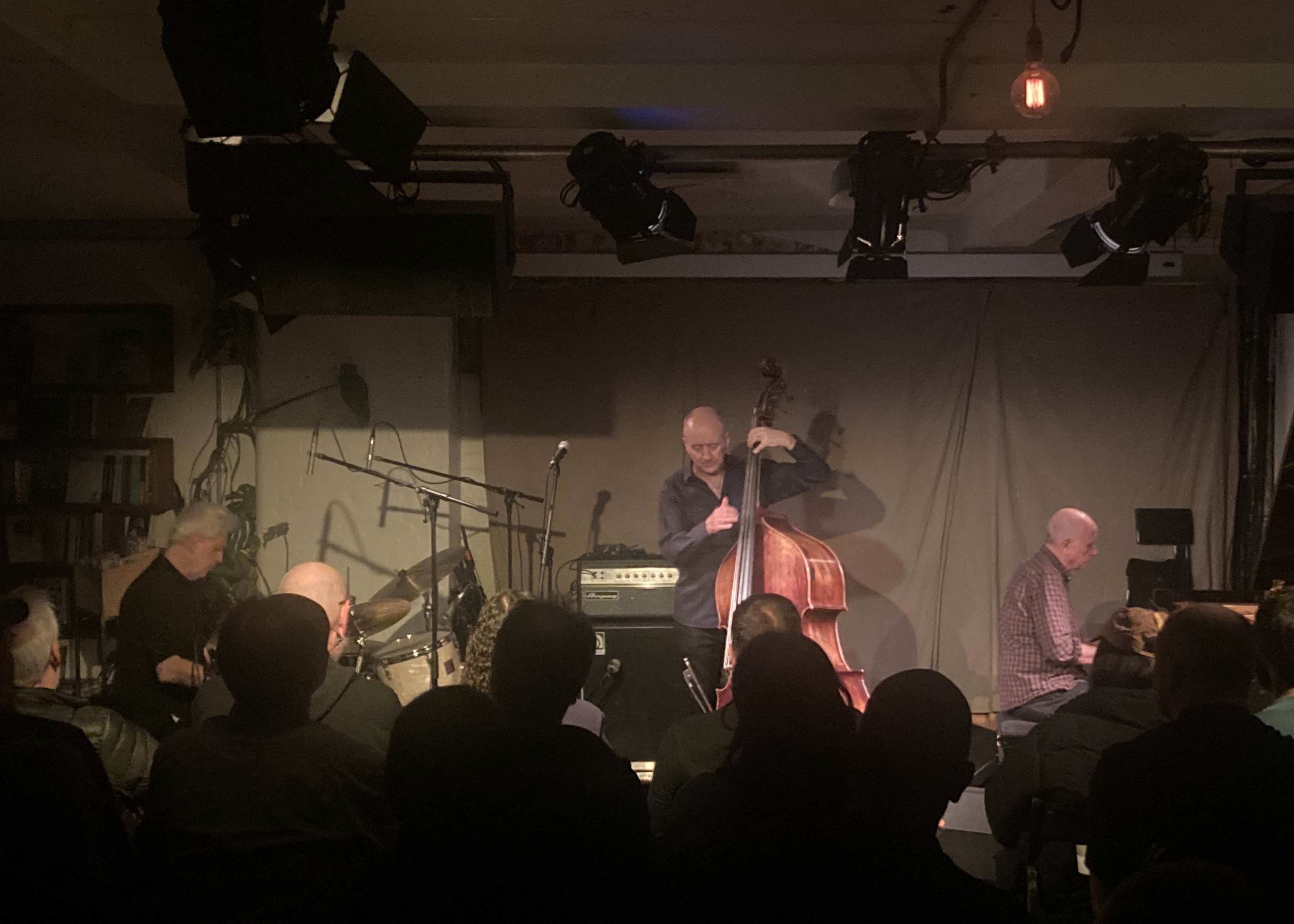
“We’ve never really been an emotional band,” Lloyd Swanton observed drily after the first set on the last of the Necks’ four nights at Cafe Oto in London this week, “but it seems to be creeping in.”

I’d been trying to tell him, somewhat incoherently, how moved I’d been by what they’d just played, and in particular how it seemed to express something about the current state of the world. His reflexive response indicated that what he and his colleagues in the Australian trio do is principally about the notes, about the process of three musicians improvising together with no preset material and certainly with no programmatic content in mind. Which is not to say that listening to them isn’t an emotional experience. It is, almost invariably, but the emotions they generate are usually non-specific.

To me, at least, it seemed that there was something different about Thursday’s first set. It started out normally enough, after they and the audience had settled, with one member — Swanton, on this occasion — breaking the silence. As he plucked an isolated note on his double bass, repeating it and echoing it an octave down, sometimes switching to his bow, and initially with long pauses, Tony Buck joined in with mallets gently rolling around his tom-toms and cymbals, followed by Chris Abrahams picking out pensive Moorish figures in the middle-upper octaves of the piano.

For a while, not much seemed to be happening. No surprise there, necessarily. Later Buck said that he’d worried it had started out “a bit washy”. But in 20 years of attending their performances I’ve learnt to wait, to show the kind of patience as a listener that they show as players, in the knowledge that the surprise will come. In fact, they are the proof that the sound of surprise can emerge slowly, by gradual accretion.

This time the process of accretion led to something extraordinary. As the playing of all three grew busier, the textures thickened, the spaces closed and the volume increased, all of it occurring almost imperceptibly, you began to feel that you were hearing things: bells, cries, gunfire. It was an illusion. They weren’t there, and neither was anyone trying to produce them. But somehow they were present — for me, anyway — in the harmonics reflecting off the piano lid, the scrabbling and keening of the bass, and the hard crack of the bass drum against the overlapping splashes of the cymbals.

Eventually it reached a pitch of intensity that was sustained for maybe 15 minutes before being gradually wound down through a collective diminuendo into silence once again. And in those 15 minutes I couldn’t help replaying the images we’ve been seeing on the TV news every night for months — images of buildings, streets, whole cities lying in ruins, of the dead being counted and the living in flight, the sort of total war we may stupidly have believed was safely consigned to a distant past.

That’s not, I’m sure, what the members of the Necks were thinking of while they were summoning the music into being. It’s more the sort of thing the pianist Vijay Iyer had in mind when, with the bassist Linda May Han Oh and the drummer Tyshawn Sorey, he recorded a new trio album whose title, Compassion, explicitly indicates its theme. “Music is always about, animated by, and giving expression to the world around us: people, relations, circumstances, revelations,” Iyer writes in the sleeve note, describing the responsibility, as he sees it, of making art in a time of suffering.

I’ve heard the Necks play music unafraid of ugliness before (a hair-raising triple-forte set at Café Oto in 2013 stands out in the memory), but never anything in which the kind of responses they normally evoke — including but not restricted to euphoria and elevation — were so strikingly replaced by this very different kind of transcendence, a sustained howl expressing something beyond words yet somehow very specific.

So that was the fifth of the six sets I heard them play this week, and the sixth was, as usual, quite different. Abrahams opened it with a reversion to the sort of thing that provokes the use of adjectives like “luminous” and “lambent”. But again there was a surprise when the piece evolved into an essay in the use of asynchronous rhythms, a field they’ve opened up in recent years, in which each one establishes his own pulse or metre and, without forfeiting closeness of listening to the others, maintains it as the piece develops. At its best, it leads to a kind of higher interplay — and this was the practice at its very best, creating a rhythmic maelstrom that activated a very different response in the audience.

All a long way from the sort of passive music for Zen meditation with which they are sometimes erroneously associated, and irrefutable evidence of their commitment, now extending well into its fourth decade, to a constant self-regeneration of which we are the fortunate beneficiaries.

* The Necks continue their European tour at Peggy’s Skylight in Nottingham on Monday (already sold out) and the Tung Auditorium in Liverpool on Tuesday, April 8 and 9 respectively. Their most recent album, Travel, was released in 2022 on the Northern Spy label. Compassion, by Vijay Iyer, Linda May Han Oh and Tyshawn Sorey, was released earlier this year by ECM.

Some universal truths

Back in 1982, Billy Valentine and his brother John recorded a song called “Money’s Too Tight (To Mention)”, a slice of disco-funk that made the lower regions of the R&B chart. Its lyric reminded me of Jimmy Witherspoon’s “Money’s Gettin’ Cheaper” and I liked it enough to buy the 12-inch from Groove Records on the corner of Greek Street and Bateman Street in Soho. Three years later it was covered by the Manchester band Simply Red, for whom it provided a first hit and the basis of a rather more successful career than was granted to the Valentine Brothers.

Now Billy returns with what will certainly end up among my albums of the year: Billy Valentine and the Universal Truth, a collection of rearrangements of eight well-known songs united by a certain social relevance. In age they range from the spiritual “Wade in the Water” to Prince’s “Sign of the Times”, first recorded by its composer in 1987. In between come songs written by Curtis Mayfield, Stevie Wonder, Gil Scott-Heron, Pharoah Sanders and Leon Thomas, the members of War, and Leonard Caston and Anita Poree.

Valentine brings the wisdom of his years to these “message” songs. The softened edge to his tone reminds me of the great southern soul singer O. V. Wright, but his vocal agility enables him to handle the rapid-fire phrasing of the Prince song with ease. The anguish in “Home Is Where the Hatred Is” matches that of Esther Phillips’s famous 1972 version.

The arrangements here are modern and imaginative, often making use of jazz gestures. There’s the eloquent improvising of the new star saxophonist Immanuel Wilkins on Mayfield’s “We the People Who Are Darker Than Blue”, sensitively accompanied by Larry Goldings on piano, Linda May Han Oh on bass and Abe Rounds on drums. There’s Claire Daly’s barely controlled baritone saxophone, preaching the spiritual jazz message on Sanders’ “The Creator Has a Master Plan”, and Theo Croker’s elegant trumpet on “Sign of the Times”. There’s Goldings again, reincarnating the spirit of mid-’60s Ramsey Lewis on “Wade in the Water” and a beautiful opening-up of Wonder’s scathingly political “You Haven’t Done Nothin'”. Other featured players include the vibraphonist Joel Ross, the percussionist Alex Acuña and the guitarist Jeff Parker.

Produced by Bob Thiele Jr, the son of the man who produced John Coltrane’s Impulse albums and recorded Ornette Coleman on his own Flying Dutchman label, this isn’t a jazz record any more than it’s a soul record, a funk record or an R&B record (some of the tracks have a rhythm section of Pino Palladino on bass guitar and James Gadson on drums). It’s all of them, mixed together in perfect proportions. And if the message of these songs isn’t new, it’s never a bad thing to be reminded of the continuing urgency of what they have to say. In a post-truth world, they hit even harder.

* Billy Valentine and the Universal Truth is released on 24 March on the Acid Jazz/Flying Dutchman label: http://www.acidjazz.co.uk. The photograph is by Atiba Jefferson.

London Jazz Festival 1: The peak of their art

After an hour of Mike Westbrook’s autumnal musings at the Pizza Express’s piano on Sunday afternoon, in which the great composer, arranger and bandleader stitched together the memories of a life in music into a seamless reverie with a quiet intensity that held the room in thrall, the scene at the 2021 London Jazz Festival moved to the South Bank, where Vijay Iyer, Linda May Han Oh and Tyshawn Sorey stormed the Queen Elizabeth Hall with something belonging entirely to the here and now.

Sometimes you get lucky and witness something that makes you realise how high the standards can be. Doesn’t matter what it is. Tennis, poetry, carpentry. On Sunday night it was jazz. A pianist, a bassist and a drummer dropped in to examine the art of the possible, demonstrating over the course of two hours of high-density interplay what can happen when three like-minded virtuosi get it into their heads to create something in which 1+1+1 = infinity.

Basically, they played their way through their recent album, Uneasy. It’s one of the year’s finest releases, but here they stretched it, expanded it, tossed its elements around, and gave it a completely new existence. So many bases were covered — 21st century takes on bebop, Latino patterns, reggae, the circular rhythms of Tyner-Garrison-Jones — that the time passed very quickly.

Linda Oh is the least known of the three, but her bass playing was the heart of the group: slight build, total physical commitment, wonderful tone, great agility, an endless flow of ideas. Vijay Iyer is a cerebral pianist who nevertheless relishes any involvement with rhythm (one night at the Lido in Berlin a few years ago, he and his regular acoustic trio — completed by the bassist Stephan Crump and the drummer Marcus Gilmore — locked into an endless groove that any funk band would have envied). Tyshawn Sorey operates with complete comfort at the absolute extremities of the dynamic range, from whisper-quiet to shatteringly loud, plus every setting in between. On this occasion he made you wonder why anyone would ever need more than a small bass drum, a medium-sized snare, a single cymbal and a hi-hat, from each of which he drew an astonishing variety of tones and timbres.

Their music rattled, jolted, cruised, purred, broke apart, blended back, cantered, swung, faked a stumble, slowed to a sigh. The audacity made you gasp. Solos were taken, but were always part of the whole. Oh’s leaping grooves made you want to dance. Iyer’s upper-register filigree made your mind soar. Sorey’s sudden whipcracks straightened your back.

Another side of the multi-dimensional Sorey is on view in For George Lewis / Autoschediasms, a two-CD set in which his compositions are performed by Alarm Will Sound, a New York-based 16-piece chamber orchestra here made up of brass, woodwind, strings and percussion, tuned and untuned. “For George Lewis”, a 50-minute piece dedication to his mentor and fellow composer, conducted by Alan Pierson, bears the imprint of Sorey’s interest in the music of Morton Feldman: fully composed, based on a process of accretion and subtraction of single held notes, it moves with mesmerising deliberation through austere and refined layers of sound, creating the musical equivalent of colour-field painting.

“Autoschediasms” is Sorey’s name for his version of the approach to creating real-time music with large ensembles pioneered by Butch Morris (who called it “conduction”) and Anthony Braxton. In these two performances, recorded in St Louis in May 2019 and in various US cities via internet video chat in October 2020, Sorey takes the rostrum, giving the musicians prompts via gestures and prepared cue-cards. “The method can involve the use of up to four batons simultaneously by the conductor,” he writes in his informative notes, and anyone who has seen him at a drum kit will know that this is a challenge well within his scope. The result is a much more obviously active ensemble music, its details and densities sometimes clashing or overlapping, but with an emerging coherence and, like a master of action painting, an excellent sense of drama.

* Uneasy by Vijay Iyer, Linda May Han Oh and Tyshawn Sorey is on ECM. For George Lewis / Autoschediasms by Tyshawn Sorey and Alarm Will Sound is on Cantaloupe Music (www.cantaloupemusic.com).

The uneasy trio

It’s possible that, like me, you think there are already quite enough jazz piano trio albums in your collection. Think again. Uneasy, the new recording by Vijay Iyer, Linda May Han Oh and Tyshawn Sorey, demands attention.

The realignment of the piano-bass-drums hierarchy from “piano with rhythm accompaniment” to a full three-way conversation of equals has been going on for decades, and Uneasy is about as elevated as the format currently gets. Listen to the opener, “Children of Flint”, to appreciate the level of interaction between three musicians with virtuoso-level skills and giant imaginations. It sounds lyrical, even simple. But just concentrate on the astonishing touch displayed by each of the trio, whether on piano keys, bass strings, drums or cymbals, and the sense of three seamlessly interlocking and interdependent components.

As you work your way through the 10 tracks — eight compositions by Iyer, plus Geri Allen’s “Drummer’s Song” and Cole Porter’s “Night and Day” — you’ll also notice a complete absence of ego-projection. No one is showing off. On the sole standard, it’s easiest to hear how far Iyer can take the line of piano-playing founded by Bud Powell. Oh displays the deep sense of swing, nimble melodic imagination and beautiful sound of a 21st-century Paul Chambers. Sorey creates a momentum at once light but deep, exploiting a combination of technique and intellect that redefines the investigation of rhythm.

Recorded in a studio in Mount Vernon, NY three months before pandemic arrived, the album comes with a cover photograph of the Statue of Liberty seen through mist and against clouds. In his sleeve note, Iyer writes that Uneasy was originally the title of a collaborative piece with the choreographer Karole Armitage in 2011, exploring “the instabilities that we then sensed beneath the surface of things… the emerging anxiety within American life. A decade later, as systems teeter and crumble, the word feels like a brutal understatement.”

That heightened disquiet, however, remains implied. You’re not thinking about the end of the world. You’re remembering how even the darkest of times can’t extinguish such astonishing creativity. One of the records of the year, no doubt.

* Uneasy is on ECM Records. The photographs of (from top) Iyer, Oh and Sorey are from the CD’s booklet and were taken by Craig Marsden.