Carla Bley 1936-2023

It seems so true to Carla Bley’s nature, such a characteristically mordant mixture of the sad and the funny, that her last album should have been called Life Goes On. Carla, who was one of jazz’s greatest composers and arrangers, died this week, aged 87. The four pieces recorded in 2019 and making up the short suite that gave the album its name are titled as follows: “Life Goes On” / “On” / “And On” / “And Then One Day”.
And then one day Carla was gone, her death making us think of the music she leaves behind, all of it suffused by her unique personality. In my case, I’m most grateful for the five studio albums she made Charlie Haden’s Liberation Music Orchestra, starting in 1970 with its eponymous debut album, continuing with Ballad for the Fallen (1983), Dream Keeper (1990) and Not in Our Name (2005), and ending with Time/Life in 2016, all of them keeping the precious flame of resistance alight. Carla had grown up listening to her father play the organ in church, and the LMO often brought out her wonderful way of orchestrating hymns and anthems, from Hanns Eisler’s “Song of the United Front” to “Nkosi Sikelel’i Afrika” and Samuel Barber’s “Adagio”, acknowledging the beauty of their aspirations while spiking that beauty with the knowledge of human frailty.
And then there is Escalator Over the Hill, the triple vinyl LP box set released in 1971, the crazily ambitious and magnificently enigmatic “chronotransduction” on with she collaborated with the poet Paul Haines, enlisting a huge cast, perhaps the most extraordinary ever assembled for a single composition. The performers went from Don Cherry, Roswell Rudd and Gato Barbieri through Jack Bruce, Paul Jones and John McLaughlin to Viva, Linda Ronstadt and her own four-year-old daughter Karen, recorded against the odds over a long period of time in several locations, using several levels of technology, subsidised by money begged and borrowed to complete it before its release on JCOA Records, the independent label set up with her then husband, the trumpeter and composer Michael Mantler.

In my copy of Escalator there’s a five-page letter written by Carla to me on yellow legal-pad paper in pencil — “We’re up at our farm in Maine for a rest and we don’t even have running water and electricity, much less typewriters and stationery” — early in 1972, soon after its release. She’d heard from Jack Bruce that the Melody Maker had made it jazz album of the year, or something like that, and she wanted to tell me about how it was now being distributed in the UK as part of a reciprocal arrangement with the saxophonist Evan Parker and the Incus label. Within months she and Mantler would set up the New Music Distribution Service, whose initial foreign partners included Incus and ECM, and which lasted until 1990, having helped disseminate the music of Laurie Anderson, Julius Hemphill, John Adams, David Murray, John Zorn and many others.
The letter is a reminder of Carla’s persistence in championing not just the value of creativity but the rights of the creator and the right to be heard. Others will write about how, as a teenager, she hitched a lift from California to New York to hear Miles Davis and took a job as a cigarette girl at Birdland, and about the enduring qualities of songs like “Sing Me Softly of the Blues”, “Vashkar”, “Ida Lupino” and “Lawns”, and how A Genuine Tong Funeral, the suite she wrote for Gary Burton in 1967, represented the first full exposure of her gifts as well as her sense of humour, beginning as it did with a sequence titled “The End”.
I last saw her at the Cadogan Hall in 2016, an almost spectral figure in black at the side of the stage, sitting down at the piano but also standing to listen as her music was played by the members of the Liberation Music Orchestra during the London Jazz Festival, two years after Charlie Haden’s death. It filled the audience’s hearts and moved me to tears, as she could.

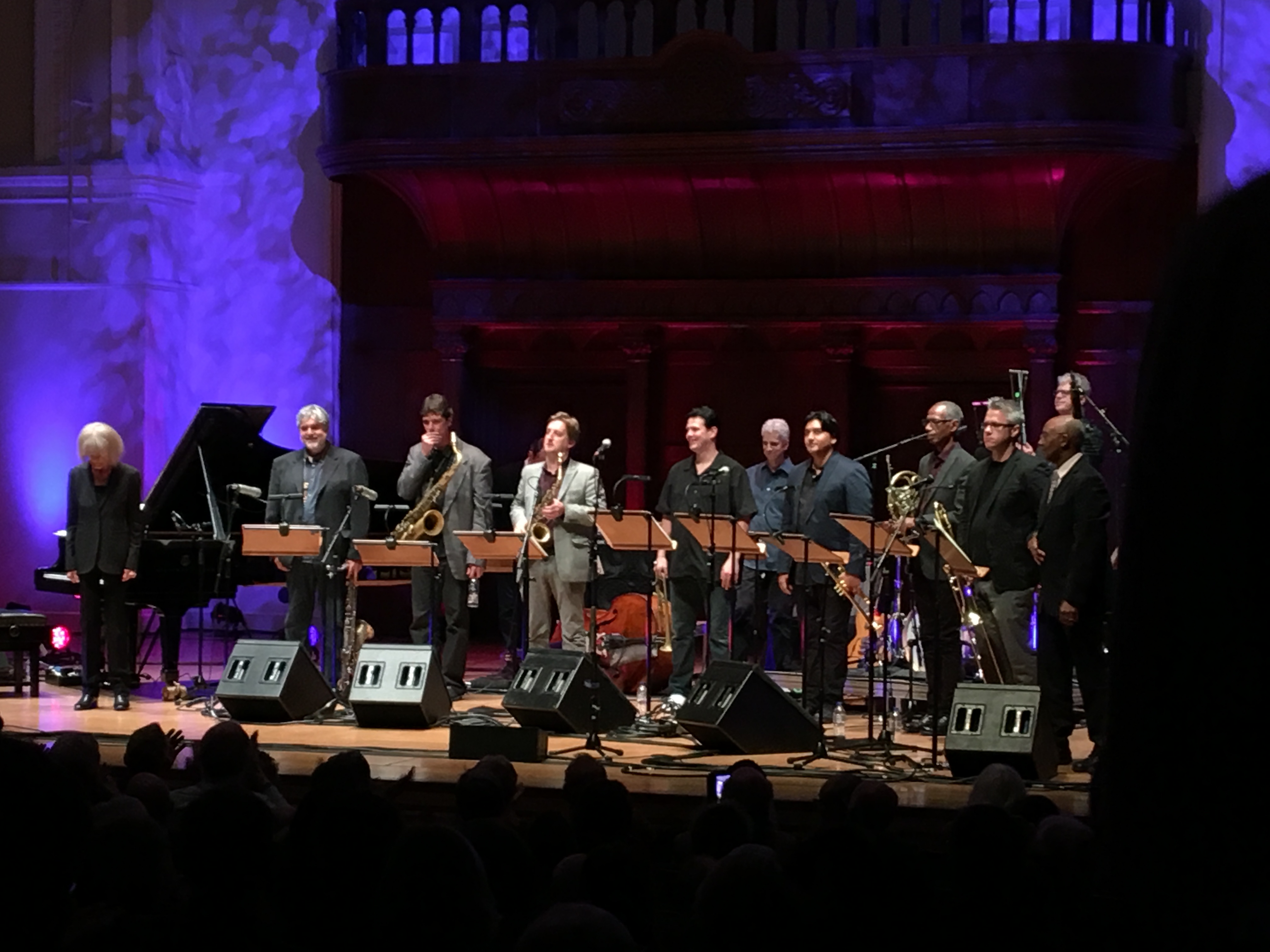 Eight years ago I was fortunate enough to be at the Blue Note in Greenwich Village to hear Charlie Haden’s Liberation Music Orchestra on the night of the US presidential election, and then again the following night after it had been confirmed that Barack Obama would be serving as America’s first black president. The anxious optimism of the first night and the joy and relief of the second could hardly have formed a greater contrast with the current mood of the world, in which the orchestra — minus Charlie, who died two years ago, and now directed by his long-time collaborator Carla Bley — arrived in London to play at Cadogan Hall as part of the EFG London Jazz Festival.
 thebluemoment.com