Skip to content

Posts tagged ‘John Tchicai’

Remembering John Stevens

I’d been working at the Melody Maker only a few weeks in the autumn of 1969 when the drummer John Stevens and the saxophonist Trevor Watts arrived to see me, unannounced, at the paper’s offices in Fleet Street. They’d sensed the presence of a writer sympathetic to their music and they’d brought me a copy of the Spontaneous Music Ensemble’s new album, recorded for Giorgio Gomelsky’s Marmalade label. I already knew about them, of course, and over the years I saw John play on many occasions and in many different musical environments. His death from a heart attack in 1994, at the age of 54, deprived the London scene of a musician who, his own great gifts aside, had devoted much of his life to encouraging others to express their creativity.

“John didn’t just change my life — he saved it,” the singer Maggie Nichols said at the Café Oto last night, while introducing an evening of hitherto unseen films featuring Stevens in a variety of contexts. They had been put together by the music and label owner Mark Wastell from a cache of videos owned by John’s widow, Anne, and his children, Ritchie and Louise. There is, as Wastell remarked, so little filmed evidence of John’s life and work available to be seen that anything is to be treasured — and these films brought him back to life in full strength.

Four films were shown. I was able to see the first three, each half an hour long. The first, filmed at the Third Eye Centre in Glasgow in 1976 on a single hand-held camera in black and white, captured a date on a tour by the trio of Stevens, Danny Thompson on bass and John Tchicai on soprano and alto saxophones. This was the bearded, roaring John Stevens with the bearded, roaring Danny Thompson — together in another incarnation as John Martyn’s accompanists — giving Tchicai the most enthusiastic and empathetic encouragement.

The second film, shot at a club in Stavanger by Norwegian TV in 1991, was a far more polished affair in every way. The music produced by this trio, completed by the American bassist Kent Carter and the Norwegian altoist Frøde Gjersted, was just as impassioned, running through different modes of collective improvisation: time, no time, and the sort of pointillism that recalled John’s famous “click pieces”, when the SME or workshop groups were instructed to use the shortest possible sounds to create their improvisations. This film included a joint interview with the three musicians, during which Carter memorably summarised his philosophy of constant renewal: “If the audience can recognise what we’re doing, it’s already been done.”

A year later, in 1991, Channel 4 filmed John’s new quartet, with the saxophonist Ed Jones, the trumpeter Byron Wallen and the bassist Gary Crosby, performing a Stevens composition dedicated to the then recently deceased Dudu Pukwana, called “Dudu’s Gone”. Not a lament but a celebration, recalling Ornette Coleman’s bounciest medium-tempo tunes, it showcased John’s beautiful time playing, with its strong echoes of Max Roach’s drive and Billy Higgins’s float. The unedited takes we were shown included an interview in which John was asked what it took to play free music. “It’s a freedom that demands high discipline and high articulation,” he replied.

Regrettably, I wasn’t able to stay to see the final episode of the evening, a 70-minute film of John playing and talking with Derek Bailey at Jazz Rumours in London in 1992, released in an edited form on video cassette by the Incus label in 1996. But I left with some more of Maggie Nichols’s words in my head, about the experience of being introduced by John to the practice of free improvisation back in the late ’60s: “It was like walking off a cliff — terrifying and ecstatic at the same time.”
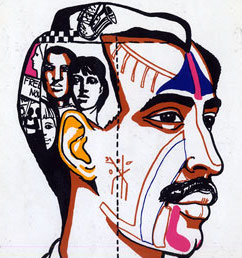
Bookshelf 2: John Tchicai

John Tchicai arrived in New York from his native Denmark in December 1962. Over the next three and a half years the sound of his saxophone became one of the most distinctive elements in jazz’s turbulent New Wave. He was a member of two foundational combos, the New York Contemporary Five and the New York Art Quartet, and took part in New York’s celebrated October Revolution in Jazz in 1964. He appeared with John Coltrane on Ascension, with Archie Shepp on Four for Trane, with Albert Ayler and Don Cherry on New York Eye and Ear Control, and on the first album by the Jazz Composers Orchestra. Then he went home, with other work to do.

Home turned out not to be just Copenhagen, where he founded the group Cadentia Nova Danica. In the years to come he would live in an artists’ colony in Switzerland; in Northern California, where he taught at Davis University; and, from 2001 until his death in 2012, a small village near Perpignan, on the French side of the Pyrenees. His extensive travels also included visits to India, Afghanistan, Iran, Japan, Sierra Leone and Mexico.

The bands he played in and the recordings he made were many. But of equal importance were the lessons and workshops he gave, sharing with young musicians the philosophy developed during the years in which a man born in 1936 to a Danish mother and a Congolese father absorbed musical ideas from around the world.

It was at a workshop in Rotterdam in 1989 that he met Margriet Naber, a young Dutch musician who became his fourth wife and his collaborator for 20 years. She was with him in California — where they had a band called the Archetypes — and France, and although they split up in 2009 and eventually divorced, they continued to live in the same village and she was with him when he died in a nursing home following a stroke. It is from their conversations, her very clear memories and the material he left behind that she has assembled a book which answers the description of a biography in conventional terms but is also, thanks to the close personal and artistic relationship between the author and her subject, something more.

Tchicai’s stories of growing up as a mixed-race boy in a white world are fascinating. His much older half-brother, Kaj Timmermann, formed a popular band called the Harlem Kiddies in 1940, and in 1953 John saw the Stan Kenton Orchestra in Copenhagen. It was hearing Lee Konitz with Kenton that inspired him to take up the alto saxophone, leaving an influence on the lighter, purer sound that made Tchicai’s own alto stand out amid the maelstrom of 1960s free jazz.

Although his many adventures and countless collaborations are part of the narrative, this is not the place to look for a deep analysis of his music. Instead Naber gives us insights into his thoughts and his teaching methods. Like John Stevens (with whom he played at a famous Cambridge concert with Yoko Ono and John Lennon in 1969), Tchicai favoured an open and practical approach that encouraged musicians of all levels of ability to express themselves though improvisation, illustrated by the score of a piece which gives the book its title: “A Chaos with Some Kind of Order”. From another example, his instructions are very similar to those Stevens used to give: “…try to anticipate and play some of the same tones in the same moment as other players would do them…”

Poetry was important to Tchicai. He wrote it — a few of his poems are included — and he recited it in his beautifully modulated voice. Naber tells us that he only consented to record with John Coxon and Ashley Wales (of Spring Heel Jack) in 2005 if they agreed to let him read Steve Dalachinsky’s “These Pink Roses”, which appeared as a kind of epilogue to the wonderful album called John Tchicai with Strings. Naber uses appendices to give us his advice on improvising and on building a set list, lead sheets of a handful of his tunes, and an outline discography.

Tchicai also looked after himself, through yoga and other practices. Naber describes his routine: “He got up around 6am and sat down for a meditation of around an hour. Then he would make some tea and a piece of rye bread for breakfast before doing more exercises, for instance pranayama (yoga/breathing exercises). That could also take an hour. After that, he’d eat some more and tend to work. Sometimes this would be musical work, working with notes, with an instrument, a piece of paper, his keyboard or sequencer. Sometimes it would be business work, like writing letters. When he was done with that, often it was lunchtime and John liked to have a hot meal for lunch. We took turns cooking meals. In the afternoon he’d go out to get some air and do chores like going to the post office or to the copyshop to make photocopies of charts and send them to musicians he played with. Or he’d go into nature. In the evening he went to hear music, watched a movie on television, or turned back to music to continue working. He didn’t go to bed late, didn’t smoke and didn’t drink much alcohol. This was John’s rhythm. When he was on tour he also tried to maintain it as much as possible, at least by doing a meditation in the morning. He was always busy, and often it was work-related, but it was always in a relaxed way. He played his musical rhythms in a relaxed way and he did the same with his life-rhythm. It was a nice rhythm to live next to…”

Remembering all the pleasure John’s music gave me on record since the early ’60s and in live performance from the first encounter in Berlin in 1969 to the last at Cafe Oto in 2009, I was delighted to respond to Naber’s request to read and comment on her manuscript before publication. I was able to give a little help, but she had it all there. It’s her great feeling for what he represented, as well as her diligence and persistence, that courses through this intimate and valuable account of his life and work.

* John Tchicai: A Chaos with Some Kind of Order by Margriet Naber is published by Ear Heart Mind Media and is available from http://www.johntchicai.com. John Tchicai with Strings is on the Treader label. The drawing of Tchicai is by the Dutch artist Marte Röling and is from the cover of Mohawk, a 1965 album by the New York Art Quartet, originally released on Fontana.