Skip to content

Posts tagged ‘John Martyn’

Danny Thompson 1939-2025

The first time I saw Danny Thompson, he was playing with Alexis Korner’s Blues Incorporated at the Dungeon Club in Nottingham. This would have been the spring of 1965. I must have liked his playing a lot because I got him to autograph a paperback copy of Nat Hentoff’s The Jazz Life that I happened to be carrying that night.

A couple of years later I saw him with the Pentangle, a band that to my ears never equalled the sum of its parts. It was his long-standing partnership with John Martyn that brought out his best, whether racing alongside the effects-driven guitar on “I’d Rather Be the Devil” or adding a darkly poetic arco line to “Spencer the Rover”.

Danny, whose death at the age of 86 was announced this week, was a member of a generation of great double bassists who emerged in and around the British jazz scene in the ’60s. If you wanted to line them up in some kind of taxonomy of interests and instincts across a spectrum of the music with which they were associated, starting with folk and proceeding to contemporary classical, it would probably go something like this: Danny, Ron Matthewson, Dave Green, Jeff Clyne, Harry Miller, Dave Holland, Chris Laurence, Barry Guy. Obviously that’s not everyone.

Danny was the Charlie Haden of British bassists, his playing warm and deep-toned, as rooted in folk modes as Haden was in bluegrass music, but just as capable of dealing with the most advanced and abstract forms.

Maybe the best way to celebrate his life is to listen to Whatever, the album he recorded for Joe Boyd’s Hannibal label in 1987. It finds him with a trio completed by two relatively unsung heroes of the scene, the wonderful Tony Roberts on assorted reeds, flutes and whistles and the terrific guitarist Bernie Holland.

I remember giving it an enthusiastic review in The Times, commending its highly evolved fusion of folk materials and jazz techniques. It’s a little bit like a British version of Jimmy Giuffre’s Train and the River trio, unafraid of the bucolic and the open-hearted.

Most of the pieces are credited as joint compositions but some are arrangements of traditional pieces, such as “Swedish Dance”, which opens with a bass solo rich in disciplined emotion before moving into an ensemble workout on a light-footed tune whose complex rhythms are made to sound as charming as a children’s song. The stately melody of “Lovely Joan” is delivered by Roberts on a set of Northumbrian pipes — mellower than their Scottish or Irish equivalents — before he switches to soprano saxophone for an intricate conversation with Holland’s nimble acoustic picking and Thompson’s firmly grounded bass. Of the originals, “Minor Escapade” adds elements of the classic John Coltrane Quartet to this trio’s distinctive approach.

Not having played it for some years, I’d forgotten what a truly exhilarating album it is. Now it’ll be at the top of the pile for some time to come, adding the sparkle and freshness of its understated virtuosity to the room. RIP, Danny.

* The photo of Danny Thompson is from the cover of Whatever and was taken by Nick White.
Alone and palely strumming…

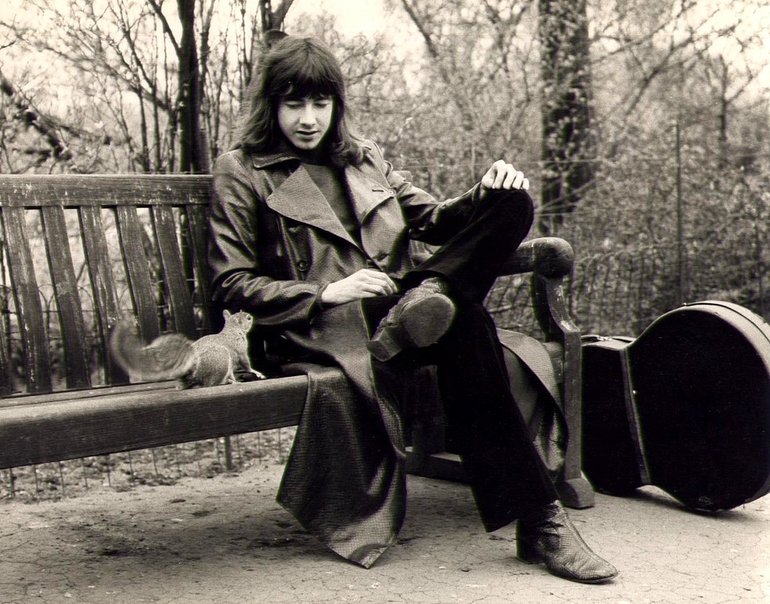
There they were, half a century ago, alone and palely loitering, with their long dark hair and their flares and their Martin guitars and their debut albums on Transatlantic, regulars at Les Cousins or the Troubadour, peering up from bottom of the bill at Implosion or next weekend’s rain-drenched festival, finding slots on Sounds of the ’70s and the Whistle Test, maybe even Top of the Pops if they struck lucky with the right song — a “Catch the Wind”, a “Baker Street”, a “Where Do You Go To (My Lovely)?”, a “Streets of London” or an “Alone Again (Naturally)”.

British male singer-songwriters mostly came out of the local folk scene, which seemed to imbue them with a leaning towards the wistfully romantic. Their American counterparts, springing from close exposure to the blues and bluegrass traditions, seemed more robust in temperament. The exception would be Paul Simon, who shared the British tendency to what it would be unkind to call feyness — but then he’d spent time playing the London folk clubs as part of his formative experience, soaking up the vibe.

There was more to them than that archetype, of course, and the whole genre is interestingly captured in Separate Paths Together, a new three-CD box subtitled “An Anthology of British Male Singer-Songwriters 1965-75”. Compiled and annotated by David Wells, it parades an extraordinary range of artists in solo guise. Most of the usual suspects are here: Al Stewart, Ralph McTell, John Martyn, Donovan. Others — Kevin Ayers, Peter Hammill, Richard Thompson, Jim Capaldi, Mike Heron, Gary Farr, Dave Cousins — had made their initial reputations as members of bands. Free-standing solo artists range from Pete Atkin, who came out of the Cambridge Footlights putting melodies to Clive James’s effortfully intricate lyrics (maybe the nearest thing ever devised to an English version of French chanson), to Peter Skellern, whose deceptively artless “Hold On To Love” still sounds like a great pop record,

Among my favourites are David McWilliams’s “Days of Pearly Spencer”, as enduringly perfect an evocation of 1967 and the days of pirate radio as could be imagined; Bert Jansch’s brief, unadorned “Tell Me What Is True Love”; Mike Cooper’s “Paper and Smoke”, with its fine horn arrangement; Andy Roberts’s warmly nostalgic “All Around My Grandfather’s Floor”, from a poem by his Liverpool Scene bandmate Mike Evans; and Murray Head’s “Say It Ain’t So, Joe” — a record that everyone at Island in 1975 expected to be a huge hit, but mystifyingly wasn’t.

The alone-and-palely-loitering archetype is particularly well represented by Keith Christmas’s diaphanous “The Fawn”, Dave Cartwright’s poised “Song to Susan” and Duncan Browne’s lovely “Journey”, which kicks off the whole collection and makes me regret a crudely dismissive review I gave him when he supported Lou Reed at the Sundown in Edmonton in 1972 (not the happiest of juxtapositions, it must be said, and I wasn’t much kinder to Lou). I’d offer an apology, but he died of cancer in 1993, aged 46.

The tracks I’ve mentioned are on the first two discs, where the genre is stretched to include something like the heavily arranged “Jesus Christ Junior” by Patrick Campbell-Lyons, a member of the original Nirvana. The third disc is largely devoted to also-rans (Bill Fay, Chris Baker, Paul Brett) and anomalies (Steve Gibbons, Jona Lewie, Crispian St Peters), including Mike Hart’s “Disbelief Blues”, a “Subterranean Homesick Blues” homage, and Al Jones’s extremely creepy “Jeffrey Don’t You Touch”, a clumsy portrayal of a sex abuser that wouldn’t get anywhere near the radio today.

The two most obvious omissions from the set’s 66 tracks represent the genre’s opposite poles: the introspection of Nick Drake and the extroversion of Elton John. I guess their absence is explained by permission issues. Cat Stevens isn’t represented, either. But you already know what they sounded like.

* Separate Paths Together is out now on Cherry Red’s Grapefruit Records label. The photograph is of Duncan Browne; perhaps someone out there can tell me who took it.