Skip to content

Posts tagged ‘John Edwards’

Mulatu Astatke says goodbye

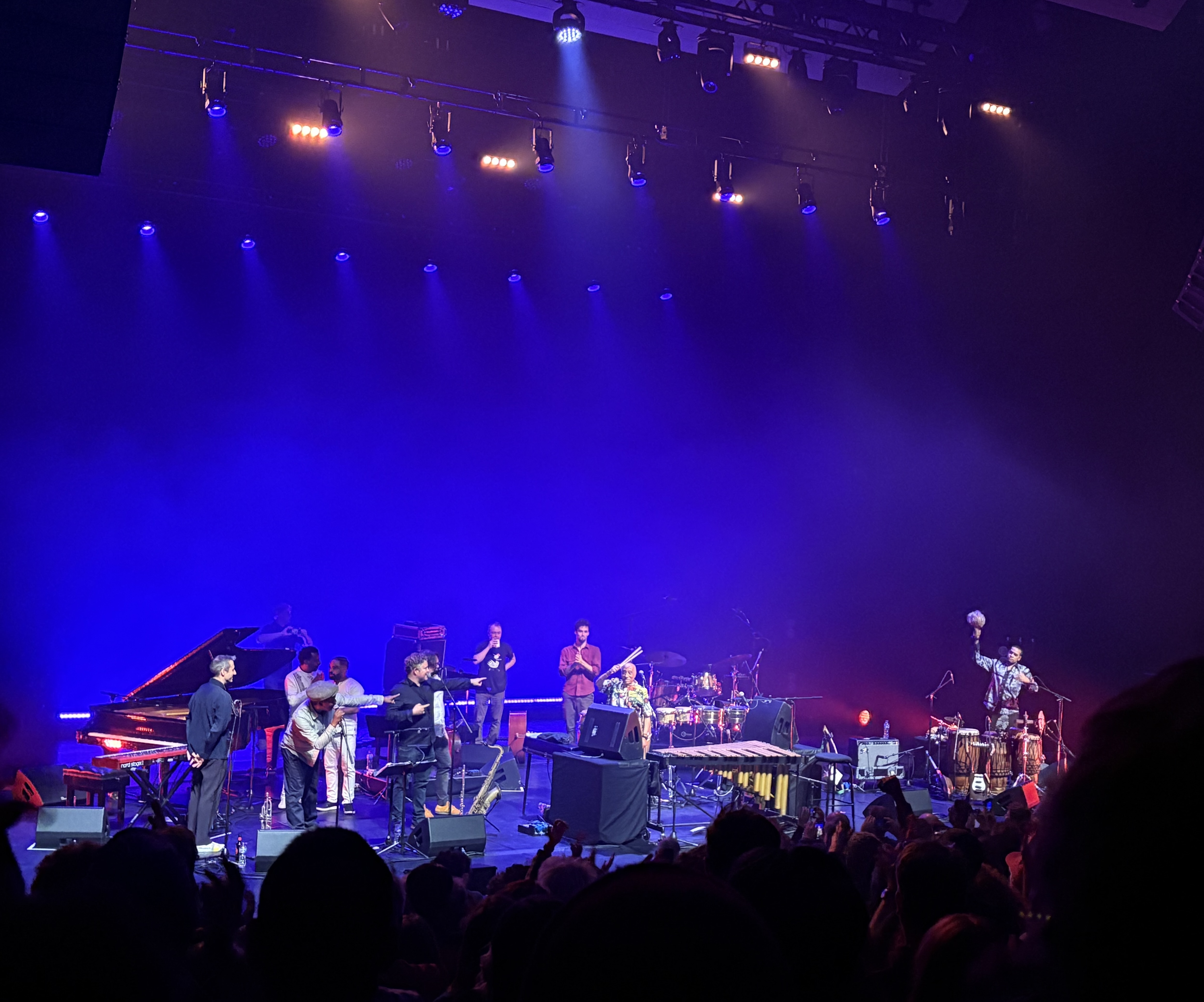
A month shy of his 82nd birthday, Mulatu Astatke brought his farewell tour to a close with two sold-out dates at the start of the EFG London Jazz Festival this week. I went to the first of them, at the Royal Festival Hall, to celebrate the work of the man generally credited with the creation of “Ethio-jazz”.

It takes more than one person to create a genre, but Astatke, who left Ethiopia as a teenager in the late 1950s to study vibraphone, his main instrument, and composition at Trinity College in London and Berklee College in Boston, was certainly a catalyst. He began making records in the US in the 1960s before returning to Ethiopia, where conditions changed after the takeover by a military junta in 1975, restricted Addis Ababa’s lively creative scene. He already had a large hipster following when the use of his music in Jim Jarmusch’s Broken Flowers in 2005 expanded his audience considerably.

On Sunday night he began the concert with Steps Ahead, his seven-piece European band, including such familiar figures as the trumpeter Byron Wallen, the pianist Alexander Hawkins and the double bassist John Edwards. The first half of the 90-minute set featured some of the compositions revived for a recently released album, Mulatu Plays Mulatu, including “Yekermo Sew”, with strong echoes of Horace Silver, and “The Way to Nice”, which plays a game with the James Bond riff. This music sounds like early-’60s hard bop filtered through Ethiopian modes and intonation, infusing it with as distinctive a flavour as the Skatellites and the Blue Notes imparted to similar material in Jamaica and South Africa respectively.

I was struck by the use of Danny Keane’s cello, sometimes strummed like a rhythm instrument, at other times interjecting short percussive phrases with a dry tone, and often combining to powerful effect with Edwards’ bass. It was intriguing to hear Edwards, Hawkins and the saxophonist James Arben delivering solos using the language of free jazz in the context of this mostly riff-based music, and receiving ovations for their efforts. While Astatke was spinning out his mellifluous extended vibes solos over the deep groove provided by the kit drummer, Jon Scott, and the percussionist, Richard Olatunde Baker, on something like “Netsanet”, I felt perfectly contented.

For the second half of the set, the band was joined by two dancers, a man and a woman, and two more musicians, playing the masengo, a single-stringed bowed lute, and the krar, a six-stringed lute. This was more of a folkloric experience, inviting the sort of mass participation that can seem awkward in a modern western concert hall. But it would be wrong to suggest that it was not greatly enjoyed, or that Astatke was not given the warmest and most rousing of valedictory salutes.

* Mulatu Plays Mulatu is out now on the Strut label.

Farewell to Bra Tebs

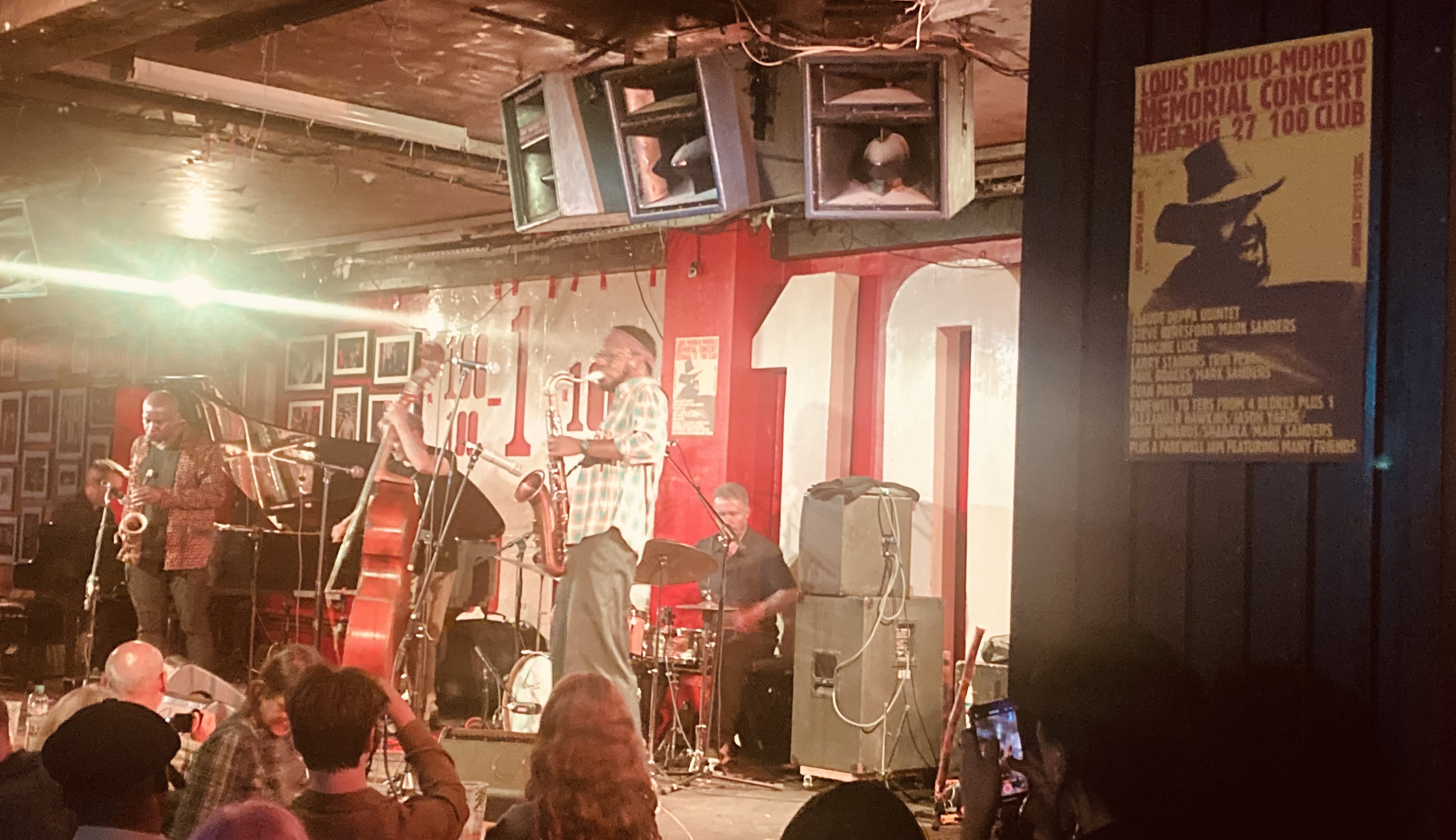
There used to be a civilised convention that normal reviewing practice should be suspended for certain kinds of musical events: those put on for charity, or memorials. Of the celebration of the life of Louis Tebogo Moholo-Moholo at a packed 100 Club last night, it need really only be said that the whole evening was suffused with the indomitable spirit of the great South African drummer, who died in June, aged 85.

The trumpeter Claude Deppa, his friend and frequent bandmate in Viva La Black, started the proceedings at the head of his warm-hearted quartet. Then the pianist Steve Beresford and the drummer Mark Sanders took over for an intricate and absorbing free conversation. Evan Parker brought out his soprano saxophone, removed its mouthpiece, and tapped the keys to produce a quite extraordinary 10-minute percussion solo which managed to be both a shadow commentary on what he might have played with the mouthpiece in place and a unique tribute to his former colleague in the band Foxes Fox. The trio of Larry Stabbins on alto saxophone, Paul Rogers on bass and Sanders again on drums played a set notable for Rogers manoeuvring his bespoke seven-string instrument into the expressive space between a Celtic harp and a cello.

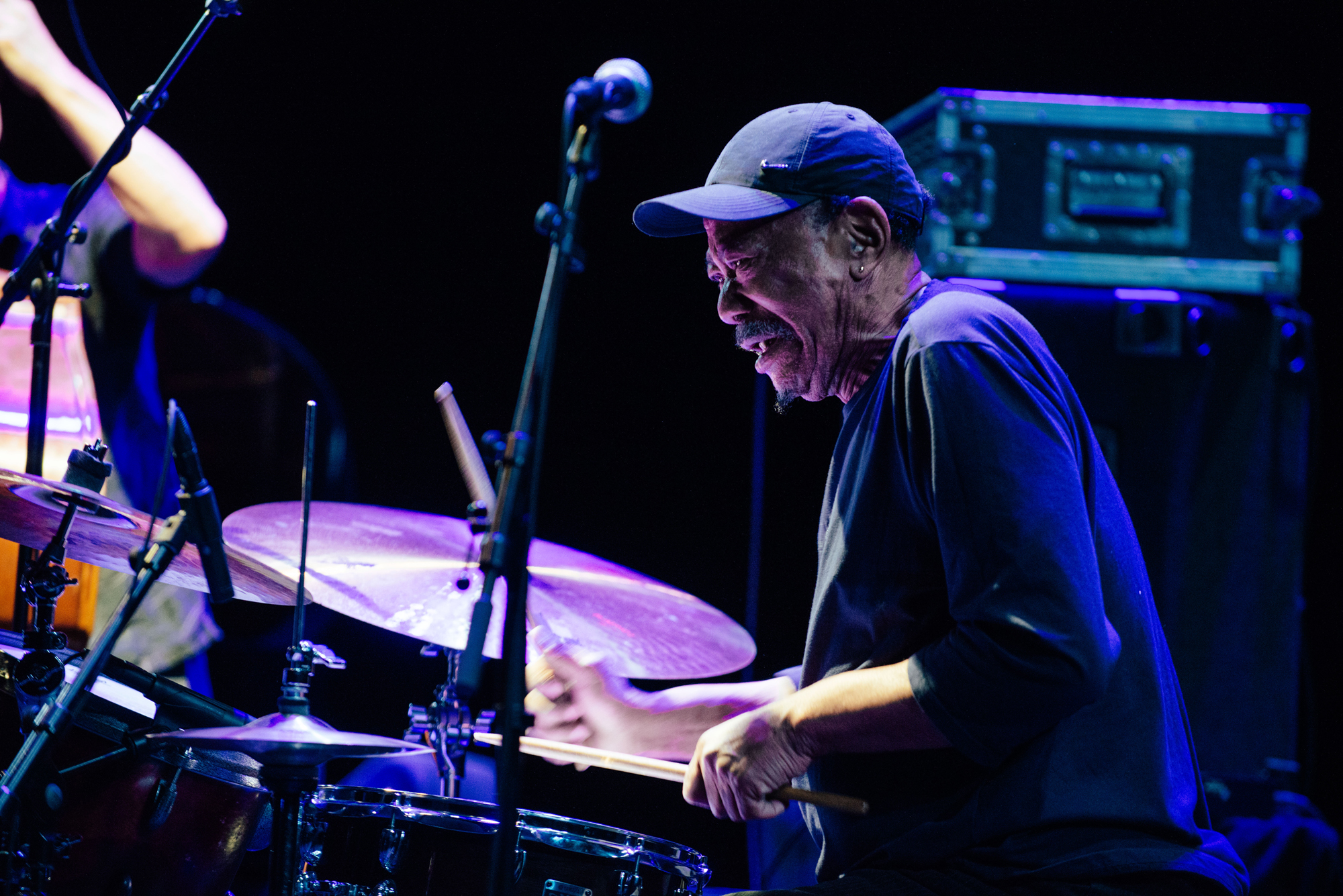
The heart of the celebration of Bra Tebs (as his friends knew him), which was organised by Hazel Miller and Mike Gavin of Ogun Records, came in the set by Four Blokes + 1, his last London-based band. Pictured above, this featured Jason Yarde and Shabaka on saxophones, Alex Hawkins on piano and John Edwards on bass, with the superb Sanders once more on the drum stool, embodying rather than imitating the characteristics of Louis’s playing. They came out roaring, and that’s how they were still sounding as I had to make my departure, with the darkly ecstatic closing cadences of “Dikeledi Tsa Phelo” accompanying me up the stairs and into the night.

The last of the Blue Notes

Louis Moholo-Moholo died on Thursday at his home in Cape Town, aged 85. He was the last survivor of the Blue Notes, the group — also including the trumpeter Mongezi Feza, the alto saxophonist Dudu Pukwana, the pianist Chris McGregor and the bassist Johnny Dyani — who arrived in Europe in 1964, fleeing South Africa’s apartheid regime. Once settled in London, they infused the British jazz scene with the warmth and directness of their playing, leaving an impression that continues to be heard in the music of later generations. Now they’re all gone.

Nobody cracked the whip from the drum stool like Louis, with the most benign of intentions. Until you saw him live, you could have only the haziest impression of his invigorating and sometimes electrifying effect on those around him — whether the other member of a duo (perhaps the pianists Keith Tippett, Livio Minafra or Alexander Hawkins) or the massed ranks of McGregor’s Brotherhood of Breath or Pino Minafra’s Canto Generàl. I treasure memories of Mike Osborne’s incendiary trio with Louis and the bassist Harry Miller, another of the South African emigré cadre. Miller’s sextet, Elton Dean’s Ninesense and later on, the extraordinary quartet Foxes Fox were other bands whose fires he stoked.

And, of course, there was Four Blokes, his own final band, with Hawkins, Jason Yarde on saxophones and the bassist John Edwards. I had the thrill, when presenting the quartet at JazzFest Berlin in 2015, of hearing them start a fire the instant Louis was settled behind his kit. The effect, as always, was indescribably exhilarating. Because that’s what Louis did: he showed you what this music could do, where it could go, how it could touch your soul. Now may he rest in peace.

* The photograph of Louis Moholo-Moholo was taken at the Haus der Berliner Festspiele in 2015 by Camille Blake.

The voices of Thom Bell

On November 5 in Brooklyn, the Spinners will be be inducted into the Rock and Roll Hall of Fame. Known to British fans first as the Motown Spinners and then as the Detroit Spinners, in order to distinguish them from a Liverpool folk group active between 1958 and 1989 under the same name, their string of hits began with “I’ll Be Around”, “Could It Be I’m Falling in Love”, “Ghetto Child” and “One of a Kind (Love Affair)”. All four were plucked from their self-titled first album for the Atlantic label, after they had moved from Motown and came under the supervision of the producer, arranger, pianist, songwriter and genius Thom Bell. Subsequent successes included “Mighty Love”, “I’m Coming Home”, “The Rubberband Man”, “Then Came You” (with Dionne Warwick) and “They Just Can’t Stop It (The Games People Play)”.

Only one member survives from the original quintet, formed in 1954, and its Bell-produced incarnation of the 1970s. Henry Fambrough, their baritone singer, will have to stand in for the rest of them: Pervis Jackson, Billy Henderson, C. P. Spencer, Bobbie Smith, Philippé “Soul” Wynne and John Edwards are all gone, along with several others who passed through the ranks at other times (and, of course, Bell himself, who died in December 2022: obit here). There is still a group of younger men legitimately touring as the Spinners, but Fambrough, who is 85, retired earlier this year.

Several other R&B vocal groups of their era, such as the Dells and the Temptations, used more than one lead singer, occasionally within the same song. None, however, pulled it off with as much ease and elegance as the Spinners. On “Could It I’m Falling in Love” and “Mighty Love”, the smooth-toned Smith started off before Wynne took over to add a rougher, more gospel-hued and improvisatory delivery. Such combinations were still working in 1976 when Jackson’s bass introduction gave way first to Smith and Henderson and finally to Wynne on “I Must Be Living for a Broken Heart” on their sixth album, Yesterday and Today.

This sophisticated update of a 1950s doo-wop vocal strategy was typical of Bell, who made great records with the Delfonics and the Stylistics before reaching his peak with the Spinners. The early hits were characterised by an adaptation of the thudding tom-tom backbeat heard on Al Green’s Willie Mitchell-produced hits, again given an extra coat of luxury varnish. Recorded at Sigma Sound in Philadelphia, with the great studio engineer Joe Tarsia, they benefitted from the musicians who became known known as MFSB: Roland Chambers, Bobby Eli and Norman Harris on guitars, Ronnie Baker on bass guitar, Earl Young on drums, Larry Washington on percussion and Vince Montana on vibes, with Bell himself on piano.

One of his trademarks was a subtle use of syncopation and uneven meters: the clipping of a beat from a single bar here, the addition of a couple of extra beats at the end of a line, or the shuffling of stresses that could make it sound, on the choruses of “Then Came You” and “Are You Ready For Love” (written for Elton John), as though he’d turned the beat around when in fact he hadn’t. These little things both seized and satisfied the ear. And no one, not even Burt Bacharach, could integrate a concert harp or an oboe into an R&B record as smoothly as Bell.

Smoothness without blandness was his trademark, as can be heard throughout the eight albums he made with the group, now included intact on a seven-CD box compiled by Joe Marchese and the veteran British journalist David Nathan. You can hit the button on just about any track and find something nourishing (perhaps with the exception of an ill-advised big band jazz version of “Don’t Let the Green Grass Fool You” on that first album, an experiment not repeated). And occasionally you’ll find a masterpiece.

Two of them are on the second album, Mighty Love. The first, written by Charles Simmons, Joseph Jefferson and Bruce Hawes, three of Bell’s regular songwriters is “Love Don’t Love Nobody”, Wynne’s finest seven minutes on a deep-soul track I’ve written about at some length before (here). The second, penned by Bunny Sigler, James Sigler and Morris Bailey, is “He’ll Never Love You Like I Do”, one of those songs about a poor boy pressing his claim on the object of his affection: “His standard of living, his social rating / There’s nothing he can’t afford / He made you think I ain’t it / But when it’s love, I can give you more…”

It opens with an octave guitar, Wes Montgomery-style, accompanied by piano, soon doubled by a muted trumpet and cushioned by a purring bass and Don Renaldo’s gentle strings. Bobbie Smith begins the song, delivering the opening lines in a confiding croon before Wynne takes over halfway through the first verse, the two reversing the sequence in the second verse, with the joins at first barely audible (although Wynne’s ad libs give him away). And just as Motown’s Holland-Dozier-Holland had used the female chorus of the Andantes to lend an extra emotional dimension to the Four Tops’ records in the ’60s, so Bell adds the voices of Barbara Ingram, Yvette Benson, Carla Benton and Linda Creed, his frequent co-composer, to create a refined blend with those of the Spinners themselves.

Like so much of Bell’s output, this track demonstrates the power of restraint, a quality evident throughout these fine albums. Even after the advent of disco, bringing adjustments to rhythmic emphases and the occasional flicker of wah-wah guitar, and with the arrival of John Edwards to replace Wynne halfway through the making of Yesterday and Today in 1977, the combination remained, and remains, exemplary.

* The Spinners’ Ain’t No Price on Happiness: The Thom Bell Studio Recordings (1972-79) is out on 29 September on SoulMusic Records. If anyone knows who took the fine photograph of Bell at the top of this piece, I’d be very pleased to add a credit.
Climate change

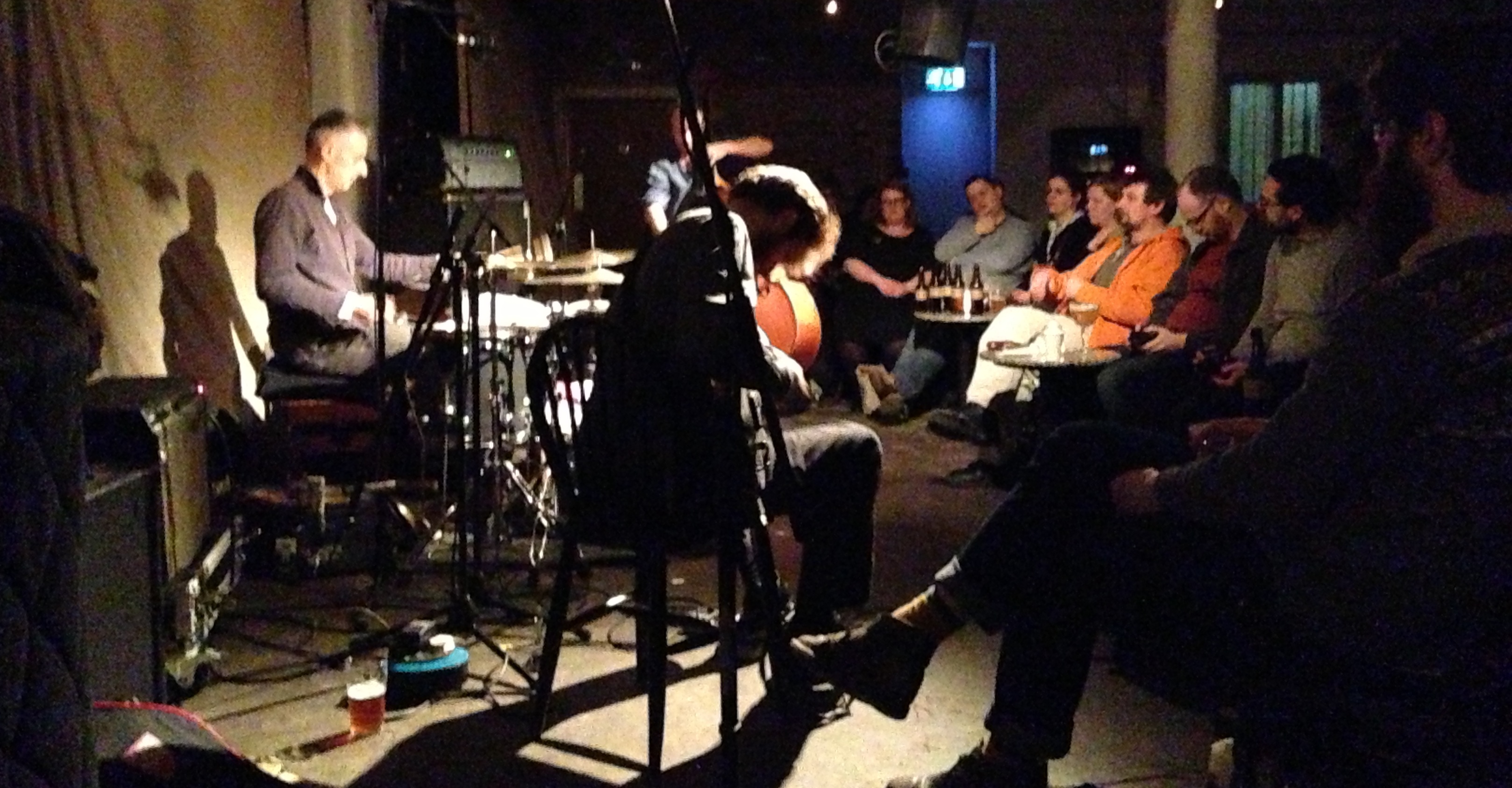
On an unseasonably cold, rainy late-July evening in East London, the trio known as Decoy — Alexander Hawkins on Hammond organ, John Edwards on double bass and Steve Noble on drums — and their regular guest, the indefatigable 83-year-old American saxophonist Joe McPhee, provided all the warmth the audience at Cafe Oto could need, and more.

That’s hardly surprising. Almost a decade and a half since their debut, Decoy + McPhee are the ultimate 21st century iteration of the hallowed organ-and-tenor combo, which at its finest — in such meetings as those of Gene Ammons and Richard “Groove” Holmes, Stanley Turrentine and Jimmy Smith, or Sam Rivers and Larry Young — provided an entire central heating system in itself.

The set I caught last night, the last of their four nights in Dalston, began with Noble marking out a fast 6/8, moving straight ahead, encouraging Hawkins to let rip with a rousing improvisation. McPhee entered with a splintered honk before the tempo slowed to a bluesy lope. A dislocated shuffle followed, powered by Edwards’ thrumming, then a modal section (with a tune I’m sure I know but couldn’t place), a fast Latin passage with chattering percussion, and a quiet gospel-tinged fade to a most elegant closure.

That’s a swift précis of 45 minutes of music full of spontaneous creativity and contrast, in which the freedom of any individual was a given. All four were astonishingly inventive, intuitive in their responses, shaping the parts and the whole with complete assurance. I was struck by the sight of a young woman amid the throng, dancing in the semi-ecstatic way people used to dance to, say, the Third Ear Band at rock festivals 50 years ago. Not something you see at many jazz gigs these days, but a pretty good sign.

The occasional bursts of B3-powered intensity reminded me of the first edition of Tony Williams’s Lifetime, a thought that led me to muse on what the classic John Coltrane Quartet might have sounded like had McCoy Tyner suddenly gone missing and been replaced for one night only by Larry Young, Lifetime’s organist, with instructions to go for it. A bit like Decoy with Joe McPhee, maybe. Anyway, the roar and the prolonged ovation at the end of the set said it all.

Blown away in Dalston

Louis Moholo 1Listen to them play their hymn-like ballads, township dances, venerable standards, riff tunes, pop songs. Hear them move from one to the other in seamless but brilliantly negotiated transition, sometimes splintering the elements of one before introducing and blending in pre-echoes of the next. Experience the sensation of being blown away by the waves of emotion, whether overwhelmingly ecstatic or exquisitely refined. And most of all, perhaps, listen to the Louis Moholo Moholo Quartet to understand how, in this music, the individual and the collective can simultaneously attain equal importance: a most elevated state of being.

They returned to Café Oto in Dalston this week and once again there were long stretches of time during the evening when I found myself wondering why I would ever bother to listen to anything else. That’s not a response that withstands interrogation, but you probably know what I mean: on a really great live music occasion, that’s how it gets you. In this case it was justified by the sheer inclusiveness of the music made by Louis and his colleagues: Jason Yarde (saxophones), John Edwards (double bass) and Alexander Hawkins (piano). It seemed to contain just about everything you could ever want to hear. Again, a sort of illusion; but what a noble and magnificent one.

This is a band that forces you to drop whatever guard you had up when you arrived, and almost everything they played in their course of two long sets was a highlight. The bits I particularly remember included a surging version of Pule Pheto’s “Dikeledi Tsa Phelo”; a wonderful deconstruction of “If I Should Lose You”, composed by Ralph Rainger for the 1936 remake of Cecil B. DeMille’s Rose of the Rancho; a gorgeous irony-free version of “What a Wonderful World”; and one of the greatest of all modern jazz ballads, Dudu Pukwana’s “B My Dear”. The audience’s response was as wholehearted as the music.

All four musicians seemed to be operating at a level where personal freedom and group interdependence achieve a perfect unity. The way they negotiated the transitions made it very hard indeed to believe that they have played only a handful of gigs as a unit, with Moholo and Hawkins keeping a particularly sharp eye on each other as visual and verbal cues were exchanged. Yarde, who started both sets on a black-lacquered baritone saxophone before moving up the registers to alto and soprano, was consistently impressive, channelling the spirits of Bird and Dudu through his broad-grained sound. And what a treat it was to hear the mighty Edwards slip into passages of driving, huge-toned 4/4, walking his lines like Paul Chambers or Leroy Vinnegar.

You need big chops and big ears to play like this, and an even bigger heart.

The N.E.W. thing

N.E.W. liveI could only stay for a single set of the trio called N.E.W. — Steve Noble (drums), John Edwards (double bass) and Alex Ward (guitar) — at Cafe Oto tonight, but it was enough to get excited about. This is an improvising group of ferocious intensity: for my taste, maybe the most effective high-volume band I’ve heard since Tony Williams’s Lifetime set the standard for such adventures more than 40 years ago.

The first piece lasted half an hour, in which everybody played without a break. They work with patterns rather than tempos, usually set by Noble’s relentlessly attacking sticks, mallets or brushes (he also has a way with cymbals that makes me think he’s the post-industrial Billy Higgins). Edwards, surely the most remarkable bassist ever produced by Britain, works off and around the drums, tugging and hammering the strings to produce huge surges of sound and in one passage bowing them above his left hand on the fingerboard while the drummer momentarily toyed  with a light Latin vamp. As for Ward, he is a constant astonishment: Bo Diddley’s “Road Runner”, Jimi Hendrix’s “Star-Spangled Banner”, Sonny Sharrock’s work with Herbie Mann and Last Exit, Robert Fripp’s solo on King Crimson’s “A Sailor’s Tale” and Derek Bailey’s amplified solo pieces — he doesn’t sound like any of them, but they might be some of the sources of inspiration behind the barrage of howling, squealing, chattering and whining but always coherent and compelling noise that he sets up.

They’ve been playing together in this configuration for half a dozen years, and the degree of empathy is phenomenal. You can hear it on their new album, Motion, a vinyl-only release on the Dancing Wayang label, limited to 300 copies (www.dancingwayang.com). The product of a studio session, it can’t possibly convey the impact of hearing them playing to an audience in a small room, but it has other, equally worthwhile qualities.

Try to imagine how a combination of Hendrix, Charles Mingus and Keith Moon might sound, stripped of ego, transported to Dalston in 2014, with modern amplification turned all the way up. If that might be your idea of a good time, don’t miss ’em.