The problem with the 1970 Isle of Wight festival was how to get out of it. On the morning of Monday, August 31, exactly 55 years ago, something like 600,000 fans were going to be trying to leave the island. In all probability, the queue for the ferry from Ryde to Portsmouth was likely to resemble a less frostbitten version of Napoleon’s army retreating from Moscow.
I’d attended the festival with my friend Geoffrey Cannon, then the Guardian‘s rock critic. I was one of three Melody Maker writers on the case; the others were Chris Welch and Michael Watts. Poor Watts, a recent recruit, had been sent to a camping supplies shop on Holborn, around the corner from the office, and given enough money to equip himself with a small tent and a bedroll. His job would be to tell the story from the perspective of the kids up on the hill.
Welch and I would be taking notes in the relatively salubrious area reserved for VIPs and the press in front of the stage, revelling in the experience of seeing Miles Davis play to a crowd of more than half a million with an average age of probably 20. And there was Joni Mitchell, and the Who, and Richie Havens, and John Sebastian, and the rest of an extraordinary bill.
Geoffrey and I both had to be at our respective offices by the Monday lunchtime, and it was he who came up with a brilliant solution. He called the flying school at Portsmouth airport and asked if they had a plane that could pick us up and take us across the Solent.
The flying school could indeed meet his request, and we were invited to report at something like six o’clock in the morning, maybe a bit earlier. After leaving the festival and making it to the nearby Bembridge airfield, we sat in a hut by the grass runway, waiting for our plane to arrive.
We’d been there for a few minutes when a limousine drew up. Out of it stepped Jimi Hendrix, still wearing the flowing multicoloured silks he’d worn on stage only three or four hours earlier, giving a performance that had begun badly but eventually coalesced into something those who heard it would never forget (luckily, the whole set was filmed).
For Jimi, a helicopter was waiting. He climbed in and disappeared into the misty dawn sky. Eighteen days later, after returning to London from gigs in Denmark and West Germany, he was dead.
Shortly after his departure from Bembridge, our single-engined Cessna turned up and off we went. I expect we shared a taxi from Portsmouth to London and put it on expenses, as we did with the cost of the plane ride, which came to nine pounds and six shillings, including landing fees. The bill was made out to Geoffrey. Somehow, I’ve managed to hang on to it for the past five and a half decades.
Stevie Wonder can play the drums (listen to “Creepin'”). So can Paul McCartney, after a fashion (“Maybe I’m Amazed”). But I didn’t know that Jimi Hendrix knew how to use a pair of sticks, too.
The proof is in American Drummers 1959-88, Val Wilmer’s new book of 36 photographs of drummers she has observed on and off the stage — and in the case of Hendrix (the only one of her subjects better known for something else), during a sound-check before his show with the Experience at the Royal Albert Hall in London on November 14, 1967.
It’s tempting to assume that Hendrix was just messing around when he sat behind Mitch Mitchell’s kit and picked up a pair of his sticks. But the photo is the evidence that he knew what he was doing. He was left-handed, of course. And he’s holding his right-hand stick in the way that a right-handed drummer would hold his left stick, were he using what is known as the orthodox grip, in which the stick rests in the cradle formed by the clefts between the thumb and forefinger and the second and third fingers.
You can see it on the opposite page in the photo of Andrew Cyrille, a great jazz drummer who has played with Cecil Taylor and many others. Cyrille is a high accomplished technician and most of the time he uses the orthodox grip. The alternative is the matched grip, in which both hands hold the sticks in the same way, as if (to make a crude analogy) they were saucepan handles. Charlie Watts used the orthodox style, Ringo Starr the matched grip.
Drummers sometimes switch from orthodox to matched when they want a particular kind of power — playing the Bo Diddley beat, for instance. And it’s the way most people who aren’t drummers hold the sticks if they’re given the chance to hit something.
But Hendrix is unmistakably using the orthodox grip, which set me thinking. Did he learn it from someone who played drums in one of the bands he’d been in, backing the Isley Brothers and others? Or from Mitch Mitchell, whose early leaning was towards jazz? That seems a bit unlikely to me. You don’t generally learn the orthodox grip unless there’s a very good reason.
So it sent me back to his days in the US Army, drafted into the 101st Airborne Division (the “Screaming Eagles”) in 1961 as an alternative to a jail sentence for joyriding in stolen cars when he was still in his teens. He hated it and lasted barely a year, given a discharge after breaking his ankle in a parachute jump. The only reference I can find to musical involvement during that year was when he asked his father in a letter from Fort Campbell on the Kentucky-Tennessee border to send him the guitar he’d left at a girlfriend’s house in Seattle.
But what if he’d been given the chance to join a marching band, and received basic tuition in playing a shoulder-slung snare drum? That would require a mastery of the orthodox grip, because that’s what it was invented for. And although it might seem at first to be awkward and unnatural, once you learn it, it never goes away.
Val’s photos are full of all the qualities that make her work so special (and which I wrote about when she had an exhibition last year). Yes, there are pictures here of musicians playing on stage — Philly Joe Jones, Max Roach, Kenny Clarke, Tony Williams, Billy Higgins, Elvin Jones, Milford Graves — but also in other, different moments: Sunny Murray reading the paper, Marquis Foster getting his drums out of the trunk of his car, Denis Charles loosening up with a practice pad.
And there are other stories, hidden and half-hidden. A well known New Orleans drummer called Freddie Kohlman is pictured playing a snare drum with the Onward Brass Band at a funeral in 1972. Val told me this week that Kohlman — who died in 1990, aged 75 — had told her how the fledgling Motown label had paid for him, and one or two others, to travel to Detroit to teach the company’s studio musicians how to play the New Orleans rhythms that were the basis of R&B and rock and roll.
Musicians trusted Val, so she could capture them in less formal settings. Below you can see a scene in the Professional Percussion Center on New York’s Eighth Avenue one day in 1971, with the proprietor, Frank Ippolito (who played with Glenn Miller’s Army Air Force Band during WW2), behind the counter, chatting to a trio of customers.
On the left is “Papa” Jo Jones, whose work with Count Basie in the 1930s survives somewhere within the work of every jazz drummer today. In the middle is Jeff Williams, a 21-year-old Berklee graduate from Ohio about to embark on a professional career with the bands of Lee Konitz and Stan Getz (and who has been based for many years in the UK, teaching at the Royal Academy of Music and the Birmingham Conservatoire). On the right is Oliver Jackson, one of Papa Jo’s acolytes, an underrated player with a sense of swing to match that of Roach, Higgins or Frank Butler, as you can hear if you listen to King Curtis’s “Da Duh Dah”.
Just a bunch of guys shooting the breeze in a drum shop one day half a century ago. And, like a lot of Val’s photos, it invites us to share the privileged access that produced this lovely little book.
* Val Wilmer’s American Drummers 1959-1988 is published by Café Royal Books (caferoyalbooks.com), price £6.70.
The Kronos Quartet were already well into their second decade when I saw them for the first time, sharing the bill with John Zorn’s Naked City at the Royalty Theatre in London in November 1988. They closed their set with Aarvo Pärt’s “Fratres”, whose hushed, prayer-like cadences were what stuck in my head, and are still there. But they’d become famous for daring to introduce the compositions of Thelonious Monk, Bill Evans and Jimi Hendrix to the format, and for making it clear that they’d be treating those works with the seriousness, rigour and spirit of inquiry that others applied to the standard Beethoven-to-Bartók string quartet repertoire.
Last night at the Barbican, during a year-long tour to mark the 50th anniversary of their creation in San Francisco by the violinist David Harrington, “Purple Haze” was their encore: a shout of joy to celebrate their longevity and the continued relevance of their founding ideal. Harrington and his fellow violinist John Sherba, Hank Dutt on viola and Paul Wiancko, the latest recruit to the cello seat filled so long and so brilliantly by Joan Jeanrenaud, worked their way through a dozen pieces, divided into two sets, coming as close to a career summary as would be possible in two hours for an organisation that, in its lifetime, has commissioned more than a thousand works.
Two guest artists appeared, both on pieces specially written for the quartet: the Indonesian composer Peni Candra Rini to deliver the swooping, chattering vocal lead on her “Maduswara” and the London-born djembe player Yahael Camara Onono to add percussive momentum to Dumisani Maraire’s “Mother Nozipo”. There were reminders of Kronos’s early days in the performance of works by three Americans commonly, if misleadingly, called minimalists: Philip Glass with a piece from the Mishima soundtrack, Steve Reich’s dense and fast-flowing “Triple Quartet”, and Terry Riley with “Lunch in Chinatown”, a light-hearted extract from a new suite featuring the members of the group chatting as if ordering a meal in a restaurant.
For me, the moments of seriousness were the most powerful. The ethereal “God-music” from George Crumb’s Black Angels featured Wiancka coaxing fragile melodies built out of harmonics from his cello while Harrington, Sherba and Dutt each bowed a table full of wine glasses. Dutt took the lead on Jacob Garchik’s arrangement of Antonio Haskell’s “God Shall Wipe All Tears Away”, a setting of a gospel song recorded in 1938 by Mahalia Jackson. This directly followed an excerpt from Zachary James Walker’s Peace Be Still, played against projection of newsreel footage from the Alabama civil rights marches in 1965 and the words of Clarence B. Jones, Martin Luther King Jr’s lawyer and adviser. Jones had helped draft the “I have a dream” speech given at the March on Washington in 1963 — which only took its final form during the speech itself, when Mahalia implored King to break away from his prepared script and tell the crowd of more than 250,000 about his dream.
And then there was their arrangement of Alfred Schnittke’s “Collected Songs Where Every Verse Is Filled With Grief”, which they recorded in 1997, a year before the composer’s death: its skeins of muted melodies and modal harmonic underpinning settled on the hall like a pale but gently glowing mist, much as I remember “Fratres” doing 35 years ago.
If you’re interested in guitar-playing, you probably need to know about Ava Mendoza. I first heard her at Subterranea in New York in 2016, during the Winter Jazzfest, when she played with a band led by the trombonist Jacob Garchik and including two other guitarists, Mary Halvorson and Jonathan Goldberger, and a drummer, Vinnie Sperrazza. You can see them in the photograph; she’s on the extreme left, with the Fender Jaguar.
Even in the company of the great Halvorson, Mendoza caught my ear. Born in Miami, Florida in 1983, she studied with Fred Frith at Mills College in Oakland, California before moving to New York in 2013. She seemed to have found a way of feeding the sound of early rock and roll guitar — think Dick Dale, Watkins Copicat echo units, and a time before tremolo arms became known as whammy bars — into the kind of thinking shared by the several generations of guitarists freed from the orthodoxies of jazz guitar by Jimi Hendrix, a list going from Sonny Sharrock, John McLaughlin, Ray Russell, Vernon Reid and David Torn to Bill Frisell, Elliott Sharp, Marc Ribot and Kim Myhr. She showed strength, inventiveness and confidence.
That first impression is confirmed on a new album which features her in a trio under the leadership of the veteran bassist William Parker, completed by the drummer Gerald Cleaver. It’s called Mayan Space Station, and it’s the sort of music you can easily imagine Hendrix making if he were still around today: loose, improvisatory, inspired, collective, which are all the words that come to mind when you think of his playing from more than 50 years ago on tracks like “Manic Depression”, “Love or Confusion” and “Third Stone from the Sun”, carried into the 21st century.
I was thinking about Hendrix anyway, since I’ve been enjoying a newly published book called Voodoo Child, in which two Los Angeles-based writers, my old Melody Maker colleague Harvey Kubernik and his brother Kenneth, compile an oral history of the guitarist’s life and work. It’s not a biography in the usual sense but a sort of 360-degree journey around the short but extraordinary life of the man who arguably had more influence on contemporary music than any individual instrumentalist since Charlie Parker.
The vast majority of the interview material is new, culled from dozens of conversations with those who knew, observed or were affected by Hendrix. They range from Brian Auger, John Mayall and Andrew Loog Oldham through John Echols of Love, Robby Krieger of the Doors, Ed Cassidy of Spirit, Marty Balin of Jefferson Airplane and James Williamson of the Stooges to Michelle Phillips, Ernie Isley, Michael Des Barres, Kim Fowley, Jerry Wexler, Billy Cox, Jim Keltner, Nils Lofgren, Patti Smith, Nels Cline and many others. Of course there’s lots of stuff about Monterey, Woodstock and the Isle of Wight, as you’d expect. But the authors aren’t afraid to dive into less obvious areas. In one of the later sections several witnesses, including Hugh Banton, the Van der Graaf Generator organist, and John Etheridge, the Soft Machine’s guitarist for the past few decades, have interesting things to say about the specifics of the equipment Hendrix used.
If I have a criticism, it’s that — like most Hendrix books — it doesn’t follow the money or go deeply into the late period when he became involved with black artists and activists such as the singer Emmaretta Marks and the percussionist Juma Sultan, getting closer to the world where free jazz intersected with political action. But as a kaleidoscopic assembly of impressions from an orbit around Planet Jimi, it has a value of its own.
The eminent composer and flautist James Newton, a professor of jazz studies who has taught a Hendrix course at UCLA, talks about Hendrix’s relationship to jazz: “Check out the floating quality in ‘(Have You Ever Been to) Electric Ladyland’. When Hendrix hits the guitar three times to establish the tempo, I’m thinking, ‘Okay, it’s in 3 but not really — most people hear it in 4/4… a polyrhythm is established, which is not something you hear in pop music, then or now. It’s Mitch (Mitchell) channelling Elvin (Jones).”
That was something you couldn’t miss when you heard Are You Experienced or saw Hendrix live in 1967, at least if you were conversant with the work of the John Coltrane Quartet in the first half of the decade. Mitch had clearly paid attention to Elvin’s sense of time — the 3-against-2 which is at the heart of the rhythms that came from Africa and became what we call swing. And Hendrix, who hadn’t (as far as I know) played jazz during his early career on the R&B circuit, responded to what he was doing. In that sense, Mitch was a liberating influence on Jimi.
It’s interesting to speculate on what would have happened had Chas Chandler recruited a more four-square British rock drummer of the time — say, Aynsley Dunbar (who was under consideration), Keef Hartley or John Steel, his former colleague in the Animals — to the Experience, as might easily have happened. John Mayall points out that “Jimi came to England and a blues world… going back to Cyril Davies and Alexis Korner, who started the blues boom. This attracted a lot of musicians who now had something new to inspire them.” But it was not just a purist’s blues world. Korner’s absolutely seminal Blues Incorporated was packed with jazz musicians, from Ginger Baker and Danny Thompson to Dick Heckstall-Smith and Art Themen, as were Georgie Fame’s Blue Flames and the Graham Bond Organisation. Even had Hendrix never listened to Coltrane, Charles Mingus and Ornette Coleman before leaving the US in 1966, he would have absorbed something of their spirit from the musicians he heard and worked with in London.
James Newton connects Hendrix to the huge change taking place in jazz two decades after the heyday of bebop. John McLaughlin (in a quote attributed to Colin Harper’s biography, Bathed in Lightning) remembers taking Miles Davis to the Monterey Pop film just to see Jimi, and the effect it had on the trumpeter. The effect on guitarists — including McLaughlin — was even greater, in terms of encouraging a more adventurous approach to tone, texture and effects, and more enduring. As we can hear in the work of Ava Mendoza and others of her generation, it shows no sign of abating.
The memory of hearing Eric Burdon sing “House of the Rising Sun” with the Animals at the Odeon, Nottingham one summer night in 1964 — a week or two before it was released as a single — is as clear as yesterday. In some ways it was the precursor of a new kind of rock music. But to Burdon, as he explains in a new biographical documentary shown on BBC4 this weekend, it meant something different. When Alan Price, the group’s organist, took credit for the words (traditional) and the arrangement (borrowed by Bob Dylan from Dave Van Ronk), it damaged the singer’s faith in music as a collective endeavour: all for one and one for all.
Luckily, although the animosity towards Price is still burning fiercely more than half a century later, it didn’t cause Burdon to end his career. As Patti Smith, Bruce Springsteen and Steve Van Zandt testify in the programme, post-Price Animals hits like “We Gotta Get Out of This Place” and “It’s My Life” were nothing short of inspirational to the next generation. But as the decades went by, there was always a sense that Burdon, one of the great English R&B voices of the ’60s, never quite recaptured the same level of fulfilment.
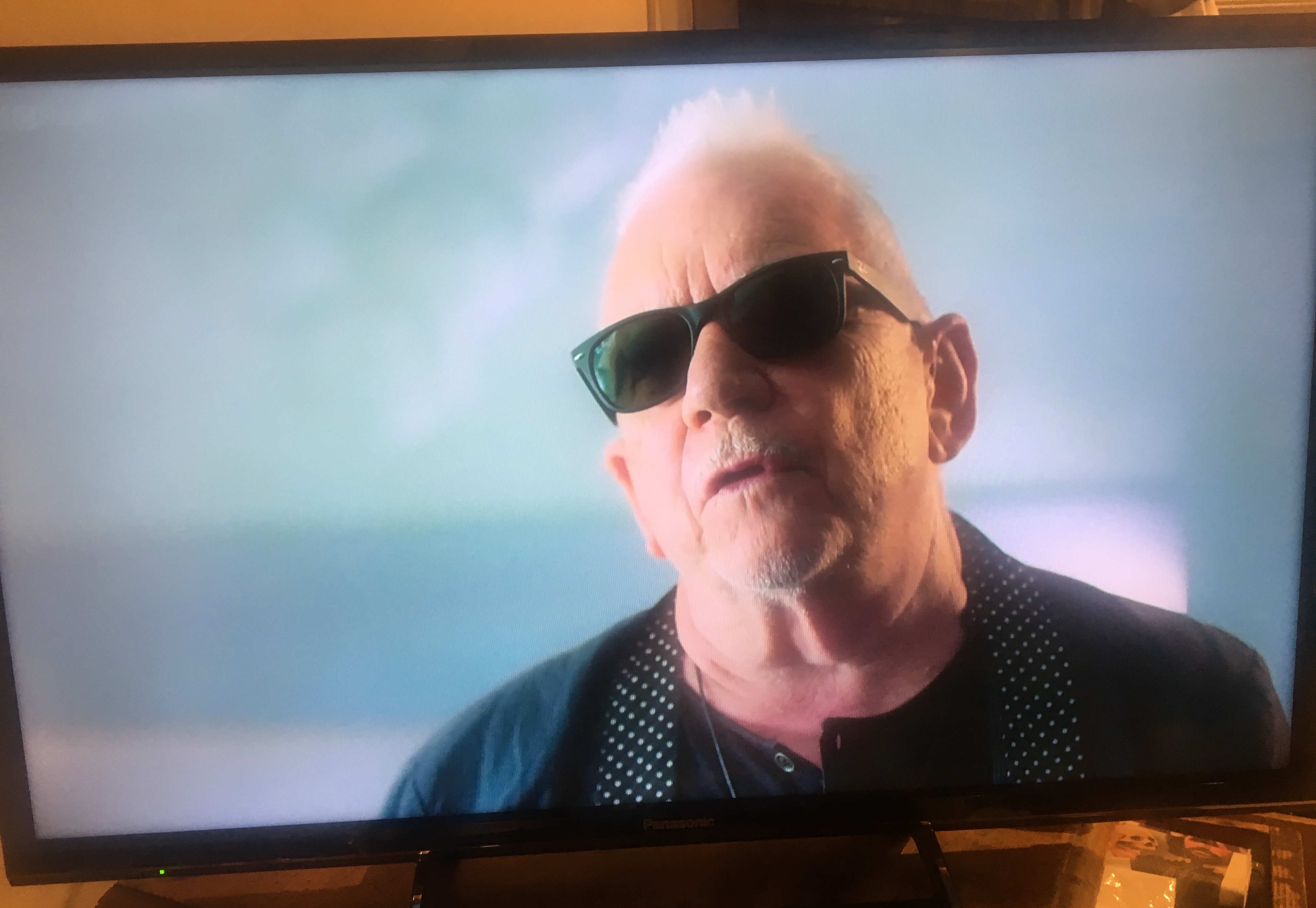
The hour-long Eric Burdon: Rock and Roll Animal, directed by Hannes Rossacher, is a co-production by the BBC with ZDF and Arte. There are interesting passages on his apprenticeship at the Club A Go Go in Newcastle, his relationship with Jimi Hendrix, his time in San Francisco and his collaboration with War — who dumped him, he claims, because he was the white guy in the band (there was actually another, the harmonica-player Lee Oskar). There’s quite a lot of stuff about his 50-odd years of living in California, and we see him cruising through the desert in some ’70s gas-guzzler or other.
We leave him, weathered but unbowed, with his new American band — new in 2018, anyway, when the film was made — preparing to record an album. He sings “Across the Borderline”, the great song written in 1981 by Ry Cooder with Jim Dickinson and John Hiatt for the soundtrack of Tony Richardson’s The Border, a film about immigrants. Originally sung by Freddie Fender, it subsequently found its way into the repertoires of Springsteen, Bob Dylan, Jackson Browne and Willie Nelson. It suits Eric Burdon just fine.
* The screen-grab is from Eric Burdon: Rock and Roll Animal, which can be watched on BBC iPlayer until the end of March.
Little Richard is said by his attorney to be “annoyed” at the rumours of his death which spread this week. He survived a heart attack in 2013 and underwent a hip replacement operation more recently, but apparently he’s otherwise fine at 83. Let’s hope so.
Let’s also take the chance to remind ourselves of one of his finest recordings: “I Don’t Know What You’ve Got But It’s Got Me, Parts 1 & 2”, a deep-soul ballad written by Don Covay and cut for Vee-Jay in the blessed year of 1965, apparently during a touring stopover in Los Angeles. Richard’s gospel roots have never been more apparent than here, accompanied by a version of the Upsetters featuring Jimi Hendrix (who had played on Covay’s “Mercy Mercy” the previous year) on guitar and Billy Preston on organ, both clearly audible. It was produced by Calvin Carter, whose sister Vivian was the “V” in Vee-Jay; he probably didn’t have to do much more on this session than give the engineer the signal to roll the tape.
A girlfriend introduced me to this one soon after its UK release, and the US copy pictured above has a permanent place in the box that holds my all-time Top Hundred 45s. If you don’t know it, you should.


 Little Richard is said by his attorney to be “annoyed” at the rumours of his death which spread this week. He survived a heart attack in 2013 and underwent a hip replacement operation more recently, but apparently he’s otherwise fine at 83. Let’s hope so.
 thebluemoment.com