‘Sue me if I play it wrong…’**
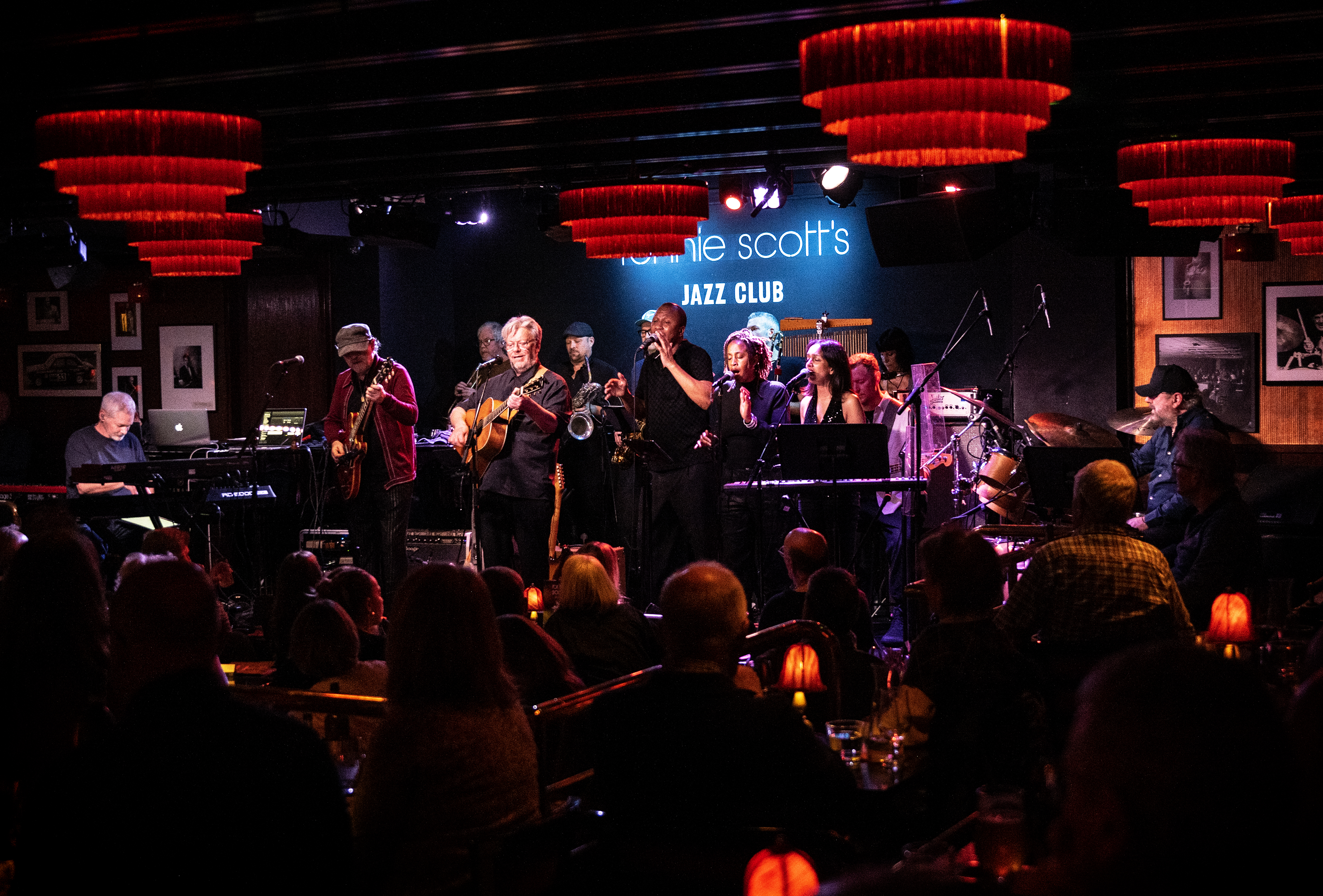
Within a very short time last night, it was apparent that my pal Martin Colyer and I were probably the only people in a packed Ronnie Scott’s who were seeing the night’s featured attraction for the first time. The enthusiasm aroused by the Royal Scammers’ versions of the Steely Dan repertoire, from the opening “Night by Night” to the closing “Aja”, was so warm and immediate that it could only have come from committed fans.
Fans of the compositions of Donald Fagen and Walter Becker, of course, but also of the 14-piece band formed by the twin Stacey brothers, Paul on lead guitar and Jeremy on drums, with two clear intentions: to pay homage to the source and to have a lot of fun in the process. It was the way every member of the band seemed to buy into those ideas that made the whole thing fly, for the musicians and the audience alike.
Let’s name them all now, these people charged with summoning the spirits not only of Fagen and Becker but of their cadre of great session musicians: Andy Caine (vocals, rhythm guitar), Sumudu Jayatilaka (backing vocals, keyboard, tambourine), Louise Marshall, Bryan Chambers (backing vocals), Dominic Glover (trumpet), Trevor Mires (trombone), Andy Ross (tenor saxophone), Jim Hunt (tenor and baritone saxophones), Dave Arch, Gary Sanctuary (keyboards), Robin Mullarkey (bass guitar) and Pete Eckford (percussion). I was amused to see that they lined up across the stage at Ronnie’s in exactly the way the actual Steely Dan did/do, as seen on the cover of Northeast Corridor, their 2021 live album.
I’ve mentioned before that I’m allergic to tributes and recreations, but there are exceptions. And sometimes a literal recreation is the only way to go. I mean, are you going to come up with anything better than Wayne Shorter’s astonishing tenor improvisation on “Aja”? Jim Hunt played it note for note, and it was beautiful. Ditto Pete Christlieb’s tenor solo on “Deacon Blues”, replicated by Andy Ross. As much as the precision, it depends on the intention and the emotion with which it’s done.
Interestingly, when the “real” Steely Dan play “Aja” now, Walt Weiskopf, their excellent tenorist, is allowed free rein to make up his own solo in the space once occupied by Shorter. But I don’t think that’s what required from the Royal Scammers. The first improvised solo I ever learnt off by heart was by the cornetist Bobby Hackett on Glenn Miller’s 1941 Bluebird recording of “String of Pearls”; if I went to see a modern Miller tribute band today and the cornetist didn’t reproduce Hackett’s improvisation note for note, I’d feel cheated. On the other hand, when the American band known as Mostly Other People Do the Killing saw fit to record an exact replica of Kind of Blue a few years ago, as a post-modern gesture, it felt like an insult — to the original and its creators, to the listener, and to the spirit of the music itself.
The spirit of Steely Dan was certainly alive and flourishing at Ronnie Scott’s last night, in a setting of wonderful musicianship. Andy Caine, facing the challenge of assuming Fagen’s voice, took two or three songs to warm up but then sang brilliantly, giving full value to two of my favourite couplets: “I cried when I wrote this song / Sue me if I play it wrong”** (“Deacon Blues”) and “Chinese music always sets me free / Angular banjos sound good to me” (“Aja”).
There spirited renderings of early songs like “Reelin’ in the Years” and “Rikki Don’t Lose that Number”, less obvious ones like “Night by Night” and “Pretzel Logic”, and ones with sudden fiendish modulations like “Green Earrings”. Wherever the original ended in a studio fadeout, the Staceys devised an interesting and wholly fitting coda.
There were also four great songs from Gaucho: “Babylon Sisters”, the always strangely spinetingling “Hey Nineteen”, “Time Out of Mind” and the title track, which actually improved on the original by subtly dialling up the mariachi inflection in the horns. The three backing singers delivered the chorus bit of “Gaucho” with such thrilling intensity that I noticed Martin spontaneously applauding not just on the first iteration but the reprise: “Who is the gaucho, amigo? / Why is he standing in your spangled leather poncho / And your elevator shoes? / Bodacious cowboys such as your friend will never be welcome here / High in the Custerdome.”
It occurred to me that tributes and recreations work where the original template is mostly established, i.e. composed. Ellington’s music can continue to be performed successfully because, although he wrote for his soloists, the settings were fixed. It’s the same with Fagen and Becker. You can play around quite happily with their wonderfully inventive, literate, cryptic and infernally catchy songs (as Chris Ingham does with his quintet) but you can also decide that playing them as written is the best homage. Which is what the Royal Scammers do, quite brilliantly.
* The Royal Scammers play two shows tonight and tomorrow and one on Sunday at Ronnie Scott’s. All are sold out. The photograph was taken last night by Tatiana Gorilovsky.
** This is not the correct lyric (see Comments). But it’s how I heard it 48 years ago and it’s how I hear it still. Yes, I’m wrong, but — sorry, Walt & Don — I prefer my version.


 thebluemoment.com