Skip to content

Posts tagged ‘Hannah Marshall’

Outer and inner space

On the 243 bus ride to yesterday’s matinee show at Cafe Oto, I finished Samantha Harvey’s short novel Orbital, the winner of this year’s Booker Prize. Starting as a description of the lives of six astronauts aboard a space station, it finishes as a meditation on the world — the planet, the universe — and our place in it.

With that in my head, listening to Evan Parker, Matthew Wright and their four colleagues in this edition of Transatlantic Trance Map create their intricate musical conversations was like zooming in on the smallest level of earthly detail: an example of our human potential, in the face of cosmic irrelevance.

For two shortish sets of unbroken free improvisation, Parker (soprano saxophone) and Wright (turntables and live sampling devices) were joined by Hannah Marshall (cello), Pat Thomas (electronics), Robert Jarvis (trombone) and Alex Ward (clarinet). The music was calm, collective, and often very beautiful in its constant warp and weft. Maybe it was the occasional (very subtle and always appropriate) pings and hums from the electronics that reinforced the connection in my mind with Orbital: the whoosh of a closing airlock, the light clang of a piece of space junk against a titanium hull. But that was obviously just me.

Many years ago I went to interview Evan at his home in Twickenham. One thing I noticed was that his shelves of LPs had a particularly long stretch of orange and black spines: John Coltrane on the Impulse label, of course. Evan has never sounded like Coltrane, but his study of the great man was foundational to his own development and his interest remains deep. Yesterday, for example, he was keen to tell me about the extraordinary sound quality of the reissue of the 1962 Graz concert by Coltrane’s classic quartet on Werner Uehlinger’s ezz-thetics label. “You can hear the ping of Elvin’s ride cymbal,” he said.

So it was by an interesting coincidence that I went on from Dalston to another event on the last day of the EFG London Jazz Festival, a concert at the Queen Elizabeth Hall called Coltrane: Legacy for Orchestra. For this performance of arrangements by various hands of some of Coltrane’s compositions (“Impressions”, “Central Park West”, “Giant Steps”, “Naima” etc), and a few other pieces that he recorded (including “So What”, “Crepuscule with Nellie” and “Blue in Green” and a handful of standards, including “My Favourite Things”), the full BBC Concert Orchestra, conducted by Edwin Outwater, was joined by two horn soloists, the young American trumpeter Giveton Gelin and the experienced British saxophonist Denys Baptiste, and the trio of the pianist Nikki Yeoh, with Shane Forbes on drums and Ewan Hastie on bass.

Inevitably, I suppose, there were times when it felt as though Coltrane was being reduced to something close to light music; there was certainly no attempt to get to grips with the turbulence of the music he made in the last three years of his life in albums such as Interstellar Space. But there were moments of distinction, too. Baptiste tore into “Impressions”, while Gelin — a New York-based Bahamian in his mid-twenties — earned ovations for his poised reading of “My One and Only Love” and for a lovely coda to “In a Sentimental Mood”, mining the elegant post-bop tradition of Clifford Brown, Lee Morgan and Freddie Hubbard.

In terms of the response from a full house, it was a great success. But there was one moment when the music went deeper, closer to what Coltrane was really about, and it came in the arrangement of “Alabama” by Carlos Simon, a composer in residence at the John F. Kennedy Centre for the Performing Arts in Washington DC, and the principal begetter of this project.

“Alabama” is Coltrane’s most sacred song, a slow, heavy hymn to the memory of the four African American schoolgirls murdered by racists in the bombing of a church in Birmingham, Alabama on September 15, 1963. Simon chose to orchestrate it in the way Eric Dolphy and McCoy Tyner might have done, had it been written in time for inclusion in 1961 in Coltrane’s first Impulse album, Africa/Brass, on which Dolphy and Tyner made dramatic use of low brass.

Here, Simon added trombones and French horns, using tympani and a gran cassa to augment Shane Forbes’s mallets on his tom-toms, thus amplifying the effect of Elvin Jones’s original rolling thunder behind Baptiste’s emotionally weighted statements of the rubato theme. Like the tenorist’s extended but carefully shaped solo on the in-tempo passage, it honoured not only Coltrane’s memory but his intentions, and will be worthy of special attention when Radio 3 broadcasts the concert later this week.

* Transatlantic Trance Map’s album Marconi’s Drift is out now on the False Walls label (www.falsewalls.com), which is also about to release a four-CD box set of Evan Parker’s solo improvisations, titled The Heraclitean Two-Step, Etc. The live recording of Coltrane: Legacy for Orchestra will be broadcast on BBC Radio 3 between 19:30 and 21:45 on Thursday 28 November, thereafter available on BBC Sounds.
For Martin Davidson

Martin Davidson, who died just before Christmas at the age of 81, was a valued friend of improvised music in Britain and elsewhere. Most significantly, he ran the Emanem label, which made its debut in 1974 with Steve Lacy’s first album of unaccompanied soprano saxophone pieces. Emanem went on to amass a catalogue of new and archive vinyl releases featuring the first generation of London-based improvisers — John Stevens, Trevor Watts, Evan Parker, Derek Bailey, Paul Rutherford and so on — and then, following its re-emergence as a CD label in the mid-’90s, of their successors and many others.

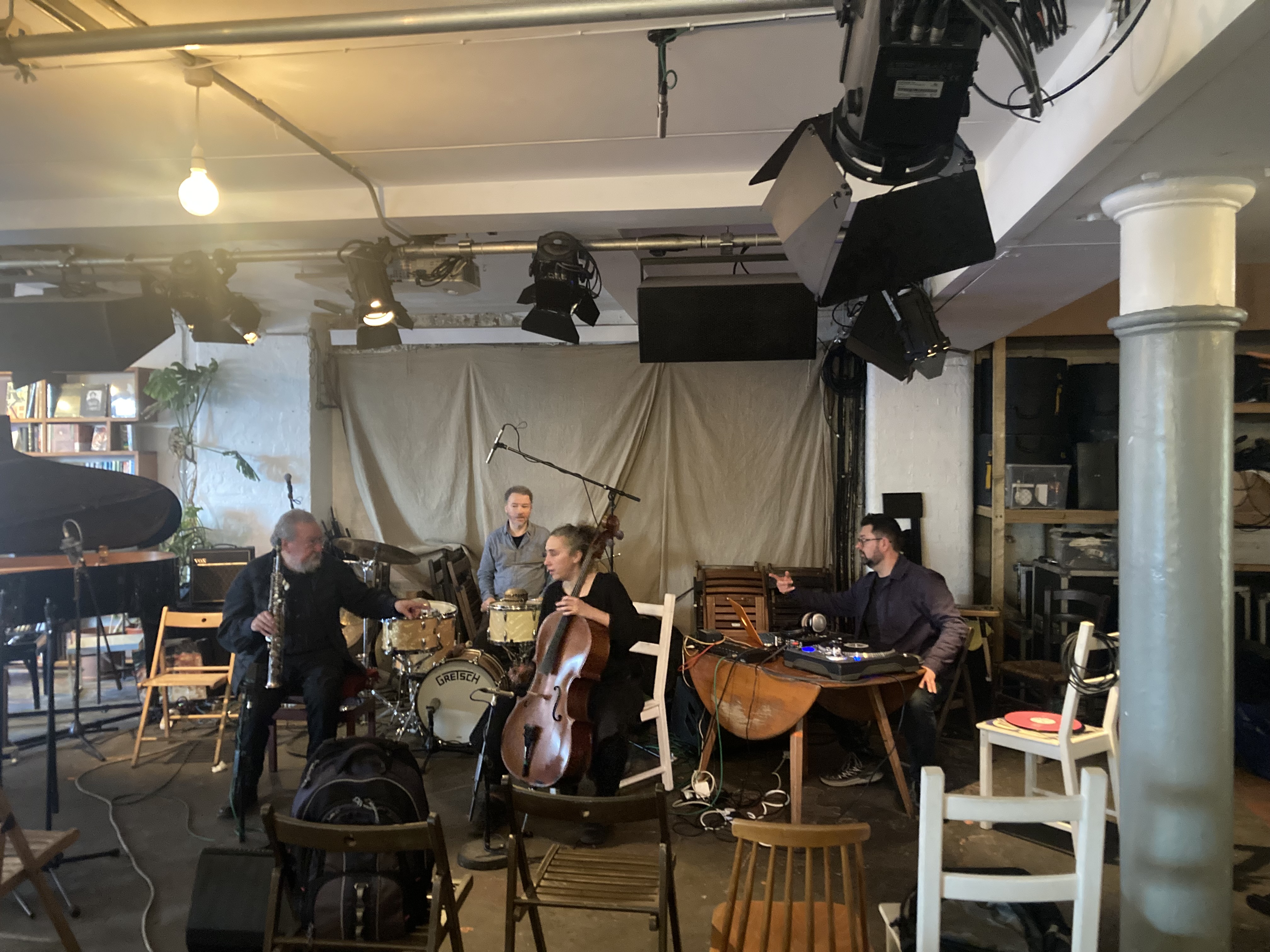
Today at Café Oto and the Vortex many of those artists performed in celebration and commemoration of Martin’s life. It was my privilege to introduce the Café Oto gig, which began with a set from the quartet pictured above during their soundcheck — Parker, Mark Sanders, Hannah Marshall and Matt Wright — and continued with the duo of the altoist Caroline Kraabel and the pianist Veryan Weston before concluding with the 27-strong London Improvisers Orchestra.

I met him 11 August 1969. I remember it because it was my first day in London, my first day at the Melody Maker, and I was sent to review Mike Westbrook’s band at the 100 Club that night. Martin was the man with a box of very desirable albums for sale, set up on a table in the space between the end of the bar and the stage. I soon learned that he was a man of views that were carefully considered and firmly held, some of them expressed in reviews for the MM over the next couple of years.

I was able to share with the audience a handful of the characteristic aphorisms from his New Musical Dictionary, which he posted online. Easy Listening: Music that is extremely difficult to listen to for anyone who really listens to music. Post-modernism: New things for people who don’t like new things. An Improviser: A musician who combines the roles of both composer and interpreter, yet usually receives less respect and remuneration than either.

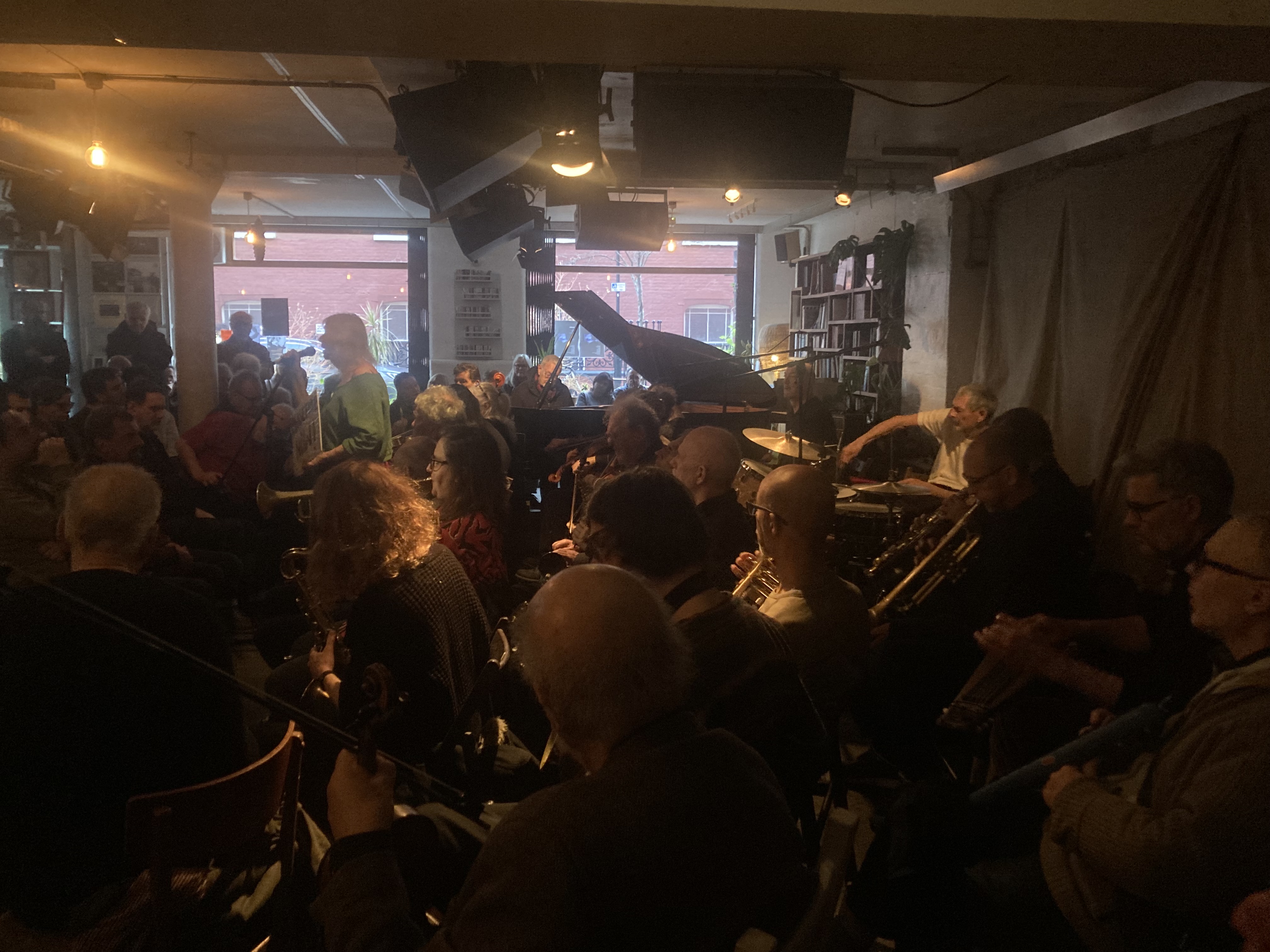
At the request of Mandy Davidson, Martin’s widow (and the other Em in Emanem), all the proceeds from the gigs, for which the musicians waived their fees, will go to B’Teselem, a Jerusalem-based non-profit organisation documenting human rights violations in Israeli-occupied Palestine. At the end of the LIO set, which consisted of ensemble improvisations conducted by Terry Day, Ashley Wales and others, Maggie Nichols — who met Martin when she was a member of the SME — read a verse by a Palestinian poet killed in the Gaza fighting. That’s what you can see in the picture below, as she holds up a placard saying CEASEFIRE NOW!!

Cats, herded

Alexander Hawkins and Evan Parker (photo: Dawid Laskowski)

Organising free improvisers might seem like a fool’s task. Why would the special breed of players who spend their lives resolutely creating music from scratch suddenly want to submit to the will of a composer? Nevertheless, history proves that sometimes it works: notable successes were recorded by Michael Mantler with the original Jazz Composer’s Orchestra, Alexander von Schlippenbach with his Globe Unity Orchestra and Barry Guy with the London Jazz Composers’ Orchestra. Each project depended to some extent on the leader/composer’s familiarity with the techniques of contemporary European straight music, but the idea was given new impetus with the introduction of the looser and perhaps more organic-to-the-idiom technique of “conduction”, pioneered by the late Butch Morris and pursued by George Lewis and Tyshawn Sorey, among others. Slightly to one side were the adventures of the British duo Ashley Wales and John Coxon, known as Spring Heel Jack, who created stimulating modern environments for many individual improvisers, including Wadada Leo Smith and John Tchicai.

The first sound heard on Togetherness Music: For Sixteen Musicians, Alexander Hawkins’ new album, is that of Evan Parker’s soprano saxophone, unwinding its always surprising coils of sound, the seemingly unbroken skeins of notes punctuated by split-second darts and lurches into other registers. As usual, it’s exhilarating and mesmerising, particularly when the sound of the isolated soprano blooms with reverberation, which may or may not be the natural property of Challow Park Studios in Oxfordshire, where the set was recorded. But then Hawkins introduces his other resources: the five string players of the Riot Ensemble and nine other musicians, including the trumpeter Percy Pursglove, the saxophonist and flautist Rachel Musson, the cellist Hannah Marshall, the bassist Neil Charles, the drummer Mark Sanders, and Matthew Wright on electronics, all conducted by Aaron Hollway-Nahum. Gradually they add sombre pedal-points, heightening the atmosphere before Parker drops out and the strings begin to slip and slide until the piece ends, after almost 10 minutes, with several of them holding a tentative D natural.

Sanders and Pursglove are the next to get the concerto grosso for improvisers treatment, a layer of restless percussion under the silvery trumpet continuing into a dialogue with written lines for flute/bass clarinet and viola/cello. On the third piece Parker returns for a pointilliste conversation with Hawkins’ scrambling piano in which the Riot Ensemble make their full presence known, soaring and churning as the music holds itself together through some mysterious centripetal force.

Hawkins, the 16th musician, is featured on the fourth piece, against a walking line played by two basses (Charles and Marianne Schofield) and possibly one of the two cellos, too. Showing the pianist at his most inventive and hyper-alert, it has the loping gait and harmonically ambiguous flavour of the music created by young Cecil Taylor and the bassist with his early groups, Buell Neidlinger, before Parker pipes up with a reminder of another early Taylor collaborator, Steve Lacy, in a passage of ensemble agitation that resolves into an elegant, ruminative diminuendo.

The strings dominate the fifth piece, a collective statement in which the individual instruments glide around each other as if in mismatched orbits, the fine details of tone and timbre revealed within an aural space that feels busy yet uncluttered. The sixth and final composition opens with a trio of Charles, Sanders and Wright, bass and drums working around light electronic taps, thuds and crackles. Pursglove and Hawkins emerge with staccato trumpet figures and a purposefully wandering single-note piano line, continuing as Sanders briefly dominates with thrashing brushwork before the other musicians reappear in a crescendo of exultant sound. A graceful withdrawal gives the last word to Parker and Hawkins, two improvisers who share a near-infallible instinct for an ending.

The six pieces are titled, in order, “Indistinguishable from Magic”, “Sea No Shore”, “Ensemble Equals Together”, “Leaving the Classroom of a Beloved Teacher”, “Ecstatic Baobabs” and “Optimism of the Will”. I’ve described them in such details because the more you listen, the more distinctive they become: each one a living organism with its own cellular structure, texture and micro-climate. I’ve said before that Hawkins has a rare understanding of how to combine composition and improvisation, and here, in this very special recording, we have a perfect example of his gift.

Perhaps I’ve found Togetherness Music particularly valuable because I’ve missed attending live performances of free improvisation very much over the past year. Recordings of small groups, however excellent, aren’t the same thing as hearing and seeing this music conjured in front of you. But by framing improvisation so creatively, Hawkins brings it to life in a different way.

* Alexander Hawkins’ Togetherness Music is out now on the Intakt label (www.intaktrec.ch)

Freedom now… and then

Trevor Watts 1

L to R: Veryan Weston, Alison Blunt, Hannah Marshall and Trevor Watts

No musicians get more of my admiration than those working in the field of jazz-derived free improvisation. An idiom under development for more than 50 years, it has never offered public acclaim or material reward to its practitioners, despite requiring levels of creative imagination and technical ability far beyond the norm in other genres. For the attentive and sympathetic listener, nothing offers quite the same degree of reward as the experience of hearing a group of musicians — or even a solo improviser — imagining the music from scratch, relying on their inner resources from start to finish and (in the case of ensembles) on an extreme sensitivity to the other individuals and to the group dynamic.

It’s a music best heard live, when the listener is able to witness that dynamic at work and watch the musicians exploring the extended instrumental vocabularies developed during the music’s long period of evolution. Given the sounds and skills involved, too, visual evidence sometimes helps in sorting out who is playing what. And so, no less than a Bob Dylan studio album, a recording of free improvisation is a snapshot of a moment.

Sometimes, however, the snapshot can carry a lasting meaning that makes it more than just a souvenir. In the second section of this piece I’ll deal with an album that has carried such significance for half a century. But this part is about a new recording from a group of experienced improvisers who have been playing together for a while, and which seems to me to convey a value beyond the hour it took to play it.

The saxophonist Trevor Watts was one of the originators of British (and European) free music, as a founder member of the Spontaneous Music Ensemble in 1966 with his former RAF colleague John Stevens. Trevor’s passionate alto playing was heard on the SME’s first album, Challenge, recorded soon after their formation, and later in his own groups, including Amalgam and Moiré Music. Now approaching his 79th birthday, Trevor retains the combination of finely tuned energy and emotional generous energy that has always distinguished his work.

His latest venture is a co-operative quartet with the violinist Alison Blunt, the cellist Hannah Marshall and his long-time musical partner, the pianist Veryan Weston. Last year Watts and Weston released a fine duo album called Dialogues for Ornette (a reminder that 50 years earlier Challenge contained a track titled “2B Ornette”)The new quartet’s debut is titled Dialogues with Strings, but it would be a mistake to assume the existence of any kind of hierarchy, or even the feeling of a pair of duos.

This is densely woven music, sometimes hectic, sometimes legato, but motivated, whatever the velocity or trajectory, by a sense of urgency from four musicians playing together as unit for the first time. It isn’t the heavy-metal variety of free jazz; there are passages of wonderful delicacy, but the overall impression throughout the album’s three pieces, recorded last spring at Cafe Oto, is one of a powerful momentum that continues to surge even through the occasional silences. It’s full of the kind of magic that the best free improvisers can conjure when they work together in the right environment.

SME 1Free improvisation is a complex business. Is the idea to create something from nothing that nevertheless sounds as though it was pre-composed? Surely not, although that can be an occasional effect. The reissue of Karyōbin, the SME’s second album, taped in February 1968, shows the music in an embryonic state, when individuals were still mixing and matching their discoveries and feeling their way towards a true group music.

Recorded at the behest of Island Records’ Chris Blackwell for a short-lived label called Hexagram, produced by the engineer Eddie Kramer in a single evening using free after-hours time at Olympic Studios in Barnes, this Watts-less version of the band features — from left in the photo above — Dave Holland (bass), John Stevens (drums), Evan Parker (soprano saxophone), Kenny Wheeler (trumpet and flugelhorn), and Derek Bailey (guitar). The album captures the sound of the musicians as they were heard in many different combinations at the Little Theatre Club in Covent Garden, a crucible of the new jazz.

The individual musicians are at various angles in their relationship to this music, but their personal voices are unmistakeable: Wheeler’s liquid squiggles, Bailey’s surreptitious scrabbling, Parker’s terse flutter and stutter, Stevens (on his skeletal Launcher kit, adopted to bring his playing down to the prevailing volume level of this unamplified music) alternating dry tapping with the pings of cymbals and small gongs. Each of these adventurous approaches would eventually be widely imitated as other musicians joined the cause.

Remastered from the original master tapes, now in Parker’s possession, and cleaned up and rebalanced by Adam Skeaping, this new reissue of the only LP to appear on the Hexagram label is a vastly better proposition than earlier efforts (a Japanese reissue, for instance, was dubbed from a vinyl album), and is matched by packaging which retains the original artwork but adds new essays and a selection of previously unseen black and white photographs taken with Parker’s camera during the session.

It’s a cornerstone of this music and has repaid repeated listening throughout its long life. If you don’t know what happened after Karyōbin, and want to find out, get hold of the 2014 reissue of the SME’s third album, Oliv, recorded in 1969 for Giorgio Gomelsky’s Marmalade label, coupled with an unissued session from the previous year featuring an extended piece called Familie. Both feature Watts back in the fold alongside various other additions, including the bassists Johnny Dyani and Jeff Clyne and the singers Maggie Nichols, Pepi Lemer and Norma Winstone.

It’s all the stuff of history. And, thanks to Watts and others, history is still being made.

* Dialogues with Strings is on the FSR label. The photograph of the quartet is from the album’s jacket, and was taken by Mark French. The reissues of Karyōbin and Oliv & Familie are on Emanem. The photograph of the SME is from the sleeve of the former and was taken by Jak Kilby. Evan Parker and Dave Holland, the only survivors of the Karyōbin quintet, will be playing at the Vortex in Dalston on Friday March 2, in a benefit for the club (www.vortexjazz.co.uk).