Skip to content

Posts tagged ‘Chuck Berry’

Everybody Loves a Train

About twenty years ago, my friend Charlie Gillett was compiling a series of themed CDs for a Polygram label called Debutante, under the aegis of the former Island A&R head Nick Stewart. Charlie asked me if I’d like to put one together, and if so, what the theme might be. “Trains,” I said, after about ten seconds’ thought, and then I went away to assemble a running order. It took a while, because I enjoyed the process so much.

Sadly, the series came to a sudden end before my contribution could see the light of day. But I’d edited together a disc of how I wanted it to go. I called it Everybody Loves a Train, after the song by Los Lobos. It has all sorts of songs, some of which speak to each other in ways that are obvious and not. I avoided the most obvious candidates, even when they perfectly expressed the feeling I was after (James Brown’s “Night Train” and Gladys Knight’s “Midnight Train to Georgia”) and instrumentals, too (see the footnote).

Every now and then I take it out and play it, as I did this week, with a sense of regret that it never reached fulfilment. Here it is, with a gentle warning: not all these trains are bound for glory. Remember, as Paul Simon observes, “Everybody loves the sound of a train in the distance / Everybody thinks it’s true.”

  1. Unknown: “Calling Trains” (From Railroad Songs and Ballads, Rounder 1997) Forty-odd seconds of an unidentified former New Orleans station announcer, recorded at Parchman Farm, the Mississippi state penitentiary, in 1936, calling from memory the itinerary of the Illinois Central’s “Panama Limited” from New Orleans to Chicago: “…Ponchatoula, Hammond, Amite, Independence… Sardis, Memphis, Dyersburg, Fulton, Cairo, Carbondale…” American poetry.
  2. Rufus Thomas: “The Memphis Train” (Stax single, 1968) Co-written by Rufus with Mack Rice and Willie Sparks. Produced by Steve Cropper. Firebox stoked by Al Jackson Jr.
  3. Los Lobos: “Everybody Loves a Train” (from Colossal Head, 1996) “Steel whistle blowin’ a crazy sound / Jump on a car when she comes around.” Steve Berlin on baritone saxophone.
  4. Bob Dylan: “It Takes a Lot to Laugh, It Takes a Train to Cry” (from Highway 61 Revisited, 1965) “Don’t the brakeman look good, mama, flaggin’ down the Double E?”
  5. Joe Ely: “Boxcars” (from Honky Tonk Masquerade, 1978) A Butch Hancock song. Ponty Bone on accordion, Lloyd Maines on steel guitar.
  6. Counting Crows: “Ghost Train” (from August and Everything After, 1993) “She buys a ticket ’cause it’s cold where she comes from / She climbs aboard because she’s scared of getting older in the snow…”
  7. Rickie Lee Jones: “Night Train” (from Rickie Lee Jones, 1979) It was a plane she took from Chicago to LA to begin her new life in 1969, and an old yellow Chevy Vega she was driving before she cashed the 50K advance from Warner Bros ten years later. But, you know, trains.
  8. The Count Bishops: “Train, Train” (Chiswick 45, 1976) London rockabilly/pub rock/proto-punk. Written by guitarist/singer Xenon De Fleur, who died a couple of years later in a car crash, aged 28, on his way home from a gig at the Nashville Rooms. Note that comma. I like a punctuated title.
  9. Julien Clerc: “Le prochain train” (from Julien, 1997) My favourite modern chansonnier. Lyric by Laurent Chalumeau.
  10. Blind Willie McTell: “Broke Down Engine Blues” (Vocalion 78, 1931) Born blind in one eye, lost the sight in the other in childhood. Maybe he saw trains in time to carry their image with him as he travelled around Georgia with his 12-string guitar.
  11. Laura Nyro: “Been on a Train” (from Christmas and the Beads of Sweat, 1970) One song she didn’t do live, as far as I can tell. Too raw, probably.
  12. Chuck Berry: “The Downbound Train” (Chess B-side, 1956) When George Thorogood covered this song, he renamed it “Hellbound Train”. He didn’t need to do that. Chuck had already got there.
  13. Bruce Springsteen: “Downbound Train” (from Born in the USA, 1984) “The room was dark, the bed was empty / Then I heard that long whistle whine…”
  14. Dillard & Clark: “Train Leaves Here This Morning” (from The Fantastic Expedition of Dillard & Clark, 1968) Written by Gene Clark and Bernie Leadon: “1320 North Columbus was the address that I’d written on my sleeve / I don’t know just what she wanted, might have been that it was getting time to leave…”
  15. Little Feat: “Two Trains” (from Dixie Chicken, 1973) In which Lowell George extends the metaphor of Muddy Waters’ “Still a Fool (Two Trains Running)”: “Two trains runnin’ on that line / One train’s for me and the other’s a friend of mine…”
  16. B. B. King: “Hold That Train” (45, 1961) “Oh don’t stop this train, conductor, ’til Mississippi is out of sight / Well, I’m going to California, where I know my baby will treat me right”
  17. Paul Simon: “Train in the Distance” (from Hearts and Bones, 1983) Richard Tee on Fender Rhodes. “What is the point of this story? / What information pertains? / The thought that life could be better / Is woven indelibly into our hearts and our brains.”
  18. Vince Gill: “Jenny Dreams of Trains” (from High Lonesome Sound, 1996) Written by Gill with Guy Clark. Fiddle solo by Jeff Guernsey. Find me something more beautiful than this, if you can.
  19. Muddy Waters: “All Aboard” (Chess B-side, 1956) Duelling harmonicas: James Cotton on train whistle effects, Little Walter on chromatic.
  20. Darden Smith: “Midnight Train” (from Trouble No More, 1990) “And the years go by like the smoke and cinders, disappear from where they came…”
  21. The Blue Nile: “From a Late Night Train” (from Hats, 1989) For Paul Buchanan, the compartment becomes a confessional.
  22. Tom Waits: “Downtown Train” (from Rain Dogs, 1985) “All my dreams, they fall like rain / Oh baby, on a downtown train.” A New York song.

Closing music: Pat Metheny’s “Last Train Home” (from Still Life (Talking), 1987) to accompany the photo of the Birmingham Special crossing Bridge No 201 near Radford, Virginia in 1957 — taken, of course, by the great O. Winston Link. Other appropriate instrumentals: Booker T & the MGs’ “Big Train” (from Soul Dressing, 1962, a barely rewritten “My Babe”) and Big John Patton’s “The Silver Meter Pts 1 & 2” (Blue Note 45, 1963, a tune by the drummer Ben Dixon whose title is a misspelling of the Silver Meteor, a sleeper service running from New York to Miami).
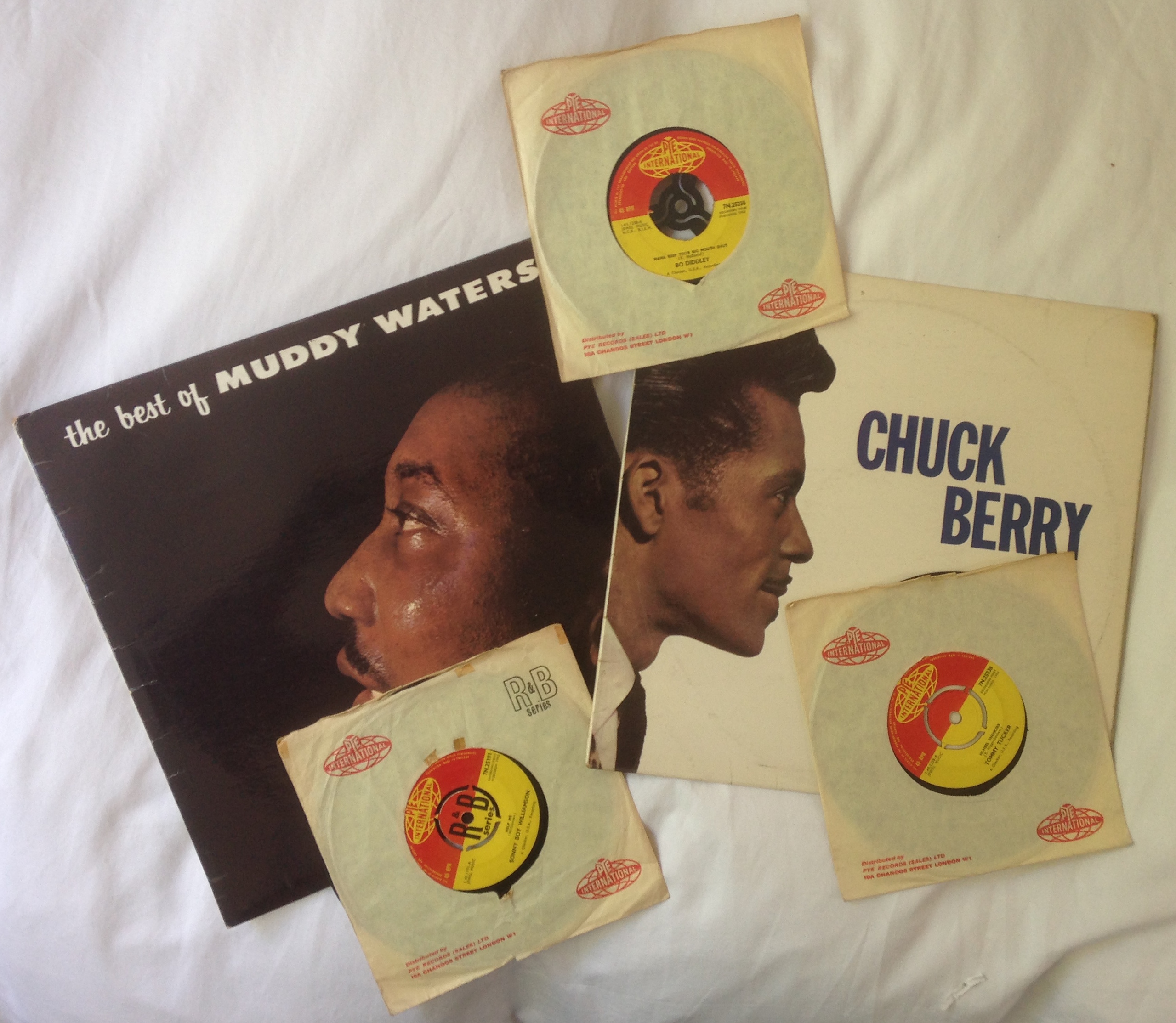
The real rhythm and blues

ChessWilko Johnson’s new autobiography, Don’t You Leave Me Here, received an eloquent recommendation from Mark Ellen in the Sunday Times at the weekend. To coincide with its publication, Universal’s Spectrum imprint is issuing a 40-track double CD set compiled by the former Dr Feelgood guitarist called The First Time I Met the Blues: Essential Chess Masters. Its appearance prompted me to dig out the records you see above: three 45s from my all-time Top 100 box, plus two magnificent albums, all licensed for release in the UK on the Pye International label in the early ’60s.

That red and yellow label still triggers an emotional response, particularly when the centre and the paper sleeve carry the “R&B Series” logo, as the copy of Sonny Boy Williamson’s “Help Me” pictured above does. Why it didn’t also appear on records like Tommy Tucker’s “Hi-Heel Sneakers” and Bo Diddley’s “Mama Keep Your Big Mouth Shut” is a question that someone out there might be able to answer.

It’s a good compilation, equally valuable to those who no longer have their original copies and to newcomers who would like a compact introduction to a golden age of Chicago rhythm and blues. There are masterpieces here: Muddy Waters’s “Hoochie Coochie Man”, Little Walter’s “My Babe”, Howlin’ Wolf’s “Smokestack Lightnin'” and “Goin’ Down Slow”, Sonny Boy’s “Don’t Start Me to Talkin'”, John Lee Hooker’s “I’m in the Mood”, Chuck Berry’s “Memphis, Tennessee” — the songs that those of us who were in British R&B groups in 1963-65 were required to know.

Muddy’s “I Can’t Be Satisfied” — recorded in 1948 with Ernest “Big” Crawford’s stand-up bass accompanying the singer’s bottleneck guitar, the two of them sounding like the whole band Waters was soon to assemble — remains one of the great moments in American popular music: magical and mysterious, a perfect integration of voice and instruments, an endlessly fascinating essay in rhythmic subtlety. “Louisiana Blues”, from a band session two years later, runs it close in that respect. It’s interesting to think about the way these particular tracks sounded before a drummer came in to tie down the beat: they float so loose and free (Elgin Evans is credited on “Louisiana Blues”, but his contribution is practically subliminal).

In some ways, however, my favourite among the 40 tracks has to be “Hi-Heel Sneakers”: a record that, in the early weeks of 1964, any young person with the slightest pretension to coolness simply had to own. It amazes me now that this modest little 12-bar blues could become not just a mod classic in the UK but such a big hit on the pop charts: No 11 in the US (Billboard), where it had the benefit of a huge number of black record-buyers, and No 23 in Britain (Record Retailer), where it didn’t.

Tucker (born Robert Higginbotham in Springfield, Ohio) sang and played organ on his own song. That exquisite and unforgettable guitar intro seems to have been played by Dean Young from Ripley, Tennessee — a member, along with bassist Brenda Jones and drummer Bo Tolliver, of Tucker’s regular band, who negotiated a then-fashionable chord pattern that echoed Jimmy Reed’s “Shame Shame Shame” and Marvin Gaye’s “Can I Get a Witness”. The producer, Herb Abramson (an original co-founder of Atlantic Records with Ahmet Ertegun), wisely left them to get on with it. They cannot have dreamed for a single instant that it would still be listened to and loved more than half a century later.

* This post originally credited the new compilation to the Ace label. Once the error was pointed out, I corrected it. The relevant label is Spectrum.

The Promised Land calling…

Fifty years ago this month the folks at Chess Records were preparing the release of a new Chuck Berry album called St Louis to Liverpool, containing the first new recordings since his release from jail a few months earlier. The album’s title, of course, acknowledged the effect of the British Invasion: the sudden takeover of the US charts by the Beatles, the Dave Clark 5, Freddie and the Dreamers, and others. Berry could hardly fail to have taken notice, since most of them were playing his songs.

Among the new numbers on the album was one I believe to be among his half-dozen finest: “The Promised Land”, the story of a poor boy making the trip from his home in Norfolk, Virginia to a new life in Southern California. The journey takes him through the Carolinas, Georgia, Alabama, Mississippi, Louisiana and Texas, where — in Houston, with the aid of friends — he’s put on a jet plane for the final leg of the journey, over New Mexico and on to touchdown in Los Angeles.

The form of it is inspired by Bobby Troup’s “Route 66”, made famous by Nat King Cole but chopped and channeled by Berry into a beat-group classic. He wrote his new song in prison, and was initially turned down when he asked for a road atlas of the US to help him with the geography, on the grounds that it might help him escape. After an appeal to the governor, the request was eventually granted.

The trick of the song is that, like the journey it describes, it never turns back on itself. There’s no chorus. Nothing is repeated. The title emerges only in the song’s very last thought. As well as precise geographical information, it’s full of beautiful details — the through-train ticket on the Midnight Flyer, the silk suit, the T-bone steak à la carte — and whole lines that, once you heard them, you never forgot, like that amazing penultimate verse: “Swing low, chariot, come down easy / Taxi to the terminal zone / Cut your engines and cool your wings / And let me make it to the telephone…”

It’s a song that seems quintessentially American, perhaps especially to a non-American who fell in love with that culture when it was at its jet-engined, tail-finned, jukebox and blue jeans height. I happen to harbour a special reverence for the version Elvis cut at the Stax studio in Memphis in December 1973, because (as I wrote in a piece in my book Long Distance Call) the combination of singer and song seems to incorporate so many myths and legends, dreams and desires. And, of course, Elvis sings the hell out of the song, like he’d written it or lived it. He really is the boy whose first instinct, on arriving in the place where he plans to make a new life, is to call home.

At the top you’ll find a YouTube clip of the man who wrote the song delivering his masterpiece in a TV studio in Paris, I’d guess during his European tour in January 1965. The pick-up rhythm section would obviously rather be playing “How High the Moon”. There’s a lovely moment when the stand holding the vocal microphone collapses. Towards the end of the song the bass-player retunes his D and G strings in mid-flow with a rather unnecessary fastidiousness. And Mr Berry is, as ever, his own sweet-and-sour self, a true genius of rock and roll.


Where the Stones were fourth on the bill

Odeon, Nottingham

If you look carefully at the top of the building in the photograph, you’ll see the faintest shadow of the long-gone neon sign that read ODEON. I took the picture on a rainy day a couple of winters ago, while passing through Nottingham, my old home town. How many of the hundreds of people walking along this pavement every day know that it was here, in this cinema on Angel Row, a hundred yards or so up from the Old Market Square, that the Beatles and the Rolling Stones played, in 1963 and ’64? And now it’s finally vanished. The demolition crew have done their job and the construction workers are in, filling the space with a building apparently intended to provide housing for students.

Buddy Holly played the Odeon in 1958: three shows on the night of March 8, during his only UK tour. I missed that one, being only 10 at the time (although I’d already saved up to buy the Crickets’ “That’ll Be the Day” on 78), but three years later I saw Cliff Richard and the Shadows, just after Brian Bennett took over from Tony Meehan on drums — a source of some regret, since Meehan was my first drumming hero. The screaming meant that not much could be heard. But at least Hank Marvin gave me my first sight of a Fender Stratocaster in action, and they were still doing the famous Shadows walk, much copied by we schoolboys in front of bedroom mirrors.

OK, I’ll own up: I missed the Beatles there — three times, on the first occasion with Roy Orbison — and the Stones. Absence of cash, I expect. I wouldn’t have been able to hear them above the hysteria anyway, although I’ve always kicked myself for not making it to the Stones’ show in October 1963, since it also featured the Everly Brothers, Little Richard and Bo Diddley, all of them above the Stones on the bill when the tour started. My friend Phil Long remembers Little Richard’s set: “One of the best I’ve ever seen. He jumped off the stage, ran all the way round the theatre, then got back on the stage and started taking his clothes off and throwing them to the audience… there was a riot.”

The most memorable concert I did manage to attend at the Odeon was on May 12, 1964, the fourth date of a 22-night package tour headlined by Chuck Berry, with support from Carl Perkins, the Animals, the Nashville Teens and King Size Taylor and the Dominos. It was great merely to see Chuck, who provided so many of us with the inspiration for our own bands, but he gave a pretty uninterested performance. He was accompanied by King Size Taylor’s excellent band, and I seem to remember that about half the set consisted of throwaway instrumentals; has any great songwriter ever taken a less obvious pride in his achievements? But it was enough to hear those guitar intros ringing out, and to witness his perfunctory demonstration of the duck walk.

Carl Perkins was not exactly spectacular, either, in his very short set. And so, curiously, the musical highlights were provided by two English bands. The Animals, of course, were excellent. “Baby Let Me Take You Home”, copied from “Baby Let Me Follow You Down” on Bob Dylan’s first album, was nudging the Top 20, and their act still had the R&B edge honed in Newcastle’s Club A Go-Go. But they also played their epic four and a half minute version of another song from Dylan’s debut: “House of the Rising Sun”. It hadn’t yet been released, or heard on the radio, and its arrangement — featuring Hilton Valentine’s arpeggiated guitar, Alan Price’s wailing Vox Continental organ and Eric Burdon’s baleful vocal — was nothing short of stunning. Five weeks later it would enter the charts, on its way to No 1.

It was the same with the Nashville Teens, whose set included John D Loudermilk’s “Tobacco Road”: another dramatic song, its structure and mood inspired by the compositions Willie Dixon provided for Muddy Waters and other blues stars. The group, from the Surrey stockbroker belt, did an enthusiastic job of impersonating the sound of the Chicago stockyards, and by July they were on their way to the UK Top 10. By August “The House of the Rising Sun” was on its way to No 1 in Billboard‘s Hot 100, while “Tobacco Road” topped out at No 14 in the US a month later. Heard for the first time in live performance, both made an immediate impression.

And now the Odeon has disappeared. I suppose it’s not exactly like losing the Cavern or the Marquee. But it would be nice, when they finished its replacement, if someone thought it worth putting up a plaque to remind passers-by of former glories. Buddy Holly, The Beatles. The Rolling Stones. The Everly Brothers. Little Richard. Bo Diddley. Chuck Berry. Not bad, eh?