Skip to content

Posts tagged ‘Chris Biscoe’

At Blackheath Halls

Yesterday, the eve of the winter solstice, turned out to be a good one for music. Looking for a Christmas present, I found myself in a clothes shop where the sound system was playing Al Green’s version of Kris Kristofferson’s “For the Good Times”, making me wonder for a moment if there had ever been a finer performance by a soul singer of a country ballad. Then, while I was having a cup of coffee, the café’s playlist surprised me by including Bob B. Soxx and the Blue Jeans’ soaring “The Bells of St Mary”, from Phil Spector’s Christmas Album, a piece of art which seems — unlike Gesualdo’s madrigals and Caravaggio’s paintings — to have been widely cancelled in the present era.

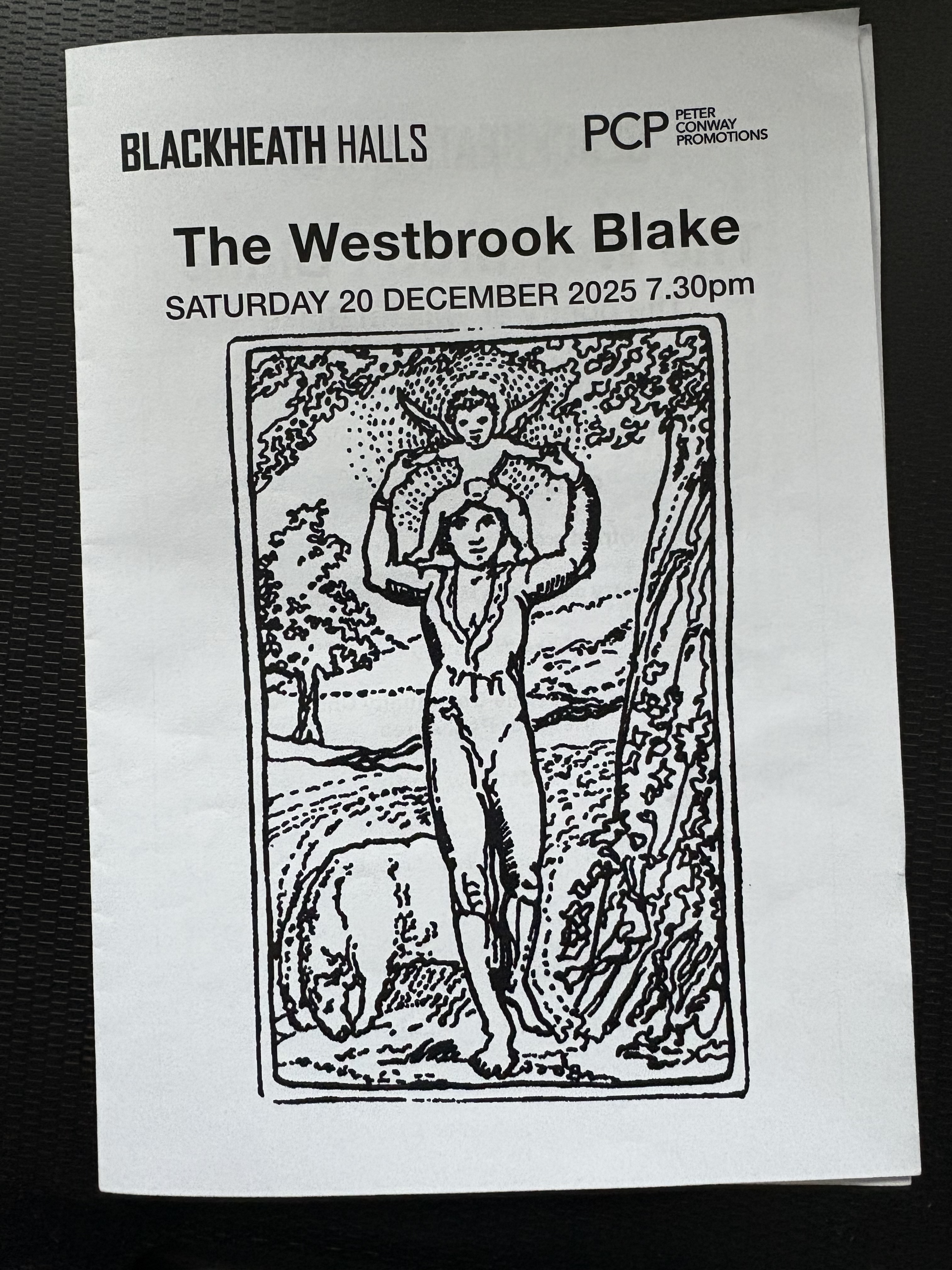
In the evening I took myself to Blackheath Halls, a really splendid venue for music, to hear The Westbrook Blake, a suite of pieces which has been in constant evolution since in 1971, when Adrian Mitchell invited Mike Westbrook to provide musical settings for some of William Blake’s poems, as part of a piece for the National Theatre called Tyger.

I’ve written about it before, here and here, so I won’t repeat myself, except to say that it’s one of the glories of contemporary English music, and the chance to see any performance of it is to be grabbed with some urgency. Last night the two wonderfully expressive solo singers (as always, Kate Westbrook and Phil Minton) and the five-piece band were joined by the 30 or so singers of the Blackheath Halls Community Singers, directed by Paul Ayers.

While Mike Westbrook’s place at the piano was taken by the brilliant Matthew Bourne, the composer himself took the stage in a wheelchair, from which he recited a couple of Blake’s more trenchant poems with clarity and feeling. The spectacular solos from the accordion of Karen Street, the violin of Billy Thompson and the alto saxophone of Chris Biscoe were more than worthy of the spontaneous applause they drew. It was an evening of proper music-making, full of communal warmth, often thought-provoking, and generally good for the soul.

Mike Westbrook’s Band of Bands

From left: Mike Westbrook, Kate Westbrook, Karen Street, Pete Whyman, Chris Biscoe, Marcus Vergette (out of shot: Coach York)

You might have noticed, Mike Westbrook said as the second of today’s two lunchtime sets at the Pizza Express drew to a close, that a lot of this music we’ve been playing has something to do with the blues. And then he quoted Duke Ellington: “When times get tough, I write another blues.” That, Westbrook said, is what he found himself doing rather a lot these days. And then he and the new septet he calls his Band of Bands played “Gas, Dust, Stone”, which he described as “a blues for the planet”.

Its slowly wandering theme, first sung by Kate Westbrook and then voiced for the alto saxophones of Chris Biscoe and Pete Whyman and the accordion of Karen Street, reminded me at times of Ellington’s world-weary “4:30 Blues” before the mood switched, charging into the 12/8 of Charles Mingus’s “Wednesday Night Prayer Meeting”, powered by Marcus Vergette’s bass and Coach York’s drums, with a beautiful Street solo.

Westbrook, who is 87, formed his first band in Plymouth in 1958, and the Band of Bands celebrates longevity. Mike and Kate have been working, writing and performing together for 50 years. Biscoe first joined them 40 years ago, to create the Westbrook Trio. Street and Whyman have been with them on various projects for 30 years. Vergette and York, the newcomers, were called to the colours a mere 20 years ago, and are now the heartbeat of the Uncommon Orchestra.

The septet is both an expansion of the trio and a reduction of the big band, capable of handling everything from the fast bebop of the opening “Glad Day”, one of Westbrook’s pieces inspired by William Blake, through a brilliantly recast version of Billy Strayhorn’s “Johnny Come Lately” to the slow-rolling gospel cadences of “Blues for Terenzi” and the open spaces of “Unsigned Panorama”, with marvellous unaccompanied solos by Whyman (on clarinet) and Street.

Several songs from Fine ‘n’ Yellow, their 2010 song cycle, made an impression. Throughout “Yellow Dog”, York maintained a pulse (on his beautifully clear Murat Diril ride cymbal) three times that of the rest of the band, allowing Biscoe to float in his typically expressive solo between the drummer’s tempo, the much slower one being paced by Vergette, and the unstated one in between. “My Lover’s Coat”, finely sung, seemed to have “Blue Monk” in its bones.

If there were frequent reminders of how thoroughly Westbrook has metabolised his love of Ellington, Mingus and Monk, there was also evidence of a new enthusiasm for the songs of Frederick Hollander, a German composer of film music. Born Friedrich Hollaender in London in 1896 and brought up in Berlin, he wrote for Max Reinhardt’s theatre productions, accompanied artists in the Weimar-era cabarets, and wrote the music for Josef von Sternberg’s The Blue Angel, including “Falling in Love Again”, delivered by the film’s star, Marlene Dietrich. Leaving Germany when the Nazis took power, he arrived in Hollywood in 1934, anglicised his name, and had written for more than 100 films before his return to Germany in 1956, where he died in 1976.

One of those Hollywood films was A Foreign Affair, a 1948 comedy-drama set in post-war Berlin, directed by Billy Wilder and again starring Dietrich. Kate Westbrook delivered two of Hollander’s songs from that film, both concerned with the perils of emotional and sexual transactions: the sardonic “Black Market”, a Weill-esque piece on which she departed from the text to display her command of vocal effects, and “Illusions”, a gorgeous ballad on which she was exquisitely supported by Street and Biscoe.

Pointing out to the audience that this was the first public appearance of the Band of Bands, Westbrook expressed the hope that there would many more. An album devoted to the music of Frederick Hollander might not be such a bad next step*.

* See a comment below.

William Blake in Piccadilly

Although any performance of the Westbrook Blake — as Mike Westbrook’s settings of William Blake’s words have been known for more than 40 years — is a powerful event, the emotional impact of last night’s concert by Mike and Kate Westbrook and their musicians at St James’s Church, Piccadilly was intensified by the knowledge that this Christopher Wren church, consecrated in 1684, was the place where the English poet, painter and visionary was baptised in 1757, soon after his birth in Soho.

Titled Visions and Voices: Echoes of William Blake, the evening began with Kate Westbrook delivering “London”, one of the most harrowing poems in the English language, before Phil Minton took over for “Let the Slave”, the next in the sequence of poems linked and illuminated by instrumental solos. Billy Thompson’s fiddle summoned angels and demons, Chris Biscoe’s alto saxophone spoke to the human capacity for joy, Mike Westbrook and a guest, Matthew Bourne, delivered absorbing piano solos, Steve Berry’s bass was lifted out of a solemn reverie by artful background figures, and most of all the accordion of the remarkable Karen Street transfixed the audience with a long unaccompanied improvisation that soared and dived and spun as if a flock of birds of many shapes and sizes but linked by an avian telepathy had found their way into the church. It was, I think, the most astonishing single piece of playing I’ve heard this year.

You might have seen the Westbrook Blake a few times over the years, and be familiar with the recordings, but its grip never slackens. In fact as the country collapses, hollowed out by a greed that Blake identified two centuries ago, it grows more strikingly relevant. As usual, Mike Westbrook recited passages as urgent and resonant in today’s seemingly very different circumstances as they were when first written:

Compel the poor to live upon a crust of bread, by soft mild arts.
Smile when they frown, frown when they smile; and when a man looks pale
With labour and abstinence, say he looks healthy and happy;
And when his children sicken, let them die; there are enough
Born, even too many, and our earth will be overrun
Without these arts.
..

A few years years after creating his Blake settings, Mike Westbrook composed an extended work for band and orchestra titled London Bridge Is Broken Down, commissioned by and first performed at a festival in Amiens in 1987. Inspired by travels around Europe and meditations on its history at a time when an old order was falling apart, it is divided into sections titled London Bridge, Wenceslas Square, Berlin Wall, Vienna and Picardie. A much admired studio version came out on Virgin the following year. Now there’s the release of the recording of a performance in Zürich in 1990, with Westbrook’s 11-piece unit and the 35-piece Docklands Sinfonietta. Even if you already have the original release, I recommend hearing this one, too, for the exceptional spirit with which the work is played and sung (by Kate Westbrook, using texts from Goethe, Siegfried Sassoon and others).

All Westbrook’s virtues and trademarks are allowed to flower in this 80-minute performance, which stands tall among his catalogue of extended works. The 23-minute sub-section of Vienna titled “Für Sie”, with solos by Alan Wakeman on soprano saxophone, Paul Nieman on trombone, Chris Biscoe on baritone and Pete Whyman on alto, is a slowly unfolding kaleidoscope of exquisite shapes, sounds, trajectories and textures.

* Mike Westbrook’s London Bridge: Live in Zürich 1990 is released on Westbrook Records (www.westbrookjazz.com)

The return of Tony Kinsey

Tony Kinsey

At the Clock House: Dave Jones, Tony Kinsey, Tony Woods, Chris Biscoe

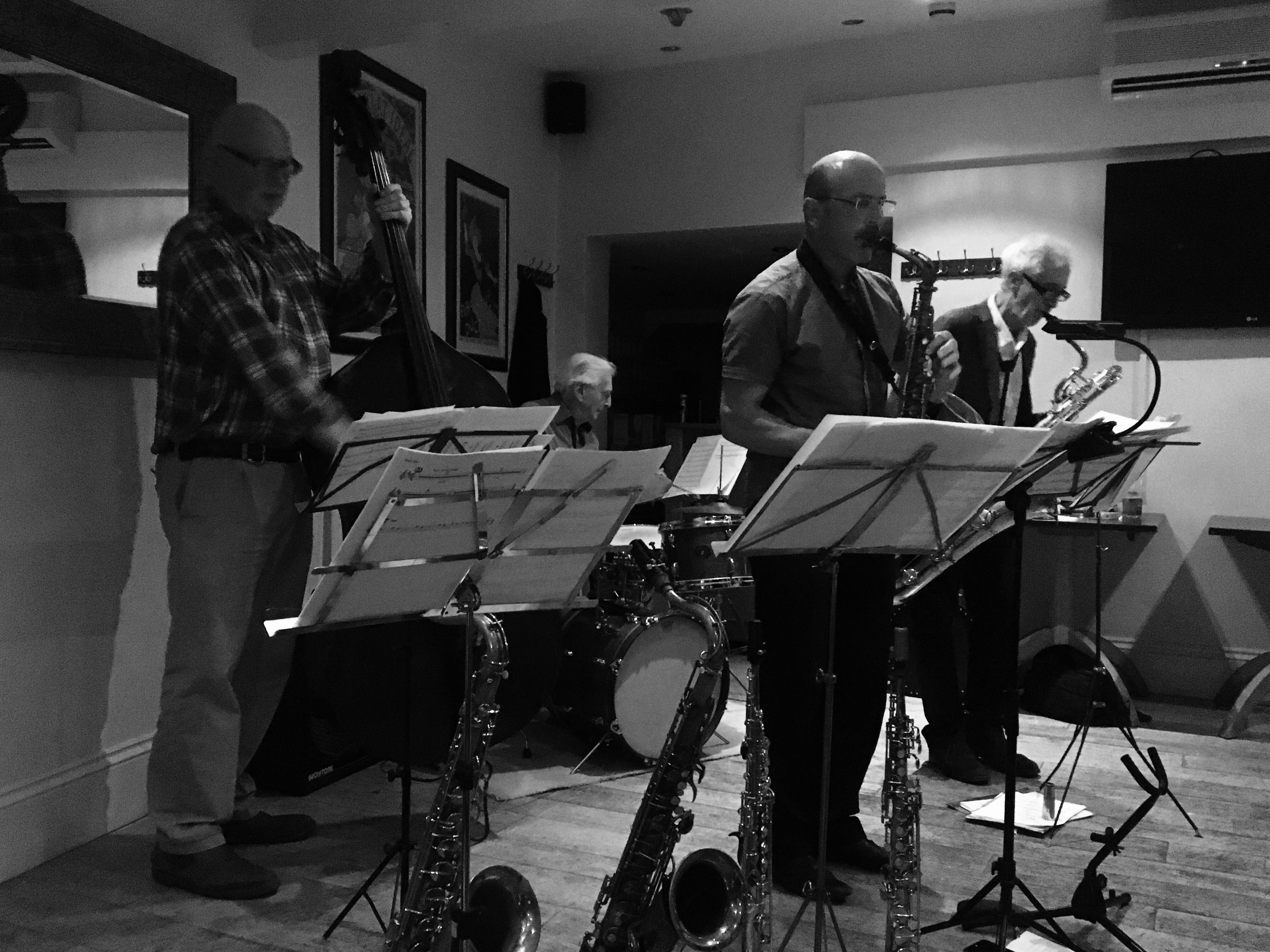
After six months off with an injury, the distinguished drummer Tony Kinsey returned to action last night, setting up his kit at the Clock House in Teddington High Street for one of the regular nights organised by the Way Out West collective, of which he is a member. WOW’s venues have included the Bull’s Head in Barnes and Cafe POSK, the Polish social club in Hammersmith; the latest location, the back room of a pub, feels appropriate to the informal vibe created by these West London-based musicians and their enthusiastic supporters.

Kinsey’s band mates on this evening were the double bassist Dave Jones and four saxophonists: Pete Hurt (soprano), Tony Woods (alto), Tim Whitehead (tenor) and Chris Biscoe (baritone). In the set I heard, they played in several different combinations.

The full sextet was assembled for the opener and closer, respectively Tadd Dameron’s “Good Bait” (arranged by the late Eddie Harvey, a co-founder of the collective) and Oliver Nelson’s “Hoe Down” (transcribed by Hurt). The four saxophones were alone on Woods’ arrangement of Herbie Hancock’s “Dolphin Dance”. The trio of tenor, bass and drums tackled “I Thought About You”. Alto, tenor and drums were heard on “Stella by Starlight”, for which Woods set Whitehead a puzzle by starting the piece in a fairly abstract kind of way, having given the tenorist a list of five songs from which the chosen one would eventually emerge — the correct answer was achieved pretty quickly. And alto, baritone and the rhythm section played a couple of tunes from Biscoe’s excellent recent album, Then and Now.

The occasional misunderstanding made a pleasant change from the blueprinted precision of so much contemporary jazz. “Moving on,” Whitehead declared brightly as Woods and Hurt debated a missed cue in “Good Bait”, to the audience’s amusement.

Kinsey, looking characteristically unruffled, played with superb empathy throughout. The elements of his style — the calm ride cymbal beat, the off-centre rimshots, the discreet brushwork, the crisp 2-and-4 hi-hat and the occasional bass-drum bomb — were perfectly deployed. This is a man who played with all the heroes of post-war British modern jazz — Tubby Hayes, Joe Harriott, Don Rendell, Johnny Dankworth et al — and with Billie Holiday and Ben Webster, and who in recent years has composed extended pieces for large jazz ensemble and string quartet.

Did I mention that, on October 11, Tony Kinsey will be 90?

Jazz in Britain, Part 1

Jazz in Britain 1The title of this two-part series is a homage to John Muir, a friend of 40-odd years ago. As a BBC radio producer, Muir saved John Peel’s career at the corporation in 1968 by giving him a Radio 1 show called Night Ride. He also booked Roxy Music for their first broadcast on Sounds of the Seventies, and supervised a series titled Jazz in Britain, devoted to the emerging generation of John Stevens, John Surman, Tony Oxley, Trevor Watts, Howard Riley and so on. John died recently, aged 80. I thought of him as being the best kind of BBC person: calm, civilised, culturally literate and unobtrusively fearless. Here are eight new albums by artists he would certainly have booked for a series of Jazz in Britain in 2017. Together they demonstrate that we are experiencing a new golden age of British jazz.

Binker & Moses: Journey to the Mountain of Forever (Gearbox). Dem Ones, a first album of duets for tenor saxophone and drums by Binker Golding and Moses Boyd, deservedly won praise and awards last year. This follow-up starts in a similar vein, with a further disc of two-part inventions, even more confident and assured. But the second disc is where things get really interesting as they add guests in various permutations. Byron Wallen (trumpet), Evan Parker (saxophones), Tori Handsley (harp), Sarathy Korwar (tabla) and Yussef Dayes (drums) join Golding and Boyd on a trip through tones and textures, creating a beautifully spacious set of improvisations, uncluttered but full of interest. The exotic titles suggest some kind of fantastical narrative is going on, but the music tells its own story.

Alexander Hawkins: Unit[e] (AH). Another two-disc set, its first half consisting of seven pieces recorded last October by Hawkins’s excellent and now disbanded sextet, featuring Shabaka Hutchings (reeds), Otto Fischer (guitar), Dylan Bates (violin), Neil Charles (bass) and Tom Skinner (drums). “[K]now”, featuring a recitation by Fischer, is a highlight. The second disc consists of pieces recorded this January by a 13-piece ensemble in which Hawkins, Bates, Fischer and Charles are joined by others including Laura Jurd, Percy Pursglove and Nick Malcolm (trumpets), Julie Kjaer (flutes and reeds), Alex Ward (clarinet), Hannah Marshall (cello) and Matthew Wright (electronics). This is dense but open-weave music, containing a composed element but sounding almost wholly improvised and writhing with invention. It’s on Hawkins’s own label (information at http://www.alexanderhawkinsmusic.com) and it’s outstanding.

Yazz Ahmed: La Saboteuse (Naim). A friend of mine describes this as “Silent Way-era Miles w/Arabic textures”, which is a fair summary. Yazz, her quarter-tone trumpet and her fine octet are investigating ways of blending jazz with the music of Bahrain, her parents’ country. At a late-night concert in Berlin last November the audience didn’t know them and they didn’t know the audience, but after an hour the musicians were able to walk away in triumph. Dudley Phillips’s bass guitar and Martin France’s drums keep the grooves light and crisp, Lewis Wright’s vibes solos are always a pleasure, and the combination of Yazz’s trumpet or flugelhorn with Shabaka Hutchings’s bass clarinet gives the ensemble a pungent and distinctive character.

Olie Brice Quintet: Day After Day (Babel). I love this band, led by a brilliant bassist and completed by Alex Bonney (cornet), Mike Fletcher (alto), George Crowley (tenor) and Jeff Williams (drums). What it has is the loose-limbed fluidity I associate with the New York Contemporary Five, the band that included Don Cherry, John Tchicai and Archie Sheep, with just a hint of Albert Ayler’s Bells ensemble. But it’s not derivative. It’s a continuation, and a worthwhile one. Brice’s own playing is exceptionally strong (he can make me think of Wilbur Ware, Henry Grimes and Jimmy Garrison), his compositions provide the perfect platform for the horns, and Williams swings at medium tempo with such easy grace that you could think you were listening to Billy Higgins.

Denys Baptiste: The Late Trane (Edition). Almost 50 years after John Coltrane’s death, there is no real consensus about the music of his last two years, when the turbulent spirituality took over and blurred the outlines that had been so clear on A Love Supreme and Crescent. Baptiste takes a conservative approach to the late material, enlisting a fine band — Nikki Yeoh (keyboards), Neil Charles or Gary Crosby (bass) and Rod Youngs (drums), with the great Steve Williamson (tenor saxophone) on a couple of tracks — to support his own tenor and soprano on Trane’s tunes (including “Living Space” and “Dear Lord”) and a couple of originals. Rather than taking them further out, he draws them nearer in through the subtle application of more recent styles, including funk, reggae and a touch of electronics. The sincerity of the homage is never in doubt.

Chris Biscoe / Allison Neale: Then and Now (Trio). One of the unsung heroes of British jazz since his arrival as a promising saxophonist with NYJO in the early ’70s, Biscoe sticks to the baritone instrument on this release, joined by Neale’s alto saxophone as they explore the mood of the albums Gerry Mulligan made with Paul Desmond in the late ’50s and early ’60s. With Colin Oxley’s guitar, Jeremy Brown’s bass and Stu Butterfield’s drums in support, the approach is deceptively relaxed: this music may not bear the burden of innovation but it demands high standards of execution and integrity. The intricate improvised counterpoint on “The Way You Look Tonight” refracts Mulligan/Desmond through the Tristano prism.

Freddie Gavita: Transient (Froggy). Fans of the Hubbard/Hancock/Shorter era of the Blue Note label would enjoy investigating the debut by this young graduate of the Royal Academy of Music and NYJO, the possessor of a beautifully rounded tone on both trumpet and flugelhorn. His shapely compositions hit a series of fine and varied grooves, lubricated by Tom Cawley’s piano, Calum Gourlay’s bass and James Maddren’s drums. The obvious comparison, for Blue Note adherents, is Empyrean Isles: not such a terrible thing with which to be compared, is it?

The Runcible Quintet: Five (FMR). Recorded live in April at the Iklectik club in Lambeth, this is music in the tradition of the Karyobin-era Spontaneous Music Ensemble, which means that Neil Metcalfe (flute), Adrian Northover (soprano saxophone), Daniel Thompson (acoustic guitar), John Edwards (bass) and Marcello Magliocchi (drums) require sharp ears, focused empathy, fast reflexes and a command of extended instrumental techniques. It’s funny to think that this tradition is only two or three years younger than those heavily referenced in some of the preceding records, but in such capable hands as these it retains its ability to startle and provoke. Edwards, as always, is staggering.

* Part 2 of this Jazz in Britain series will deal with reissues.