Skip to content

Posts tagged ‘Charles Lloyd’

Silence and slow time

“Silence and slow time…” John Keats’s beautiful phrase finds an echo in some of the music I love, the kind that emerges from a stillness to which it eventually returns, taking its time and not raising its voice to attract attention. Here are five brand-new examples of music with healing qualities, all highly recommended.

1 The Necks: Disquiet (Northern Spy)

Three hours of glorious studio-recorded collective interplay on three CDs. “Rapid Eye Movement” is a 57-minute exploration of densities, starting with Chris Abrahams’ Rhodes piano, punctuated by Lloyd Swanton’s abrupt double bass figures. It changes slowly, like the weather, eventually reaching a passage of single-note cascades from the acoustic piano over Tony Buck’s rumbling tom-toms, leading to an exquisitely tapered ending. “Ghost Net” is 74 minutes of lurching, clattering, gradually darkening polyrhythmic layering, with each musician apparently playing in 12/8, but in three different 12/8s. Using what sounds like a Farfisa organ, it’s as though they’ve suddenly found the sweet spot between Thelonious Monk and ? and the Mysterians. The other two tracks divide an hour between them. “Causeway” opens with echoing guitar and celestial organ and contains a completely intoxicating E minor/B minor/A minor vamp — the Necks’ own three-chord trick — with piano above guitar and organ before a sudden gearchange, involving the addition of thrashing drums, turns a reverie into something soaringly urgent. “Warm Running Sunlight” is an essay in textures and the contemplative space between them: string bass going from plucked to bowed and back, splashing cymbals, Rhodes heavy on the reverb. A lot to take in, but among their very best, I’d say.

2 Tom Skinner: Kaleidoscopic Visions (Brownswood)

The drummer and composer whose Voices of Bishara project I liked so much, in both its studio and live incarnations, takes a slightly different tack here. The music is built around his regular bandmates — the saxophonists Chelsea Carmichael and Robert Stillman, the bassist Tom Herbert and the cellist Kareen Dayes — but with a handful of guests: Meshell Ndegeocello layering her voices on one track, Portishead’s Adrian Utley adding his guitar to a couple more, the singer Contour (Khari Lucas) from South Carolina gently intoning the poetic lyric of “Logue”, and Yaffra (London-born, Berlin-residing Jonathan Geyevu) reciting the poem “See How They Run” over his own piano and Skinner’s overdubbed keyboards, vibes, bass, guitar and percussion. Music without boundaries, full of human feelings, ancient to the future.

3 Jan Bang / Arve Henriksen: After the Wildfire (Punkt Editions)

The two Norwegians devise eight pieces featuring Henriksen’s distinctive trumpet with Bang’s samples, Eivind Aarset’s guitar, Ingar Zach’s percussion, three singers, the Fames Institute Orchestra, a cellist, two Balkan instruments — the tapan (a double-headed drum) and the kaval (an end-blown flute) — and the zurla, a Turkish double-reed instrument. Ravishing from beginning to end, starting with “Seeing (Eyes Closed)”, which made me think that Miles Davis and Gil Evans had been reincarnated as graduates of the contemporary Norwegian jazz scene, to “Abandoned Cathedral II”, a continuation of Henriksen’s classic 2013 album, Places of Worship.

4 Rolf Lislevand: Libro Primo (ECM New Series)

Another Norwegian, this time an exponent of the archlute and the chitarrone, examining the works written for the lute and its variants by the 16th and 17th century composers Johann Hieronymus Kapsberger, Giovanni Paolo Foscarini, Bernardo Gianoncelli and Diego Ortiz. Lislevand’s sleeve essay explains the revolution in which these composers were involved, and he brings them into the present day with free, fluid interpretations that make this music ageless. His own riveting “Passacaglia al Modo Mio” is both a salute and a declaration of possibilities. Anyone with a fondness for Davy Graham or Sandy Bull will enjoy this enormously.

5 Charles Lloyd: Figures in Blue (Blue Note)

For the latest in his series of drummerless chamber trios, the great saxophonist is joined by an old colleague, the pianist Jason Moran, and a newer one, the guitarist Marvin Sewell. This two-CD set begins with what is surely the first version of “Abide with Me” to appear on a jazz album Monk’s Music in 1957 and ends with a exquisite rumination on the standard “My One and Only Love”. In between Lloyd invokes the spirits of Duke Ellington, Billie Holiday, Langston Hughes and Zakir Hussain. On two tracks he also makes fine use of Sewell’s command of bottleneck techniques, leading one to wish that more modern jazz musicians would explore the blues in the way Gil Evans did with “Spoonful” and Julius Hemphill with “The Hard Blues”.

The lost genius of Albert Stinson

This is a piece about the bassist Albert Stinson (1944-1969). It’s something I’ve been meaning to write for a long time. The great drummer Jim Keltner was kind enough to talk to me about his boyhood friend, as was another drummer from Los Angeles, Doug Sides, who toured and recorded with him in John Handy’s band. I first heard Stinson in 1963 on Passin’ Thru, Chico Hamilton’s very striking Impulse album, recorded when the bassist was all of 18 years old. To my 16-year-old ears, he was exceptional even then; goodness knows what he might have become.

It’s the evening of Friday, April 7, 1967 in the Harmon Gymnasium at the University of California, Berkeley. Your name is Albert Stinson, you play the double bass, and you’re about to deputise for Ron Carter in what might be the greatest small jazz group of all time: the Miles Davis Quintet as constituted between the autumn of 1964, when Wayne Shorter arrived to join Davis, Carter, Herbie Hancock and Tony Williams, and the middle of 1968, when Carter became the first to leave. The greatest? Certainly the one applying new levels of freedom and near-telepathic interplay to the business of improvising on tunes.

So this group has been together and constantly evolving for the best part of three years and you’re being dropped into the middle of it. You’re only 22 years old but you’re ready, in the sense that you have the chops and the experience. You were a prodigy, and you’ve played alongside Charles Lloyd and Gábor Szabó in a brilliant Chico Hamilton Quintet, and with other heavyweights.

But to play in this band, at this stage, you had to be ready for anything. Accelerando or ritardando, not always synchronised. Stopping on a dime without warning, restarting at the merest twitch of a nerve-end, intuiting the leader’s moves but following without following, waiting out a silence, hitting the short, sharp ramp from triple-p to triple-f without a moment’s doubt. Playing against or through what someone else was doing.

You’re not the first bassist to deputise for Carter, a busy guy on call for many sessions. Gary Peacock was the first. Then Reggie Workman, then Richard Davis. After you, there’ll be Miroslav Vitous before Carter goes for good and Dave Holland becomes a permanent member. All great, great bassists. And now it’s your turn.

There’s a buzz in the Harmon Gymnasium. For starters, Miles calls “Gingerbread Boy”, the brusque, flaring Jimmy Heath tune featured on Miles Smiles, the quintet’s second studio album, the one that made everyone realise something different was happening here. At a rocket-propelled 80 bars a minute, the theme hurtles past, with Williams’s drums at their most volcanic. You play time, straight. You survive, although you miss the cue at the end and the piece finishes with your phrase trailing off, as if surprised by the sudden silence around you.

Miles leads into “Stella by Starlight”, his tone at its purest, the trumpet holding a long note into what feels like infinity as you join Hancock in a free background that seems to be inventing itself outside the tune. Eventually you move into a walking medium 4/4, deploying your big, strong tone but keeping the elasticity that enables you to move with the others when the tempo doubles and Williams starts to force the issue. You’re okay, and a little more than that when you respond to the wind-down of Shorter’s solo with something that shows you’re getting the hang of this particular freedom of narrative. Hancock’s solo begins out of tempo and you invent figures to support him before you slide back into the 4/4, seamlessly.

And then, on Shorter’s “Dolores”, a post-bop epigram also from Miles Smiles, the tempo goes back up, and now you’re no longer feeling your way but fully contributing, the equal of these four giants as they charge through a warp-speed exercise in musical plasticity, in aural geometry, in listening, hearing and responding at some Zen level of intuitiveness. In fact you’re almost too ready when Miles creates the silence from which he goes into “Round Midnight”, and you let your lower-register notes bloom in a way that Carter would probably consider excessive. But you’re part of the excitement as Williams’s snare-drum fusillades overwhelm the two-horn fanfares and soon you’re shifting the time around behind the flickering, nudging phrases of Shorter’s solo.

And now you’re home, riding the waves as the set continues with something based on the bones of “So What” and concludes with “Walkin'”. After just under an hour, it ends with an ovation.

—ooOoo—

“Albert brought something different to that band,” the drummer Jim Keltner told me when I asked him to talk about his longtime friend. “Ron Carter is one of the greatest musicians ever, but Albert brought a different kind of fire. They were so highly evolved, and Albert was one of them. I don’t really want to talk about genius-this and genius-that, but I do believe that he was a genius. He came back and told us that Miles had asked him to join the band, but he said he couldn’t because he had too many gigs lined up with Chico. That’s mind-boggling. But it’s the kind of player and person he was.”

Keltner, who would go on to play with Bob Dylan, John Lennon, George Harrison, Ry Cooder, Neil Young and countless others, was in his last year at the mostly white Pasadena High School when he met Stinson, who was two years younger and attending the mostly black John Muir HS. They were neighbours in the Altadena. “I was always aware that I was older than Albert,” Keltner said, “but I knew that I would never be as smart as him. A very, very smart cat. A very high IQ.” Another neighbour, the vibraphonist Bobby Hutcherson, had just graduated from John Muir, and the three played together constantly.

“Albert lived in a kind of cul-de-sac about five minutes from my house. It was a very diverse community, very well integrated. White people had black or Asian neighbours, and there were a lot of Mexicans around. And I’m half-Mexican.”

He remembered that Stinson lived with his mother, a former dancer, and her steady flow of boyfriends. His father had left the family early. When Keltner got married young, to a girl he’d known in high school, Stinson envied him. “He always loved the fact that Cynthia, my wife, and me, we made the long haul, which is very unusual for musicians. I think he wanted that and thought he could have it, but it wasn’t to be. I can’t really bring myself to talk about his personal life, but he was hurt badly by his relationship. His very first girlfriend was really young, a young beautiful black girl, and he was young, too… he was in love with her. I can’t speak for her but he was really in love with her. They were a little team. At some point he married and had a baby. He’s called Ian Stinson. He looks just like Albert, but with dreads… a beautiful kid. He’s a drummer and lives up north.”

Keltner remembered an early visit to the Stinson house on Shelly Street. “One afternoon I went over and he was sitting on the floor with his cigarette and ashtray and his weed and a little half-smoked doobie and a glass of cheap Ripple white wine, with a newspaper and glue and a huge massive book. He was making his own bass from a library book. I’m not sure how he did it, but the bass that he built himself was the one that I used to put in my car, because I would drive him everywhere. An upright bass and my drums in a Volkswagen.”

But before long they’d all hooked up with another young star of the future, the saxophonist and flautist Charles Lloyd. “I told Charles Lloyd about Albert when we were driving down from a little gig in a country club up in the mountains,” Keltner said. He was subbing for Mike Romero, Lloyd’s regular drummer. Hutcherson was already in the band, along with the pianist Terry Trotter and the bassist George Morrow. Soon Stinson would be replacing Morrow and also persuading Keltner, who thought he would never be as good as Romero, out of giving up music altogether.

“Mike Romero would come into the music store where I worked and I just thought he was the coolest guy in the world. One day he said to me, ‘You want to sub for me for half a set?’ I acted very confident and yet I was scared shitless. So I played, then I stayed and watched Mike, and I was so demoralised. Albert lit into me and told me how dumb I was. He said, ‘I would rather play with you any day than with Mike Romero.’ I said, you’re just saying that because you’re my friend. But I never forgot it. It carried me through.”

Of Stinson’s six albums with Chico Hamilton, recorded between 1962 and 1965, Passin’ Thru is the one that made a deep impression on me at the time. On pieces like “Lady Gabor” and the title track, he seemed to have metabolised the deep-groove drone effects created by the multiple bassists on such John Coltrane recordings as Olé and Africa/Brass. Barely 18, his strength and maturity were extraordinary.

He’d also recorded for Pacific Jazz with the pianist Clare Fischer (Surging Ahead, 1962), the guitarist Joe Pass (Catch Me!, 1963) and Charles Lloyd (Nirvana, 1965). He’d played (although not recorded) with Gerald Wilson’s mighty big band in Los Angeles. In 1964 he’d visited London with Hamilton, Szabó and the altoist/flautist Jimmy Woods to record the soundtrack for Roman Polanski’s Repulsion. He’d been in Rudy Van Gelder’s famous studio in Englewood Cliffs, New Jersey, one day in 1967 to record a quartet session for Blue Note under Hutcherson’s leadership, with Hancock on piano and Joe Chambers on drums, featuring a fantastic Stinson solo on a piece called “My Joy”, although the album wouldn’t be released until 1980, under the title Oblique.

“Albert loved playing music and he loved jazz,” Keltner said. “He was a thorough jazz musician. All of our friends, jazz players, were completely inspired by him. He was a leader, a ringleader. I was always round at his house, listening to music. We listened to Bartók, we listened to Coltrane. Everything I heard, I heard it first with Albert. Bobby Hutcherson lived even closer to him than I did. Those 3 a.m. calls to rescue Albert, it was always Bobby and me who went to save him.”

Those 3 a.m. calls came when he’d overdosed on heroin, something that had existed in his life alongside music well before, in 1967, he, Hutcherson and Keltner joined the band of the altoist John Handy, whose reputation had been made by an incendiary performance at the 1965 Monterey Jazz Festival. “Albert got me that gig,” Keltner said. “It was a fantastic time for me. It was at a club in San Francisco called the Both/And. I don’t remember playing very good, just hanging on and trying to get it right. I didn’t have the confidence. Jazz playing is a huge amount about confidence. Not like rock and roll, where you do your thing. Not that I’m belittling it. But jazz is a different thing. And even though I wasn’t cutting it, and I knew it, Albert would make it right.”

By the time the new line-up made a well received album, New View, recorded live at the Village Gate in New York for Columbia, featuring a wonderful version of Coltrane’s “Naima”, Keltner had been replaced by Doug Sides, another young musician from Los Angeles.

“Albert was one of these kids who just had a glorious talent, and he was a person that almost anybody would love,” Handy told David Brett Johnson, a deejay on Indiana University’s radio station, in 2008. “A very easy, sweet young guy, and his playing was just incredible. He seemed to have a bunch of natural ability, which I understood because I came that way myself, without that much experience, but just kind of knew how to do it. However, I was afraid — even with those guys in my band, there were drugs. They kept it away from me. They were younger, they kind of… you know, when you‘re the bandleader the little cliques kind of take place, and they weren‘t vicious, they just… I could see the half-generation difference in age and all.”

Doug Sides, who moved to the UK in 2010 and died at his home in Kent this month (October 2024), aged 81, remembered meeting Stinson at jam sessions in an LA place known as the Snake House — actually the home of a musician who kept pet snakes.

“Albert a very special human being,” he told me. “He was one of the nicest guys I ever met. He didn’t have animosity toward anybody. He just liked to have fun. But he had one problem. He liked to get high and he liked to shoot up with the junkies. And he tried to keep up with them, which caused him to overdose a few times before he died in New York doing the same thing.

“He was a really great player. He had a big sound, too, and he could play any tempo. For a small cat – he was short – but he was very strong, strong like somebody who was 6’5 or something, he had that kind of strength. In those days they had beer cans that you couldn’t crush very easily, not like the modern ones where you just squeeze and they fold up. He used to crush them like they were the modern ones.”

His seven months with Handy included a stint in San Francisco performing an opera, The Visitation, written by Gunther Schuller for 19 voices, woodwind and string sections and a jazz quartet, applying ideas from Kafka’s The Trial to the world of civil rights in America, and blending 12-tone composition with jazz.

“Albert had never played with a conductor,” Handy told David Brent Johnson. “Well, man, he learned those parts by just — with one or two rehearsals, and they were very difficult, as you can imagine if you know anything about Gunther Schuller‘s music. And at one point Gunther Schuller stopped the rehearsal and said to the bass players, ‘Do you hear this bass player? He sounds as big as almost all of those guys put together back there!’ And poor Albert was so sick, I didn‘t realise it, from doing crazy things, you know, and vomiting during the breaks because he was taking drugs… I didn‘t know that. He kept it away from me. All I know is he played his butt off.”

Jim Keltner said he thought one of the reasons Stinson turned down Miles Davis’s offer was that he didn’t want to leave Altadena, where his mother had left him their house on Shelly Street. “My own life had really changed by that time,” the drummer recalled. “I’d done rock and roll with Gary Lewis and the Playboys in 1965. Albert thought that was cool. He wasn’t judgmental. Some of the others were jazz snobs. By 1968-69 I was playing in a couple of bands and Albert was travelling more so I was seeing him less, but I’d hear things.”

Stinson joined the band of the guitarist Larry Coryell, whose popularity had taken off during his time with Gary Burton’s quartet. “When I heard he’d joined Coryell,” Keltner continued, “someone said he was playing electric bass, or thinking about it. I thought, oh wow, that’s incredible. He’ll burn that thing up. He’ll make it his own and he’ll be one of the baddest cats and maybe at some point we’ll play together again. But then, bam.”

On the road in June 1969, a few weeks short of his 25th birthday, Stinson overdosed again in a New York hotel room. This time he would not be saved. “It wasn’t a shock,” Keltner said, “but it was incredibly sad. Then I started hearing stories about the guys he was getting high with. Instead of trying to save him, they got scared and ran away. That’s one of the things I learned in the earlier days, one of the sad, dumb things, about how you don’t do that. You’ve got to save them. Which then, in turn, I got saved two times later. Bobby and I weren’t there to save him.

“Because of that rumour, I remember just hating Larry Coryell and everything about him. It was a misplaced anger. I didn’t know the details or anything. Eventually I had to let go of blaming him for Albert’s death.”

Whatever his habits, and the problems they may have caused for himself and others, Albert Stinson was someone who inspired powerful feelings of love and loss in fellow musicians. In Keltner and Sides, obviously, and also in Charles Lloyd, who cherishes his memory. Four months after Stinson’s death, Bobby Hutcherson wrote and recorded a lament called “Now”, dedicated to his late friend, with a lyric by Gene McDaniels delivered by the soprano Christine Spencer: “At the end, no more need…”

“Later in life,” Keltner told me, “I came to appreciate that although people will compliment you on your talent, generally speaking your talent is based on who you’re playing with. Every time I played with Albert, under any situation, whether it was some little silly gig like a bar mitzvah or whatever, it was incredible. It was always great. I always felt like I was somebody.

“It shows how amazing Albert was. He was so soulful. And he was too sensitive a cat for the world. A sensitive, beautiful old soul.”

* The fine photograph of Albert Stinson is by Ave Pildas, whose work in jazz and many other fields can be seen at http://www.avepildas.com. A bootleg of the radio broadcast of the Miles Davis Quintet’s Harmon Gymnasium concert was released on a CD some years ago by the recordJet label.

Sounds from silence

Gerald Clayton, Charles Lloyd and Marvin Sewell at the Barbican 17/11/23

Charles Lloyd’s set with his Ocean Trio at the Barbican on Friday felt like a voyage into the core of jazz. Together they created music full of warmth, humanity, experience and spontaneity, ranging from the gently probing lyricism of Lloyd’s tenor saxophone, flute and tarogato through Marvin Sewell’s stunning essay in Delta blues bottleneck guitar to the brilliant pianist Gerald Clayton’s ability to reinvigorate familiar gospel and Broadway material, enriching it with his own personality.

Lloyd is 85 now, and he wears those years with a hard-won but lightly born combination of wisdom and innocence. This is a man born in Memphis, Tennessee, of African, Cherokee, Mongolian and Irish ancestry, whose employers, friends, collaborators and sidemen have included B. B. King, Howlin’ Wolf, Booker Little, Eric Dolphy, Chico Hamilton, Cannonball Adderley, Keith Jarrett, the Beach Boys, Brad Mehldau, Billy Higgins, Jason Moran, Bill Frisell and Lucinda Williams. Even now, his sense of creative adventure remains undimmed. And what you still feel at one of his concerts, even after he has delivered the benediction concluding with “Om shanti shanti shanti”, is that he can’t bear to stop now.

In one way or another, all music emerges from silence. As part of the 2023 EFG London Jazz Festival, Lloyd’s group was preceded on to the Barbican stage by another trio, that of the tenor saxophonist and composer Mette Henriette Martedatter Rølvåg, whose first album appeared on the ECM label in 2015. On Friday she, the pianist Johan Lindvall and the cellist Judith Hamann played pieces from its follow-up, Drifting, released last year. Maybe none of the company’s releases comes closer than Mette Henriette’s music to the ideal expressed in ECM’s famous early slogan: “The most beautiful sound next to silence.”

This was quiet, patient music constructed from slow lines and careful tonal combinations, but none the less intense for an absence of overt drama. Early in her career, Mette Henriette was being told that she sounded like various prominent free-jazz saxophonists before she had even heard of them, although really she sounds like no one but herself. This was the second time I’ve seen her in concert, and on both occasions she demonstrated through her music as well as her poised presence a marked ability to cast a spell over an audience who may not have known much, if anything, about her in advance.

There was no shortage of drama in the short duo set played by the pianist Pat Thomas and the drummer Tyshawn Sorey at Café Oto on Saturday night: half an hour of relentless dynamic and textural contrasts followed by a spirited encore of “A Night in Tunisia” that lasted barely a minute, so short that it didn’t even reach the middle eight. The intensity with which ideas were investigated and compressed made it seem quite enough to satisfy any listener.

Thomas belongs to the school of jazz pianism that proceeds from Ellington through Monk, Elmo Hope, Herbie Nichols and Andrew Hill, splintering off via Cecil Taylor to Alex von Schlippenbach, Misha Mengelberg and Alexander Hawkins. He’s a player of great intellectual weight but also of emotional power, and his partnership with the extraordinary Sorey produced great dividends.

I once heard Sorey hit a very large gong with unimaginable force and precision, producing a sound of such volume that I feared it was going to bring down the walls of the Haus der Berliner Festspiele. Although some of the climaxes he devised with Thomas were quite ferocious, there was no such threat to the fabric of Café Oto. His command of the dynamic spectrum is such that at one moment, when the dialogue was at its most refined, almost transparent, he spent several seconds waving his wire brushes above his drums and cymbals, striking nothing at all. In the silence, I’ll swear you could hear him playing the air.

In Underground London

Underground London 2

I’ve taken a lot of pleasure in recent days from listening to Underground London, a three-CD set that attempts to recreate, through a mosaic of recordings, the feeling of being a certain kind of person in London in the first half of the 1960s, someone either growing out of, or who had been a little too young for, the full beatnik experience in the 1950s, but looking for similar sensations in a changing time: free speech, free jazz, free verse, free love.

The first disc starts with Ornette Coleman’s “W.R.U.”, ends with Jimmy Smith’s “Autumn Leaves”, and includes Lawrence Ferlinghetti reading “Dog”, Allen Ginsberg reading “America”, a track from Red Bird, the jazz-and-poetry EP Christopher Logue made with Tony Kinsey, and György Ligeti’s “Atmosphères”. The second opens with Jimmy Giuffre’s “Jesus Maria”, ends with Albert Ayler’s “Moanin'”, and includes Ravi Shankar’s “Raga Jog”, Jack Kerouac reading from On the Road and Visions of Cody, and the Dudley Moore Trio playing the theme from Beyond the Fringe. The third opens with Cecil Taylor’s “Love for Sale”, ends with Thelonious Monk’s “There’s Danger in Your Eyes, Cherie” and includes Davy Graham and Alexis Korner playing “3/4 AD”, Aldous Huxley reading from The Visionary Experience, the MJQ playing “Lonely Woman”, Luciano Berio manipulating Cathy Berberian’s voice in “Visage”, and “A Rose for Booker” by the Chico Hamilton Quintet, with Charles Lloyd.

Add in Stockhausen, Don Cherry and John Coltrane, Annie Ross, John Cage and David Tudor, Sonny Rollins, Sun Ra, Eric Dolphy and Joe Harriott, and you get the idea. And to set up the mood for the sort of extended listening session the set deserves, I’d suggest candles in Chianti bottles, something vaguely cubist on the wall, the Tibetan Book of the Dead on the coffee table, and a black polo-neck sweater, or perhaps a chocolate-brown corduroy jacket. And if the party is going well, maybe a Beatle or two, in an adventurous mood, will drop by on the way home from Abbey Road.

But it’s not really a joke, or a caricature. There’s a lot of completely wonderful stuff here, some of it revealing new qualities when isolated from the context of its original full-album setting (an underrated virtue of anthologies or compilations). And practically everything is on the edge of something, some new discovery, some unexplored territory worth taking a risk to reach. How exciting was that?

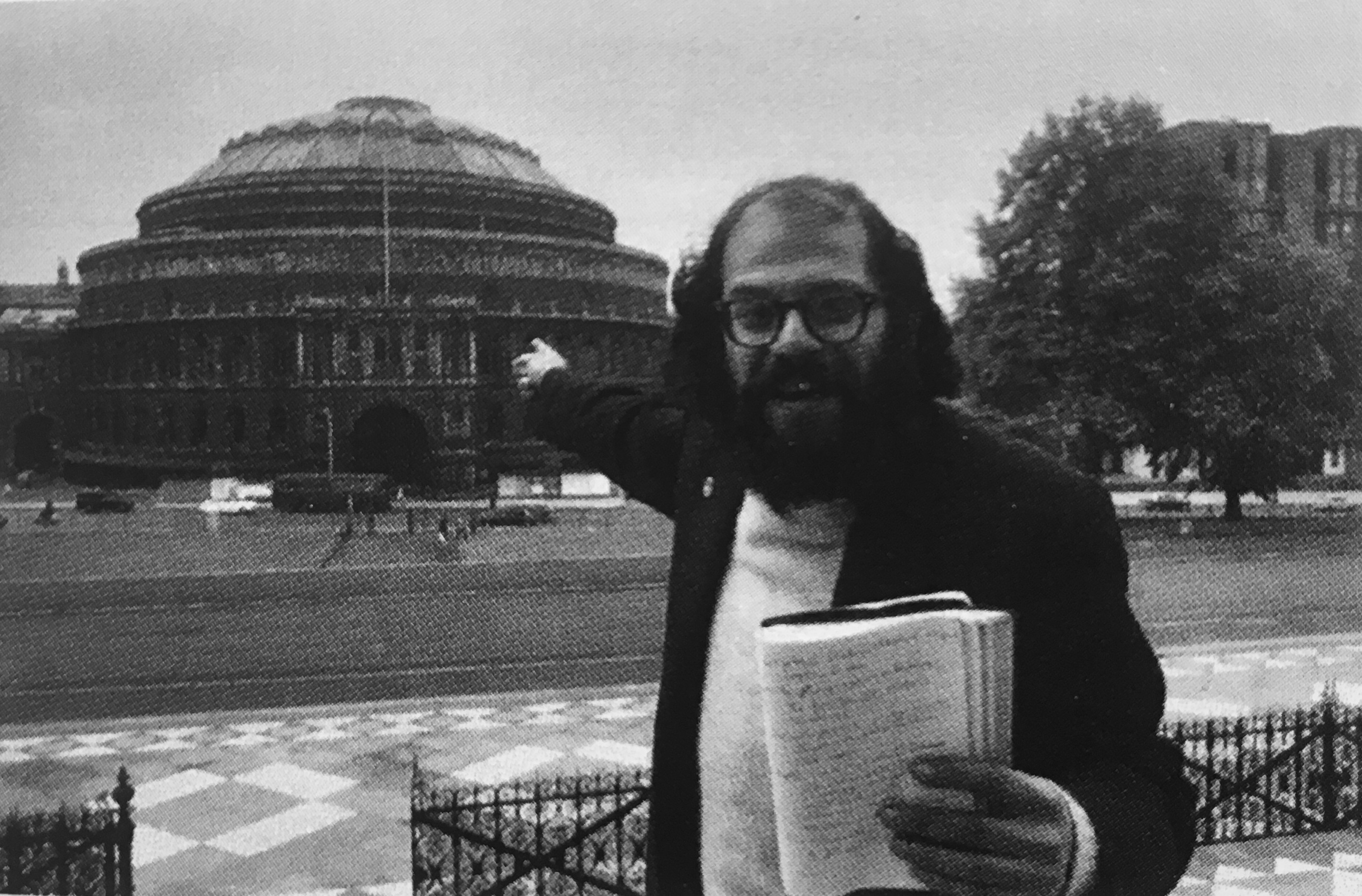
* The photograph of Allen Ginsberg outside the Royal Albert Hall was taken in 1965 by John Hopkins and was used in the poster for the International Poetry Incarnation held on June 11 that year. It’s included in the booklet accompanying Underground London: Art Music and Free Jazz in the Swinging Sixties, which is on él records, via Cherry Red. 

January 20, 2017

us-flagWith three hours to go until the inauguration of Donald J. Trump as the 45th president of the United States, the coffee shop I frequent was playing the Staple Singers’ “Respect Yourself”. That’s a record with a lot of American history in it, one way and another: a message delivered by a mixed group of black and white singers and musicians, showing how music can provide encouragement, comfort and even guidance.

The saxophonist Charles Lloyd and the singer Lucinda Williams have chosen to mark today’s events by releasing an eight-minute version of Bob Dylan’s “Masters of War”, streamable on Spotify here. It was recorded live at the Lobero Theatre in Santa Barbara, California, on November 28 last year, three weeks after the election, with Bill Frisell on guitar, Greg Leisz on pedal steel, Rueben Rogers on bass and Eric Harland on drums. That’s a real A Team, and together they give Dylan’s song the full treatment: harsh, menacing, an ebb and flow of emotions but underneath simmering with rage.

As a teenager in Memphis in the 1950s, Lloyd played with B. B. King, Howlin’ Wolf and Bobby Bland. He is 78 years old now, and has performed in public through 12 presidencies, counting this latest one. “The world is a dog’s curly tail,” he says in the press statement accompanying the release. “No matter how many times we straighten it out, it keeps curling back. As artists we aspire to console, uplift and inspire. To unite us through sound across boundaries and borders and to dissolve lines of demarcation that separate us. The beautiful thing is that as human beings, even under the most adverse conditions, we are capable of kindness, compassion and love, vision and hope. All life is one. Who knows, maybe one day we’ll succeed. We go forward.”

Feat. Bill Frisell

Bill Frisell at home 2There was a time, seven or eight years ago, when I came to the conclusion that Bill Frisell was simply making too many records. I fell out of the habit of automatically buying his new releases because he seemed to be spreading himself too thin. Good Dog Happy Man (1999) and Blues Dream (2001) are still two of my all-time favourite albums, but I tend to prefer him nowadays as a contributor to other people’s records — something to which his particular expertise is well suited. Used sparingly, the characteristics of his playing add texture and flavour, just like King Curtis or Steve Cropper once did.

The job of being an accompanist is much underrated these days, so it’s good to welcome the arrival of two outstanding new albums on which Frisell fulfils that role: first with the saxophonist and flautist Charles Lloyd on I Long to See You and second with singer-songwriter Lucinda Williams on The Ghosts of Highway 20. They’re very different, of course, but they benefit equally from the guitarist’s modest, graceful touch.

When I interviewed him for the Guardian in 2002, Frisell explained a personal evolution that had begun with his first 45, the Beach Boys’s “Little Deuce Coupe”. Then came the Beatles and Manfred Mann — “that’s where I heard the blues for the first time” –followed by the Rolling Stones, John Mayall and the Paul Butterfield band. “I was coming to the blues backwards,” he said, “by figuring out where the English bands were getting a lot of their stuff from.” He may be in his sixties now, but he’s kept a sense of discovery in his music, whatever company he happens to be keeping.

I Long to See You finds Lloyd and Frisell tackling some familiar material, such as the saxophonist’s “Of Course Of Course” and “Sombrero Sam”, and a version of “Shenandoah” that doesn’t quite match the sublime reading Frisell and Ry Cooder contrived on Good Dog Happy Man. The biggest surprise is a resolute instrumental version of Dylan’s “Masters of War”, while the soulful Spanish traditional song “La Llorona”– previously recorded by Lloyd — invites Frisell to display his innate lyricism. Guest appearances by Willie Nelson on “Last Night I Had the Strangest Dream” and Norah Jones on “You Are So Beautiful” are pleasant but not exactly essential.

The track that justifies the album’s existence, however, is its closer, the 16-minute “Barche Lamsel”. Named after a Buddhist prayer, it allows Lloyd (its composer), Frisell and their three bandmates — the steel guitarist Greg Leisz, the bass guitarist Reuben Rogers and the drummer Eric Harland — to improvise a dreamy five-minute intro on a single chord before drifting into a pulse defined by the drums  for a delicately funky jam that would once have been described as “spaced out”.

The concerns of The Ghosts of Highway 20 are more earthly in tone but no less spiritual in nature, if much less comforting. Lucinda Williams’ ravaged voice and bar-room country-blues songs do not trade in reassurance. Her America is a place of wayfaring strangers fleeing the past and seeking refuge from the future. As the poet of this world of lost highways and dangerous glances, Williams is rivalled only by James McMurtry.

Like its predecessor, 2014’s Down Where the Spirit Meets the Bone (which also featured Leisz and Frisell), this one is a two-disc set. The extra length offered by the format would exhaust the capacity of most singer-songwriters, but it seems ideally suited Williams’ temperament. Although her songs are often skeletal, they need to stretch out and breathe inside arrangements that create their own sense of time. On “Louisiana Story” the two guitarists sit either side of the parched voice, carefully picking out a double commentary against a tempo that flows like a thin stream of black treacle.

* The photograph of Bill Frisell is by Monica Frisell.

Zen archer

Charles Lloyd 1There’s a poignant moment during Arrows into Infinity, a new biographical film about Charles Lloyd, when the saxophonist recalls a conversation by the bedside of his old friend and colleague Billy Higgins in 2001. The great drummer, who is close to death, declares that they’ve got to keep working on the music. “He’s like 90lb,” Lloyd says. “I said, ‘Are you going to get off this bed and come back and play with me?’ He said, ‘I didn’t say I’d be there, but I’ll always be with you.'”

Lloyd is a spiritual man, which accounts for his absence from music for several years in the 1970s. In conventional career terms, his withdrawal made no sense. His late-’60s quartet, with Keith Jarrett on piano, had sold plenty of records and made connections beyond the usual jazz audience; they had played the Fillmore and toured behind the Iron Curtain. He had appeared as a guest on recordings by the Beach Boys (Holland, 15 Big Ones, MIU) and the post-Morrison Doors (Full Circle). Nevertheless he chose to drop out, in response to the music industry’s unwelcome expectations. “They wanted me to become a product,” he says in the film. “And to become a product, I would have to be predictable. I wasn’t looking for fame or fortune. I was looking for the zone, the holy grail of music. That was my salvation, because I had heard it and I knew what it was. That was my saviour. It was the light.”

He moved from Malibu to Big Sur, married an artist named Dorothy Darr, and established a different sort of life, his performing for a while largely restricted to playing the oboe at readings by his neighbours Lawrence Ferlinghetti and Gary Snyder. Not until 1980 did the French pianist Michel Petrucciani pay him a visit and entice him back to the public stage. Since then he has re-established himself as an important figure, recording a series of albums for the ECM label, where he was teamed first in a quartet with the pianist Bobo Stenson and then with other partners including Higgins, the guitarist John Abercrombie, the pianist Geri Allen, the tabla master Zakir Hussain and the singer Maria Farantouri.

His current quartet features Jason Moran (piano), Ruben Rogers (bass) and Eric Harland (drums), young men who clearly relish their interaction with a veteran whose sound and ideas become more exquisitely distilled with each passing year. It’s a fine band, a perfect setting for his breadth of vision. Here they are at a French jazz festival in 2011, giving Brian Wilson’s “Caroline, No” a rather different treatment.

Born in Memphis in 1938, Lloyd listened to Lester Young and Charlie Parker as a teenager and played R&B with Howlin’ Wolf and Junior Parker before leaving for Los Angeles. I first heard him as a key member of the Chico Hamilton Quintet of 1962-63, one of my favourite groups of the time. Lloyd wrote virtually all of the group’s material, which — like his own tenor-playing — took its inspiration from John Coltrane’s innovations and marked a fruitful change of direction for Hamilton, away from chamber jazz and towards something more robust. The distinctive flavour of the quintet’s sound came from the guitar of Gabor Szabo, who loved drones and could summon the effect of a sitar, a koto, an oud or a saz, blending particularly well with Lloyd’s flute. They made three albums as a quintet — Drumfusion for Columbia, Passin’ Thru for Impulse and A Different Journey for Reprise — and one as a quartet, Impulse’s Man from Two Worlds, which also included the first version of Lloyd’s “Forest Flower”, which became a hit for his own quartet a few years later.

The recordings with Hamilton are all available on CD, and Passin’ Thru remains one of my favourite albums of the era, not least thanks to the powerful grooves sustained by the phenomenal young bassist Albert Stinson. Here’s a track called “El Toro”, which shows why Stinson was good enough to sub for Ron Carter with Miles Davis and would surely have become a major figure on his instrument had he not died from a heroin overdose while touring with Larry Coryell in 1969, aged 24.

Drugs were another reason why Lloyd dropped out. “I hit a wall and I couldn’t really function,” he says. “At a certain point I began to suffer musically and I began to suffer spiritually. I had to go away.” His studies in philosophy and religion got him through it, with the help of Dorothy Darr, who has produced and directed Arrows into Infinity with Jeffery Morse, gathering historic TV and concert footage from the ’60s (London, Newport, Antibes, Tallinn etc), film of recent performances with the current quartet, and of duets with Billy Higgins, giving us a chance to enjoy again the drummer’s matchless sense of swing and unforgettable smile. There are interviews with Herbie Hancock, Jack DeJohnette, Robbie Robertson, Jim Keltner, Don Was, Zakir Hussain, Geri Allen and many others — including, amazingly, Lewis Steinberg, the original bass player with Booker T and the MGs, who knew the young Lloyd in Memphis. There’s also a delightful sequence of Lloyd playing pool with Ornette Coleman; the two were friends in LA in the ’50s.

Lloyd himself, however, is the most interesting witness to the journey that took him from Howlin’ Wolf to Zakir Hussain. The film tells a fascinating story of survival and self-realisation in which his gentle wisdom is as impressive as his music.

* The photograph of Charles Lloyd is from the booklet accompanying Arrows into Infinity, which is released by ECM.