Skip to content

Posts tagged ‘Cécile McLorin Salvant’

Tension and release

While writing about Nik Bärtsch recently, I mentioned his practice of giving all his compositions the same title — each is called “Modul”, with a distinguishing number attached, thereby establishing no preconceptions in the listener’s mind. In that respect Darcy James Argue, the Canadian-born, New York-based composer, could hardly be more different. In the past, the pieces on his albums with his big band, Secret Society, have variously directed our attention towards an imagined dystopian Brooklyn, a philosopher of ancient Greece and a distinctly realistic dystopian deep state. His latest, a 2CD set called Dynamic Maximum Tension, consists of pieces inspired by specific individuals, ideas and events, bearing dedications clearly signposting their themes, and reflecting those origins in their sound and structures.

This can be almost literal in something like “Codebreaker”, dedicated to Alan Turing, in which the staccato brass phrases evoke the chatter of an Enigma decoding machine, opening up for a lovely soft-toned alto saxophone solo by Rob Wilkerson. Or it can be implied, as in “Tensile Curves”, a multipart work dedicated to Duke Ellington, with seven individual soloists and lasting 35 minutes, which in past times would have been a respectable length for a single long-playing album. It was inspired by the unorthodox extended structure of Ellington’s “Diminuendo and Crescendo in Blue”; there is nothing particularly Ducal about the sound, but he would surely have appreciated the grace with which the piece, having opened with shrill brass fanfares against Jon Wiken’s galloping drums, creates a kaleidoscope of moods before it winds down through a passage featuring Sara Caswell’s hardanger d’amore (a modern Norwegian fiddle with 10 strings, five of them sympathetic), Adam Birnbaum’s sombre piano chords and a Mingus-like passage of collective polyphony, with Sam Sadigursky’s clarinet closing a darkly glowing coda.

More unexpected is “Last Waltz for Levon”, a tribute to Levon Helm — the only member of the Band, of course, who was not Canadian — which summons as much backwoods spirit as a 20-piece band can, with the trombonist Mike Fahle as its featured soloist (over mellow writing for clarinets) and incorporating sidelong quotes from “The Night They Drove Old Dixie Down”, introduced by Mike Clohesy’s bass guitar. Cécile McLorin Salvant pops up to do a turn on “Mae West: Advice”, singing a jolly lyric based on a sort-of-Dadist poem by Paisley Reckdal: Ban tobacco: do bacon abed, be delectable, collectible, a decent debacle. Décolleté don’t conceal; acne, do...

The title of the opening track, “Dymaxion”, is the short form of Dynamic Maximum Tension, the principle on which the engineer-architect Buckminster Fuller, the dedicatee, created his structures, including the geodesic dome before which Argue is standing in the picture above. You can sense in the writing the measured use of tension to ensure that an unreinforced structure retains its shape, while Carl Maraghi’s gorgeous baritone saxophone improvisation reminds us that Fuller worked with people and nature as well as geometric formulae in mind. At times such as this, Argue’s confident manipulation of his resources makes me think that finally someone has taken the theory behind Bob Graettinger’s controversial modernistic Third Steam pieces of the early ’50s (such as City of Glass, written for Stan Kenton) and turned it into actual music.

But out of this densely packed sequence of 11 compositions and 110 minutes of music, “Your Enemies Are Asleep” is the piece that will stay with me longest. Here Argue metabolises his debt to Gil Evans quite brilliantly in the opening passage: a slow, well-spaced string bass figure to set an ominous mood, spare woodwind voicings, a half-concealed bass clarinet beneath lightly sketched brass. Then the bass figure is augmented, the brass becomes a choir, and Ingrid Jensen — another Canadian — enters for a solo which, for the subtlety of its entry and the enthralling development of its trajectory over an increasingly dense and emphatic orchestration, reminds me of nothing less than the way Evans turned “The Barbara Song” into a concerto for Wayne Shorter 60 years ago. Jensen’s improvisation is a masterpiece in its own right: flaring, squeezing, dodging, soaring and fluttering around the contours of the writing. The closing passage is another example of Argue’s gift for ending a piece on a quietly dramatic note of reflection.

Oh yes, and Martin Johnson’s sleeve essay informs us that “Your Enemies Are Asleep” is dedicated to Ukraine’s resistance to Russia’s invasion, its title taken from a 19th century Ukrainian poem set to music by Vasyl Ovchynnikov, a bandura player who disappeared during the Stalinist terror of the 1930s. The notes beyond the notes add another layer of resonance to this outstanding album of completely modern music whose precision — whether of conception or execution — never excludes the human component.

* Dynamic Maximum Tension by Darcy James Argue’s Secret Society is released on the Nonesuch label: https://darcyjamesargue.bandcamp.com/album/dynamic-maximum-tension. The photograph of Argue is by Lindsay Beyerstein.
London Jazz Festival 2: Cécile McLorin Salvant

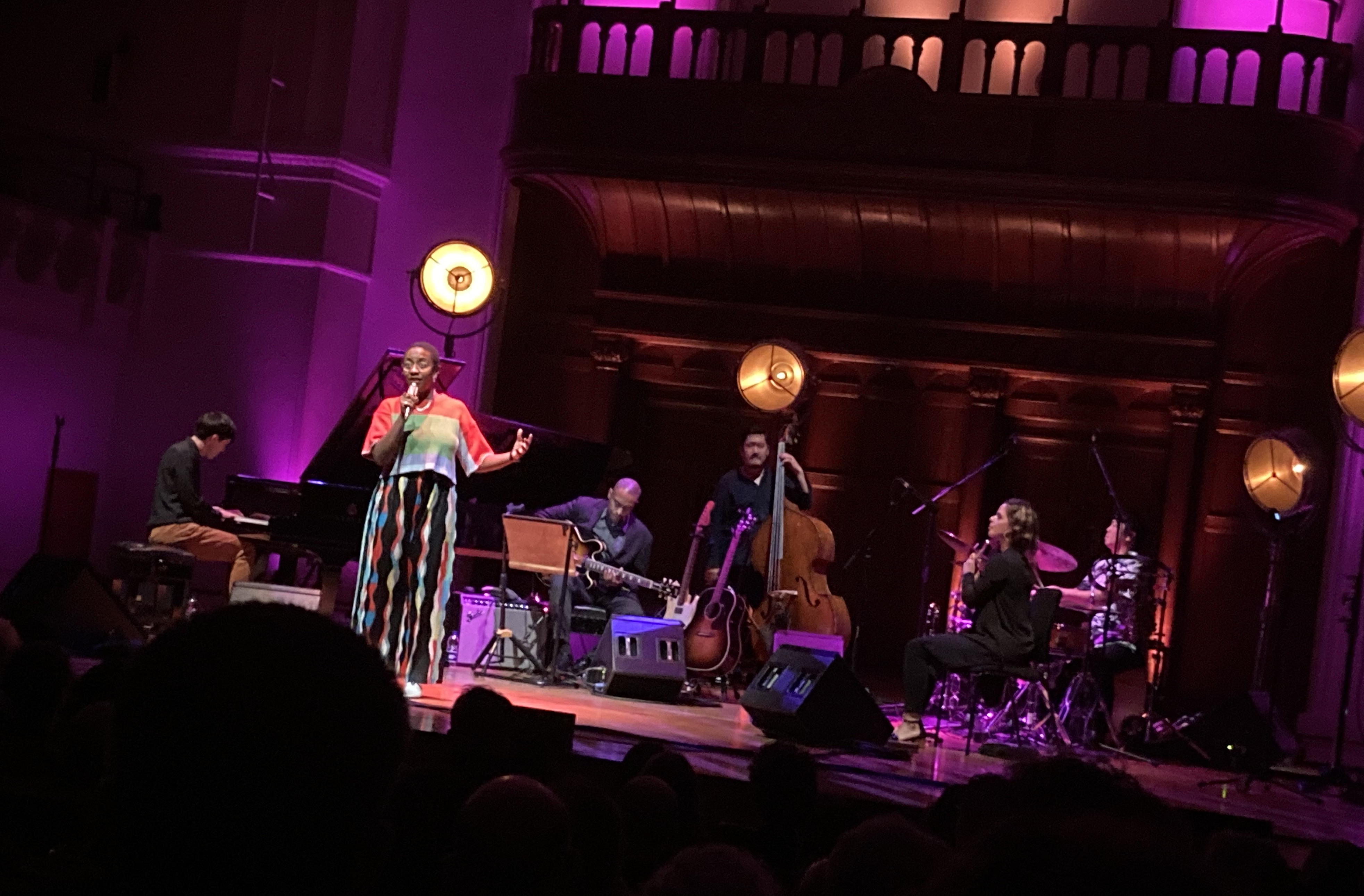
With Grammy awards on her mantelpiece for each of her last three albums, Cécile McLorin Salvant could be cruising. Instead she’s challenging herself and her audience. Listening to her at Cadogan Hall on Tuesday, I was reminded of Rhiannon Giddens: these are women with powerful voices, vast musicality, great curiosity, and a disinclination to opt for the comfortable life that could be the reward for the acclaim both have received in recent years.

For the tour preceding the arrival of her next album, Ghost Song, early next year, McLorin Salvant has jettisoned the familiar support of a jazz piano trio in favour of a kind of chamber quintet featuring flute (Alexa Tarantino), guitar (Marvin Sewell), piano (Glenn Zaleski), bass (Yasushi Nakamura) and percussion (Keito Ogawa). Carefully deployed, the ensemble is flexible enough to cover all the territory she now explores as she expands her range from the basic repertoire of ballads and blues.

Her own songs at this concert included “Fog”, from the 2015 album For One to Love, the new “Thunderclouds”, inspired by Les Enfants du Paradis and finished with a couple of lines from Colette, “Obsession”, from 2018’s The Window, and the haunting “Ghost Song” itself, her voice on its final chorus plaintively joined by that of Tarantino. In these compositions, Broadway theatre music meets art song and the virtuosic inventiveness of Betty Carter meets the emotional focus of Nina Simone.

Her choice of cover versions was intriguing. “I Want to Know” was an ’50s-style R&B song, a 12-bar blues with a bridge, showcasing Sewell’s fine bottleneck playing. Brecht and Weill’s “Pirate Jenny” came from Simone’s repertoire, sung with a teasing lightness. Sting’s “Until…”, from the soundtrack to the 2001 film Kate & Leopold, was interestingly rearranged to culminate in a Latin section featuring fine flute and piano solos. But the biggest surprise came with “Wuthering Heights”, a song I cordially detest in its original version, here slowed and spun into something mesmerisingly beautiful, its gimmicks completely removed in order to facilitate this remarkable transfiguration.

She’s on a journey, just as Cassandra Wilson, a member of a previous generation, was when she moved from the supper-club safety of Blue Skies in 1988 to the uncharted waters of Blue Light ‘Til Dawn five years later, using different instrumentations to tackle Robert Johnson, Joni Mitchell and the Monkees. Even McLorin Salvant herself may not know where her well-stocked mind and innately inquisitive spirit will take her in the coming years, but from the sound of Tuesday’s ovation she will not be alone on the trip.

Extraordinaire: Cécile McLorin Salvant

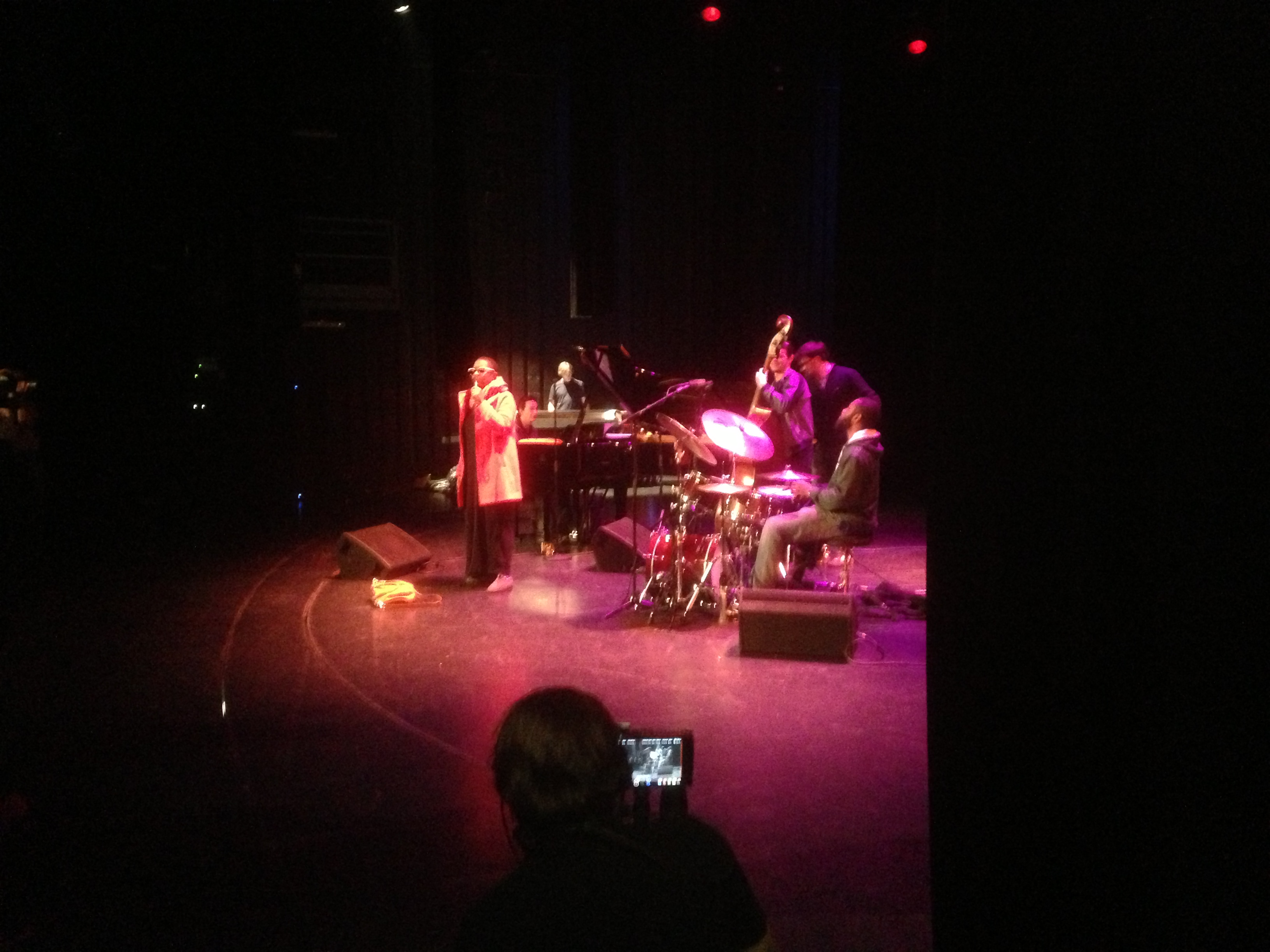
Cécile McLorin SalvantTwo years ago I presented Cécile McLorin Salvant and her trio at the Berlin jazz festival. At that point, most of the audience hadn’t heard of the young Franco-Haitian singer who was brought up in Miami before studying classical and baroque music at the conservatory in Aix-en-Provence. To say they were impressed by her performance would be an understatement.

For me, however, the greater privilege was to be present at her soundcheck, when she ran through two or three songs to get the feel of the hall. Among the pieces she ran down was Cole Porter’s “So in Love”, which happens to be one of my favourite songs, thanks largely to Mabel Mercer’s 1956 version. Still in her overcoat (it can be chilly in Berlin in November, and singers need to be careful), she had me transfixed by the way she drew out the song’s elegance with simple, unaffected directness.

A few hours later, during the concert itself, she gave it a very different delivery: much more highly wrought, full of decoration and elaboration and dynamic contrast, making full use of her phenomenal vocal technique and fine imagination. And it didn’t move me nearly as much.

This, I thought to myself, is a brilliant young artist still discovering and celebrating her own extraordinary abilities. At this stage, it’s natural for her to push everything as far as she can. Come back in 20 years’ time, I concluded, and she’ll be singing “So in Love” the way she did at the soundcheck, with an understanding that sometimes less is more.

Her new album, Dreams and Daggers, has a lot of that exuberance, and you can hear its effect on an audience in the tracks recorded live with the trio at the Village Vanguard in September of last year. There’s an almost audible attentiveness and a lot of whooping when, having executed a breathtaking series of vocal aerobatics, she finally brings a song back to earth.

She’s not a show-off, and she doesn’t scat (thank goodness). She has some of the girlish flexibility of the young Ella Fitzgerald, some of Sarah Vaughan’s ability to manipulate her tone in quietly jaw-dropping ways, and some of Betty Carter’s combination of daring and sheer musicianship. That’s a fair old combination. Occasionally she can overdo it, as in a highly dramatised version of “My Man’s Gone Now”, but most of the time her twists and turns are at one with the material.

Her originality will take time to emerge, but it is certainly there. At the moment it reveals itself most clearly in her choice of material, which is built on a foundation of standards — “You’re My Thrill”, “Let’s Face the Music and Dance”, “Mad About the Boy” and so on — but also includes items intended to prod her listeners in interesting ways, through “Si je serais blanche”, from the repertoire of Josephine Baker, “Somehow I Never Could Believe”, Kurt Weill’s setting of Langston Hughes’s lyric, and the feminist irony that bubbles away in her readings of “Never Will I Marry” and “If a Girl Ain’t Pretty”.

She and her brilliant trio — Aaron Diehl (piano), Paul Sikivie (bass) and Lawrence Leathers (drums) — make a formidable unit, particularly on something like a tightly arranged version of “I Didn’t Know What Time It Was”. There are delightfully insouciant treatments of the two ultra-hip Bob Dorough tunes, “Nothing Like You” and “Devil May Care”, recorded by Miles Davis in 1962.

Half a dozen studio-recorded tracks on this 2-CD set feature a string quartet, arranged by Sikivie to add a welcome astringency. By contrast there’s the singer’s penchant for covering the work of the early classic blues singers: here we get lusty versions of Ida Cox’s “Wild Women Don’t Have the Blues” and Bessie Smith’s haughtily dismissive “Sam Jones’ Blues”. “Don’t need your clothes, don’t need your rent,” she sings, “don’t need your ones and twos. Though I ain’t rich, I know my stitch. I earned my strutting shoes.”

By a distance, she is the most interesting jazz singer to come forward in the past couple of decades. The new album reaffirms the impression that her virtuosity, such a double-edged gift, could take her anywhere.

* Dreams and Daggers is released by Mack Avenue Records on September 29.