Skip to content

Posts tagged ‘Bruce Springsteen’

Too much, too late

Once upon a time there was a phenomenon called the rip-off, a form of commercial exploitation that could be defined as being overcharged for something you really wanted and had to have. I guess that was back in the ’60s. You knew it when you saw it. Now we live in a rip-off culture, where the price of things is calculated not on the cost of the parts plus a bit of profit for the maker and distributor but on what a sufficient number of buyers can be induced to pay.

I’m writing this while wincing from the pain of having parted with £229 for Bruce Springsteen’s Tracks II: The Lost Albums. This, as you may be aware, is a set of seven CDs recorded between 1983 and 2014, six of them conceived and recorded at the same time and one assembled from bits and pieces. I’ve loved Springsteen since reviewing Greetings from Asbury Park, N. J. for the Melody Maker in early 1973, I bought bootlegs like You Can Trust Your Car to the Man With the Star and the Roxy tapes in the early days, and the last of the many times I’ve seen him, at Wembley in the summer of 2024, is a cherished memory. So I was looking forward to hearing these “lost albums” (which, of course, weren’t lost at all, merely filed away in Bruce’s personal tape store).

Their arrival was a bit disconcerting. They came in a container of very large dimensions, carefully packaged up, opening to reveal a box big enough to hold seven 12-inch vinyl albums, never mind seven little silver discs. The reason for the use of the outsized packaging seems to be the inclusion of a large-format 100-page hardback book containing a lot of impressionistic black and white photographs — Fender Esquire headstock, Twin Reverb amp, Bruce on horseback, Bruce on a motorbike, Bruce in the studio — and a series of short essays explaining the making of each of the CDs.

Despite this early evidence of art-director overkill, I was still looking forward to hearing the music. Gradually, though, as I worked my way through the CDs in sequence, it became obvious that their maker had made the right decision to put them on the shelf. There is virtually nothing here that reaches the level of his best officially released music. What it shows most clearly is that he’s written and recorded a lot of songs over the years in his various home studios, and some of them aren’t very good, which is why they were left on the shelf.

That’s most clearly apparent on the first disc, LA Garage Sessions ’83, where he sounds uncomfortably like the guy of limited horizons gently satirised by Prefab Sprout on “Cars and Girls” in 1988. Streets of Philadelphia Sessions is no better: one-paced and somehow enervated. Faithless, commissioned as the soundtrack for an “as-yet unmade” movie, is better: a well-turned essay in Americana with atmospheric instrumentals and lots of acoustic slide guitar and harmonica, a bit like one of Ry Cooder’s soundtracks, or Dylan’s Pat Garrett and Billy the Kid, with a strong song in “My Master’s Hand”, making it an album you can put on and quite enjoy from beginning to end.

Of Somewhere North of Nashville, a quite lavish but ultimately heavy handed production with lots of Soozie Tyrell’s fiddle and Marty Rifkin’s steel guitar, you can only say that if it were a bunch of demos it wouldn’t get him a publishing contract on Music Row, not when the best of the dozen songs is “Poor Side of Town”, written by Johnny Rivers and Lou Adler, here delivered in a version that lacks the charm of Rivers’ original, a No 1 hit on its release in 1966. Bruce’s stab at a Tex-Mex album, titled Inyo, is fresher, but still not really convincing, despite the occasional use of mariachi musicians, the pleasant textures and the attempt to create complex, poetic lyrics; you merely end up wishing he’d make an album with Los Lobos.

The worst, by a distance, is Twilight Hours, his stab at writing and recording a sumptuously upholstered album of saloon songs, laments for lost love glimpsed in the bottom of a whisky glass in a dimly lit cocktail bar while car tyres hiss by in the rain and neon signs glow in the puddles. That sort of thing. When Sinatra patented the genre, he had the benefit of repertoire composed by likes of Sammy Cahn and Jimmy Van Heusen, Harold Arlen and Johnny Mercer, Jerome Kern, Yip Harburg, Richard Rodgers, Lorenz Hart, Jule Styne and Gordon Jenkins — people who could fit together richly chromatic melodies and highly literate lyrics. And just as none of them could have written “Thunder Road” or “Badlands”, so Springsteen couldn’t write “Angel Eyes” or “Violets for Your Furs”. His decision not to release this album six years ago shows that he knew the results were not satisfactory.

The final album, Perfect Days, although cobbled together from various sessions, is paradoxically quite the most coherent of all the discs, with some songs that would have taken their places happily in second-rank Springsteen albums like Working on a Dream or High Hopes. Big and beefy in an E Street Band way, “Another Thin Line” is a fine take on the “Gloria” template, while “The Great Depression” is a particularly attractive strummed ballad.

If you told me that Dylan often leaves great stuff in the vault until it finds its way into a volume of his Bootleg Series, I’d answer that there’s no “Blind Willie McTell”, “Red River Shore” or “Cross the Green Mountain” here. If you were to say that Dylan often tries on costumes, whether for Nashville Skyline or Shadows in the Night, as Springsteen does here, I’d reply that the older artist made important strategic use of those genre-hopping adventures, allowing them to condition the music that came next. Dylan may have recorded “Autumn Leaves”, but he didn’t make the mistake of thinking he could write something like it; instead he used the experience of delivering it to redirect his approach to singing his own songs.

So I dunno. Previous dives into Springsteen’s vaults have delivered excellent official versions of much loved and often bootlegged songs such as “Santa Ana”, “Thundercrack” and “The Promise”. When it comes to this set, I admire him for exercising good judgment when it came to making an initial assessment of the material. I suppose it ought to be interesting to hear the stuff that didn’t work — but at more than 30 quid a disc? I really don’t think so.

Everybody Loves a Train

About twenty years ago, my friend Charlie Gillett was compiling a series of themed CDs for a Polygram label called Debutante, under the aegis of the former Island A&R head Nick Stewart. Charlie asked me if I’d like to put one together, and if so, what the theme might be. “Trains,” I said, after about ten seconds’ thought, and then I went away to assemble a running order. It took a while, because I enjoyed the process so much.

Sadly, the series came to a sudden end before my contribution could see the light of day. But I’d edited together a disc of how I wanted it to go. I called it Everybody Loves a Train, after the song by Los Lobos. It has all sorts of songs, some of which speak to each other in ways that are obvious and not. I avoided the most obvious candidates, even when they perfectly expressed the feeling I was after (James Brown’s “Night Train” and Gladys Knight’s “Midnight Train to Georgia”) and instrumentals, too (see the footnote).

Every now and then I take it out and play it, as I did this week, with a sense of regret that it never reached fulfilment. Here it is, with a gentle warning: not all these trains are bound for glory. Remember, as Paul Simon observes, “Everybody loves the sound of a train in the distance / Everybody thinks it’s true.”

  1. Unknown: “Calling Trains” (From Railroad Songs and Ballads, Rounder 1997) Forty-odd seconds of an unidentified former New Orleans station announcer, recorded at Parchman Farm, the Mississippi state penitentiary, in 1936, calling from memory the itinerary of the Illinois Central’s “Panama Limited” from New Orleans to Chicago: “…Ponchatoula, Hammond, Amite, Independence… Sardis, Memphis, Dyersburg, Fulton, Cairo, Carbondale…” American poetry.
  2. Rufus Thomas: “The Memphis Train” (Stax single, 1968) Co-written by Rufus with Mack Rice and Willie Sparks. Produced by Steve Cropper. Firebox stoked by Al Jackson Jr.
  3. Los Lobos: “Everybody Loves a Train” (from Colossal Head, 1996) “Steel whistle blowin’ a crazy sound / Jump on a car when she comes around.” Steve Berlin on baritone saxophone.
  4. Bob Dylan: “It Takes a Lot to Laugh, It Takes a Train to Cry” (from Highway 61 Revisited, 1965) “Don’t the brakeman look good, mama, flaggin’ down the Double E?”
  5. Joe Ely: “Boxcars” (from Honky Tonk Masquerade, 1978) A Butch Hancock song. Ponty Bone on accordion, Lloyd Maines on steel guitar.
  6. Counting Crows: “Ghost Train” (from August and Everything After, 1993) “She buys a ticket ’cause it’s cold where she comes from / She climbs aboard because she’s scared of getting older in the snow…”
  7. Rickie Lee Jones: “Night Train” (from Rickie Lee Jones, 1979) It was a plane she took from Chicago to LA to begin her new life in 1969, and an old yellow Chevy Vega she was driving before she cashed the 50K advance from Warner Bros ten years later. But, you know, trains.
  8. The Count Bishops: “Train, Train” (Chiswick 45, 1976) London rockabilly/pub rock/proto-punk. Written by guitarist/singer Xenon De Fleur, who died a couple of years later in a car crash, aged 28, on his way home from a gig at the Nashville Rooms. Note that comma. I like a punctuated title.
  9. Julien Clerc: “Le prochain train” (from Julien, 1997) My favourite modern chansonnier. Lyric by Laurent Chalumeau.
  10. Blind Willie McTell: “Broke Down Engine Blues” (Vocalion 78, 1931) Born blind in one eye, lost the sight in the other in childhood. Maybe he saw trains in time to carry their image with him as he travelled around Georgia with his 12-string guitar.
  11. Laura Nyro: “Been on a Train” (from Christmas and the Beads of Sweat, 1970) One song she didn’t do live, as far as I can tell. Too raw, probably.
  12. Chuck Berry: “The Downbound Train” (Chess B-side, 1956) When George Thorogood covered this song, he renamed it “Hellbound Train”. He didn’t need to do that. Chuck had already got there.
  13. Bruce Springsteen: “Downbound Train” (from Born in the USA, 1984) “The room was dark, the bed was empty / Then I heard that long whistle whine…”
  14. Dillard & Clark: “Train Leaves Here This Morning” (from The Fantastic Expedition of Dillard & Clark, 1968) Written by Gene Clark and Bernie Leadon: “1320 North Columbus was the address that I’d written on my sleeve / I don’t know just what she wanted, might have been that it was getting time to leave…”
  15. Little Feat: “Two Trains” (from Dixie Chicken, 1973) In which Lowell George extends the metaphor of Muddy Waters’ “Still a Fool (Two Trains Running)”: “Two trains runnin’ on that line / One train’s for me and the other’s a friend of mine…”
  16. B. B. King: “Hold That Train” (45, 1961) “Oh don’t stop this train, conductor, ’til Mississippi is out of sight / Well, I’m going to California, where I know my baby will treat me right”
  17. Paul Simon: “Train in the Distance” (from Hearts and Bones, 1983) Richard Tee on Fender Rhodes. “What is the point of this story? / What information pertains? / The thought that life could be better / Is woven indelibly into our hearts and our brains.”
  18. Vince Gill: “Jenny Dreams of Trains” (from High Lonesome Sound, 1996) Written by Gill with Guy Clark. Fiddle solo by Jeff Guernsey. Find me something more beautiful than this, if you can.
  19. Muddy Waters: “All Aboard” (Chess B-side, 1956) Duelling harmonicas: James Cotton on train whistle effects, Little Walter on chromatic.
  20. Darden Smith: “Midnight Train” (from Trouble No More, 1990) “And the years go by like the smoke and cinders, disappear from where they came…”
  21. The Blue Nile: “From a Late Night Train” (from Hats, 1989) For Paul Buchanan, the compartment becomes a confessional.
  22. Tom Waits: “Downtown Train” (from Rain Dogs, 1985) “All my dreams, they fall like rain / Oh baby, on a downtown train.” A New York song.

Closing music: Pat Metheny’s “Last Train Home” (from Still Life (Talking), 1987) to accompany the photo of the Birmingham Special crossing Bridge No 201 near Radford, Virginia in 1957 — taken, of course, by the great O. Winston Link. Other appropriate instrumentals: Booker T & the MGs’ “Big Train” (from Soul Dressing, 1962, a barely rewritten “My Babe”) and Big John Patton’s “The Silver Meter Pts 1 & 2” (Blue Note 45, 1963, a tune by the drummer Ben Dixon whose title is a misspelling of the Silver Meteor, a sleeper service running from New York to Miami).

The Ballad of Dennis Hopper

If anyone contained multitudes, it was surely Dennis Hopper. Wild and crazy guy, but also a proper artist. Incarnated the simmering potential of the ’50s, the multicoloured dream of the ’60s, the long scream of the ’70s, and the all-over-the-place uncertainty of the ’80s.

All those movies: not just Rebel Without a Cause, Easy Rider, Apocalypse Now and Blue Velvet but The Trip, The American Friend and Rumble Fish. And the folie de grandeur of The Last Movie. Married to Michelle Phillips for eight days and to Daria Halprin, co-star of Antonioni’s Zabriskie Point, for a little longer. Great photographer, too (he spent so much time with a camera around his neck that his friend nicknamed him “the tourist”). No wonder Mike Scott decided to make a Waterboys album about him.

I took Life, Death and Dennis Hopper on a road trip last weekend and it kept me entertained and fascinated all the way there and back. Its 25 tracks form a mosaic of a life that began in Dodge City, Kansas in 1936 and ended in Venice, California in 2010. “Kansas”, the opening track, is bookended by the sound of a street parade and a departing steam train: the song itself, sung and co-written by Steve Earle, with just the singer’s guitar and Mickey Raphael’s harmonica, is like something from Nebraska‘s country cousin.

Then Scott enters to sing “Hollywood ’55” — the story of Hopper’s arrival in Movieland — against a finger-snapping beatnik swing and we’re into a sequence of snapshots set to era-adjacent music. “Live in the Moment”, about making it, rolls on Mitch Ryder’s Detroit Wheels. “Andy”, referencing his friendship with Warhol, is a smooth uptown pop mix settling somewhere between Broadway and Hollywood & Vine. “The Tourist”, about Hopper and his camera documenting the short life of hippie dream, could be the Strawberry Alarm Clock or H. P. Lovecraft imitating the Jefferson Airplane. “Riding Down to Mardi Gras”, in which Hopper and Peter Fonda make Easy Rider, is a fine piece of outlaw country-rock. And so on, all the way to “Golf, They Say”, a funny song about the late-life experience of Willie Nelson teaching Hopper to swing a club.

But it’s not just a kind of jukebox musical. There are brief interludes — notably five short impressionistic instrumental pieces of contrasting styles and hues, each dedicated to one of Hopper’s five wives — and a couple of recitatives, one a description of the 1967 Monterey Festival in an English posh-hippie voice, the other a parody of an American TV news report of his death.

The two finest individual tracks are the hard-slugging, thick-textured “Ten Years Gone”, referring to Hopper’s lost decade and closing with a passage spoken by Bruce Springsteen, and “Letter From an Unknown Girlfriend”, a painfully stark voice-and-piano ballad in slow waltz time sung and played by Fiona Apple. They’re followed by a snatch of aural hallucination called “Rock Bottom”, evoking the years Hopper spent in the abyss, and then the gorgeous, achingly redemptive “I Don’t Know How I Made It”, somewhat like the Blue Nile covering Blonde on Blonde.

As Scott suggests, you can listen to the tracks indvidually or in any order, but it’s really made to be heard from start to finish, although not in any burdensome or dutiful way. Congratulations to him and his guests and his co-writers and fellow Waterboys, including Paul Brown, James Hallawell, Aongus Ralston, Ralph Salmins and Greg Morrow. It’s a brave thing, executed with flair and imagination.

* The Waterboys’ Life, Death and Dennis Hopper is out now on Sun Records.

Springsteen’s road movie

About halfway through Road Diary, Thom Zimny’s new film of Bruce Springsteen and the E Street Band returning to action in 2023, Patti Scialfa steps forward to talk about the diagnosis of early-stage multiple myeloma she received in 2018. Treatment for the rare form of blood cancer has compromised her immune system and kept her from appearing on stage on all but rare occasions.

And that’s where we’re at. Deep into an eighth decade, with more future behind than ahead. The girl you took to both shows at Hammersmith Odeon in 1975 is dead. Your parents have gone, which — depending on your relationships — may be a loss that doesn’t fade. (Adele Springsteen, who was in her eighties when she sashayed across a stage in her son’s arms to “Dancing in the Dark”, died this year at 94.) Your husband or wife — or you — have health issues. Your kids are suddenly what you once were. And priorities change. But some stuff doesn’t.

That stuff includes the feeling of joy that Springsteen can still bring you, and there’s a big helping of it in Zimny’s 90-minute documentary, which blends together contemporary and archive footage of rehearsals and performances with interviews: Springsteen himself, Steve Van Zandt and the other members of the band, from those now gone — the eternally missed Danny Federici and Clarence Clemons — to recent arrivals, such as the very engaging percussionist Anthony Almonte. And we hear the voices of others, from dedicated fans in Italy, Norway and the UK to his manager of almost 50 years, the erstwhile rock critic Jon Landau, who broadened his cultural horizons while guarding his interests.

Bruce turned 75 this year and he looked a little stiffer as he mounted the short flight of steps to the stage for a Q&A after an advance screening of the film in London last night. He spoke very touchingly about keeping a band together for so long. It’s hard enough with just two guys, he said: Simon hates Garfunkel, Sam hates Dave, Hall hates Oates, Don hates Phil. Can you imagine having four friends at school and then spending every day for the rest of your life with those same guys? That takes some good decisions at critical moments.

The keystones of the 2023 shows were two newer songs: “Last Man Standing”, about the realisation that he is the now last survivor of his teenage band, the Castiles, and “I’ll See You in My Dreams”, the final solo encore, about George Theiss, that band’s other guitarist and singer, who died in 2018. Mortality is more than just the subtext of the film.

Later last night, on Graham Norton’s BBC1 chat show, he was an amiable presence alongside the actress Amy Adams, the singer Vanessa Williams and the comedian Bill Bailey: a very congenial lineup. When he and Bailey got into a discussion about Fender guitars, Norton might have said, “Come on, girls, let’s leave the boys to talk about their hobby.” But then Bruce called Adams “my second-favourite redhead”, which was very sweet and turned this viewer’s thoughts back to Patti. And although we know the outline of that part of the story, the reality of it is theirs alone.

At the screening I was sitting next to Damien Morris, who writes for the Observer. Before the film started we were chatting about Springsteen gigs. He asked me which song that Bruce doesn’t normally play in concert would be the one I’d ask him for, if I had a request. That was easy. “Thundercrack”, which he actually played on his return to Asbury Park in September. But later, when I thought about it some more, there were other answers. “Santa Ana” or “The Promise”. “Rendezvous”, of course. “Wreck on the Highway”. “Brilliant Disguise”. “One Step Up”. “Let’s Be Friends (Skin to Skin)”. There’s so much, isn’t there? All of it resting on the unshakeable twin pillars of “Born to Run” and “Thunder Road”. Such depth and richness.

Or there’s “Fire”. During the film Zimny suddenly cuts to Bruce and Patti on stage together somewhere or other last year, leaning into each other as they croon that song into a single microphone. “Romeo and Juliet, Samson and Delilah / Baby, you can bet, a love they couldn’t deny…” His favourite redhead.

During the Q&A, he was asked how long he saw himself continuing to make music. “Until the wheels fall off,” he said.

* Road Diary is on Disney+ from October 25.

Another night on E Street

The epiphany came early at Wembley last night, only a couple of songs into an unbroken three-hour set. That monster freight train called “Seeds” howled into the stadium, carrying with it all the dread and desolation that can be packed into the repetition of a single word: “Gone… gone… gone…”

I wrote about “Seeds” the last time Bruce Springsteen played Wembley Stadium, so I won’t repeat myself. But something about it moves me in a way I haven’t been moved by rock and roll since Elvis recorded Chuck Berry’s “Promised Land”, finding all of America in a song you could get on one side of a 45.

Last night I wanted it to go on for ever. But there were other good things. “The E Street Shuffle” turning into a soul symphony that made perfect use of the horn section. The way “Land of Hope and Dreams” did the same for the backing singers, with a gospel coda of “People Get Ready”. Steve Van Zandt strapping on a Stratocaster painted to resemble the flag of Ukraine for “No Surrender”. A beautiful “Racing in the Street”, the patina on its bodywork deepening as the decades pass. The Latino trumpets and cowbell turning “Twist and Shout” back into something of which Bert Berns would be proud. The softly spoken introduction to “Long Walk Home”: “This is a prayer for my country.”

It’s a show now, of course, carefully routined and built with the help of high technology to reach a crowd of 50,000 in a sports stadium. But there are still moments when the place goes dark, the spotlight picks up the lone figure at the front of the stage, a harmonica wails, and those opening words — The screen door slams / Mary’s dress sways / Like a vision she dances across the porch / As the radio plays — bring all the magic back to life once again.

Under the same sky

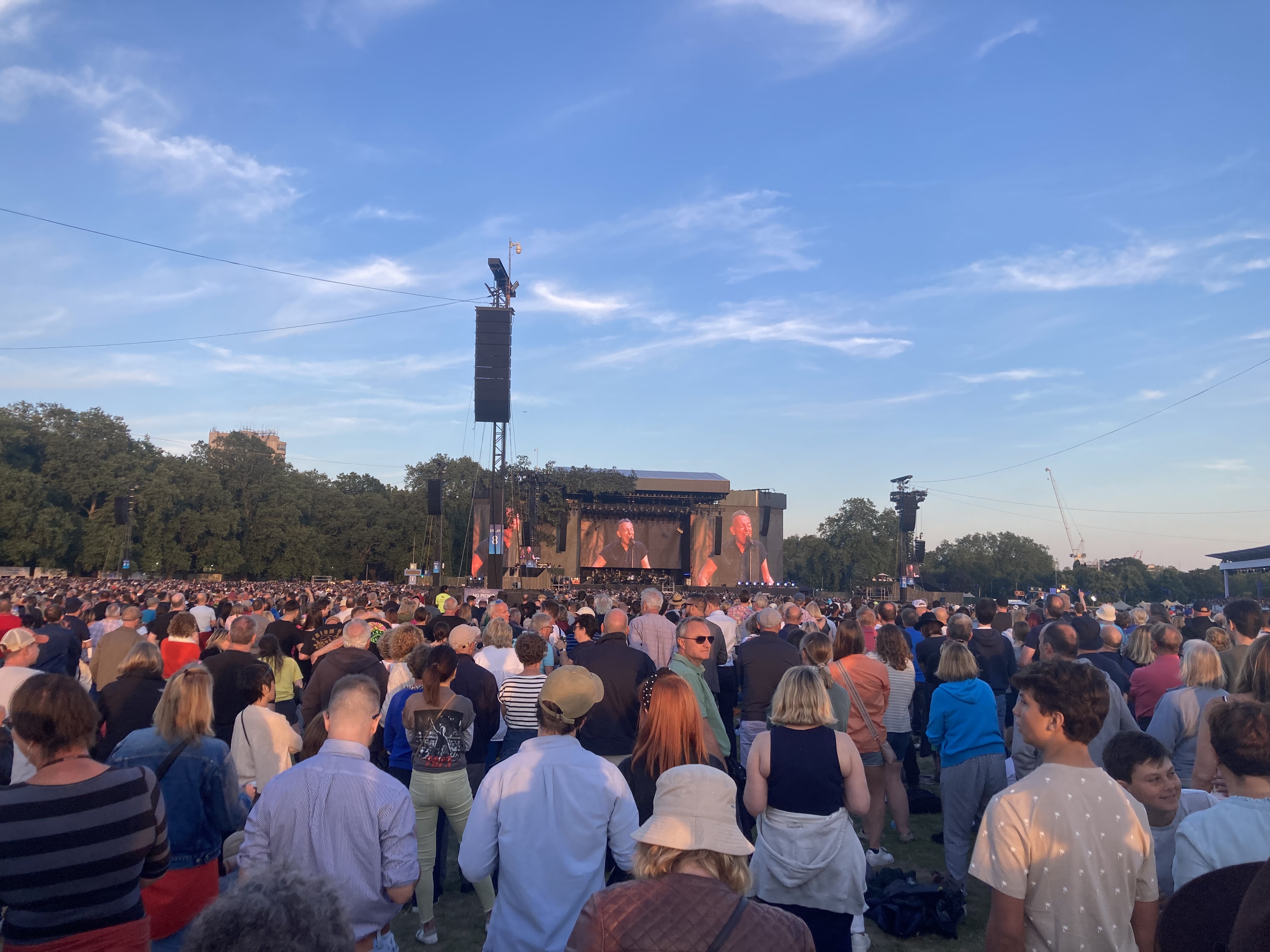
It’s 10 years since the veteran countercultural insurrectionist Mick Farren died. In 1976, in a celebrated polemic for the NME headlined “The Titanic sails at dawn”, he asked: “Has rock and roll become another mindless consumer product that plays footsie with jet set and royalty, while the kids who make up its roots and energy queue up in the rain to watch it from 200 yards away?” I thought of his words while watching — from a range of almost exactly 200 yards, as it happened, albeit on a warm, dry afternoon — Bruce Springsteen and the E Street Band giving the first of their two concerts in Hyde Park.

Farren wrote his piece only seven years after the Rolling Stones had played a free concert in Hyde Park to an audience of perhaps a quarter of a million (although I’ve always questioned that figure): a significant event in the history of both the band and the Sixties youth culture of which it was a part. All you had to do was turn up and find yourself a space on the grass. There were no merchandise stalls, because there was no merchandise. If you wanted anything to eat, drink or smoke, you had to bring it with you.

By contrast, Springsteen’s gigs (and others in the British Summer Time series) were sponsored by American Express. To secure a couple of tickets, even those very far away from the privileged enclosures housing the jet set (and perhaps even royalty), you needed to spend a few hundred quid. In the days leading up to the event, there were messages via a special app telling you what to expect and what you could and couldn’t do, with a map of the site, a list of prohibited items (including food and drink), and so on. And it all worked fine. Pleasant attendants, a variety of refreshment outlets and the provision of adequate toilet facilities made it a civilised experience. The weather was warm but not too hot, and the setting sun provided the golden light that enhances any performance.

Once upon a time Springsteen made concert halls feel like clubs. Then he made stadiums feel like concert halls. At 73 he still performs for three hours with impressive vigour and generosity of spirit (he gives the band a mid-set break rather than taking one himself), but nowadays his big gigs feel like big gigs. That’s the price, I guess, of having such a massive following. But although I liked hearing “Darlington County” and “Mary’s Place” and “Badlands” and “Wrecking Ball”, and enjoyed his decent stab at the Commodores’ “Nightshift”, a lot of the set sounded coarsened, which was not how it used to be. Maybe the band is now so big — all those horns and voices — that the music has lost the agility which was such a vital part of its early charm.

And, of course, from 200 yards, each figure on stage was about a quarter the size of a matchstick. So you watched it all on the big screens. Which, inevitably, were not quite synched with sound travelling such a distance to where I was standing. That was about halfway back in a crowd of 62,000, some of whom said afterwards that it was the best Springsteen show they’d ever seen. In the Guardian, Jonathan Freedland wrote an affecting piece about his reaction to the concert’s valedictory tone and its message for a generation now growing old.

I don’t begrudge anyone their enjoyment in Hyde Park. I’ve seen Springsteen at other times and in other places when the shows he delivered were as good as anything of their kind could possible be. But when I think about the corporate infrastructure of the Hyde Park concerts, and about the row over “dynamic pricing” in the US, and about the stories of what people are having to go through (and spend, of course) to see Taylor Swift on her forthcoming tour, I think Mick Farren’s point was so well made that its meaning has only grown louder over the years.

When he wrote that piece, punk rock was coming down the track. For a while that movement seemed to destabilise the commercial edifice built up around the music. Then the music industry found ways to reassert its authority, to globalise its product while building an impenetrable wall around it. Whatever the instincts and virtues of Springsteen, Swift and others, however immaculate and sincere, their gigantic tours are now an expression of that authority.

I’m probably sounding naive, because in a sense it’s nothing new. At the time of their free concert in Hyde Park, the Stones were managed by Allen Klein, the American hustler whose involvement was emphatically not motivated by countercultural concerns. Mick Farren also wrote books about Elvis Presley, and he knew perfectly well that Colonel Tom Parker didn’t care about Elvis’s audience or the culture they represented. He cared about making a buck.

Revisiting Eric Burdon

Eric Burdon 1

The memory of hearing Eric Burdon sing “House of the Rising Sun” with the Animals at the Odeon, Nottingham one summer night in 1964 — a week or two before it was released as a single — is as clear as yesterday. In some ways it was the precursor of a new kind of rock music. But to Burdon, as he explains in a new biographical documentary shown on BBC4 this weekend, it meant something different. When Alan Price, the group’s organist, took credit for the words (traditional) and the arrangement (borrowed by Bob Dylan from Dave Van Ronk), it damaged the singer’s faith in music as a collective endeavour: all for one and one for all.

Luckily, although the animosity towards Price is still burning fiercely more than half a century later, it didn’t cause Burdon to end his career. As Patti Smith, Bruce Springsteen and Steve Van Zandt testify in the programme, post-Price Animals hits like “We Gotta Get Out of This Place” and “It’s My Life” were nothing short of inspirational to the next generation. But as the decades went by, there was always a sense that Burdon, one of the great English R&B voices of the ’60s, never quite recaptured the same level of fulfilment.

The hour-long Eric Burdon: Rock and Roll Animal, directed by Hannes Rossacher, is a co-production by the BBC with ZDF and Arte. There are interesting passages on his apprenticeship at the Club A Go Go in Newcastle, his relationship with Jimi Hendrix, his time in San Francisco and his collaboration with War — who dumped him, he claims, because he was the white guy in the band (there was actually another, the harmonica-player Lee Oskar). There’s quite a lot of stuff about his 50-odd years of living in California, and we see him cruising through the desert in some ’70s gas-guzzler or other.

We leave him, weathered but unbowed, with his new American band — new in 2018, anyway, when the film was made — preparing to record an album. He sings “Across the Borderline”, the great song written in 1981 by Ry Cooder with Jim Dickinson and John Hiatt for the soundtrack of Tony Richardson’s The Border, a film about immigrants. Originally sung by Freddie Fender, it subsequently found its way into the repertoires of Springsteen, Bob Dylan, Jackson Browne and Willie Nelson. It suits Eric Burdon just fine.

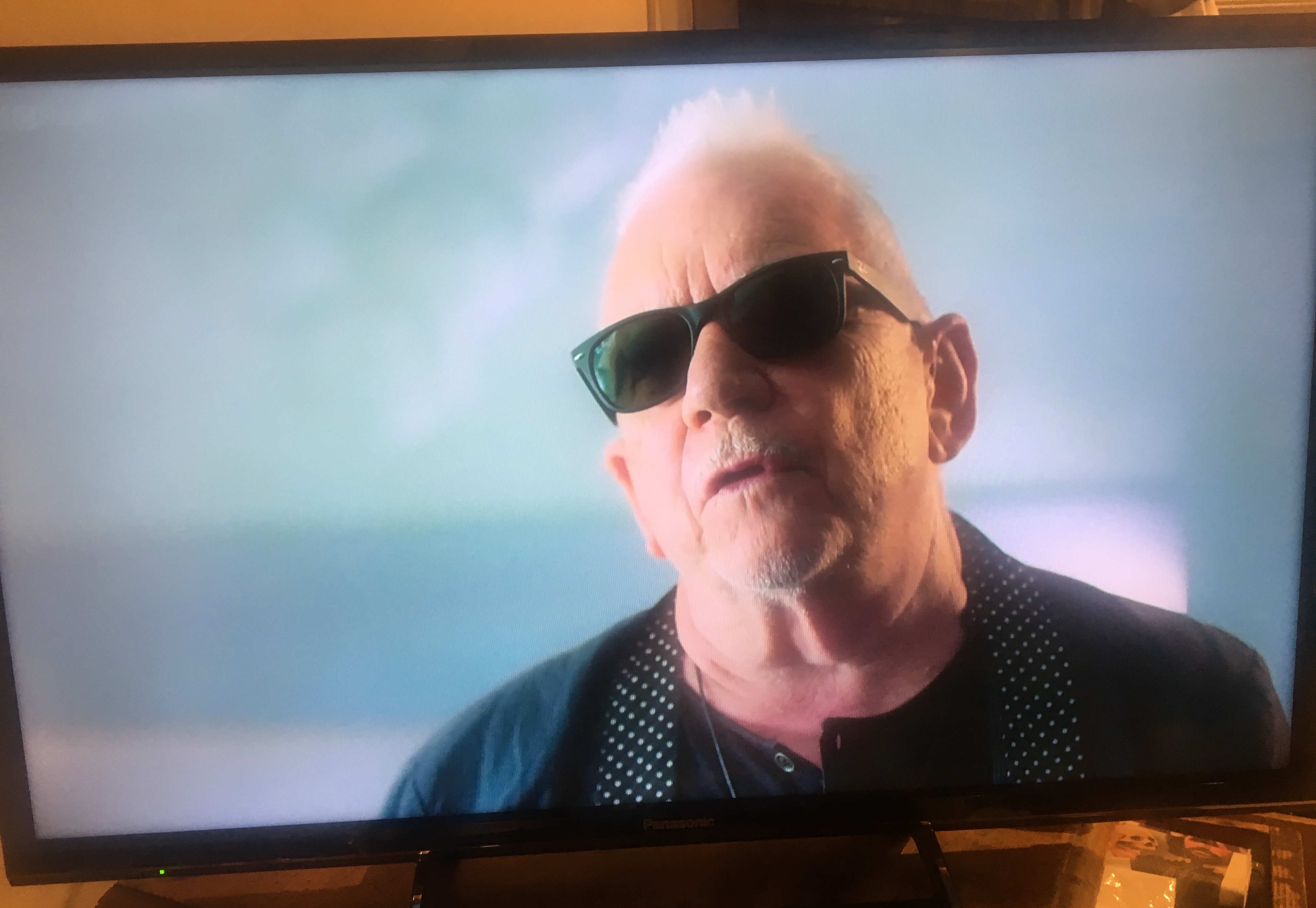
* The screen-grab is from Eric Burdon: Rock and Roll Animal, which can be watched on BBC iPlayer until the end of March.

Seeing ‘Western Stars’

Western Stars

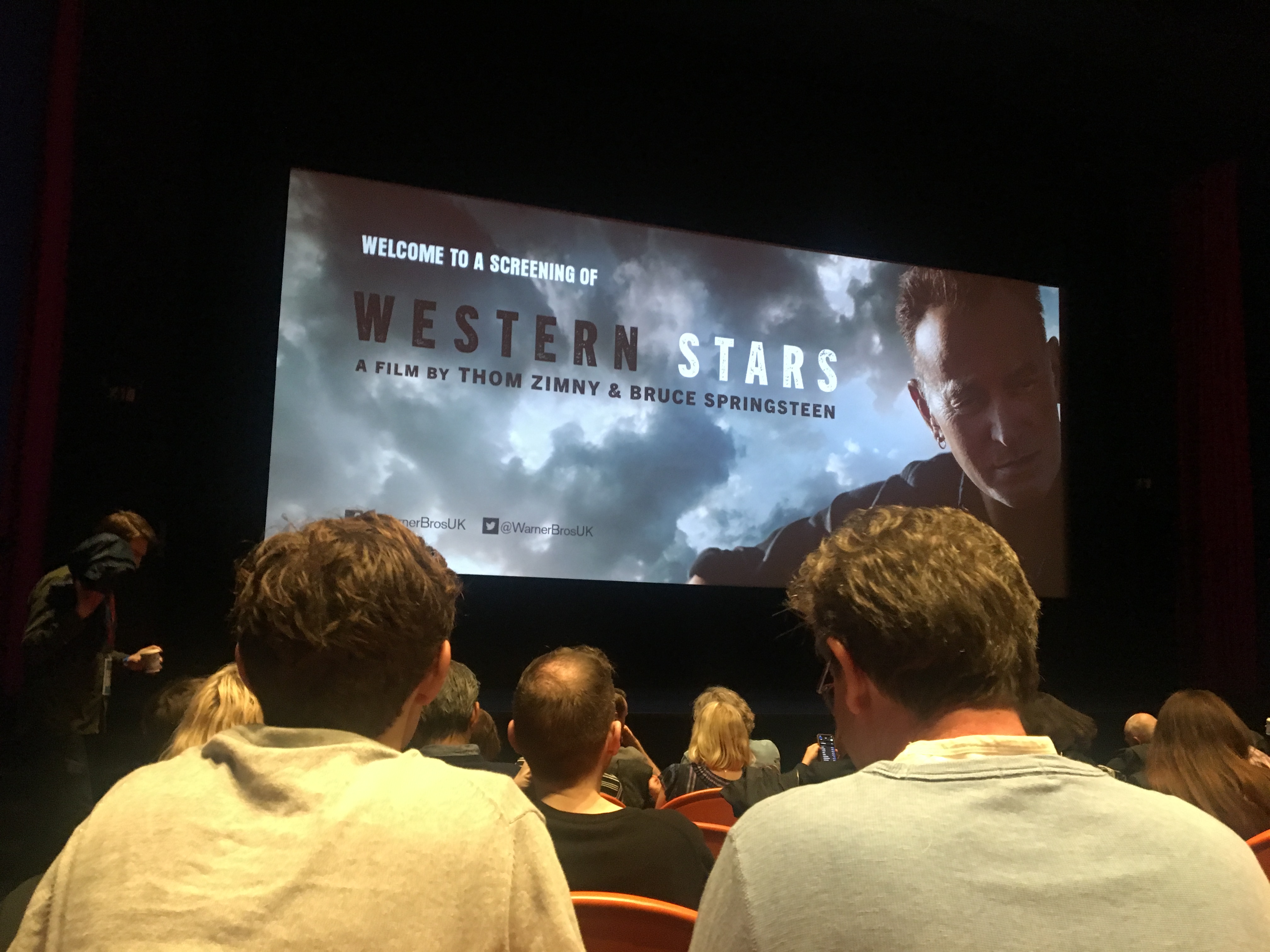
“This is my 19th album,” Bruce Springsteen says towards the beginning of the film Western Stars, “and I’m still writing songs about cars.” But then he excuses himself by explaining how cars can become a metaphor for all kinds of things, including travelling without getting anywhere.

Western Stars is a performance film, but much more than that. Recorded over two days in front of a small audience in the hayloft of the 19th century wooden barn on his property in New Jersey, it features the 13 songs from the recent album of the same name, played by around 30 musicians: a basic band of various guitars, keyboards, bass and drums, plus two trumpets, two French horns, a string orchestra of violins, violas and cellos, and four or five female backing singers, discreetly directed by the album’s orchestrator, Rob Mathes.

There are a few differences from the album versions, but the sound of Bob Clearmountain’s mix is so close to the lush Californian warmth of the original recordings that I found myself frequently checking for signs that the musicians were miming. An inability to spot anyone playing the glockenspiel part on “Drive Fast” provided the only evidence that post-production work had been undertaken.

Having seen the trailer, I worried in advance that the film — directed by Springsteen with his long-term collaborator Thom Zimny — would include too much footage of wild ponies cantering in slow-motion through desert landscapes beneath spectacular open skies, close-ups of silver and turquoise jewellery on weathered hands, and El Camino pick-ups raising dust on long, lonesome dirt roads. There’s some of that, particularly in the early sequences, but the visual clichés recede as more serious matters come to the fore in what Springsteen calls “interstitial material”, the snatches of home movies and found footage with voiceovers in which he introduces the songs and reflects on their themes of life, love, loss and longing.

On the face of it, the songs on Western Stars aren’t about Springsteen. One protagonist is a stuntman, another a fading movie actor. But, as he said during a Q&A session that followed the screening I attended this morning, “When I write a song in character, it’s a way of exploring your own life and struggles.”

After feeling initially indifferent towards much of the album, it came as a surprise to discover how rewardingly the film illuminates their qualities, both via Springsteen’s commentary and the performances. “Sleepy Joe’s Café” was a song I quite disliked until seeing it contextualised in a social setting. “Somewhere North of Nashville” acquires greater depth. “Stones”, sung as a duet with Patti Scialfa, his wife of 30 years, is now almost unbearably moving in its evocation of the undercurrents of a long marriage. (“I should have had Patti on the record,” Springsteen said during the Q&A.)

The songs I already liked gain a new lustre. “Moonlight Motel” adds a couple more shades of gorgeous soul-weariness. The soaring “There Goes My Miracle” is introduced with a rumination on “losing the best thing you ever had — the perfect formula for a pop song.” Or maybe it was “the formula for a perfect pop song”, which it is. Watching the string players tear into it with such joy, I thought of how I’ve always believed the special E Street secret is making every person in the audience feel as though they’re up on stage, playing in the band, sharing that special exhilaration; this lot made me wish I’d carried on with violin lessons.

* This weekend’s London Film Festival screenings of Western Stars are sold out. It will be in cinemas around the UK on October 28, three days after the release of the soundtrack album.

California dreams

california_greetings_from_us_states_postcard-r5368607368ea442aa47a55bde0b3e6f7_vgbaq_8byvr_540

There was no law preventing Bruce Springsteen from making a California-themed album, and Western Stars seems to have received a generally warm reception for its ballads of longing and regret, laden with strings, banjos and steel guitars. For myself, I find it a little bit soupy in texture, predictable in content and lacking in energy. I’ll probably be listening to “Moonlight Motel”, “There Goes My Miracle” and the title track occasionally in the future, but to these ears it’s his least distinguished work since the Human Touch / Lucky Town dual release in 1992, and far behind other non-E Street Band solo albums such as Nebraska, Tunnel of Love and The Ghost of Tom Joad.

Its arrival did have one unexpected benefit. While pondering the list of artists and songwriters that he presented as having provided direct inspiration for the project, I pulled out a couple of albums recorded in Los Angeles half a century ago by the singer Johnny Rivers, mostly because the first of them — Rewind (1967) — includes several songs by Jimmy Webb, one of the names Springsteen mentioned. The second album — Realization (1968) — has no Webb songs, but it does have a feeling of continuity with its predecessor.

Born John Ramistella in the Bronx in 1942, Rivers might easily have become one of those Italian American pop singers who found fame in the early ’60s: a rival to Dion DiMucci, John Mastrangelo (Johnny Maestro), and Francesco Castelluccio (Frankie Valli). Instead he moved with his parents to Baton Rouge, Louisiana as a child, absorbing the local R&B and rock and roll sounds as he grew up and became a guitarist. Having changed his name at the behest of Alan Freed, he moved to Los Angeles at the end of the ’50s, working as a songwriter before Lou Adler had the brainwave of recording his nightclub act at the Whisky à Go Go, where his repertoire — with a stripped-down trio completed by Joe Osborn’s bass and Eddie Rubin’s drums — included songs like Chuck Berry’s “Memphis, Tennessee” and Willie Dixon’s “Seventh Son”, both of which became hit singles for him.

Rivers was a good songwriter (“Poor Side of Town”, his self-penned 1966 hit, is a beauty) but a better interpreter; whatever the material, he retained a kind of plaintive honesty. Rewind and Realization show him grappling with a broader range of material, from Motown songs (“Baby I Need Your Lovin'”, “The Tracks of My Tears”) to Paul Simon’s “For Emily, Whenever I May Find Her” and Oscar Brown Jr’s “Brother, Where Are You”, as well as demanding Webb songs such as “Rosecrans Blvd” and “Sidewalk Song (27th Street)”. With arrangements by Webb and Marty Paich and great playing from the Wrecking Crew, the two albums form a fine snapshot of an artist getting to grips with material from songwriters exploring the new ways of living, thinking and behaving.

Out of the two albums, I selected four tracks to create what I think of as a perfect summer EP. The first is Webb’s “Do What You Gotta Do”; there will be those who prefer the later readings of this sublime song by the Four Tops, Nina Simone or even Roberta Flack, but I like this one for its conversational understatement. The second is “Positively 4th Street”, which Dylan names in Chronicles Vol 1 as his favourite cover of one of his songs, perhaps because Rivers took a gentler approach to the song’s bitter invective than the man who wrote it. The third is “Summer Rain”, a great piece of orchestral folk-rock written by James Hendricks, a former Mugwump (with Mama Cass, John Sebastian and Zal Yanovsky) and a regular collaborator with Rivers. The fourth is Rivers’ own “The Way We Live”, in which he takes the sound and cadences of “Positively 4th Street” — particularly Larry Knechtel’s Al Kooperish B3 — and applies it to his own thoughtful meditation on life in America as the decade turns sour.

I suppose I can see what Springsteen was getting at when he namechecked Webb, particularly if he was thinking of the hits the songwriter provided for Glen Campbell: “By the Time I Get to Phoenix”, “Wichita Lineman” and “Galveston”, with their powerful sense of geographical and emotional distance. (It was Rivers, as it happens, who took “Phoenix” to Campbell, having recorded the first version of it on an album already overloaded with hit singles.) More so, anyway, that Burt Bacharach, also on Springsteen’s list, whose chromatic melodies, sophisticated harmonies and games with metre are about as far from Bruce’s basic bluecollar style as you could get within the same general idiom.

I’m going to give Western Stars a few more spins in the coming days, but at the moment those four Rivers tracks are the ones I can’t get out of my head. And I’ll be thinking of the night in London in the spring of 1973 when he turned up at the Valbonne, a Mayfair discothèque, to promote his latest album by playing an early-evening showcase set with an A Team line-up consisting of Chuck Findley on trumpet, Jim Horn on saxophones, Dean Parks and Herb Pedersen on guitars, Mike Melvoin on keyboards, Jack Conrad on bass and Jim Gordon on drums. Few of us who were there will forget a storming show that, of its kind, rivalled Van Morrison’s Caledonia Soul Orchestra at the Rainbow the following month and wouldn’t be bettered until Springsteen turned up at Hammersmith Odeon with the E Street Band two years later — which is saying something, for all concerned.

Greetings from Asbury Park

ASBURY PARK_QUAD ARTWORK

There are many heroes in Asbury Park: Riot, Redemption, Rock & Roll, a documentary film in which the writer/director Tom Jones explores the musical history of the New Jersey beach resort. Bruce Springsteen, Steve Van Zandt and Southside Johnny Lyon top the bill, but the list also includes David Sancious and Ernest “Boom” Carter, respectively the organist and drummer with early editions of the E Street Band, who provide eloquent accounts of the music to be heard in the clubs and bars of the town’s West Side, where the black population lived.

Springwood Avenue was the West Side’s main stem, and the Orchid Lounge was where great music was heard (Carter mentions Grant Green, Jimmy McGriff, and many others). The cross-community synergy between West and East was important in the development of the music for which, in the wake of Springsteen’s success, Asbury Park eventually became internationally famous, but it had come to an end in 1970, when a riot over the Fourth of July weekend saw 75 per cent of the businesses on Springwood Avenue burned to the ground, never to be rebuilt.

The riot — eventually suppressed by the arrival of state troopers — expressed the desperation of people who felt they had nothing. Tragically, and as is so often the way, the principal victim of their demonstration was their own community. The film ends on an upbeat note, looking at the current activities of the Lakehouse music academy and studio, where very young musicians are given a chance to learn, to play and to perform, but it cannot pretend that the grievances which erupted almost 50 years ago have been properly addressed.

Springsteen, Van Zandt and Lyon speak with great fondness about what the place gave them, by enabling them to immerse themselves in the world of music. Unlike Dylan and the Beatles, Springsteen says, those who learnt their trade in the Asbury Park bar bands were not musical revolutionaries: they were alchemists, he says, taking bits from all over the place — soul, R&B, Elvis and Little Richard, the British Invasion — and turning it into something of their own. He and his old friends speak with a warmth that is as powerful a defining characteristic of their music as any stylistic element.

The film shows us important venues including the Convention Hall (where the Who shared a bill with Herman’s Hermits and the Blues Magoos), the Upstage Club (where, because it lacked a liquor licence, teenagers could congregate to play and listen) and the Stone Pony (made famous by Southside Johnny and Miami Steve). At the screening I went to, it finished with 20 minutes of a recent fund-raising concert at which practically everybody who ever played in an Asbury Park bar band gathered on stage to run through cheerfully chaotic versions of “Johnny B. Goode”, “Bye Bye Johnny”, and — at Springsteen’s behest — “Lucille”, in the great Everly Brothers arrangement.

The director both excavates the Asbury Park legend and polishes it up a bit. And why not? As Springsteen remarks: “Everything’s broken. We are the fixers of broken dreams.”

* The film was shown on Wednesday of this week at various cinemas in London. There seems to be a screening on May 25 in Liverpool, and there may be others.