Skip to content

Posts tagged ‘Bob Dylan’

Young but daily growing

It was difficult to tell what song he wrote and what song he didn’t write, because sometimes I noticed that he said he wrote a song and he didn’t, and other times I thought he didn’t write a song and he did.

Those words have been in my head while listening to the eight CDs and 139 tracks of Through the Open Window, the 18th volume of Bob Dylan’s Bootleg Series, which arrived a couple of weeks ago. A quote from his boyhood friend John Bucklen, it’s a perceptive early observation about Dylan’s approach to making music: a process of listening, absorbing, blending, modifying and recombining in which borrowed and created materials become one and become new. For him, that’s been a permanent process since he first tuned in to the radio and heard Little Richard.

This new set covers his early years. It begins in 1956 with a 15-year-old schoolboy in Minnesota, taping songs with his pals, and ends in 1963, when he’s standing on the stage at Carnegie Hall, in front of a full house, a 22-year-old at the apogee of his first incarnation, feeling the warm glow of real fame.

I don’t know whether or not it’s the “best” volume of the series to date, but it certainly fills me with a powerful set of emotions. While listening to it, I sent an old friend a message saying that it made me realise how lucky I’d been to live my life alongside his. I’m six years younger than Dylan, so I was 16 when I first heard Freewheelin’ in 1963; for members of my generation who discovered him early, he’s been a unique kind of companion, and still is. Through the Open Window does a good job of showing how that came about.

Over about eight hours, we see continuous progression, evolution, growth. We hear Dylan honing his art as an interpreter of the hellhound-haunted blues (a clenched “Baby Please Don’t Go”, “Fixin’ to Die”, “See That My Grave Is Kept Clean”), hooking his young boho audiences with protest ballads based on specific stories (the incendiary “Emmett Till”, the rousing “Davey Moore”, the plodding “Donald White”), playing harmonica with blues elders Victoria Spivey and Big Joe Williams on Spivey’s album Three Kings and a Queen, practising singing in an older person’s voice and inhabiting traditional material with an astonishing level of empathy (“Young But Daily Growing”, “House Carpenter”, “Moonshiner”, the transcendent 1962 Gaslight version of “Barbara Allen”), and carefully building his own legend (“Bob Dylan’s Blues”, “Bob Dylan’s Dream”, “Bob Dylan’s New York Rag”).

You hear how the droning blues jams — and perhaps the influence of John Lee Hooker, with whom he shared the bill at his first significant New York booking, at Gerdes Folk City in April 1961 — inform a certain strand of songs he soon began to write: “The Ballad of Hollis Brown”, “North Country Blues”, “Masters of War”. Songs about bleak, blasted landscapes, both external and internal. When I listened to those songs in 1963-64, I’m sure that somewhere in my mind I was making a connection with what John Coltrane was doing at the same time. Not a literal connection; something beyond that, to do with stretching structures to fit the times we were living in. A year later, and just beyond the time-frame of this set, that strand of songwriting would lead Dylan to the unsurpassable achievement of “It’s Alright, Ma (I’m Only Bleeding)”.

All this comes through loud and clear on a set thoughtfully assembled by the writer Sean Wilentz (who contributes an impeccable essay to the accompanying hardback book) and the veteran producer Steve Berkowitz, particularly in the performances recorded in friends’ homes and small clubs. We hear Dylan trying things out: using humour to beguile his listeners, sometimes telling tall stories to embellish his myth but also unafraid to acknowledge his sources. Introducing “Tomorrow Is a Long Time” — still a work in progress — into a tape recorder at the home of his friend Dave Whitaker in Minneapolis in August 1962, he seems to drop his guard: “My girlfriend, she’s in Europe right now, she’s sailed on a boat over there and she’ll be back September 1st, but till she’s back I never go home and it gets kind of bad sometimes. Sometimes ir gets bad, most times it’s doesn’t. But I wrote this specially thinking about that.”

Suze Rotolo, the “girlfriend” in question, is a presence in many of these songs. She was also an unheard presence in the tender version of “Handsome Molly” recorded at Riverside Church on the Saturday afternoon in July 1961, which is when they first met (“He comes from Gallup, New Mexico,” the MC tell us). The accompanying book contains some lovely outtakes from Don Hunstein’s Freewheelin’ cover shoot in the snow on Jones Street to go with the outtakes from the recording sessions; an astounding “Ramblin’ Gamblin’ Willie” seems to be setting him off on the path that led a dozen years later to “Lily, Rosemary and the Jack of Hearts”.

A few of the selections are notable more for their historical interest than their musical value, which is fine. They’d include the very first track, a snatch of Shirley and Lee’s “Let the Good Times Roll” recorded with Bob on piano and his friends Larry Keegan and Howard Rutman joining him on vocals in a St Paul music shop in 1956; the surviving fragment of “The Ballad of the Gliding Swan” from his first visit to London in early 1963, engaged to appear in the TV play Madhouse on Castle Street for the BBC; and the versions of “Only a Pawn in Their Game” and “Blowin’ in the Wind” performed at the SNCC voter registration rally in Greenwood, Mississippi in the summer of 1963.

The live recordings include extended extracts from his most significant early New York concerts, including the poorly attended Carnegie Chapter Hall on November 4, 1961 and the sold-out Town Hall show on April 12, 1963. It all leads — and I firmly recommend listening to the set in sequence — to two CDs devoted to the complete Carnegie Hall concert of October 26, 1963, in which the dimensions of his talent are fully revealed.

He comes to the concert while putting the finishing touches to his third album, The Times They Are A-Changin’, which won’t be released for another three months. So the audience is unfamiliar with some of these songs. He hits them straight off with the title song, then “Hollis Brown”, “Boots of Spanish Leather”, “North Country Blues”. There are great new songs that won’t be officially released: “Lay Down Your Weary Tune”, “Seven Curses”, “Percy’s Song”, “Walls of Red Wing”. When he talks, he’s charming and confident and tells some funny stories and in this formal setting he achieves the kind of audience rapport he’d worked hard to establish at the Gaslight or Gerdes, drawing sympathetic laughter when he has trouble with his microphone and mid-song applause when, in “Davey Moore”, he sings about boxing being banned by the new Cuban government (temporarily, as it turned out).

And he finishes with this sequence: “With God on Our Side”, “Only a Pawn in Their Game”, “Masters of War” (that one being from Freewheelin’, of course), “The Lonesome Death of Hattie Carroll” and “When the Ship Comes In”. Just imagine hearing four of those songs for the first time in that climactic five-song fusillade of rage and revelation. The controlled intensity of his delivery comes through as powerfully as it must have done that night. It’s electrifying, even at more than 60 years’ distance.

Here are some lines he wrote as part of a long poem for the sleeve of Peter, Paul and Mary’s album In the Wind, the one that included “Don’t Think Twice, It’s Alright”, “Quit Your Lowdown Ways” and “Blowin’ in the Wind”, released in 1963:

Snow was piled up the stairs an onto the street that first winter when I laid around New York City / It was a different street then — / It was a different village — / Nobody had nothin / There was nothin t get / Instead a being drawn for money you were drawn / for other people —

It is ‘f these times I think about now — / I think back t one a them nites when the doors was locked / an maybe thirty or forty people sat as close t the stage as they could / It was another nite past one o clock an that meant that the tourists on the street couldn’t get in — / At these hours there was no tellin what was bound t happen — / Never never could the greatest prophesizor guess it — / There was not such a thing as an audience — / There was not such a thing as performers — / Everybody did somethin / An had somethin to say about somethin —

Most of all him. And it’s all here.

Everybody Loves a Train

About twenty years ago, my friend Charlie Gillett was compiling a series of themed CDs for a Polygram label called Debutante, under the aegis of the former Island A&R head Nick Stewart. Charlie asked me if I’d like to put one together, and if so, what the theme might be. “Trains,” I said, after about ten seconds’ thought, and then I went away to assemble a running order. It took a while, because I enjoyed the process so much.

Sadly, the series came to a sudden end before my contribution could see the light of day. But I’d edited together a disc of how I wanted it to go. I called it Everybody Loves a Train, after the song by Los Lobos. It has all sorts of songs, some of which speak to each other in ways that are obvious and not. I avoided the most obvious candidates, even when they perfectly expressed the feeling I was after (James Brown’s “Night Train” and Gladys Knight’s “Midnight Train to Georgia”) and instrumentals, too (see the footnote).

Every now and then I take it out and play it, as I did this week, with a sense of regret that it never reached fulfilment. Here it is, with a gentle warning: not all these trains are bound for glory. Remember, as Paul Simon observes, “Everybody loves the sound of a train in the distance / Everybody thinks it’s true.”

  1. Unknown: “Calling Trains” (From Railroad Songs and Ballads, Rounder 1997) Forty-odd seconds of an unidentified former New Orleans station announcer, recorded at Parchman Farm, the Mississippi state penitentiary, in 1936, calling from memory the itinerary of the Illinois Central’s “Panama Limited” from New Orleans to Chicago: “…Ponchatoula, Hammond, Amite, Independence… Sardis, Memphis, Dyersburg, Fulton, Cairo, Carbondale…” American poetry.
  2. Rufus Thomas: “The Memphis Train” (Stax single, 1968) Co-written by Rufus with Mack Rice and Willie Sparks. Produced by Steve Cropper. Firebox stoked by Al Jackson Jr.
  3. Los Lobos: “Everybody Loves a Train” (from Colossal Head, 1996) “Steel whistle blowin’ a crazy sound / Jump on a car when she comes around.” Steve Berlin on baritone saxophone.
  4. Bob Dylan: “It Takes a Lot to Laugh, It Takes a Train to Cry” (from Highway 61 Revisited, 1965) “Don’t the brakeman look good, mama, flaggin’ down the Double E?”
  5. Joe Ely: “Boxcars” (from Honky Tonk Masquerade, 1978) A Butch Hancock song. Ponty Bone on accordion, Lloyd Maines on steel guitar.
  6. Counting Crows: “Ghost Train” (from August and Everything After, 1993) “She buys a ticket ’cause it’s cold where she comes from / She climbs aboard because she’s scared of getting older in the snow…”
  7. Rickie Lee Jones: “Night Train” (from Rickie Lee Jones, 1979) It was a plane she took from Chicago to LA to begin her new life in 1969, and an old yellow Chevy Vega she was driving before she cashed the 50K advance from Warner Bros ten years later. But, you know, trains.
  8. The Count Bishops: “Train, Train” (Chiswick 45, 1976) London rockabilly/pub rock/proto-punk. Written by guitarist/singer Xenon De Fleur, who died a couple of years later in a car crash, aged 28, on his way home from a gig at the Nashville Rooms. Note that comma. I like a punctuated title.
  9. Julien Clerc: “Le prochain train” (from Julien, 1997) My favourite modern chansonnier. Lyric by Laurent Chalumeau.
  10. Blind Willie McTell: “Broke Down Engine Blues” (Vocalion 78, 1931) Born blind in one eye, lost the sight in the other in childhood. Maybe he saw trains in time to carry their image with him as he travelled around Georgia with his 12-string guitar.
  11. Laura Nyro: “Been on a Train” (from Christmas and the Beads of Sweat, 1970) One song she didn’t do live, as far as I can tell. Too raw, probably.
  12. Chuck Berry: “The Downbound Train” (Chess B-side, 1956) When George Thorogood covered this song, he renamed it “Hellbound Train”. He didn’t need to do that. Chuck had already got there.
  13. Bruce Springsteen: “Downbound Train” (from Born in the USA, 1984) “The room was dark, the bed was empty / Then I heard that long whistle whine…”
  14. Dillard & Clark: “Train Leaves Here This Morning” (from The Fantastic Expedition of Dillard & Clark, 1968) Written by Gene Clark and Bernie Leadon: “1320 North Columbus was the address that I’d written on my sleeve / I don’t know just what she wanted, might have been that it was getting time to leave…”
  15. Little Feat: “Two Trains” (from Dixie Chicken, 1973) In which Lowell George extends the metaphor of Muddy Waters’ “Still a Fool (Two Trains Running)”: “Two trains runnin’ on that line / One train’s for me and the other’s a friend of mine…”
  16. B. B. King: “Hold That Train” (45, 1961) “Oh don’t stop this train, conductor, ’til Mississippi is out of sight / Well, I’m going to California, where I know my baby will treat me right”
  17. Paul Simon: “Train in the Distance” (from Hearts and Bones, 1983) Richard Tee on Fender Rhodes. “What is the point of this story? / What information pertains? / The thought that life could be better / Is woven indelibly into our hearts and our brains.”
  18. Vince Gill: “Jenny Dreams of Trains” (from High Lonesome Sound, 1996) Written by Gill with Guy Clark. Fiddle solo by Jeff Guernsey. Find me something more beautiful than this, if you can.
  19. Muddy Waters: “All Aboard” (Chess B-side, 1956) Duelling harmonicas: James Cotton on train whistle effects, Little Walter on chromatic.
  20. Darden Smith: “Midnight Train” (from Trouble No More, 1990) “And the years go by like the smoke and cinders, disappear from where they came…”
  21. The Blue Nile: “From a Late Night Train” (from Hats, 1989) For Paul Buchanan, the compartment becomes a confessional.
  22. Tom Waits: “Downtown Train” (from Rain Dogs, 1985) “All my dreams, they fall like rain / Oh baby, on a downtown train.” A New York song.

Closing music: Pat Metheny’s “Last Train Home” (from Still Life (Talking), 1987) to accompany the photo of the Birmingham Special crossing Bridge No 201 near Radford, Virginia in 1957 — taken, of course, by the great O. Winston Link. Other appropriate instrumentals: Booker T & the MGs’ “Big Train” (from Soul Dressing, 1962, a barely rewritten “My Babe”) and Big John Patton’s “The Silver Meter Pts 1 & 2” (Blue Note 45, 1963, a tune by the drummer Ben Dixon whose title is a misspelling of the Silver Meteor, a sleeper service running from New York to Miami).

The art of Peter Till

Back in 1978, when I was editing Time Out, Bob Dylan came to play at Earl’s Court, his first London concerts in 12 years. As part of a preview, Jenny Fleet, the magazine’s art director, and I commissioned several illustrations. The one above was by the great Peter Till. I had a special fondness for it and a few years later he was kind enough to offer me the original. Yesterday I collected it.

The opportunity for the handover came at a private view of Peter’s exhibition at Hornsey Library, near his North London home. It’s a selling exhibition of his brilliant work over the years for many publications, including the Guardian, The Times, the New Scientist, the Radio Times and the New York Times. The money raised will go to supporting the Shepherd Hill allotment. That seems a worthy cause and I was glad to make a donation. The show is on until April 15 (see below).

The Pauline Boty film

The restoration of the painter Pauline Boty to her rightful place in the pantheon of British pop art took a further step this week with the screening of an hour-long biographical documentary on BBC4. I enjoyed Pauline Boty: I Am the Sixties, despite its rather silly title, which it didn’t really attempt to justify, although the programme was certainly suffused with aspects of the spirit of that decade.

It justified the increased attention Boty been receiving in recent years, and the producer, Vinny Rawding, and the director, Lee Cogswell, deserve credit for their persistence in getting it made. If the inclusion of so many talking heads sometimes makes it feel rather old-fashioned, they do take a chance on inserting, between the clips of Boty from various sources and the testimony from talking heads, a handful of sequences of an actress (Hannah Morrish) resembling Boty, overlaid by passages from an imagined memoir written by Rawding. Perhaps devised as a solution to cost and copyright problems, it just about comes off.

Some of the talking heads are not worth their space. Among the exceptions is the artist Derek Boshier, who appeared with Boty, his fellow student at the Royal Academy, in Pop Goes the Easel, the film made by Ken Russell for the BBC’s Monitor series in 1962. Boshier, who died last year, says something interesting about the culture from which they sprang: “The ideal art college should be one where all departments integrate.” That was certainly the case at the English art college where some of my friends went in the early ’60s: Students of fine art, photography and fashion all took part in each other’s projects.

It was to Boshier that I turned, a few months before his death, when I found myself wondering about Boty’s taste in music. Apparently she listened to music while she painted. What could it have been?

In Pop Goes the Easel, she and Boshier are seen doing the Twist at a party to the record of “Twist Around the Clock” by Clay Cole and the Capris. In another scene the pair, with their fellow students Peter Blake and Peter Phillips, are seen walking through a street market to the Chicago doo-wop of Gene Chandler’s “Duke of Earl”. I got a mutual friend to ask Boshier what Boty might have been playing on the Dansette while she worked. Sadly, he couldn’t remember.

Boty died in 1966, aged 28, so maybe she’d have liked the Beatles and the Stones and the Yardbirds. She’d danced at the very first edition of Ready Steady Go! in 1963 — presumably not, by then, still doing the Twist — and made a painting called 5-4-3-2-1, after the Manfred Mann signature tune.

She also met Bob Dylan, thanks to her relationship with the film-maker Peter Saville. In 1962 Saville directed Evan Jones’s play Madhouse on Castle Street for the BBC, casting the unknown Dylan as “Bobby”. This was Dylan’s first trip abroad, and according to Marc Kristal’s very good Boty biography, the couple picked him up at London Airport.

I imagine her liking Dusty Springfield and the Walker Brothers. But the pop references in her paintings generally came from a different vector: Marilyn Monroe, Jean-Paul Belmondo, Monica Vitti and — in her portrait of her friend Celia Birtwell — Elvis and the Everlys. Other figures were drawn from outside the world of the arts, such as Christine Keeler and Fidel Castro.

In 1964-65 Boty painted a diptych titled “It’s a Man’s World I and II”. Where the first panel has images of masculinity (Muhammad Ali, El Cordobes, a B52 bomber, the dying JFK, Elvis, Ringo and Lennon, Einstein, Proust), the second depicts what Boty sees as going on inside men’s heads: images of naked young women in sexualised poses. At the centre is the dominant image of a full frontal nude, cut off above the shoulders and below the knee.

Caroline Coon, one of the film’s talking heads, hints at a greater significance behind this woman’s lack of a face, and therefore of an individual identity. But later on the film also includes a brief clip from a film called The Day of Ragnarok, a nuclear-scare drama written and directed by John McGrath for BBC2 in 1965, in which Boty made one of her appearances as an actress. It shows her in her studio, working on “It’s a Man’s World II”. At that stage, as can be seen in the screen-grab above, the figure originally had a head, which must later have been painted over. Nobody comments on this in the film, but it’s an interesting decision for the artist to have made.

Inevitably Boty’s career was affected by the attitudes of the time, particularly the assumption that, as a woman, her work couldn’t possess a significance equal to that of her male contemporaries. Perhaps that prejudice lay behind her decision to diversify into modelling and acting (there’s a brief scene in Alfie with Michael Caine). If her looks and her exuberance were attracting more attention than her art, then why not exploit the opportunities?

We’ll never know what might have happened had her progress to a full career in painting not been affected by passive (and perhaps active) obstruction. Nor what she might have done had she not, while pregnant and in what seems to have been a good marriage to the literary agent Clive Goodwin, been told that she had cancer. She declined treatment rather than risk damage to the unborn baby. Four and a half months after giving birth to a daughter, she died. Her renaissance continues.

* Pauline Boty: I Am the Sixties is on BBC iPlayer: https://www.bbc.co.uk/programmes/m0028nyw

The Bob look

In her 2008 memoir, A Freewheelin’ Time, Suze Rotolo described how Bob Dylan, her boyfriend between 1961 and 1964, developed his look. Apparently it was Dave Van Ronk, a slightly older Greenwich Village folkie, who urged the 21-year-old Dylan to start paying attention to his image.

In Rotolo’s words: “Such things might have been talked about in jest, but in truth they were taken quite seriously. Much time was spent in front of the mirror trying on one wrinkled article of clothing after another, until it all came together to look as if Bob had just gotten up and thrown something on. Image meant everything. Folk music was taking hold of a generation and it was important to get it right, including the look — be authentic, be cool, and have something to say.”

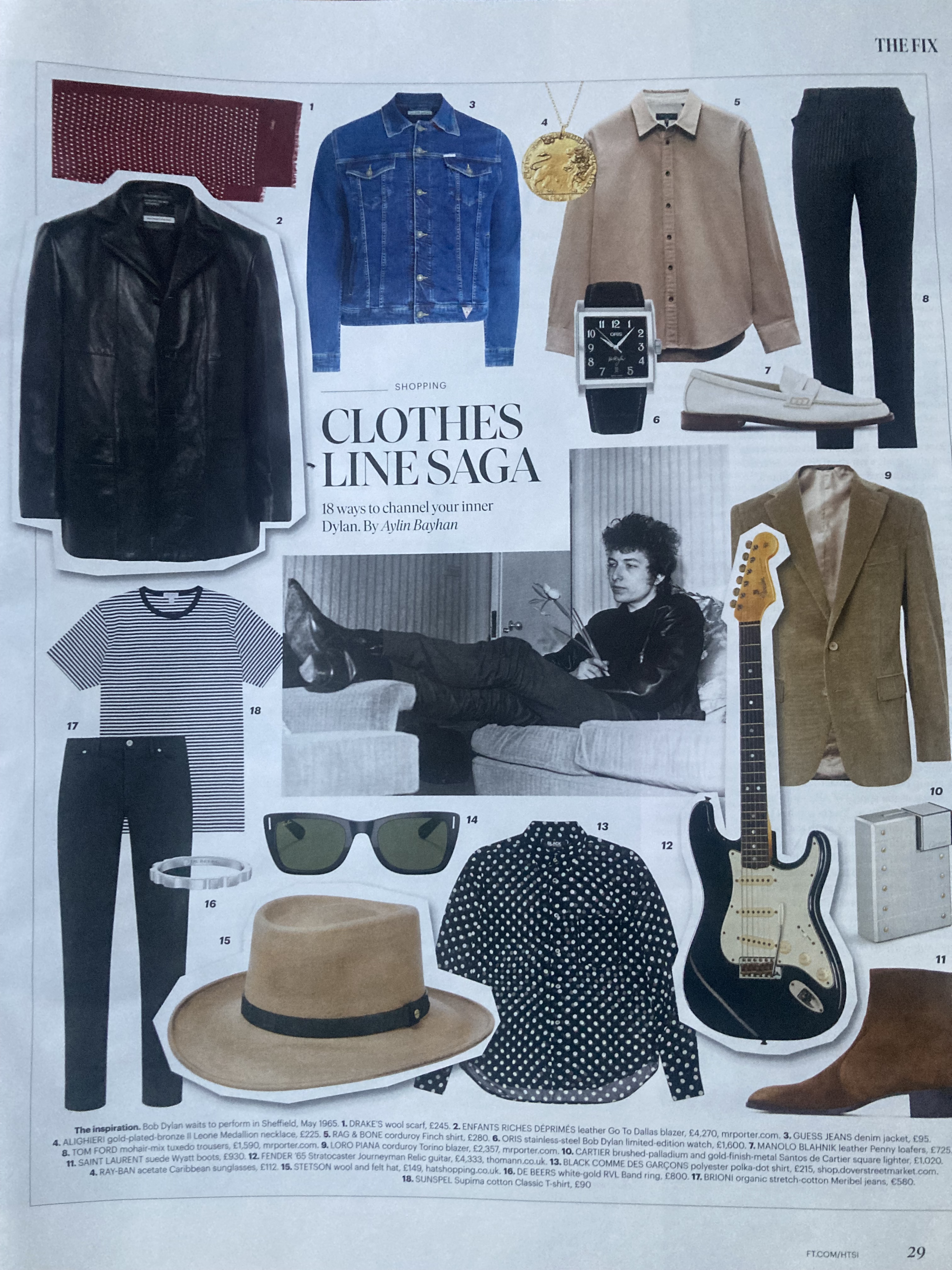
The result was the transfixing sight of Dylan and Rotolo wrapped around each other on the cover of Freewheelin’ in 1963. If you were, say, 16 years old at the time, Don Hunstein’s shot of the couple on Jones Street in Greenwich Village opened up a whole world, and his suede jacket, denim shirt, jeans and boots seemed to offer an easy way in. If you could get hold of them, that is. And now, just six decades later, the Financial Times is telling you how. What you see above is a guide, published in its HTSI (How to Spent It) magazine, showing you to how to look like Bob Dylan.

It’s pegged to the release of A Complete Unknown, James Mangold’s film of Dylan’s life between 1961 and 1965, and it made me laugh quite a lot, for several reasons. The polka-dot shirt they recommend is black and white, which is how it looked in the monochrome photos from the soundcheck at the Newport Folk Festival in 1965; the real thing was green and white — and it was actually a blouse rather than a shirt (the film gets that right). And have you ever seen Dylan in white loafers, never mind 700-quid ones by Manolo Blahnik? The black leather blazer they recommend retails at £4,270. Mine cost a fiver in 1964 from the harmonica player in our band, who was skint at the time and needed rent money. I wish I still had it.

But it’s not just a matter of looking like Bob Dylan. You can try to sound like him, too. The rock critic of The Times went off to the vocal coach who did such good work with Timothée Chalamet in order to try and achieve that distinctive nasal whine. Again it sent me back to 1964 and sitting in my bedroom, strumming an acoustic guitar acquired very cheaply from a girl called Celia and bellowing the words of “The Times They Are A-Changin'” loud enough for my blameless parents to hear: “Come mothers and fathers throughout the land / And don’t criticise what you can’t understand / Your sons and your daughters are beyond your command…”

That was in real time. So was the £5 leather jacket. It was all part of growing up and finding out who you were, and it seems weird now to watch people turn it into a novelty, however good the cause.

As it happens, I enjoyed A Complete Unknown a lot, with only a very few reservations. When Chalamet-as-Dylan sings “The Times They Are A-Changin'” to a festival crowd, Mangold orchestrates the audience’s response in a way that precisely evokes how it felt to experience that song in 1964, with all the emotion of realising that it spoke for you. It was a relief to come out of the screening with the knowledge that I wouldn’t have to be explaining to younger people that it really wasn’t like that at all. Mostly, it was.

Rougher and rowdier (take 2)

So many people told me how much they’d loved the first of Bob Dylan’s three nights in London this week that, having written a rather grumpy response to his performance in Nottingham last Friday, I went on the secondary market to buy tickets for the third and final night, also the last show of the 2023-24 edition of the Rough and Rowdy Ways Tour.

The most telling words came in an email from the historian David Kynaston, who expressed “a powerful sense of gratitude that here I was seeing him at the Albert Hall in 2024, some 55 years after he’d been a speck in the distance at the Isle of Wight, and with all sorts of thoughts about the intervening years – the ups and downs of his different phases, how they rhymed or didn’t rhyme with my own life, his constant presence in one’s interior landscape – coursing through my mind.”

His constant presence in one’s interior landscape. That did it for me. And because I thought it might help give me a different perspective, this time I left my notebook and pen at home, setting aside the working habit of a lifetime.

Buying those tickets turned out to be the year’s best decision. In the warm and dignified surroundings of the Albert Hall, almost everything I found frustrating about the Nottingham show, rooted in a sonic harshness, was smoothed away. The sound was perfect, the vocals were clear and perfectly balanced against the instruments, Dylan’s piano-playing was always relevant to the song, he made each note of every harmonica solo count, and in the moody lighting of those old tungsten lamps the musicians clustered around him as if they were playing together in someone’s front room.

One thing he does is allow the audience to see the music’s working processes. Nowadays he has a set-list that seldom varies, but last night there was an unusually strong sensation of being invited in to watch and hear decisions being made on the fly, in the moment.

At times it had the delicacy of chamber music. “Key West” — a song whose setting he’s played around with throughout the tour — was particularly exquisite in that respect. So was “Mother of Muses”. The new arrangements of “All Along the Watchtower” and “Desolation Row” came into much clearer focus. The music ebbed and flowed with freshness and grace. “Goodbye Jimmy Reed” and “False Prophet” located the Chicago blues sound so fundamental to Dylan’s feelings about how a band should be organised. The spare treatment of “It’s All Over Now, Baby Blue” was heartstopping. The closing “Every Grain of Sand” was a serene benediction.

Without his refusal to be consistent or predictable, he wouldn’t be what he is. But last night he drew us in, and I think most people there would have felt unusually close to him. If I really was seeing him for the last time, it ended with seeing him at his best.

Rougher and rowdier (take 1)

Almost as soon as Bob Dylan and his musicians emerged on to the half-darkened stage of the Motorpoint Arena last night, a jangle of discordant electric guitars made me uneasy. It turned out that the discordance was chiefly coming from the guitar of Dylan himself, who was already sitting at his piano bench, with his back turned to the audience. Within a few seconds that jangle had somehow formed itself into the opening of “All Along the Watchtower”, the first of the 17 songs — nine of them from Rough and Rowdy Ways — he’d give us.

For me, it was a strange concert from several perspectives. It was certainly far from the poised, concentrated, finely detailed performance he’d presented at the same venue in Nottingham two years earlier, which had been a measurable level up even from the two fine shows I’d seen him give at the London Palladium a week before that. Quite often I found myself thinking we were back in the ’90s, when the thing I seemed to say most frequently after one of his concerts, while defending him to sceptics, was, “Well, they’re his songs, he can do what he likes with them.”

Another early warning sign: he repeated the first verse of “Watchtower”, meaning that the song no longer ended with “Two riders were approaching / The wind began to howl” — among the most effective closing lines in popular music — but with “None of us along the line / Know what any of it is worth.” I have no better idea of why he’d choose to do that than of why he’d rearrange a full-band version of “Desolation Row” to the galloping tom-tom beat of “Johnny, Remember Me” or decide to extend the same song with a meaningless piano solo.

The sound was much worse than two years earlier in the same hall. It was louder and harsher, and yet somehow less powerful, and with a much more distracting echo on the voice. Sometimes I flinched involuntarily when he put exaggerated emphasis on a particular syllable, as he so often does. The harmonica, which appeared on several songs, had mislaid its customary poignancy and what he played on it was, unusually, not particularly interesting, even on the closing “Every Grain of Sand”.

His current modus operandi is to start many songs — “I’ve Made Up My Mind to Give Myself to You”, for instance — standing near the back of the stage, singing into a handheld microphone. After a verse or two he advances to the baby grand piano, leans over it, and sings another verse or two, reading from the book of lyrics resting on top of the instrument. So far, so good. But then he sits down and clogs up the music by adding his wilful and often wayward piano-playing to the guitar interplay of Bob Britt and Doug Lancio. There’s no finesse in his keyboard contribution this time round, which is another contrast with 2022. It’s a form of interference, which of course may be what he’s after.

“My Own Version of You” closed with a chaotic ending that suggested that this was the first time they’d played it, rather than the two-hundred-and-twenty-somethingth. “To Be Alone With You” was such a mess that I couldn’t help thinking, “What on earth does he imagine he’s doing?” The drumming of “the great Jim Keltner” — as Dylan quite justifiably introduced him — never seemed as well integrated into the band as that of his precedessor in 2022, Charley Drayton, or George Receli from further back.

During the boogie of “Watching the River Flow” it was tempting to conclude rather irritably that the Shadow Blasters, Dylan’s first band, probably sounded better doing something similar at the Hibbing High School talent contest in 1957. For the first time in 59 years of going to see him on a fairly regular basis, I felt that I could have left my seat, gone to buy a beer, and returned without having missed anything important.

Of course that’s not true. There were moments of grace, mostly when the instrumentation was reduced to voice and piano, as in “Key West”, or voice and guitars, as in “Mother of Muses”. The first two verses of “Made Up My Mind” were lovely, as were the out of tempo bits of “It’s All Over Now, Baby Blue”, delivered against Tony Garnier’s bowed bass. By the time Dylan got to “Goodbye Jimmy Reed”, the penultimate item on the set list, he was singing beautifully, with clarity and marvellous timing.

Every time you see him now, you think it might be the last. So this one wasn’t great. But that doesn’t really matter, even if there aren’t any more. Time past, time present: lucky to have it at all, all of it.

Daniel Kramer 1932-2024

Bob Dylan was fortunate in the photographers who recorded his progress from his arrival in New York in January 1961 to his motorcycle accident in Woodstock in July 1966. John Cohen, a member of the New Lost City Ramblers, and the Village Voice staffer Fred W. McDarrah chronicled his early days in Greenwich Village. Richard Avedon caught him on the New York waterfront in 1963. Jim Marshall was at Newport and in San Francisco when Dylan hung out with the Beat poets. Don Hunstein took the Freewheelin’ cover shot on Jones Street and was there for the “Like a Rolling Stone” session, as was W. Eugene Smith. Jerry Schatzberg caught the amphetamine Dylan of early 1966 in formal portraits and took the Blonde on Blonde cover. Barry Feinstein was in the limos and the dressing rooms on the European tour that summer, present as Dylan spent time with John Lennon and Françoise Hardy.

But I’m probably not the only one who has a special fondness for the photos taken in 1964-65 by Daniel Kramer, who has died aged 91. Brooklyn-born, the young Kramer worked as an assistant to Diane Arbus and Philippe Halsman. He had just set up his own studio and knew little about Dylan when he first saw him on TV early in 1964 but then spent six months petitioning Albert Grossman to allow him access. The first session, at Grossman’s house in Woodstock that August, established a rapport between the photographer and the singer, and there would be many more encounters over the following 12 months.

Kramer photographed Dylan being swept off his feet — quite literally — by Joan Baez at a post-concert party, cheerfully (and top-hattedly) signing photographs for fans in Philadelphia, and relaxing by playing pool and pinball and (see the photo above) reading the NY Herald Tribune, again at Grossman’s house, with Sally Grossman, who has just come in from swimming, at the edge of the shot. She was also featured on the front of Bringing It All Back Home, the first of Kramer’s two great narrative cover photos (the other being Highway 61 Revisited). And he was there in Columbia’s Studio A as Dylan rewrote and recorded “Positively 4th Street”, framed by a forest of microphone booms and music stands.

In 1967 Kramer published a book of his work with Dylan, adding a commentary. His words and pictures were, as Michael Gray observes in his Bob Dylan Encyclopedia, “recurrently revealing but never prurient or obtrusive… respectful but clear-sighted.” As well as their observational and technical qualities, there was a humanity in Kramer’s photographs that gave us Dylan from a very special perspective.

* Daniel Kramer’s photographs of Dylan, along with those of Barry Feinstein and Jim Marshall, are in Early Dylan, published in the UK by Pavilion Books in 1999, and in Bob Dylan: A Year and a Day, published by Taschen in 2018.

Diamante visions

Phil Manzanera has been a friend since I first interviewed him during the days of Quiet Sun, the band of school friends he was in before being recruited by Roxy Music in time to play on their debut album in 1972. So I can’t pretend to be completely objective about Revolución to Roxy, his newly published autobiography. But I can be completely honest in saying that it will prove informative and entertaining to anyone who’s followed his career over the past half-century, even from a distance.

Here’s a sample that had me almost collapsing with laughter, when he spins a metaphor out of one of the trappings of early success: a maroon Rolls-Royce coupé whose combination of heavy weight and light steering was guaranteed to induce car sickness in children, making it “completely useless as an everyday family vehicle” and forcing him to keep in storage, bringing it out only on special occasions.

“The car carried a famous brand name,” he writes, “it was sleek, stylish and smooth, and undoubtedly in its own way it was iconic. It was a treat to take out, and whenever I did, it was admired and enjoyed by everyone who experienced it. Eventually, though, the time would come when it needed to go back into the garage and once again be covered by the tarpaulin to keep it well preserved and in good order, ready for the next outing.

“I guess you can see where this is going. There was something about that Roller which felt to me to be a bit like Roxy Music. Eye-catching, stylish and high quality, extremely enjoyable and I was proud to be associated with it. From time to time, it would be an absolute joy to take out for a ride so that it could be admired and appreciated; but the ‘steering’ difficulties and the resultant discomfort meant that its outings were strictly limited. After a while it had to go back under the tarpaulin so I could live my everyday life in my runabout.”

The history of Roxy Music as a kind of artistic Petri dish is, of course, explored in some depth throughout these 300 pages, from Manzanera’s first failed audition through the years of great success to the period in which, he began to feel like “not much more than a session player in my own band” — a band in which “I had to find out what was going on more or less by accident.”

Not least, the book is an interesting exploration of rock-band dynamics, with all the associated uncertainties, insecurities, frustrations and exasperations, and Manzanera has a perceptive take on Bryan Ferry’s legendary penchant for procrastination and prevarication: “His Fine Arts background obliged him to tinker and fiddle way beyond the point where the vast majority of people would long since have settled. I now understand this is about his need to make everything he does artistically beautiful and perfect. I tend to want to do things quickly and I’m not worried if they have a primitive edge, and what I’ve learned is that in Roxy opposites can attract. That’s integral to what makes Roxy music special. Makes it us. Makes us it.”

As musical director of the Guitar Legends festival in Spain is 1991, he had the job of telling Bob Dylan that the organisers expected him to perform “All Along the Watchtower”. How he coped and got there in the end, with the aid of Richard Thompson, is worthy of a place in Ray Padgett’s recent book of interviews with people who’ve worked with Dylan. Recollecting in tranquillity, Manzanera writes: “The way I think about the whole thing is much the same as I used to think about my first visit to various foreign countries. I’m really keen to go, really keen to get to know their individual customs and idiosyncrasies, but having been there and done that, I don’t necessarily ever feel the urge to revisit.”

There are stories about his long collaboration with David Gilmour, a shorter and almost Dylanesque one with the Argentinian hero Fito Paez, a WOMAD tour of South Africa and the Antipodes, his discoveries of the pizzica music of Puglia while directing another festival, his adventures with Jack Bruce in Cuba, his songwriting partnership with Tim Finn and his long relationship with Robert Wyatt. And about 801, that short-lived but incandescent all-star band he created in 1976 with Brian Eno, Bill MacCormick, Francis Monkman, Simon Phillips and Lloyd Watson. And, of course, about those diamante-studded bug-eyed sunglasses created for him in Roxy’s early days by Antony Price.

But, as the man who interviewed Phil for today’s Times observed, this isn’t one of those rock-star biogs where you skip the early chapters dealing with childhood, family and schooldays. In this case, that aspect of the narrative is quite as compelling as the rock-star stuff. Phil was born in London but grew up in Cuba during the run-up to the Castro revolution, the son of an Englishman, Duncan Targett-Adams, who had worked for the British Council in Colombia but now represented BOAC in South America, and a Colombian mother, Magdalena Manzanera. There were mysterious elements on his father’s side of the family — was he a spy? where did an Italian opera singer fit into the picture? — and the Latino influence from his mother’s side on his life and work is interestingly explored.

In a way, though, the most striking passage in the book come when he discusses the phone call from America one day in 2012 in which he was told that Kanye West and Jay Z had sampled a riff from K-Scope, his slightly obscure second solo album, then more than 30 years old. They used it on “No Church in the Wild”, a bleak modern masterpiece and the lead track from their album Watch the Throne, which went platinum in the US and gold in the UK before the track appeared in ads for Audi and Dodge cars. Most significantly of all, as it turned out, it was used by Baz Luhrmann on the soundtrack and the trailer for The Great Gatsby.

“Who knew,” Phil writes, in a sentence that tells you a great deal about the evolution of the music industry in our lifetime, “that I would earn more money from a short guitar riff I wrote one evening on a sofa in front of the telly in 1978 than I ever earned in the entire 50 years as a member of Roxy Music?”

* Phil Manzanera’s Revolución to Roxy is published by A Way With Media (£35)

Summer books 2: ‘Pledging My Time’

I don’t imagine I’m alone in sometimes glancing at a stack of books about (or by) Bob Dylan and thinking, OK, that’s enough now. The last two new volumes, bought hot off the press in the past couple of years, turned out to be expensive time-wasters, prompting the thought that maybe I’d be better off re-reading some of the old ones. Anthony Scaduto’s early biography, maybe, or Suze Rotolo’s memoir, or The Nightingale’s Code. Or even the one Patrick Humphries and the late John Bauldie published in 1990, called Oh No! Not Another Bob Dylan Book. But there’s always an exception, and one such is Pledging My Time by Ray Padgett, subtitled “Conversations with Bob Dylan band members”.

All I know about Padgett is that he has an erudite and entertaining email newsletter called Flagging Down the Double E’s, on which he discusses topics related to Dylan’s live performances. The book is an outgrowth of that newsletter, consisting of interviews with 40 people who have played with Dylan, either in his band or in briefer encounters, or, in a handful of cases, worked with him in slightly different capacities, such as Betsy Siggins, who ran a folk club in Cambridge, Massachusetts in the late ’50s and early ’60s, Chris O’Dell, the Rolling Thunder tour manager, and Keith Dirks, a sound engineer in the early stages of the Never Ending Tour.

You don’t want big names in a book such as this. Most of them have already told their stories many times. You want Ramblin’ Jack Elliott, Happy Traum, David Mansfield, Spooner Oldham, Fred Tackett, Stan Lynch, Christopher Parker, Dickey Betts, Larry Campbell and Benmont Tench, whose impressions are not worn thin by overexposure. You want someone like Jim Keltner, with a lifetime of service to music and a deep love of how it feels to explore it in Dylan’s company: “The thing I love about Bob is his fearlessness. There’s a fearlessness from some artists that transmits to the musicians playing. When that happens, you get the best from the musicians, because the musicians are not worried about tempo or about whether they’re rushing or they’re dragging or whether they’re not in the pocket. It’s not about finding a pocket. It’s more about searching for the vibe, searching for the thing that makes the song live.”

Keltner is not the only one here who likens the experience of playing with Dylan to jazz. It’s not jazz, of course, but it shares some important characteristics. Gary Burke, who played percussion on the 1976 Rolling Thunder dates, says: “Dylan lived more in the present than most musicians I know. The most common question I get is, ‘What’s it like to play with Dylan?’ I say, ‘Oh, it was the greatest jazz gig I ever played.’ People look at me like I’m crazy. I don’t mean stylistically it was like a jazz gig, but in terms of the mindset. It was very spontaneous. You never know where he’s going to go. You weren’t given directions ahead of time.”

The pianist Alan Pasqua had played with the New Tony Williams Lifetime when he joined Dylan for the Street Legal sessions and the 1978 tour. “Bob was a great bandleader,” he says. “I was lucky enough to play with Tony Williams early on in my life. He learned from Miles Davis. Miles never told him what to play, but by how Miles played, he showed Tony what he needed to do. I found Bob to be quite a bit similar to Miles.” He adds: “I didn’t know at the time that Bob was a jazz fan.”

In 2017 Pasqua was asked, out of the blue, to provide piano music against which Dylan could read his Nobel Prize acceptance speech. And then, a couple of years later, he was invited to play on “Murder Most Foul”. “They were playing a demo. I heard it and I just couldn’t believe it. In rock music, things usually have a specific beat and pulse. This was free. The time was free. It was elastic. It wasn’t specific to a certain time, feel, or tempo. It just moved and flowed. When I was done listening to the track, I turned to Bob and I said, ‘My God, Bob, this sounds to me like A Love Supreme.’ He just stopped and looked at me.”

Sometimes other aspects of being Bob Dylan are sharply illuminated. Burke remembers the business that went on at the end of every gig, when Dylan’s security men took charge: “When we would leave a place on the tour, security would go into the room where he was staying and take everything out. Every piece of garbage, everything. They would put it in bags and take it with them so that nobody went in and tried to find the lost verse to ‘Tangled Up in Blue’ or something like that.” That’s a tough way to live, Padgett observes. “It is. You got the feeling he was rubbed raw by it all.”

To Billy Cross, who played guitar in the 1978 band, he seemed “very friendly and very warm. He was lovely, absolutely lovely, considering what he’d been subjected to through his life at that point. Everywhere he goes, someone thinks he’s got the answer that’s blowin’ in the wind. I thought it was unbelievable that he could be as normal and personable and pleasant as he was.”

Padgett is a marvellous interviewer: not just enthusiastic and sympathetic but alert and perceptive, equally good at prompting and just letting people talk. Of course, the testimony is mostly admiring. There’s nothing resembling the interview with the veteran soul singer Betty LaVette in the Daily Telegraph earlier this month, where she described her “contempt” for Dylan, five years after enjoying a warm reception for an excellent album of his songs titled Things Have Changed.

She was annoyed that he never told her how good it is, and to underline her irritation she mentioned an incident from several years earlier, when they encountered each other in Spain and “he ran over to me. He put my face in his hands and kissed me square in the mouth. I don’t offer Bob Dylan a kiss and I’m not a f—ing fan. I was not looking to be kissed. If he thinks I’m good enough to put his mouth on, then he should have opened it to say just one good word about my record. When you’re as big as he is, that can make a huge difference to sales.” She didn’t mention whether she’d ever got in touch to thank him for the songs.

More than most people, Bob Dylan presents himself to the world as a jigsaw puzzle, full of complexities and seeming contradictions and bits that are hard to fit together. Maybe some missing bits, too, and others that once fitted but no longer do. Each of us assembles the puzzle as best we can. The keyboards player Benmont Tench, who once found himself playing “Desolation Row” — which he had listened to “a million times” but never played — with its composer to a festival audience of tens of thousands, is among the most thoughtful interviewees in Padgett’s book. He’s allowed to close it with some words that seem to express the feelings of many who’ve worked with Dylan.

“You can read about Bob’s life,” he says, “and you can pay attention to what he says, and you can learn from it, but when you play music with somebody of that calibre, you learn something entirely different. It can only be passed on by that person. And those of us who have the opportunity to play with that person can pass on what we took away, but we only each take away a certain part of our experience with someone like that. Long may he live, because he’s something else.”

* Ray Padgett’s Pledging My Time is published in hardback and paperback by EWP Press. Padgett’s email newsletter is at dylanlive.substack.com