Skip to content

Posts tagged ‘Bill Frisell’

Feat. Bill Frisell

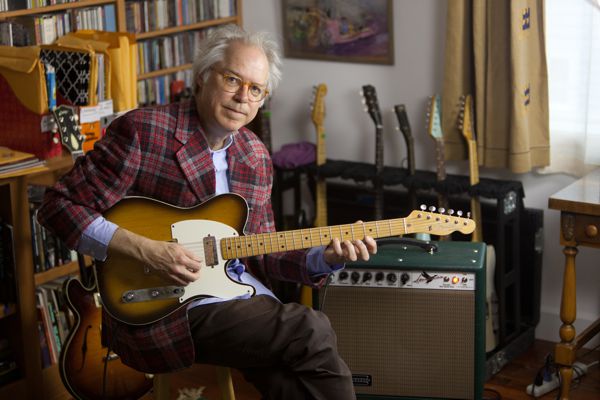
Bill Frisell at home 2There was a time, seven or eight years ago, when I came to the conclusion that Bill Frisell was simply making too many records. I fell out of the habit of automatically buying his new releases because he seemed to be spreading himself too thin. Good Dog Happy Man (1999) and Blues Dream (2001) are still two of my all-time favourite albums, but I tend to prefer him nowadays as a contributor to other people’s records — something to which his particular expertise is well suited. Used sparingly, the characteristics of his playing add texture and flavour, just like King Curtis or Steve Cropper once did.

The job of being an accompanist is much underrated these days, so it’s good to welcome the arrival of two outstanding new albums on which Frisell fulfils that role: first with the saxophonist and flautist Charles Lloyd on I Long to See You and second with singer-songwriter Lucinda Williams on The Ghosts of Highway 20. They’re very different, of course, but they benefit equally from the guitarist’s modest, graceful touch.

When I interviewed him for the Guardian in 2002, Frisell explained a personal evolution that had begun with his first 45, the Beach Boys’s “Little Deuce Coupe”. Then came the Beatles and Manfred Mann — “that’s where I heard the blues for the first time” –followed by the Rolling Stones, John Mayall and the Paul Butterfield band. “I was coming to the blues backwards,” he said, “by figuring out where the English bands were getting a lot of their stuff from.” He may be in his sixties now, but he’s kept a sense of discovery in his music, whatever company he happens to be keeping.

I Long to See You finds Lloyd and Frisell tackling some familiar material, such as the saxophonist’s “Of Course Of Course” and “Sombrero Sam”, and a version of “Shenandoah” that doesn’t quite match the sublime reading Frisell and Ry Cooder contrived on Good Dog Happy Man. The biggest surprise is a resolute instrumental version of Dylan’s “Masters of War”, while the soulful Spanish traditional song “La Llorona”– previously recorded by Lloyd — invites Frisell to display his innate lyricism. Guest appearances by Willie Nelson on “Last Night I Had the Strangest Dream” and Norah Jones on “You Are So Beautiful” are pleasant but not exactly essential.

The track that justifies the album’s existence, however, is its closer, the 16-minute “Barche Lamsel”. Named after a Buddhist prayer, it allows Lloyd (its composer), Frisell and their three bandmates — the steel guitarist Greg Leisz, the bass guitarist Reuben Rogers and the drummer Eric Harland — to improvise a dreamy five-minute intro on a single chord before drifting into a pulse defined by the drums  for a delicately funky jam that would once have been described as “spaced out”.

The concerns of The Ghosts of Highway 20 are more earthly in tone but no less spiritual in nature, if much less comforting. Lucinda Williams’ ravaged voice and bar-room country-blues songs do not trade in reassurance. Her America is a place of wayfaring strangers fleeing the past and seeking refuge from the future. As the poet of this world of lost highways and dangerous glances, Williams is rivalled only by James McMurtry.

Like its predecessor, 2014’s Down Where the Spirit Meets the Bone (which also featured Leisz and Frisell), this one is a two-disc set. The extra length offered by the format would exhaust the capacity of most singer-songwriters, but it seems ideally suited Williams’ temperament. Although her songs are often skeletal, they need to stretch out and breathe inside arrangements that create their own sense of time. On “Louisiana Story” the two guitarists sit either side of the parched voice, carefully picking out a double commentary against a tempo that flows like a thin stream of black treacle.

* The photograph of Bill Frisell is by Monica Frisell.

A threnody for Lou Reed

lou and jzIt’s already a year since Lou Reed died. You could mark the anniversary by saving up for the new super-deluxe edition of the Velvet Underground’s third album, now expanded to six CDs through the addition of alternative mixes and live stuff, or by reading the updated version of Jeremy Reed’s biography, Waiting for the Man. Or you could make a lateral move and listen to Transmigration of the Magus, written and recorded by John Zorn in memory of his late friend.

Just released on Zorn’s own Tzadik label, the album features the composer’s well established Gnostic Trio — Bill Frisell (guitar), Carol Emanuel (harp) and Kenny Wollesen (vibes and bells) — plus John Medeski (organ), Bridget Kibbey (harp) and Al Upowski (vibes and bells). The instrumentation along gives you an idea of what the music sounds like: a bright celestial noise reflecting Zorn’s interest in the numinous and his desire to write something to help Reed’s spirit through the bardo — the Tibetan word for the transitional state between death and the next incarnation.

Somewhere beneath the profanity of Reed’s music, the sacred was always lurking — whether in the exquisite melody of  “Pale Blue Eyes” or in Songs for Drella, the lovely elegy he and John Cale wrote for Andy Warhol. It’s not hard to glimpse him in the shimmering, tinkling haze of Zorn’s heavily arpeggiated compositions, but easier still in the handful of pieces where, without breaking the poise or the delicate weave of the ensemble, Frisell and Medeski get the chance to cut loose.

At the London Jazz Festival last week I listened to Frisell and Greg Leisz playing electric guitars on “Tired of Waiting for You” and “Turn! Turn! Turn!” during the Guitar in the Space Age! show and was struck by how the silvery quality of the combined strings and a general feeling of ascension reminded me of two other partnerships: Television’s Tom Verlaine and Richard Lloyd and the Grateful Dead’s Jerry Garcia and Bob Weir. Frisell is equally wonderful here. The title track of Transmigration of the Magus is one of the loveliest and most powerful things I’ve heard all year.

* The photograph of Lou Reed and John Zorn was taken by Heung Heung Chin at (le) Poisson Rouge in New York City on September 2, 2008, at a concert in celebration of Zorn’s 55th birthday.

Lee Konitz: the improviser at 85

Lee Konitz 1No musician interrogates a song more thoroughly than the alto saxophonist Lee Konitz: separating its components, wiping off the accumulated dirt and scraping away the rust, holding the bits up to the light, examining them from all angles, and then reassembling them in a more interesting form. He was doing it in 1947, when he made his first recordings with the Claude Thornhill Orchestra, aged 20. He is still doing today, halfway through his ninth decade.

He’s featured on a new CD, Costumes Are Mandatory, released on the HighNote label and recorded in August 2012 with a quartet under the leadership of the pianist Ethan Iverson, noted for his work with the trio The Bad Plus. The bassist Larry Grenadier and the drummer Jorge Rossy complete the group. Together with two other albums released in the past couple of years, Live at Birdland (ECM), recorded in December 2009 with Brad Mehldau, Charlie Haden and Paul Motian, and Enfants Terribles (Half Note), made in June 2011 with Bill Frisell, Gary Peacock and Joey Baron, it provides a view of a great artist in his final years, his work subject to the changes imposed by time and the ageing process.

The late work of a long-lived great artist is always interesting and can provide a fascinating distillation of his or her career-long preoccupations. Sometimes the reduced powers are physical, sometimes they are mental. The painter Willem De Kooning was suffering from a form of Alzheimer’s disease when, in his eighties, he produced a series of strange, pale, almost luminous canvases that seemed like the ghosts of his former work. Fortunately, any reduction in Konitz’s powers is purely physical; the articulation might not be as swift, but the intellect is as sharp as ever.

No longer the fleet-footed musical athlete of his youth, when he and his fellow saxophonist Warne Marsh leapt with such alacrity over the high hurdles set for them by their mentor, the pianist Lennie Tristano, now Konitz deploys his reduced powers to different ends. The last of his strength is being spent on searching his material — almost always drawn from the standard American songbook — for new connections, new angles, new avenues of approach.

My best memory of Konitz is also one of my best memories of music, full stop. It comes from about 30 years ago, and a night at a short-lived jazz club called the Canteen on Great Queen Street in Covent Garden, occupying premises that had formerly been Blitz, the headquarters of the New Romantic movement, would later become a discotheque and now house a lap-dancing club. The Canteen, although ultimately unsuccessful in its attempt to rival Ronnie Scott’s, was for a while a very good place to hear such people as Esther Phillips, Chet Baker and Lee Konitz.

On the night in question Konitz was accompanied by an excellent British rhythm section: the pianist (and composer) Bob Cornford, the young bassist Paul Morgan and the experienced drummer Trevor Tompkins. What I remember most vividly is that one complete set was taken up by a treatment of “On Green Dolphin Street”, the Hollywood film theme composed by Bronislau Kaper in 1947 and rescued just under a decade later by Ahmad Jamal, who was responsible for its subsequent popularity among jazz musicians. Konitz started out by improvising unfamiliar and seemingly arbitrary phrases, inviting the other three musicians to go along with him as he gradually allowed these shreds of melody to take new forms, uncovered the connective tissue between them. This mesmerising process reached its apogee when, after much feinting and seeming disgression, Kaper’s theme gradually began to emerge and was stated for the first time as the piece ended. It was like watching a film of an explosion being run backwards in super slow motion.

Lee Konitz 3He does something similar, at a more compressed and less exalted level, on the version of “What’s New” included in Costumes Are Mandatory, allowing Iverson to lead the way, before entering with a phrase from the theme which is quickly deformed into a series of glancing allusions to the original tune, inventing their own sense as they go along. This is something that used to be called “thematic improvisation”, and it is almost a lost art. His distinctive tone — which once proposed an alternative to the all-pervasive influence of Charlie Parker — may be more fibrous and less robust than in his youth or his prime, and the comparison with Live at Birdland and Enfants Terribles indicates that time is having an inevitable effect, but it remains the perfect vehicle for his thoughts.

Konitz, of course, was a member of Miles Davis’s famous 1948 nonet, the Birth of the Cool band, and another personal memory of his playing comes from 1991, when he appeared at London’s South Bank with a band billed as Re-Birth of the Cool, an attempt by another original member, Gerry Mulligan, to recreate those celebrated sessions. Lew Soloff played Davis’s parts, and the other original present was Bill Barber, the tuba-player. For me, the outstanding impression was left by the way Konitz approached the project: he was the only one not interested in honouring the past by recreating it note-for-note but was intent on playing as though more than 40 years had passed and the world had moved on.

Working as a soloist for hire suits him because it presents him with a constant variety of challenges. That is how he has operated throughout his career, which has never been short of recorded documentation, from those early sides with Thornhill, Davis, Tristano and Stan Kenton through his own albums on Atlantic and Verve, his fascinating and fearless encounters with Martial Solal, Elvin Jones, Albert Mangelsdorff, Kenny Wheeler and countless others, to this most recent crop of albums. As a body of work, it offers not just a vast quantity of great music but a salutary lesson in the value of living in the present.

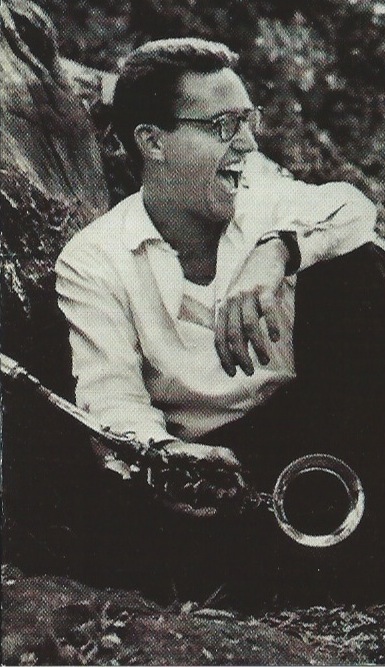
* The photograph of Konitz at the top is a detail from the cover of the 1955 Atlantic album Lee Konitz with Warne Marsh, taken by William Claxton. The lower photograph is a detail from the cover of Costumes Are Mandatory, taken by John Rogers. For those who want to know more, I thoroughly recommend Lee Konitz: Conversations on the Improviser’s Art by Andy Hamilton, published by the University of Michigan Press in 2007.